



Six Nations Tournament Prediction: Our Guide to Analyzing Rugby Matches
Making a successful prediction for the Six Nations Tournament is not just a matter of instinct. It’s a true art, a clever blend of sharp analysis and pure passion for rugby. Experts leave nothing to chance; they rely on a mountain of data to dissect each match and turn their intuitions into solid predictions.
Going Beyond Chance for Thoughtful Predictions
Every winter, the Six Nations Tournament attracts millions of viewers, establishing itself as THE unmissable event for rugby enthusiasts. But beyond the spectacle, this competition is a fascinating playground for those who love to analyze, decipher, and anticipate. Because no, making a good prediction has nothing to do with luck. It’s the result of a well-honed method.
To achieve this, you need to put on the boots of an analyst. Forget your supporter jersey for a moment and objectively assess the strengths and weaknesses of each nation. The idea of this guide is simple: to give you the keys and the right reflexes to build a Six Nations prediction that holds up, match after match.
A Popular Fervor That Never Fades
The enthusiasm for the competition is palpable and only continues to grow. For proof, the TV ratings of 2025 shattered records: 38.8 million French were in front of their screens, which is 2.7 million more than the previous year! A figure that clearly shows how rugby holds a special place in the hearts of the public.
This passion naturally finds its way into the office, where the tournament becomes a golden opportunity to unite teams. Launching an internal prediction contest transforms the sporting event into a collective experience, perfect for boosting communication and team spirit. It’s an excellent way to:
- Create a fun and truly engaging activity.
- Bring employees together around a shared passion.
- Establish a friendly competition between departments.
Organizing a prediction contest is much more than a game. It’s a formidable strategy to channel the positive energy of sport and turn it into a real lever for corporate culture.
Of course, the success of such an initiative depends on choosing the right tool. To delve deeper into the subject, take a look at our comprehensive guide on how to choose the ideal prediction platform for your company.
Breaking Down the Elements of a Good Prediction for the Tournament
Making a successful prediction for the Six Nations Tournament is a bit like assembling a puzzle. Each piece is a key piece of information, and it’s only by putting them all together that the final picture – the most likely outcome – takes shape. Forget the crystal ball; a solid rugby prediction is based on a well-considered analysis of several decisive factors.
This approach allows you not to rely solely on your intuition or your supporter jersey. The idea is to objectively dissect the strengths at play to sense the real dynamics that will weigh on the score.
This mind map summarizes the pillars of effective analysis: it shows how studying the numbers and understanding group dynamics complement each other to refine predictions.
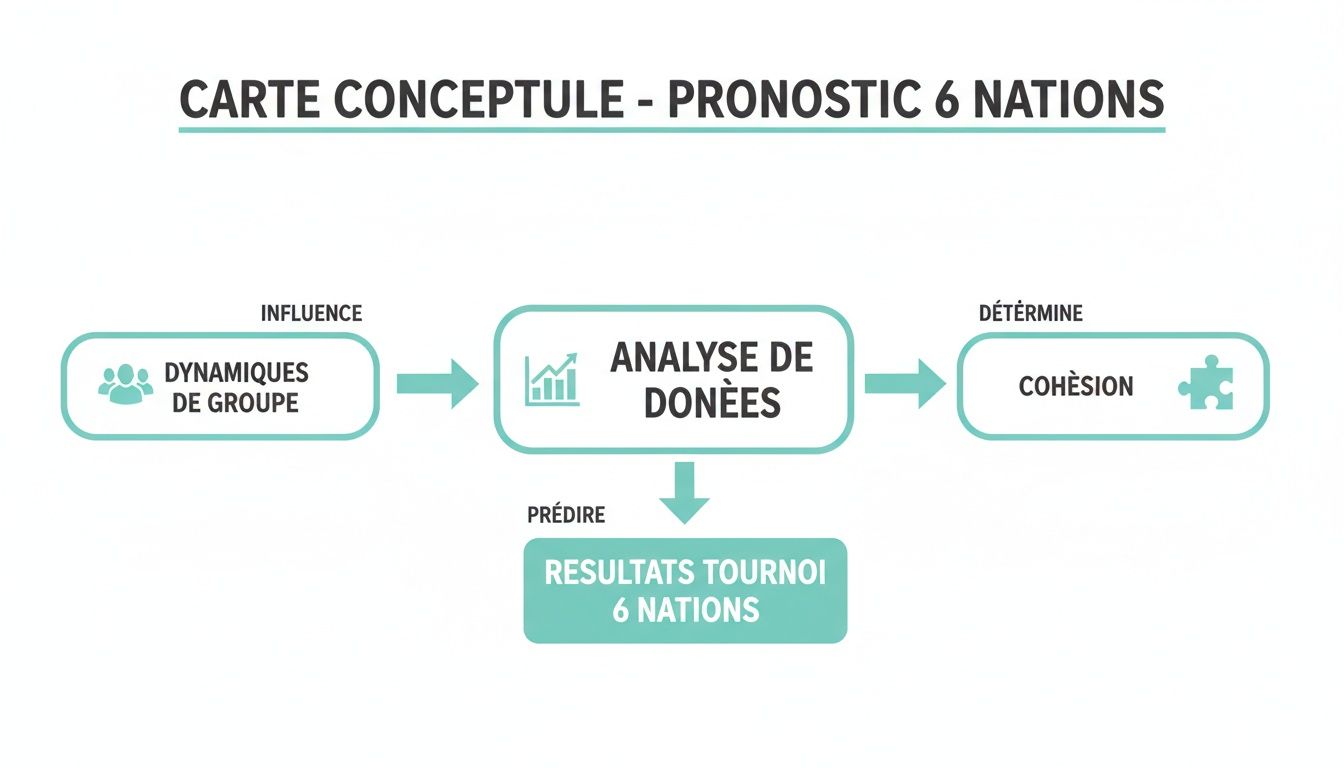
It clearly shows that mastering stats and sensing human factors are two sides of the same coin for anticipating the outcome of a match.
The Current Form: The Most Obvious Indicator
The first reflex is to take a look at the teams' dynamics. But be careful, it’s not enough to count victories. It’s how they were achieved that really matters. A team that wins its last three matches narrowly against modest opponents is not in the same state of confidence as another that has just outclassed direct competitors.
Look at the content of the last matches. Was the defense an impenetrable wall? Was the attack pragmatic and surgical? These details are often much more telling than the raw score.
And then there’s confidence. It’s a huge factor in rugby. A series of victories, even if hard-fought, can forge a winning mentality capable of tipping the balance in tense moments.
The Impact of Absences and Home Advantage
Sometimes, a single player can change the face of an entire team. The absence of a key player – whether it’s the kicker, the captain, or a nuisance in the rucks – can throw the whole machine off. Before each match, the injury list is therefore an essential read for any good predictor.
At the same time, the advantage of playing at home is a powerful factor that tends to be underestimated. Driven by over 60,000 supporters, players transcend themselves, and this can even sometimes influence refereeing. Stadiums like the Principality Stadium in Cardiff or Murrayfield in Edinburgh are true fortresses.
A prediction for the Six Nations Tournament cannot overlook the "sixteenth man." The atmosphere, the energy of the crowd, the comfort of playing in a familiar environment... all of this is a statistical and psychological advantage that often translates into points on the scoreboard.
The History of Head-to-Head Matches: The Boogeyman Exists
There are teams that are true "boogeymen" for others, regardless of their current form. The history of confrontations often reveals repeating patterns. Sometimes, a playing style systematically disrupts an opponent.
Take a look at the results of the last five years between the two teams.
- Does one nation clearly dominate the debates?
- Are the matches often tight, decided by just a few points?
- Are victories more frequent at home or away?
This analysis provides valuable context. It allows for a nuanced prediction based solely on recent form and helps avoid certain pitfalls.
Advanced Statistics for Clarity
To go further, advanced stats provide a touch of objectivity that makes a difference. They allow you to measure performance beyond the score. Here are some indicators to follow for a sharp Six Nations prediction:
- Defensive Efficiency: The percentage of successful tackles is a great barometer of a team's solidity. A rate exceeding 90% is a sign of great rigor.
- Points per Entry into the 22 Meters: This stat measures offensive realism. A team that scores a lot every time it enters the scoring zone is a scoring machine.
- Discipline: The number of penalties conceded per match is crucial. An undisciplined team gives away easy points and often finds itself at a numerical disadvantage, a huge handicap.
By combining all these levels of analysis – form, absentees, home ground, history, and stats – your simple guess transforms into a solid, reasoned, and much more reliable prediction.
Understanding the Strengths and Weaknesses of the French XV
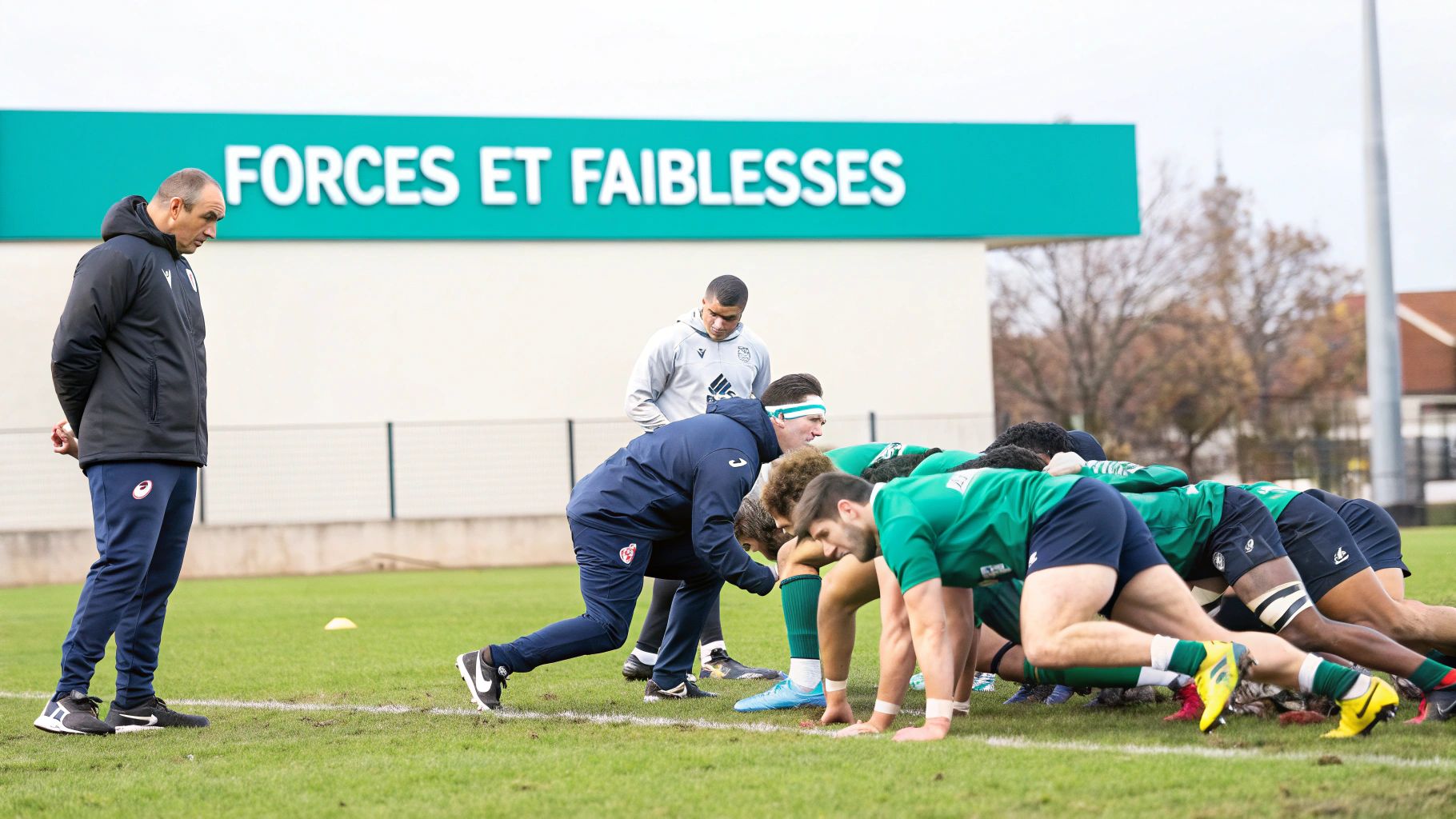
The French XV is an enigma. A team capable of brilliant flashes as well as frustrating dry spells. To dare a prediction on the Six Nations Tournament, one must look at the Blues with clarity, weighing the pros and cons.
Understanding this team starts with remembering its status. France is a historical heavyweight in European rugby, with a playing identity that has marked generations of supporters.
Before diving into the analysis of the current team, a quick look in the rearview mirror is necessary to measure the weight of the legacy. The record of the French XV speaks for itself.
Here’s a table summarizing the performances of each nation since the tournament has been played with six teams.
Six Nations Tournament Record Since 2000
| Nation | Titles Won | Grand Slams |
|---|---|---|
| England | 7 | 2 |
| France | 6 | 4 |
| Ireland | 6 | 4 |
| Wales | 6 | 4 |
| Scotland | 0 | 0 |
| Italy | 0 | 0 |
As we can see, France is among the top three, with a number of Grand Slams that reflects its ability to completely dominate the competition during its great years.
The Power of the Pack and the Spark of "French Flair"
The first obvious strength of the Blues is the density of their forward pack. The French scrum is often a weapon of mass destruction, capable of crushing the opponent to obtain decisive penalties. It’s the launch pad for the entire system.
But this physical domination would mean nothing without a rare individual technique among the "big guys." They have forwards who play like backs, capable of keeping the ball alive after contact and creating chaos in defenses.
And then there’s the famous "French Flair". This ability to improvise, this instinctive rugby that can turn a match on a whim. It’s a double-edged sword, of course, but when mastered, it’s simply irresistible.
Here are some key points to remember:
- Tactical Kicking Game: The French half-backs are often masters in the art of occupying the field and applying pressure.
- Iron Defense: An aggressive and well-organized defensive line that stifles opposing attacks.
- Lightning Counterattack: The ability to turn a lost ball by the opponent into a try in seconds is a trademark.
Vulnerabilities Not to Be Overlooked
However, the French XV is not infallible. Its greatest weakness remains its inconsistency. The team can deliver a perfect performance one Saturday and then completely miss the mark the following week. This is what makes predictions so complex.
Indiscipline is also a recurring Achilles' heel. The Blues have this unfortunate tendency to concede too many penalties, offering easy points and exposing themselves to costly yellow cards in tight duels.
The whole challenge for the French XV is to find the right balance between tactical framework and creative freedom. Too much control stifles their instinct, but too much "flair" leads to disorder and loss of control.
Finally, the depth of the squad in certain key positions can be a cause for concern. The injury of a major player, especially in the half-backs, can throw the whole machine off and impact the team’s effectiveness.
In summary, a good prediction on the Blues depends on their ability to channel their immense potential. If they combine power, discipline, and creative genius, they can beat anyone. Otherwise, their journey may be fraught with obstacles.
Diving into the Nations: Who Are the Real Favorites?
To refine a prediction on the Six Nations Tournament, much more than general impressions is needed. It’s essential to scrutinize each team. Beyond the French XV, each nation has its own DNA, its key players, but also its weaknesses. It’s by dissecting these details that one begins to sense the dynamics of a match and sniff out potential surprises.
This review of the strengths at play is your best ally in identifying the favorites, the outsiders, and the matchups that promise to be explosive. Let’s forget preconceived notions and dive into an objective analysis of each competitor.
Ireland: The Green Machine
Ireland is today the reference in terms of tactical rigor and collective mastery. Their game resembles a perfectly executed musical score, where each player knows their role inside out. Their secret? Exceptional ball retention and the ability to chain phases of play until exhaustion, causing the opposing defense to crack.
Their forward pack is mobile and technical, while the half-backs dictate the tempo with surgical precision. The only downside is that this well-oiled machine can sometimes lack flair and become predictable. If a team manages to disrupt them with ultra-aggressive defense and create chaos, the Irish XV can quickly find themselves in trouble.
England: The Constant Physical Challenge
The English XV traditionally bases its game on intense physical challenges. The power of the pack, solidity in set pieces (lineout, scrum), and a kicking game focused on territory are the pillars of their strategy. They aim to wear you down, pushing you to make mistakes to rack up penalties.
The English excel in combat and have players capable of breaking through any defense with sheer strength. Their weakness? A certain lack of creativity when plan A doesn’t work. If they are physically dominated or if their kicking game is countered, they often struggle to find alternative solutions.
Scotland: The Wild Card
Scotland is undoubtedly the most unpredictable team in the Tournament. Capable of producing flamboyant, fast, and daring rugby, they can take down anyone on a given day, especially in their fortress of Murrayfield. Their strength lies in the speed of their backs and their talent for exploiting every scrap of ball.
However, this risk-taking has a downside: inconsistency. The Scottish XV often alternates between brilliance and chaos, sometimes lacking the discipline and pragmatism needed to control a match from start to finish. Their performance will depend on their ability to be effective for 80 minutes.
For a predictor, Scotland represents the greatest challenge. Betting on them is bold but can prove very rewarding. Their spectacular playing style makes them capable of defying the most established predictions, making them the perfect "spoiler" of the competition.
Wales: Heart and Grit
Wales has built its successes on iron defense and steely mentality. The Welsh "fighting spirit" is not a legend: it’s a team that never gives up, capable of turning around compromised situations thanks to its resilience. Their airtight defense and precise kicking game are their main weapons.
The challenge for the Welsh is often offensive. They can struggle to produce play and score tries against well-organized defenses. Their success will largely depend on the form of their key players and their ability to be realistic in converting every opportunity.
Italy: Progress to Confirm
Long considered the "little one," Italy has shown impressive progress. Gone are the days when they served only as sparring partners. The team has gained structure, discipline, and has talented individuals capable of brilliance, especially in the backline.
Their major weakness remains the lack of depth on the bench and the difficulty in maintaining high intensity throughout a match. They are formidable at home but still crack too often in the last 20 minutes. A prediction in their favor remains a gamble, but they are now capable of toppling a favorite on a misunderstanding. To delve deeper into the analysis, discover how our platform adapts for predictions on rugby competitions and other sports.
How to Turn Rugby Passion into a Corporate Event
The excitement surrounding the Six Nations Tournament is not just in the stadiums or among friends in front of the TV. It’s also a golden opportunity to unite your teams, break the routine, and strengthen bonds well beyond files and meetings. And for that, nothing is simpler and more effective than organizing a prediction contest for the Six Nations Tournament.
Instead of letting heated debates be limited to the coffee machine, why not channel that positive energy? An internal contest transforms this collective enthusiasm into a real management tool, creating healthy competition among colleagues, departments, and even different subsidiaries.

Organizing a Prediction Contest Made Easy
Launching such an event may seem complicated, but platforms like ccup.io make it incredibly easy. In just a few clicks, you create a personalized game space in your company’s colors, ready to welcome predictions from all your employees.
The advantage of these tools is twofold. On one hand, they handle all the tedious logistics, such as automatic score calculations and leaderboard updates. On the other, they offer a really fun and engaging experience for participants, who can track their progress live, compare themselves to others, and exchange some friendly banter.
The Concrete Benefits for Your Corporate Culture
Beyond the purely fun aspect, the impact on the office atmosphere is very real. A prediction contest is an excellent excuse to break down silos and encourage informal discussions among people who don’t necessarily talk every day. Communication improves, as does the feeling of belonging to the same collective.
Here’s what you gain concretely:
- Enhanced Cohesion: Employees share a common experience, create memories and conversation topics that bond the group.
- Better Atmosphere: A little friendly competition brings lightness and fun to daily life, which directly contributes to well-being at work.
- Enhanced Employer Brand: It’s a simple initiative that shows the company cares about the well-being of its employees.
Launching a prediction contest is not just an activity. It’s using the emotion of sport as a catalyst to build a stronger, more connected, and more human corporate culture.
Features like real-time rankings, personalized badges, or reminder notifications make this activity a powerful and sustainable engagement lever. To ensure you succeed, take a look at our detailed guide that explains how to create a prediction contest for the Six Nations Tournament step by step. It’s the perfect solution to make this sporting event an unforgettable moment for your teams.
Frequently Asked Questions About Six Nations Predictions
Even after a thorough analysis, there are always a few questions that linger in the mind when it comes to validating your prediction for the Six Nations Tournament. That’s normal. This section is here to directly address the most common queries and help you dispel any remaining doubts.
The idea is to solidify your approach by tackling the points that make even the most knowledgeable among us hesitate.
What is the Most Decisive Factor for a Prediction?
There’s no magic formula, but if we had to choose one, it would be the duo of current form and home advantage. A team riding a wave of confidence, supported by its fans, changes everything. The psychological and strategic advantage is immense.
But be careful, never underestimate the history of confrontations. Some teams are true "boogeymen" for others, regardless of form. And of course, a last-minute injury to a key player can completely reshuffle the cards just before kickoff.
Is It Really Worth Betting on an Outsider Like Italy or Scotland?
Betting on an outsider is by definition riskier, but that’s also where the most interesting gains can be found. Scotland is fully capable of taking down anyone, especially in their cauldron of Murrayfield. Italy, even if they often finish last, is improving and can certainly create a surprise in Rome.
The secret is to analyze the specific context of the match. Is the favorite weakened by injuries? Is the outsider on a good run? A bet on a less favored team should never be a snap decision, but a thoughtful choice based on concrete facts.
The risk is greater, that’s a fact. But good analysis can turn it into a calculated opportunity.
How to Use Bookmaker Odds to Refine Your Judgment?
Odds are an excellent tool. They reflect highly advanced statistical analyses and the general sentiment of the market. They should not be your only compass, but consider them a powerful tool to validate or challenge your own analysis.
There are two smart ways to use them:
- To Confirm Your Intuition: If you see a team as a strong favorite and their odds are low, it reinforces your conviction. That’s a good sign.
- To Spot Good Bets: Conversely, if you think a bookmaker has underestimated a team’s chances (the odds seem unusually high), it might be a sign of a value bet.
In summary, use the odds as a "second opinion" from an expert to confront your own prediction on the Six Nations Tournament.
Ready to make the Tournament a real moment of cohesion in your company? With ccup.io, you can launch a personalized prediction contest in just a few clicks and engage your teams like never before. Discover how at https://ccup.io.
From Content To Conversion
Turn your next sports event into a company prediction contest
Discover the platform, explore available competitions, and launch a branded experience that supports engagement, internal communication, and team cohesion.
See available competitions
Related articles

2 weeks ago
Rugby Contest: 7 Formats to Engage Your Teams
Transform the try. Many companies still think that a rugby contest is just about "guessing a score" and giving away a prize at the end. That's too short. The real issue is to convert a major sports moment into a long-lasting engagement device that is easy to join and does not create legal or operati...

3 months ago
2026 Six Nations Tournament Game in the Workplace, the Practical Guide
Launching a prediction game for the Six Nations Tournament in the workplace is not just a distraction. It’s a real opportunity to energize office life and strengthen the bonds between your employees. You transform a popular sporting event into a powerful and unifying engagement lever. Why Your Compa...

4 months ago
Six Nations Tournament Predictions: A Guide to Engaging Your Teams
A predictions contest for the Six Nations Tournament is much more than just a game. It’s a golden opportunity to transform the sporting fervor that grips the country into a real engine of engagement for your teams. It’s a simple strategy to tighten bonds, break down silos, and create an amazing atmo...





















Contact us
For any question or quotation requests, do not hesitate to reach us by phone at 01 83 79 24 54 or by email : contact@ccup.io
Contact us


Frequently asked questions
What is ccup.io?
Ccup.io is a cohesion tool, allowing firms to gather their collaborators on the occasion of major sporting events, such as World Cup or Olympic Games. We offer an interactive forecasting platform, turnkey and customisable to your company’s colours.
What are you doing with our data?
By deciding to use our services, you decide to entrust us a part of your data – this will allow us to optimise your experience. We place great emphasis on the protection of your data, in compliance with current regulations. Given that it is important to be informed on the issues and challenges of personal data protection, ccup.io provides you with a most complete documentation on this matter.
How much does it cost?
In order to give our clients flexibility, we make a special rate depending on the number of registered players using a degressive system for an important number of participants. This allows firms to organise tailored events, adapted to their capacity. To receive a commercial offer in less than an hour, you only need to fill out the quotation requests form, with just a few clicks.



Don’t miss this opportunity 😍
Start now and enjoy numerous benefits