



The Guide to Organizing an Engaging Prediction Contest in the Workplace
Far from being just a gadget, the prediction contest in the workplace is a fantastic tool for cohesion. It’s a simple and incredibly effective way to transform a major sporting event into a moment of sharing for your teams, to energize the company culture, and, above all, to break the ice between departments.
Why a Prediction Contest is a Winning Idea for Your Company
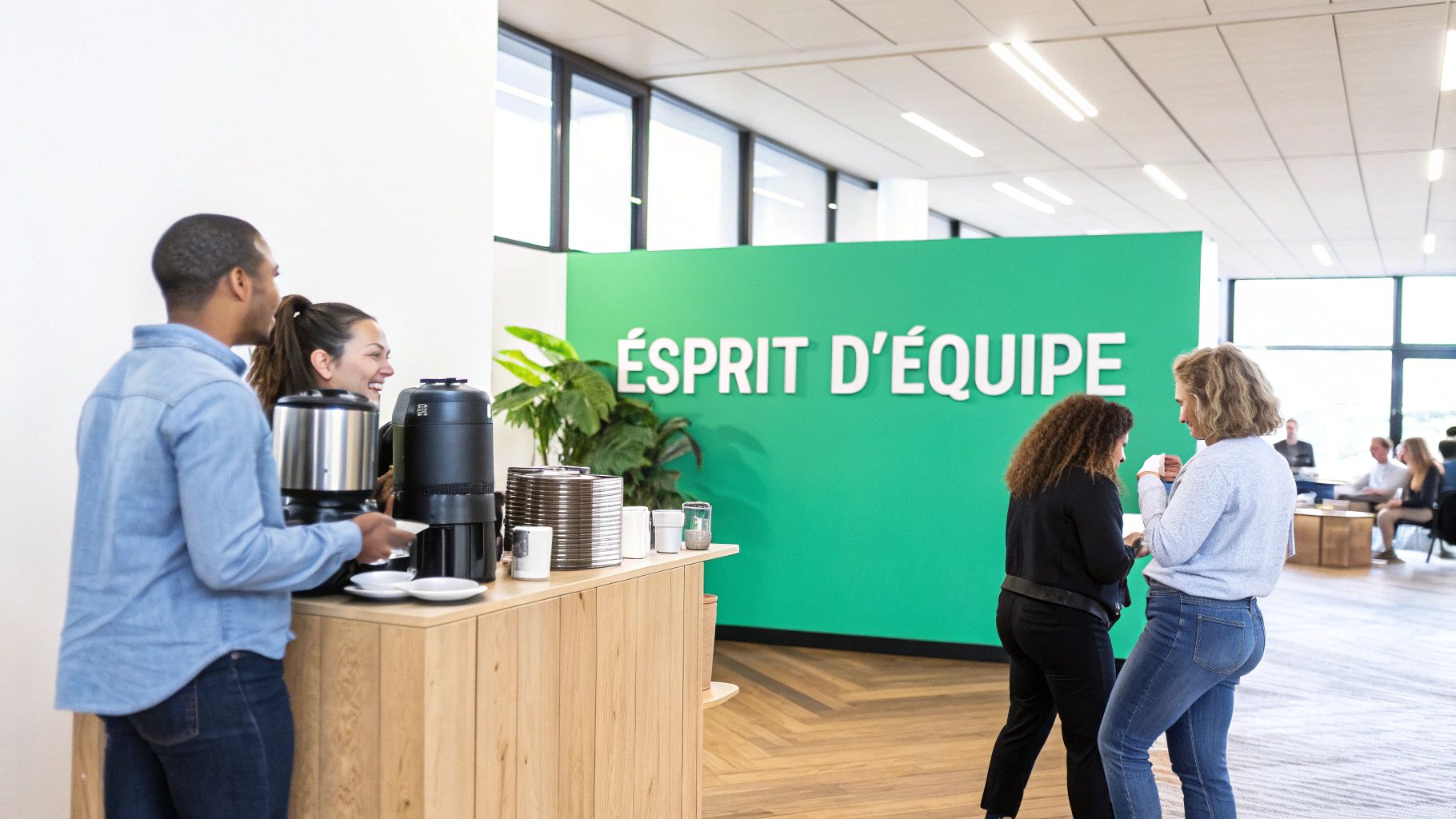
Well beyond the sporting results, organizing a prediction contest is primarily about creating the perfect excuse to multiply informal and spontaneous interactions. Those that make all the difference in the daily atmosphere and transcend hierarchical barriers.
Imagine for a moment the discussions at the coffee machine. Instead of only talking about ongoing projects, people debate the score of the previous day's match or the internal ranking. This is where the magic happens: an accountant and a developer who never interact discover a shared passion. Connections are formed, simply.
Creating Authentic Connections
This initiative goes far beyond mere distraction. It addresses a fundamental need for connection. By bringing everyone together around a collective and positive experience, you strengthen teams and enhance the sense of belonging.
A well-orchestrated prediction contest measures not only sports knowledge but also a company's ability to create shared moments of conviviality. It’s a direct investment in your human capital.
The event becomes a catalyst for conversations. It offers a neutral playing field where everyone, from the CEO to the intern, participates on equal footing. This horizontal dynamic is great for flattening the hierarchy in a playful way, fostering a more open and collaborative work climate.
Enhancing the Employer Brand
Organizing such an event is not trivial. It sends a strong signal to your employees: the company cares about their well-being and invests in moments that go beyond purely professional settings.
This approach directly contributes to enhancing your employer brand, a crucial asset for attracting and especially retaining talent.
A successful contest leaves lasting positive memories. What people remember is not so much who had the best predictions, but the moments of suspense, laughter, and shared enthusiasm. The benefits for the company culture are felt long after the final whistle.
For a prediction contest to be more than just another activity, but a true success, it all rests on an essential foundation: clear rules of the game that are understood and accepted by everyone. This framework ensures fairness, avoids frustrations, and keeps the game enjoyable from start to finish.
Even before diving into the scoring system, the first question to ask is about the objectives. What are you looking to achieve? Is it purely for fun, to provide a breath of fresh air? Or is the idea to create connections and encourage interactions between different departments?
This reflection is far from a detail. It will directly influence the complexity of your rules. A contest focused on relaxation will do just fine with a very simple points system. On the other hand, if you aim for cohesion, more elaborate rules, such as bonuses for team predictions, will make perfect sense.
Defining a Clear and Motivating Scoring System
The points system is the engine of your contest. It must strike the right balance between simplicity and challenge. An overly complicated scoring system may discourage participants even before the kickoff, while a too-basic system might quickly lack excitement.
Here are some classic elements you can integrate:
- The Correct Winner: The basics. The participant finds the right team (or the draw) and scores points. It’s simple, effective, and accessible to everyone, even novices.
- The Exact Score: The Holy Grail for predictors! Much harder to find, it should logically yield the maximum points. It’s the little “jackpot” that can create spectacular turnarounds in the rankings.
- The Correct Goal Difference: A clever alternative. The player doesn’t have the exact score, but they guessed the difference (for example, a prediction of 2-0 for a final score of 3-1).
- The Correct Number of Goals: Another option to reward the accuracy of the analysis, even if the score isn’t quite right.
The secret is not to go overboard. Two or three criteria are more than enough to create an engaging dynamic without overwhelming participants with information.
To help clarify, here’s a comparison of two approaches for your scoring system.
Examples of Scoring Systems for Your Contest
Comparison of different scoring systems to help you choose the one that best aligns with your engagement and simplicity goals.
| Type of Prediction | Points Awarded (Option A - Simple) | Points Awarded (Option B - Detailed) | Advantages and Disadvantages |
|---|---|---|---|
| Correct Winner | 5 points | 10 points | Option A: Easy and quick to understand, ideal for maximum engagement. Option B: Values the basic prediction more, but can create larger gaps. |
| Exact Score | 10 points | 25 points | Option A: Attractive, but not too punishing for those who don’t get it. Option B: Becomes a real “game changer” that keeps the suspense until the end. |
| Correct Goal Difference | Not included | 15 points | Disadvantage: Adds a layer of complexity. Advantage: Rewards the finesse of analysis and offers more chances to score points. |
| Correct Number of Goals (per team) | Not included | 5 points per team | Disadvantage: Can complicate point counting. Advantage: Allows for rewarding very precise analysis, even if the final result is different. |
In summary, Option A is perfect for a fun and accessible contest, while Option B adds a more strategic dimension that will appeal to the more competitive participants.
The transparency of the points system is not just an option; it’s a cultural expectation. Participants want to understand how the ranking is calculated, a logic inherited from mutual betting where the redistribution of winnings is codified. This expectation for quantified systems makes platforms with real-time rankings particularly effective.
Anticipating Special Cases (to Avoid Headaches)
A good set of rules is one that has answers to everything, or almost. Two points deserve special attention to ensure a smooth experience: managing ties and participation deadlines.
What to do if multiple players finish tied? It’s a classic: several people end up with the same number of points. By planning a tiebreaker rule from the start, you cut short any potential discussion.
Here are some ideas for breaking ties:
- The most exact scores: To prioritize ultimate precision.
- The most correct winners: To reward consistency.
- A tiebreaker question: Asked at the time of registration (“How many goals will be scored in total during the competition?”), the person closest to the correct answer wins. It’s simple and impartial.
Setting Clear and Non-Negotiable Deadlines The golden rule is undoubtedly that of deadlines for submitting or modifying a prediction. Clearly state that predictions must be validated before the kickoff of each match. The simplest? Use an automated platform that manages this for you and blocks submissions the moment the match starts. No more discussions!
Finally, consider centralizing these rules in a single, easily accessible document. A simple email, a page on your intranet, or a dedicated section in the prediction tool will do just fine. Don’t forget to check the legal aspects; even if an internal contest without financial stakes is generally simple to frame, it’s better to be cautious. To delve deeper into the subject, feel free to consult our article on the legality of a sports prediction contest in the workplace.
In the end, clarity is your best ally for a successful contest.
The Ideal Platform to Manage Your Contest: The Nerve of the War
Let’s not kid ourselves, the era of shared Excel files is over. It was nice at first, but it quickly becomes a nightmare to manage once you exceed ten participants, not to mention the almost inevitable risk of errors. The tool you choose is the true keystone of your employees' experience. For a prediction contest that leaves a mark, a dedicated platform is no longer a luxury but a necessity.
A good solution transforms a simple activity into a professional and smooth event. The time savings are colossal: no more manual entry of scores, point calculations, and ranking updates. This time can finally be devoted to what really matters: engaging your community and boosting the atmosphere.
Key Criteria Not to Overlook When Choosing Your Tool
The choice of platform should not be left to chance. For the contest to take off and for your cohesion objectives to be met, certain points are simply non-negotiable.
Here are the key elements to scrutinize:
- Customization in your company colors: The platform should reflect your company culture. Integrating your logo, fonts, and colors is essential for the contest to be perceived as a genuine internal initiative. It’s a real plus for your employer brand.
- Flawless mobile experience: Your colleagues should be able to make their predictions anywhere, anytime, between meetings or during commutes. A responsive interface that displays perfectly on smartphones is no longer an option.
- Features to create connections: A good tool should encourage discussions and friendly competition. Look for options like instant messaging, badges to unlock for the boldest participants, or the ability to create mini-leagues by team or department.
- Automated and real-time rankings: This is the heart of the reactor. The ranking should update instantly after each match. This creates suspense and encourages participants to keep coming back to see where they stand.
A platform like ccup.io, for example, has been designed to natively integrate these elements. The goal is to offer an immersive experience that makes people want to return.
It’s clear on this interface how a real-time ranking, badges, and simple navigation transform a game into a true friendly and professional competition. Everything is centralized in one place: predictions, rankings, rules of the game. It’s fluid, it’s clear.
Consider the Habits of French Players
In France, predictions are taken seriously. Sports contests “among friends” have become a true societal phenomenon. To be convinced, just look at the figures from platforms like PronoContest, which claims nearly 66,000 contests organized and over 301,000 players. These figures show how features like trend visualization or detailed rankings have become expected standards among users.
Turnkey solutions like ccup.io draw inspiration from these well-established codes to turn this leisure reflex into a genuine tool for cohesion in the workplace. If this topic interests you, you can check out PronoContest statistics to better understand expectations.
Never underestimate the user experience. An intuitive and fun platform is not just a comfort. It’s what makes the difference between a contest that limps along and an event that becomes the number one topic of conversation at the coffee machine.
If your company has an international dimension, one criterion adds to the list: multilingual support. Offering an interface in each employee's language is a mark of respect and inclusion that will make all the difference.
Finally, a good partner should support you beyond the technical aspects. Do they provide resources to help you communicate? Ready-to-use email templates, posters, ideas for activities? These little extras are often what ensures the success of your event. For a more in-depth analysis of the different options on the market, take a look at our comprehensive guide on how to choose the internal prediction platform.
Communicating Effectively to Launch Your Contest
No matter how great your platform is and how solid your rules are, if no one knows about it, your prediction contest is likely to flop. Good communication is what transforms a simple activity into a true internal event. It’s the spark that creates anticipation, generates enthusiasm, and gives everyone the desire to participate.
Rather than a hasty email, imagine a well-orchestrated launch campaign. The idea is to gradually build up the pressure, play on curiosity, and release information at the right time. A real buildup!
This timeline summarizes the steps to go from an idea on a corner of the table to a well-crafted launch.
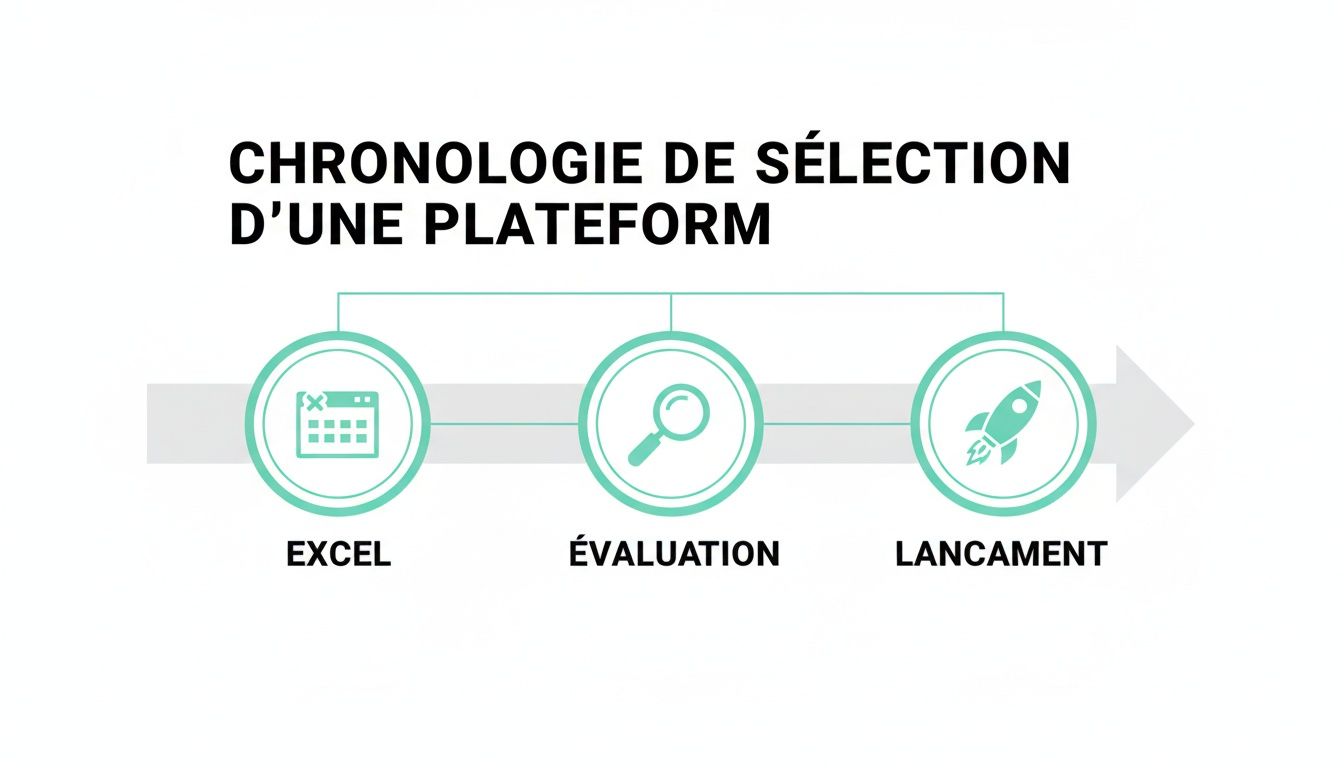
It’s clear that choosing a dedicated platform is a turning point. It allows you to move from tedious manual management on Excel to a smooth and truly engaging experience for everyone.
Building Anticipation with a Teaser Announcement
About one or two weeks before kickoff, launch a “teasing” phase. The goal is not to reveal everything but simply to pique curiosity. This is the time to drop hints and get people talking.
A short and intriguing message on your discussion channels like Slack or Teams works perfectly. Here’s an example you can draw inspiration from:
Teaser Message Template (Slack/Teams) ⚽ Get ready! Something big is coming for the Euro/World Cup. Do you think you’re the best predictor in the office? You’ll soon have the chance to prove it... Stay tuned! #InternalChallenge
This kind of message is perfect for sparking initial conversations and setting the stage before the official announcement.
Orchestrating the Official Launch
The big day is here. Now is the time to make an impression with complete and motivating communication. Your launch message should be a true user manual: clear, concise, and containing all the information to participate in under two minutes.
Your message must absolutely include:
- The direct link to register and start playing.
- A simple summary of the rules and how points work.
- Key dates: contest opening, deadline for first predictions, and the grand finale.
- An overview of the rewards to motivate even the least competitive participants!
Here’s a launch email template that strikes the right balance between information and enthusiasm:
Subject: 🏆 It’s on! The big prediction contest is open!
Hello everyone,
The moment you’ve been waiting for has arrived! Our prediction contest for [Name of the competition] is officially launched. It’s the perfect opportunity to challenge your colleagues in a good-natured way, showcase your expertise (or luck!), and of course, try to win some fantastic prizes!
How to participate? It’s simple:
- Click here to register on our platform: [Link to the platform]
- Make your predictions for the first matches before [Date and Time deadline].
- Follow the live ranking and adjust your predictions throughout the competition!
The complete rules and scoring system are available directly on the platform.
May the best win!
Creating a Visual Identity to Make an Impression
To make your contest a real topic of conversation, give it an identity. A catchy name and a few visual elements, even very simple ones, can make all the difference. It makes the event more concrete and more visible in daily life.
Consider creating a few easy-to-make materials:
- A banner for your intranet or your email signature.
- Square visuals or stories for internal networks.
- A small poster to put up near the coffee machine.
These visuals become regular touchpoints. They remind everyone of the event and help anchor the prediction contest in the company culture during the competition. It’s this little extra that turns an activity into a truly unifying moment.
Animating the Game to Maintain Engagement Until the Finale
That’s it, the launch is a success. The enthusiasm is there, the first predictions are coming in. Congratulations! But the hardest part is just beginning. How to ensure that the excitement doesn’t deflate like a soufflé after the first week? Animating your prediction contest is key to transforming a simple distraction into a continuous conversation that energizes the company until the final whistle.
A competition is long. If you don’t keep the flame alive, only a few participants at the top of the ranking will remain truly engaged. The goal is to create mini-events and regular touchpoints so that everyone feels involved, no matter their ranking.
Far from being a chore, animation is an opportunity to tell a story: that of your contest. Every match, every surprise, every turnaround is a nugget of content to exploit.
Transforming Stats into Captivating Stories
Your prediction platform is a goldmine of information. Don’t let the ranking live its life in a corner. Use this data to create fun and regular communications that encourage people to follow the game.
Here are some simple ideas to deploy each week:
- The Weekly Ranking: This is the must-see event. Share the Top 5 or Top 10 on your internal channels (Slack, Teams, email) with a nice personalized note.
- The Fantastic Comeback: Highlight the colleague who has gained the most places. It’s the best way to show that nothing is ever decided and to motivate those who are a bit behind.
- The Unlikely Prediction: Celebrate the one who dared to predict a score that no one expected... and got it right! It values boldness and creates memorable anecdotes.
- The Duel of the Week: Organize a friendly rivalry between two departments. “Will the Marketing team finally surpass Accounting? Find out after this weekend’s matches!”
This approach works so well because it relies on a mechanism rooted in our culture. In the 1980s, the Sports Lottery could already record over 500,000 tickets for major events. Long before the internet, it was estimated that there were 6 million regular bettors in France. Your internal contest thus addresses an audience already familiar with these codes. To learn more, you can check the evolution of prediction games in France.
Going Beyond the Simple Prediction
Not everyone is a sports expert, and that’s perfectly fine. To ensure everyone has fun, integrate side challenges that allow points to be scored, even when one is completely off on the scores.
The goal is not to reward only sports expertise but to celebrate participation and the spirit of the game. Side challenges are perfect for reminding everyone that everyone has a chance.
Think of varied activities that can earn bonus points:
- Thematic Quizzes: Each week, a little question about the history of the competition, an anecdote about a player, or an unknown rule.
- Fun Polls: “Which team has the best jersey?” or “Who will have the craziest goal celebration?” A few points for each participation, it’s simple and effective.
- Creative Challenges: Launch a contest for the best supporter photo at the office or the best-decorated office in the colors of the event.
These mini-games have a double advantage. On one hand, they allow for unexpected “comebacks” in the rankings and maintain suspense. On the other hand, they reinforce the idea that the contest is primarily an excuse to have fun together.
Finally, and perhaps most importantly: encourage discussions. Ask open-ended questions on your communication channels: “What’s your riskiest prediction for tonight?” “Who do you see as the surprise of the competition?” By reacting to comments and tagging participants in your posts, you transform a simple activity into a truly lively and engaged community.
Closing the Event and Celebrating the Winners
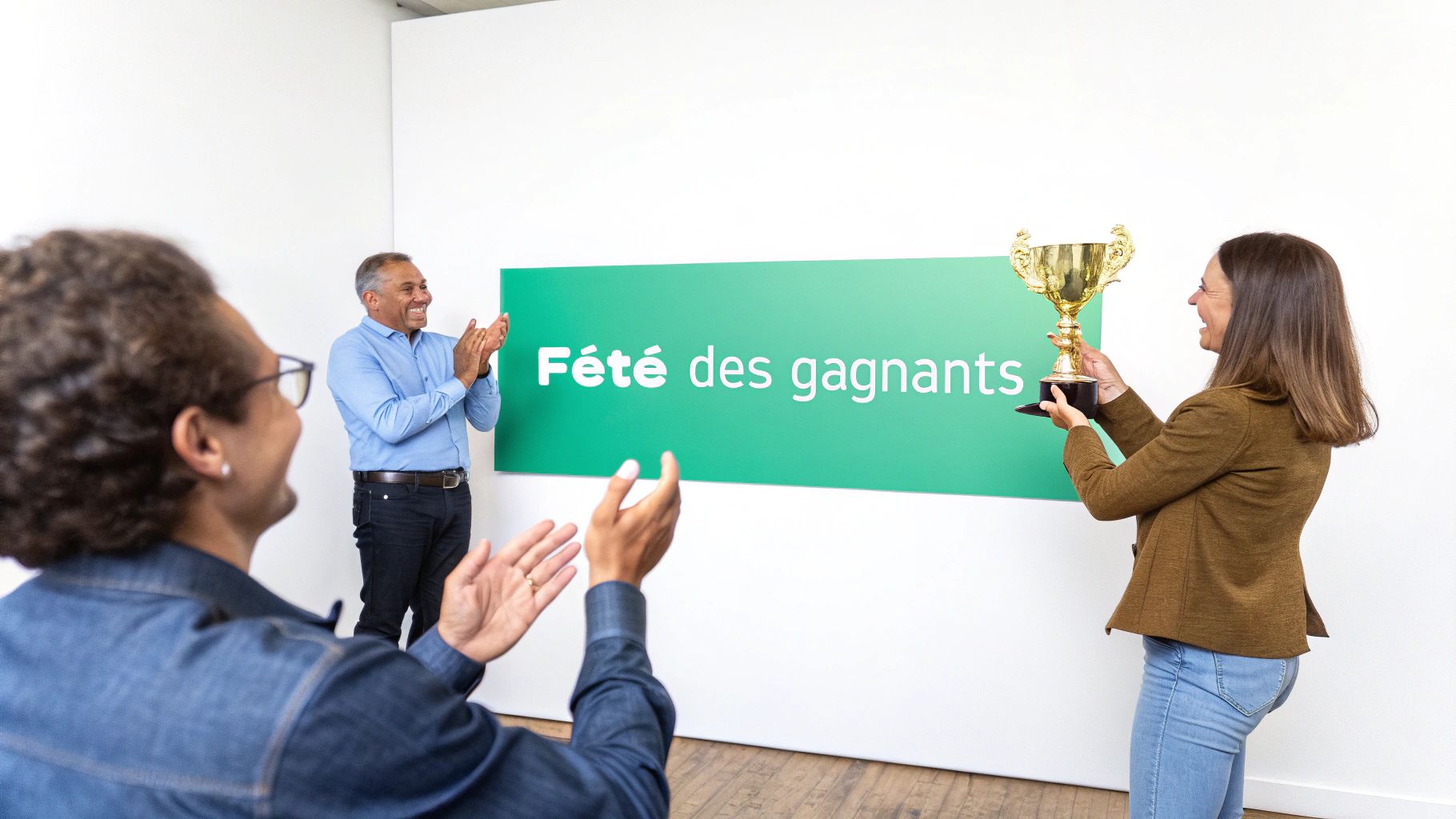
The way you conclude your prediction contest is just as crucial as its launch. A grand finale leaves a lasting positive impression and transforms a simple activity into a true company memory. It’s time to celebrate, thank, and capitalize on all the positive energy that has been generated.
Make the announcement of the results a little event in itself! Depending on your company culture, several options are available to you. Organize a mini-ceremony in person for a friendly and suspenseful moment. For remote teams, a live announcement on Teams or Slack, with screen sharing of the final ranking, creates a great effect. A simple well-crafted summary email, with the names of the winners and some fun stats, also works very well to close the loop.
Rewards That Make an Impression
Forget about promotional goodies that will end up at the back of a drawer. The best rewards are those that provide real value or a memorable experience. It’s a simple and powerful lever to show the company’s appreciation.
Here are some standout ideas:
- Unique Experiences: Two tickets for a match, a concert, or a cultural event in your city.
- Quality Time: An extra day off, often the most appreciated reward!
- Personal Development: A voucher for an online training course or a subscription to a wellness app.
- A Charitable Gesture: Offer the winner the chance to make a donation to a charity of their choice, in the company’s name.
Choosing the right reward is an art. To delve deeper into the subject, our comprehensive article on the best ways to reward employees will give you plenty of other concrete ideas.
Capitalizing on This Success for the Future
Once the champions are celebrated, the work is not quite finished. It’s the perfect time to gather valuable feedback that will serve you for your next initiatives. A simple satisfaction survey will allow you to know what was most liked and what could be improved.
The end of the contest is not a conclusion; it’s the beginning of your post-event communication. Use the results to strengthen your employer brand and illustrate a vibrant company culture.
Communicate widely internally about the success of the operation. Share the final podium, the participation rate, and some anecdotes on your intranet or in your newsletter. It values everyone, from participants to organizers, and already creates a desire to participate in the next event.
Last Questions Before You Dive In?
Do you still have some doubts before taking the plunge? That’s perfectly normal. Here are answers to the most frequently asked questions to reassure you and help you launch confidently.
Is a workplace prediction contest legal?
Yes, absolutely. It’s perfectly legal and poses no issues. The only golden rule to follow is that participation must be completely free for all your employees. As long as no one has to spend a single cent, it’s not a gambling game, but simply an internal activity, a pure team-building moment.
How to involve colleagues who are not interested in sports?
Excellent question, as the goal is indeed to engage everyone. The trick is not to rely solely on sports results.
- Think of side challenges: a little quiz about the company’s history, general knowledge questions...
- In your communication, emphasize friendliness and team spirit.
- Offer collective rewards for the team or department that performs best.
The idea is to hammer home that sports are just a pretext. The real objective is to have fun together.
What are the best rewards for the winners?
To make an impression, forget about gadgets. Focus on experiences that create memories. The rewards that work best are often those that offer time or a special opportunity.
Imagine the impact of an extra day off, tickets for a concert or a match, or a gift voucher for a great restaurant.
A reward that offers a strong experience will always hold more value in people’s eyes than an object. It’s a direct investment in the satisfaction of your teams.
How much time should be allocated to organize all this?
Honestly, with a turnkey platform like ccup.io, the technical part takes just a few hours. It’s astonishingly quick. The bulk of the work is in anticipating communication. Plan for one to two weeks in advance to properly set the rules, draft your messages, and build up a bit of excitement before the big launch.
Ready to make the next major sporting event an unforgettable moment for your teams? With ccup.io, you can launch a custom prediction contest in just a few clicks and give a real boost to your company culture. Discover how ccup.io can help you.
From Content To Conversion
Turn your next sports event into a company prediction contest
Discover the platform, explore available competitions, and launch a branded experience that supports engagement, internal communication, and team cohesion.
See available competitions
Related articles

2 weeks ago
Olympic Games 2026 Animations: Team Building Ideas
The Olympics: a gold medal for your company culture. Many HR and internal communication teams, however, start with a bad reflex. They reduce Olympic Games activities to an office olympiad, an improvised quiz, or an evening in front of a final. This creates a highlight, but rarely a true engagement m...

2 weeks ago
Rugby Contest: 7 Formats to Engage Your Teams
Transform the try. Many companies still think that a rugby contest is just about "guessing a score" and giving away a prize at the end. That's too short. The real issue is to convert a major sports moment into a long-lasting engagement device that is easy to join and does not create legal or operati...

2 weeks ago
Sports Event Poster: 7 Models and Tips 2026
Your next sports event poster probably doesn't look like what you had in mind yet. You have a date, a location, maybe an interdepartmental tournament, a charity run, or a prediction contest to launch. But between the management brief, brand constraints, printing deadlines, and the fear of producing...



















Contact us
For any question or quotation requests, do not hesitate to reach us by phone at 01 83 79 24 54 or by email : contact@ccup.io
Contact us


Frequently asked questions
What is ccup.io?
Ccup.io is a cohesion tool, allowing firms to gather their collaborators on the occasion of major sporting events, such as World Cup or Olympic Games. We offer an interactive forecasting platform, turnkey and customisable to your company’s colours.
What are you doing with our data?
By deciding to use our services, you decide to entrust us a part of your data – this will allow us to optimise your experience. We place great emphasis on the protection of your data, in compliance with current regulations. Given that it is important to be informed on the issues and challenges of personal data protection, ccup.io provides you with a most complete documentation on this matter.
How much does it cost?
In order to give our clients flexibility, we make a special rate depending on the number of registered players using a degressive system for an important number of participants. This allows firms to organise tailored events, adapted to their capacity. To receive a commercial offer in less than an hour, you only need to fill out the quotation requests form, with just a few clicks.



Don’t miss this opportunity 😍
Start now and enjoy numerous benefits