



Lack of Motivation at Work: A Guide to Reignite Engagement
We often hear about a temporary "slump," but the lack of motivation at work is much more than that. It is a real warning sign, a signal of a disconnection that settles between an employee and their professional daily life. It is recognized by a loss of meaning, a dwindling energy, and a gradually disappearing desire to invest oneself.
Transforming Demotivation into a Performance Lever

The lack of motivation is a bit like a car engine that starts to sputter. It’s not yet a complete breakdown, but it’s a sign that something is off. The key components—whether it’s recognition, the sense of missions, or team cohesion—clearly need a tune-up. Ignoring these signals risks a drop in productivity, an increase in turnover, and ultimately, a deteriorating work atmosphere.
However, far from being a fatality, this phenomenon is an opportunity for managers, HR, and leaders. It is an invitation to reassess and strengthen the company culture. By digging deeper to understand the root causes, we don’t just solve a temporary problem. We build an environment where engagement and enthusiasm can truly thrive in the long term.
A Roadmap for Concrete Action
The goal of this article is simple: demystify demotivation. It should not be seen as a failure, but rather as a diagnosis. And a good diagnosis is the first step towards targeted and effective actions. To achieve this, we will focus on several key points:
- Knowing how to read the signals: Learning to spot the symptoms of disengagement, from the most obvious to the more subtle.
- Analyzing the roots of the problem: Breaking down the factors, whether related to the organization or the individual, that contribute to this lack of enthusiasm.
- Discovering effective strategies: Exploring concrete solutions, from team dynamics to gamification, to reignite the spark.
To give you an idea, the annual cost of disengagement in France is estimated at €14,840 per employee. Therefore, acting on motivation is not just a matter of well-being; it is also a major financial issue for the company's performance.
Consider this guide as your roadmap. You will find everything you need to move from observation to action and turn the lack of motivation into a real growth lever.
Identifying the Warning Signs of Disengagement

The lack of motivation at work rarely sets in overnight. It is an insidious process that often starts with weak signals that can easily be ignored. Knowing how to decode them in time is crucial to act before disengagement settles in for good.
Imagine a careful gardener. They don’t just notice that a plant is dead; they spot yellowing leaves, stagnant growth, or dry soil. Similarly, a manager or HR leader must cultivate this sense of observation to preserve the vitality of their teams.
Beyond the Obvious Indicators
The most well-known signals, such as an increase in tardiness or a rising absenteeism rate, are just the tip of the iceberg. The real challenge is to capture the more subtle behavioral changes that betray a loss of momentum.
A previously proactive employee may turn into a mere executor. Their involvement in team life dwindles, they speak less in meetings, and seem to withdraw. These transformations are often the first symptoms that something is wrong.
Isolation is a particularly telling sign. An employee who reduces their interactions, eats alone, or avoids informal moments often expresses discomfort or disinterest in their work environment.
Taken in isolation, these behaviors may seem trivial. It is their accumulation and persistence that should really raise a red flag.
Behavioral Changes to Watch For
Disengagement manifests through several observable attitudes in daily life. Learning to recognize them allows one to distinguish between a simple temporary "slump" and a much deeper lack of motivation at work.
Here is a list of weak signals that deserve your full attention:
- Decrease in initiative: The employee does the bare minimum, no longer proposes new ideas, and passively waits for instructions.
- Cynicism or ambient negativity: Recurring criticisms of projects, a pessimistic posture in meetings, or sarcastic remarks may signal growing frustration.
- Emotional detachment: Enthusiasm has disappeared. Successes and failures seem to slide off them without eliciting a reaction.
- Declining work quality: There is a noticeable increase in careless mistakes, forgetfulness, or a general lack of rigor.
These symptoms are not irrefutable evidence, but serious leads. They should primarily open the door to dialogue to understand what lies behind this change in attitude.
Comparison of Engaged and Demotivated Behaviors
To help you better visualize these nuances, this table highlights the differences in behavior to help you spot the weak signals of disengagement.
| Observable Behavior | Sign of Engagement | Sign of Lack of Motivation |
|---|---|---|
| Participation in Meetings | Proposes ideas, asks relevant questions, actively contributes to discussions. | Remains silent, does not take notes, seems distracted or expresses a consistently negative opinion. |
| Taking Initiative | Seeks new ways to improve processes, volunteers for projects. | Waits for specific instructions, avoids new responsibilities, and limits themselves to their tasks. |
| Collaboration with the Team | Shares information, helps colleagues, participates in the social life of the group. | Isolates themselves, communicates only when necessary, avoids informal interactions. |
| Reaction to Challenges | Sees problems as opportunities to learn, remains optimistic and persevering. | Quickly expresses frustration, complains about difficulties, gives up easily when faced with an obstacle. |
| Quality of Work Delivered | Pays attention to details, seeks to exceed expectations, checks their work. | Delivers work that is just "acceptable," with mistakes or omissions, without seeking to improve it. |
Learning to decipher these behaviors gives you the keys to act preventively. The next step will be to dig deeper to understand the roots of this demotivation.
Diving into the Heart of Demotivation Causes
Identifying the first signs of disengagement is good. It is even an essential first step. But it is only the beginning of the journey. To truly address the lack of motivation at work, one must look beyond the symptoms and tackle the root causes of the issue.
Much like a doctor who, faced with back pain, does not just prescribe painkillers. They seek to find out if the problem stems from poor posture, a lack of exercise, or something deeper.
Demotivation is rarely the result of a single cause. It is rather a complex cocktail of factors that intertwine. Some are related to the company itself, while others are more personal, unique to each employee. To act in a targeted manner, it is crucial to differentiate between them.
Factors Originating from the Company
The work environment has a direct and massive impact on team engagement. If the setting is not healthy, it can quickly become a source of frustration and burnout, ultimately undermining the motivation of even the most invested employees. Several recurring black spots are evident.
- Excessive or poorly managed workload: When employees are constantly under pressure, without ever having time to breathe, burnout is never far away. The result? A lasting loss of energy and enthusiasm.
- Vague or non-existent objectives: Moving forward without a compass is exhausting. If an employee does not know precisely what is expected of them or how their work fits into the overall vision of the company, they end up losing the sense of their mission.
- Toxic or inadequate management: A manager who micromanages, who does not trust, who gives no constructive feedback, or who is unable to listen... This is a perfect recipe for generating stress and gradually killing motivation.
- Lack of recognition: Working hard and feeling invisible is deeply discouraging. The absence of recognition, whether financial or simply verbal, sends a terrible message: "your efforts do not matter."
Motivation does not depend solely on the tasks one accomplishes. It primarily depends on the environment in which one operates. A healthy, fair, and stimulating work environment is the essential soil for long-term team engagement.
Individual Triggers of Demotivation
Of course, the company is not solely to blame. Motivation also draws from very personal factors. The expectations, values, and backgrounds of each individual weigh heavily in the balance of engagement.
For example, an employee may feel completely demotivated if their work clashes head-on with their values. Imagine a person very committed to ecology working for a company with polluting practices. This mismatch creates an inner discomfort that ultimately extinguishes all motivation.
The feeling of stagnation is another silent but formidable killer of motivation. Not learning anything new, seeing no prospects for advancement, repeating the same tasks over and over... This is the royal road to boredom and disengagement. This is also one of the reasons why more and more employees, especially the younger ones, are looking elsewhere.
Work Expectations Have Changed
We must face the facts: the relationship with work is no longer the same. New generations, in particular, are no longer just chasing a salary. They are in search of meaning, flexibility, and a true balance between their professional and personal lives.
The CentreInffo Barometer clearly shows this: 35% of French workers are considering changing jobs within the next two years. And among the young, it is even more pronounced: 52% of Generation Z could leave their position for a better offer. The reason? For 45% of 20-24 year-olds, the job must primarily be a pleasure. To go further, take a look at these key recruitment statistics.
This thirst for meaning completely changes the game. Flexibility has also become a non-negotiable criterion: 64% of young workers place it at the top of their expectations. Companies that turn a deaf ear to these new aspirations risk seeing their best talents slip away, worn out by a lack of motivation at work fueled by this mismatch.
Understanding these deep-rooted causes is the only way to build strategies that truly work to re-engage your teams.
Measuring the Level of Motivation in Your Teams
Acting on the lack of motivation at work without concrete data is a bit like navigating in a storm without a compass. To be truly effective, one must first understand where they are starting from. Measuring engagement is not just a one-time exercise, but rather a continuous process that allows you to take the pulse of your teams in real-time.
The idea is to combine quantitative indicators, which provide an overview, with more human approaches that reveal the nuances hidden behind the statistics. This way, we move from simply observing symptoms to a precise diagnosis on which we can build a strategy.
Quantitative Indicators to Monitor Closely
Some raw data are real warning signals. Easy to collect, they offer a first objective snapshot of the health of your organization. Think of them like the lights on a dashboard: they light up when something deserves your attention.
Here are the essential KPIs to keep an eye on:
- Turnover rate: If this rate is high, it often means that your employees do not see themselves staying long-term. It is a symptom of a deeper problem, which may be related to management, company culture, or lack of prospects.
- Absenteeism rate: An increase in absences, especially if they are short and repeated, may betray physical or psychological fatigue. It is a key indicator of professional burnout or a too-stressful work environment.
- Declining productivity: When objectives are increasingly unmet or the quality of work deteriorates, it may be directly related to a collective loss of engagement.
These numbers do not lie, but they do not tell the whole story. They indicate what to look at, but not why things are deteriorating. And that’s where qualitative methods come into play.
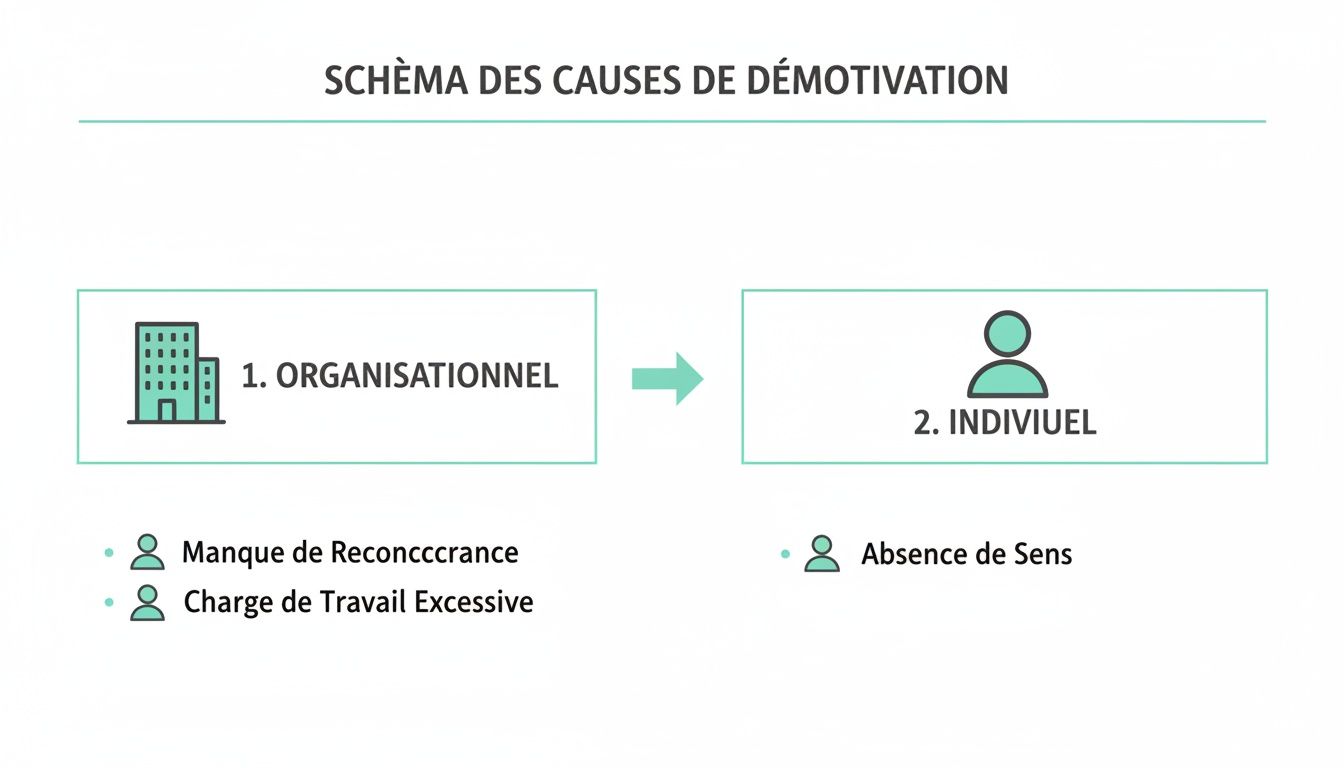
This diagram clearly shows that disengagement rarely has a single cause. It is often the result of a complex interaction between the company context and each individual's personal feelings.
Qualitative Tools to Understand Feelings
To truly grasp the roots of the lack of motivation, there is no secret: one must listen. Qualitative methods allow you to give a voice to the numbers, to understand the emotions, frustrations, and expectations of your teams.
The greatest danger is to be satisfied with the numbers without ever seeking to understand the human behind them. A statistic tells you there is a problem, but only a conversation will reveal its cause.
Here are powerful tools to go beyond the data:
- "Pulse" surveys: These short and frequent questionnaires (weekly or monthly) are perfect for tracking the morale of the troops on specific themes such as workload, recognition, or clarity of objectives.
- eNPS (Employee Net Promoter Score): With a single question (“On a scale of 0 to 10, would you recommend your company as a great place to work?”), you get a simple indicator of overall engagement. To delve deeper into the topic, take a look at our guide to measuring employee engagement.
- Regular one-on-one meetings: Nothing replaces a face-to-face discussion. It is the perfect moment to talk about aspirations, difficulties, and an employee's feelings in a confidential and supportive setting.
- "Stay interviews": Unlike exit interviews, their purpose is to understand why your best talents stay. By asking them what motivates them and what might make them leave, you gather golden information to improve the experience for everyone.
By combining these two approaches, quantitative and qualitative, you no longer just observe demotivation: you understand it. You then have a solid foundation to build targeted actions that will have a real impact.
Creating a New Dynamic Through Gamification
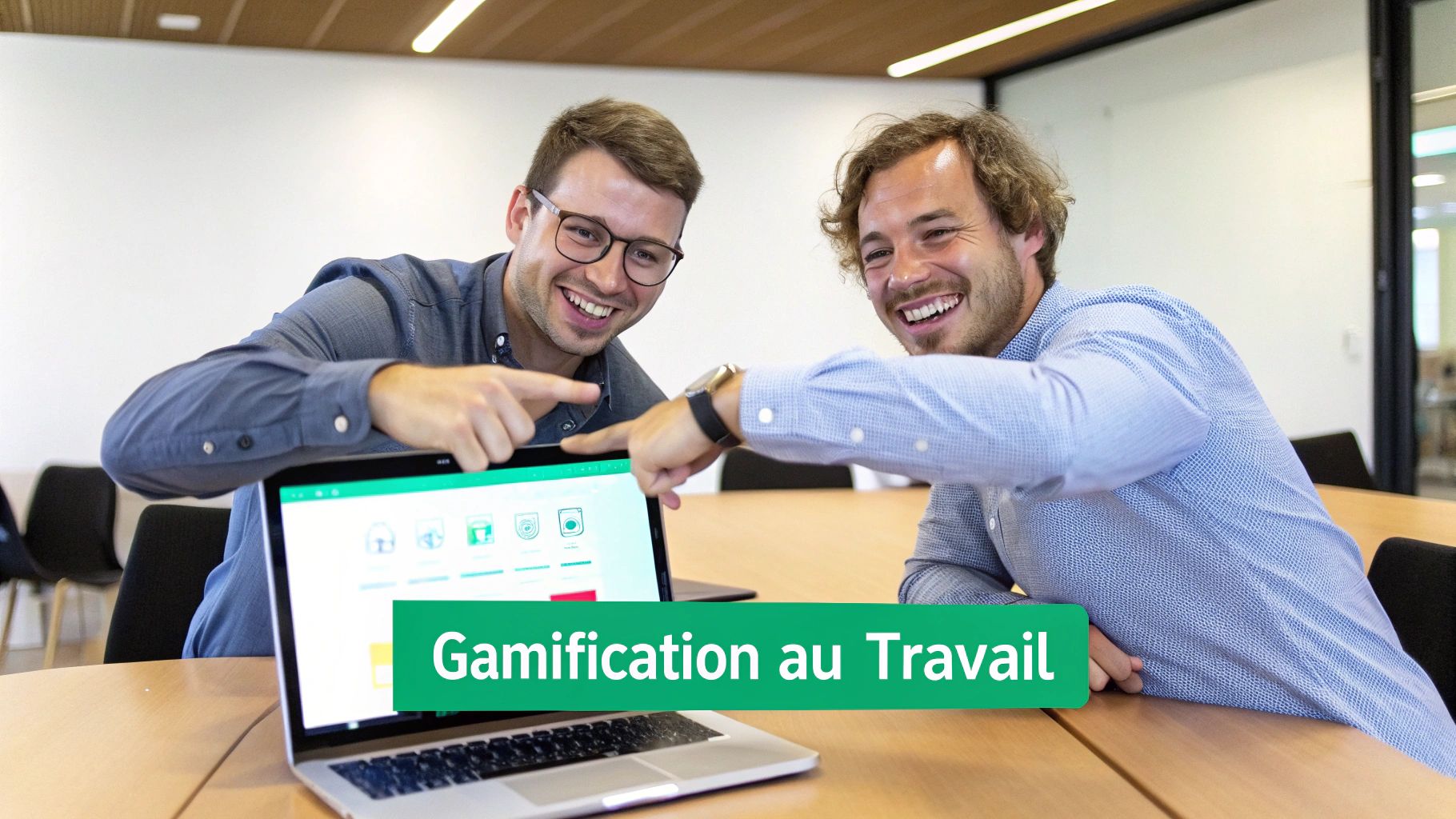
When the lack of motivation at work sets in, traditional solutions can quickly lose their effectiveness. Sometimes it is necessary to think differently, to inject a dose of play and friendliness to break the routine and reignite the flame. This is where gamification comes into play and shows its full power.
The principle is simple: we transpose game mechanics into a context that is not, like the office. The idea is not to turn the open space into an arcade room, but to use well-known psychological levers such as friendly competition, reward, and the feeling of accomplishment to rekindle desire.
Why Play is Such an Effective Motivation Lever
Play has this unique power to awaken our intrinsic motivation, the one that comes from the simple pleasure of doing something, without expecting an external reward. It creates a space where exchanges become more spontaneous, less formal. This is all the more valuable today, with teams often split between the office and remote work.
Take a major unifying event, like a sports competition. It’s a golden opportunity! It provides a universal and positive conversation topic, capable of breaking down barriers between departments and hierarchical levels.
Gamification transforms everyday tasks or professional interactions into stimulating challenges. By establishing healthy competition, it meets our fundamental need for recognition and progress while bonding teams together.
Far from being a mere gimmick, this approach is rooted in the new realities of the working world. A recent European survey confirms this: employee expectations have changed. While salary remains important, reducing stress (37%) and improving work-life balance (34%) are now absolute priorities. Conversely, promotions motivate only 9% of respondents.
In the face of a routine that extinguishes engagement, playful initiatives can truly make a difference by bringing a breath of fresh air and enjoyment.
Implementing a Prediction Contest to Boost Morale
One of the simplest and most effective ways to apply gamification is to organize internal contests, for example around a sports event. It is a very accessible way to create a positive dynamic where everyone can participate.
Specialized platforms like ccup.io allow you to launch this kind of activity in just a few clicks. They offer a turnkey solution to manage predictions, rankings, and interactions, without any hassle.
The goal is to make the experience intuitive and engaging to transform a simple contest into a true company event. It includes all the elements that stimulate participation: a ranking that evolves in real-time, badges to reward good performances, and discussion spaces to exchange and gently tease colleagues. Competition then becomes a social and collaborative experience.
The Concrete Benefits of Such an Initiative
Beyond the fun, organizing a prediction contest has very positive repercussions for company culture and for countering the lack of motivation at work.
- Strengthening team cohesion: The contest becomes a common playground where employees from different departments, and even different countries, can interact. The virtual coffee machine finally comes to life.
- Stimulating informal interactions: Discussions about the scores of the last match or the boldest predictions help break the ice and forge more authentic connections.
- Valuing participation: Thanks to rankings and badges, each participant feels recognized for their involvement, not just for their results.
- Creating positive memories: These shared moments of conviviality remain in memory and contribute to forging a positive image of the company.
In practice, it is very easy to deploy. All it takes is clear communication to launch the contest, a few reminders to maintain interest, and nice rewards for the winners to create a lasting dynamic. If you are looking for ideas to reward your teams, our article explains how to effectively reward your employees.
Gamification is not a magic formula, but it is an incredibly effective tool for injecting new energy. It allows you to tackle disengagement in a positive and proactive way, making the workplace a space where it is also enjoyable to be.
Making Engagement a Sustainable Company Project
Fighting against the lack of motivation at work is not a sprint, but a marathon. It is not about launching a few one-off actions hoping for a miracle, but about building a true company project, a strategic and ongoing investment in your most valuable asset: your employees. The idea is to build a culture where engagement can blossom and thrive in the long term.
This approach is a shared responsibility. On one side, it relies on a management that listens, capable of recognizing efforts and showing kindness. On the other, it is supported by a strong company culture that gives concrete meaning to everyone’s work. In this context, team activities or gamification are not gadgets, but real tools to strengthen bonds and inject a dose of pleasure into daily life.
Actively Prevent Rather Than Suffer
The key message is simple: we must stop suffering from disengagement and start actively preventing it. To do this, we need to go beyond traditional performance indicators and sincerely focus on the feelings and aspirations of the teams. Cultivating a growth mindset can completely transform how your employees perceive challenges and encourage them to persevere in the face of obstacles.
This attention must extend to all generations. The lack of motivation hits seniors hard in France, with an employment rate of only 62% for those aged 55-64. At the same time, 70% of French people criticize their company’s salary policy. Retaining talent, whether young or experienced, requires powerful engagement levers to strengthen ties, especially in the era of hybrid work. To learn more about the fractures in the job market, you can consult this analysis from Forbes.
Motivation is not a given; it is an ecosystem that must be maintained. Every decision, every interaction, every initiative contributes to strengthening or weakening your teams' engagement.
By adopting a long-term vision and a human-centered approach, you can transform a gloomy work atmosphere into a true culture of enthusiasm. This dynamism will become the engine of your performance and innovation for years to come. To delve deeper into the topic, take a look at our article on how to motivate your employees daily.
Frequently Asked Questions About Lack of Motivation at Work
The lack of motivation at work is a topic that raises many concrete questions for managers and HR teams. How to react? What tone to adopt? What actions to implement? Having the right answers can change everything.
Here are some clear guidelines to help you navigate the most common situations and turn doubts into constructive dialogues.
How to Discuss with an Employee Who Seems Demotivated?
Starting the conversation is the first step, and often the most delicate. The goal is not to point fingers, but to open a door. The approach should be human, fact-based, and focused on finding common solutions.
The key is to prepare for this exchange by relying on concrete observations, not judgments. Talk about what you have seen, such as a decrease in participation in meetings or a delay on a project, rather than launching into a "you seem demotivated".
To start a constructive dialogue:
- Choose the right time and place. Prefer a confidential setting and a time slot where no one will be pressed for time.
- Express your feelings factually. You might start with a phrase like: "I noticed that you seemed more withdrawn lately during our team meetings. I just wanted to take a moment to see if everything is okay."
- Practice active listening. Let your employee express themselves without interruption. Ask open-ended questions to help them share their perspective: "How do you feel about your current tasks?" or "Is there something that could help you regain more enthusiasm?"
The goal is not to find a culprit, but to understand the situation. A conversation is successful when the employee feels heard and supported, and when you both leave with concrete action points.
Does Remote Work Worsen Lack of Motivation?
Remote work is a double-edged sword. For some, it is a breath of autonomy that boosts engagement. For others, isolation can quickly extinguish the flame and create a sense of disconnection with the team and the company.
The greatest risk of remote work is the loss of informal social ties. Those discussions at the coffee machine or those impromptu lunches are the glue of a team. Without these moments, the sense of belonging erodes, and demotivation sets in.
To keep everyone engaged remotely, one must be proactive:
- Plan regular team rituals. Very short daily check-ins or virtual coffees help maintain contact.
- Encourage a good balance of communication. Use the right tools for the right discussions to avoid the infamous "zoom fatigue".
- Create moments of conviviality. Online activities or fun challenges can recreate bonds and lightness.
What is the Exact Role of the Manager in Prevention?
The frontline manager is undoubtedly the pillar of motivation. They are the first person an employee turns to, and their influence is enormous. Their role is not to "motivate" artificially, but rather to create an environment where motivation can naturally flourish.
Their actions play out on several levels. They must ensure that each team member understands how their work contributes to broader objectives, which gives concrete meaning to daily tasks.
The manager must also be a facilitator: giving their employees the means to succeed and granting them enough autonomy to feel in control of their work. Regular recognition of efforts and successes, even the smallest ones, is another powerful lever. A simple "great job on that" can have a considerable impact.
Finally, constructive and regular feedback allows for guidance, correction, and encouragement of progress. The manager then transforms into a coach, helping each person grow and remain engaged in the long term.
Engage your teams and break the routine with prediction contests from ccup.io. Transform major sporting events into unforgettable moments of cohesion.
Discover how to launch your activity in just a few clicks on ccup.io
From Content To Conversion
Turn your next sports event into a company prediction contest
Discover the platform, explore available competitions, and launch a branded experience that supports engagement, internal communication, and team cohesion.
See available competitions
Latest articles

8 hours ago
How to Lead an Engaging Team Meeting
Let's be honest: we've all experienced meetings that drag on for no reason. This infamous "meetingitis" is not a fatality. It's just a symptom of bad habits and outdated methods.
The idea is to transform this often-dreaded appointment into a real moment of exchange and decision-making. A g...

3 days ago
Your Serie A Prediction Guide for the 7 Best Tools 2026
The Serie A, with its tactical duels and twists, is an exciting playground for prediction enthusiasts. But how do you move from intuition to structured analysis? To succeed in your next Serie A prediction, it is essential to rely on effective tools that combine advanced statistic...




















Contact us
For any question or quotation requests, do not hesitate to reach us by phone at 01 83 79 24 54 or by email : contact@ccup.io
Contact us


Frequently asked questions
What is ccup.io?
Ccup.io is a cohesion tool, allowing firms to gather their collaborators on the occasion of major sporting events, such as World Cup or Olympic Games. We offer an interactive forecasting platform, turnkey and customisable to your company’s colours.
What are you doing with our data?
By deciding to use our services, you decide to entrust us a part of your data – this will allow us to optimise your experience. We place great emphasis on the protection of your data, in compliance with current regulations. Given that it is important to be informed on the issues and challenges of personal data protection, ccup.io provides you with a most complete documentation on this matter.
How much does it cost?
In order to give our clients flexibility, we make a special rate depending on the number of registered players using a degressive system for an important number of participants. This allows firms to organise tailored events, adapted to their capacity. To receive a commercial offer in less than an hour, you only need to fill out the quotation requests form, with just a few clicks.



Don’t miss this opportunity 😍
Start now and enjoy numerous benefits