



Improving Internal Communication: Strategies to Strengthen the Team
Improving internal communication is key to transforming employees from mere participants into true ambassadors for your company. To achieve this, a clear strategy, the right tools, and above all, experiences that bring people together, strengthen bonds, and align everyone on the same goals are essential.
Why Internal Communication is a Performance Lever

In the era of hybrid work and teams scattered across the globe, good internal communication is no longer a luxury; it is a performance driver. We see it every day: ineffective communication has direct and costly consequences. It creates silos between departments, hinders engagement, and ultimately derails strategic projects.
The observation is particularly striking in France. About 25% of employees find their company's communication insufficient. This figure sheds light on another observation: France ranks only 38th out of 142 in terms of engagement, with barely 7% of employees claiming to be truly involved. Without a well-defined strategy, nearly 57% of projects fail due to a lack of clear communication. This is a huge risk that no organization can afford to ignore. To delve deeper into the subject, you can take a look at the complete data on internal communication in France at edflex.com.
Transforming Interactions into Cohesion
To break this vicious cycle, we need to rethink daily interactions. It’s not just about disseminating information, but about creating a real dialogue. The goal? For every employee, whether in the office or thousands of miles away, to feel truly connected to the company’s vision.
Successful communication guarantees:
- Strengthening strategic alignment: everyone is rowing in the same direction because the course is clear for all.
- Improving collaboration: exchanges between teams become smooth, even remotely.
- Boosting morale and motivation: successes are celebrated, and everyone’s work is given meaning.
Gamification as a Connection Tool
A successful approach to engage teams is to leverage significant moments to create connections. Imagine transforming a major sporting event, like the Olympics or a World Cup, into a unifying moment for the entire company.
Organizing a sports prediction contest, for example, is not just a game. It’s a perfect excuse to create informal and positive interactions, break the routine, and strengthen the sense of belonging.
These shared experiences are powerful catalysts for improving internal communication. They generate spontaneous conversations and allow employees who barely cross paths to connect on neutral and fun ground. Ultimately, these initiatives directly contribute to talent retention and overall performance. Why? Because connected employees are more engaged and productive. It’s also an excellent way to cultivate a strong sense of belonging to the company.
Auditing Your Internal Communication Without Preconceived Ideas

To truly improve internal communication, you must first dare to face the situation honestly, without filters. Launching new initiatives without an honest diagnosis is like navigating without a compass: you may be very active, but you risk just going in circles. This first step is fundamental to building a strategy that meets the real needs of your teams.
The goal is not to judge, but to understand. It’s about pinpointing what’s not working, the friction points that your employees experience daily. What important messages get lost along the way? Which channels have become mere background noise? And, most importantly, which teams feel isolated or poorly informed?
Combining Quantitative and Qualitative
To have a 360-degree view, you must absolutely cross-reference sources. Relying on a single method would be a mistake. It’s by marrying raw numbers and human feelings that you will obtain a reliable and nuanced assessment.
Think of this audit as a three-phase investigation:
- Quantitative data (the “what”): analyze the statistics from your current tools. What is being used, or not?
- Large-scale feedback (the “how many”): deploy anonymous surveys to gauge the general pulse.
- In-depth discussions (the “why”): organize small discussion groups to explore the reasons behind the numbers.
This multi-faceted approach will help you avoid hasty conclusions and uncover problems that are not immediately obvious.
Diving into the Data from Your Existing Tools
Start with what you already have. Your communication tools are a goldmine of objective information if you know where to look. It’s time to dive into the statistics of your intranet, internal newsletter, or company messaging.
Here are some key indicators to scrutinize:
- Open and click rates of newsletters: a low rate may hide a relevance issue, timing problem, or simply a title that doesn’t grab attention.
- Most viewed (and least viewed) pages on the intranet: this immediately tells you what really interests employees and which content is gathering dust.
- Activity on messaging channels: which groups are the most active? Are there teams communicating in isolation?
- Participation rates in events (online or in-person): this is often a good barometer of overall engagement.
By analyzing this data, you will obtain a preliminary mapping of information flows. You will quickly identify which channels are effective and which ones your employees have learned to ignore.
Launching Anonymous Surveys That Really Matter
Numbers are good, but they don’t tell the whole story. To understand the perception and feelings of the teams, the anonymous survey is your best ally. Anonymity is key to obtaining honest responses, especially on such a sensitive topic.
Your questionnaire should be short, clear, and to the point. No one wants to spend 30 minutes on a survey. Aim for about ten questions maximum, mixing satisfaction scales and open-ended questions to gather valuable feedback.
For example:
- On a scale of 1 to 10, how clear do you find the strategic information shared by management?
- What is your preferred channel for receiving important information? (Email, intranet, team meeting...)
- Do you feel you have all the information necessary to do your job well?
- If you had a magic wand to change one thing about our internal communication, what would it be?
Organizing Focus Groups to Get to the Bottom of Things
If surveys give you an overview, focus groups provide depth. These small group workshops (6 to 8 people) are perfect for open discussions and understanding the “why” behind the numbers.
The classic mistake? Only inviting managers or headquarters teams. For the exercise to be useful, you need a real diversity of participants. Consider including employees from different departments, hierarchical levels, and, importantly, don’t forget the teams on the ground or in your foreign subsidiaries. Their reality is often very different, and their feedback is invaluable.
Your role as a facilitator is to create a trusting environment where people feel free to speak. Ask open-ended questions, prompt discussions, and let the conversation flow. This is where you will discover the small stones in the shoe of daily life and the most concrete improvement suggestions. You will then have a solid and realistic foundation to build your future strategy.
Absolutely! Here’s the section rewritten in a natural, human, and expert style, following your instructions and the provided examples.
Defining Meaningful Goals and KPIs
Now that the assessment is in place, one question arises: where do you want to go? Simply wanting to “improve internal communication” is a commendable ambition, but it’s a bit like going on a trip without a destination. For your efforts to bear fruit, you need to transform this general intention into clear and, above all, measurable goals.
Too many companies still get lost in what I call “vanity metrics.” A spike in “likes” on an intranet post or thousands of views on a video may seem impressive, but they say very little about the real impact. Did employees really understand the message? Did it change anything in their daily lives? Often, the answer is no.
Going Beyond Surface Metrics
To avoid this pitfall, the SMART method remains a powerful ally. By making your goals Specific, Measurable, Achievable, Realistic, and Time-bound, you force yourself to clarify your intentions and focus on what really matters.
For example, instead of aiming for vague “more engagement,” formulate a much more specific goal: “Increase participation in our quarterly strategy webinars by 15% by the end of the year.” Now, we have a precise target, a number, and a deadline. It’s concrete, it’s actionable.
Identifying the Indicators That Really Matter
Once the goals are set, you need the right indicators (KPIs) to measure progress. And the best KPIs are those that reflect real behavioral change or business results, not just communication activity.
Here are some ideas to concretely assess the effectiveness of your actions:
- Participation rates in internal events: Whether it’s a seminar, a virtual coffee, or a prediction contest, a high participation rate is a telling sign.
- Reduction in turnover: Good communication strengthens the sense of belonging. If the departure rate decreases, especially in the first 12 months, it often indicates better integration and more transparent information.
- Improvement in engagement scores: Does your company conduct annual eNPS surveys? An increase in scores related to communication is a golden KPI.
- Number of inter-departmental collaborative projects: When communication breaks down silos, collaboration follows. Tracking this number can reveal the direct impact of your actions on organizational fluidity.
The ultimate goal is to link your communication actions to tangible results for the company. By showing how better information flow reduces errors on a project or how a unifying event improves collaboration, you demonstrate the strategic value of your function.
Adapting KPIs to Your Specific Context
There is no one-size-fits-all solution. The right dashboard depends on your company culture, current challenges, and maturity. A rapidly growing startup will obviously not have the same priorities as a large international group looking to unify its subsidiaries.
Imagine a tech company wanting to boost innovation. A good goal might be to “stimulate knowledge sharing among R&D teams.” The KPIs could then be the number of ideas posted on a collaborative platform or the participation rate in monthly “technical lunches.”
Conversely, for a retail chain with many employees on the ground, the goal might be “to ensure that 95% of in-store teams feel connected to headquarters’ decisions.” The main KPI would then become the score on this specific question in a quarterly flash survey.
To help clarify, here are some concrete examples showing how to translate a strategic objective into relevant indicators.
Examples of Internal Communication Goals and Their KPIs
This table correlates strategic internal communication objectives with concrete key performance indicators (KPIs) to measure their impact.
| Strategic Objective | Main KPI | Secondary KPI | Suggested Measurement Tool |
|---|---|---|---|
| Strengthen company culture in international subsidiaries | 20% increase in sense of belonging score in annual surveys. | 75% participation rate in inter-country prediction contest. | Engagement survey, platform like ccup.io. |
| Improve team alignment on product strategy | 30% reduction in recurring questions about the roadmap during “All Hands” meetings. | 85% open rate of the monthly product newsletter. | Post-meeting surveys, email tool statistics. |
| Accelerate onboarding of new employees | 15% decrease in time taken for a new employee to reach full productivity. | Satisfaction score of 4.5/5 on the onboarding process. | Manager feedback, onboarding surveys. |
| Break down silos between Marketing and Sales departments | 25% increase in the number of qualified leads generated by joint campaigns. | Number of best practice sharing meetings organized per quarter. | CRM, team activity reports. |
By choosing the right indicators, you do much more than measure your work: you steer it. You obtain the necessary data to justify your investments, continuously adjust your strategy, and ultimately make internal communication a true performance lever, recognized by all.
Choosing the Right Channels for Maximum Impact
Having clear objectives is good. But the best strategy in the world will remain dead letter if the message never reaches its target. To truly improve internal communication, you must master the art of dissemination: sending the right information to the right person through the most relevant channel.
The era of a single newsletter sent to everyone without distinction is over. The most common mistake is to habitually rely on one or two historical channels. Yet, each tool has its strengths and weaknesses. Critical and urgent information should not be disseminated like an invitation to an after-work event. The choice must be intentional.
Mapping Your Communication Channels
First, take a moment to pause and list the tools you are already using. Also think about those you could add. The key is diversification. A young developer, a salesperson on the road, or a factory technician simply do not have the same information consumption habits.
Here’s a quick overview of the essentials:
- Email: Still there for formal communications and messages that require detail. Its major flaw? Overload. It is so often drowned in notifications that important messages end up disappearing.
- The intranet: It’s your company’s library, the ideal place for information that doesn’t change (HR procedures, official documents, etc.). The challenge is not to let it become a graveyard of files, but to make it a lively and consulted space.
- The mobile app: The perfect tool to reach mobile employees or those who aren’t at a desk all day. Push notifications are a major asset for urgent alerts.
- Events (physical or virtual): For major announcements, celebrations, or Q&A sessions, nothing will ever replace direct contact. They create a powerful sense of connection but require a bit more logistics.
Of course, this list is far from exhaustive. To explore the topic further, you can look into a much broader overview of internal communication tools and pick what truly fits your culture.
Varying Formats to Maximize Engagement
Let’s be honest, your employees’ attention is a rare resource. To capture it, you need to surprise and vary the pleasures. A long block of text, even perfectly written, will always have less impact than a more visual and easily consumable format.
A good practice is to recycle your key messages in different forms.
An important strategic announcement can be communicated via an official email from management. A few days later, it is summarized in a short and impactful video from the CEO on the intranet. Finally, the following week, an “Ask Me Anything” (AMA) session is organized to discuss it freely.
This multi-format approach ensures better retention and allows everyone to appropriate the information in their own way.
Gamification, a Channel for Interaction in Its Own Right
Sometimes, the most powerful channel is not the one you think of. Take a gamification platform like the one offered by ccup.io for prediction contests. At first glance, it’s a game. But in reality, it transforms into a true communication channel.
During a major sporting event, for example, the platform becomes a natural rallying point. Interactions are no longer top-down but completely spontaneous and cross-functional. Employees from different subsidiaries, who would never have spoken, find themselves exchanging on the integrated messaging to comment on a match. Informal yet strong bonds are created.
This type of initiative generates positive and unifying energy. The game becomes a pretext for communicating, sharing, and celebrating together. This is what we call an experiential channel: it doesn’t just transmit information; it creates connections and strengthens company culture organically. This is where internal communication shifts from a mere support function to a true engine of engagement.
Implementing Engaging Actions That Create Connections
Once your channels are well identified, it’s time to bring them to life. Implementing concrete actions is the heart of the reactor to truly improve internal communication. The goal is not just to push information but to create moments that generate authentic interactions and strengthen bonds between employees.
Moving from theory to practice may seem daunting, but there are numerous initiatives, from the simplest to the most ambitious, to energize exchanges. The essential thing is to find the right balance between daily rituals and significant moments that leave a mark.
Establishing Simple Yet Effective Rituals
The power of habit is immense. Regular rituals, even very short ones, can transform a team’s dynamics, especially in a hybrid context where opportunities to bump into each other at the coffee machine are rare.
Here are a few easy-to-launch ideas:
- Virtual coffees: Once a week, 15 minutes on video, with no agenda. It’s the digital equivalent of a coffee break, a precious moment for informal discussions that bond a team.
- The “wall of successes”: Create a dedicated channel on your company messaging platform (like Teams or Slack) where everyone can share a victory, big or small. It’s an excellent way to recognize everyone’s work and maintain a positive atmosphere.
- “Walk in my shoes” sessions: Once a month, an employee presents their job and challenges in 30 minutes. It’s incredibly effective for breaking down silos and helping everyone understand how others contribute to the common project.
For a message to bear fruit, its journey must be clear: a clear idea, the right channel to disseminate it, and a well-understood target. This simple yet essential flow guarantees impact.
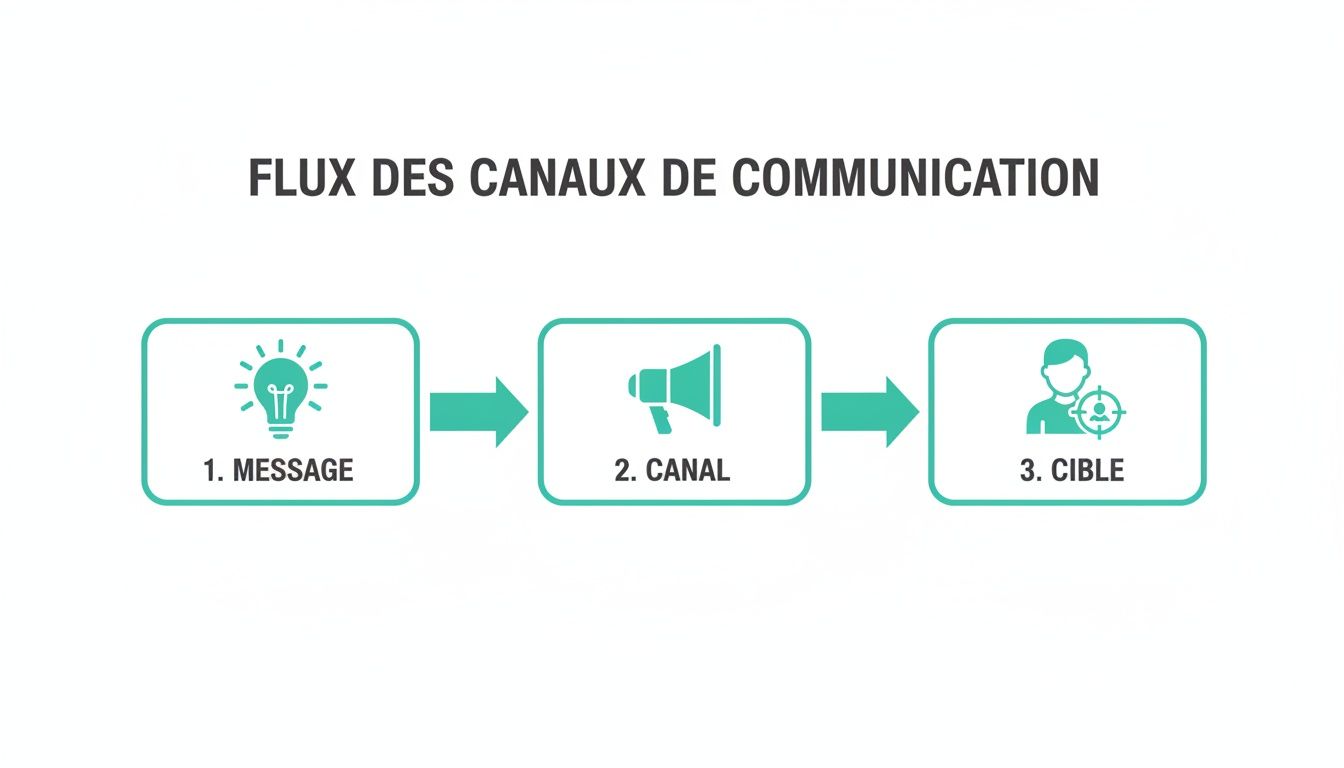
This basic logic reminds us that the message, channel, and target are inseparable. Without this coherence, even the best idea will fall flat.
The Unifying Power of Play
To create a true collective momentum, nothing beats a campaign that stands out. And in this area, play is an unparalleled engagement tool. It allows for healthy competition, provokes spontaneous interactions, and effectively strengthens the sense of belonging.
The observation is indeed clear: 57% of corporate projects in France fail due to a lack of internal communication. In a country where only 7% of employees claim to be truly engaged, gamification changes the game. Organizing a sports prediction contest (during the Olympics or a World Cup) with a points system, rankings, and integrated messaging creates fun and essential interactions. To delve into these figures, a comprehensive analysis on the link between internal communication and project success is available here.
Organizing a sports prediction contest is not just a distraction. It’s a strategic action that uses a universal passion to connect people who otherwise might never interact.
Launching a Prediction Contest Step by Step
Imagine a major sporting event approaching. It’s the perfect opportunity to launch an initiative that will get everyone talking across the company, including in foreign subsidiaries. To avoid getting bogged down in logistics, a turnkey platform like ccup.io simplifies everything.
Here’s how to orchestrate your initiative for guaranteed success:
- The launch communication: This is the kickoff. Announce the contest via an email campaign that excites and posts on your usual channels. Emphasize the fun aspect, the prizes to be won, and above all, the opportunity to compete with colleagues in good spirits.
- The animation during the event: The platform becomes the beating heart of the animation. Quizzes on the events, badges to unlock for correct answers, and real-time updated rankings keep the excitement alive. This is also where managers engage their teams, comment on scores, and encourage their troops via integrated messaging.
- The celebration of winners: This is the final touch that anchors the experience in memories. Organize a ceremony, even virtually, to congratulate the overall ranking winners, as well as those by team or subsidiary. It’s the moment to share anecdotes and thank everyone for participating.
A single well-executed initiative like this can have a lasting impact. It breaks the routine, generates dozens of informal conversations, and transforms the work atmosphere. It’s a perfect demonstration of how to improve internal communication by creating a positive shared experience, a cornerstone of a strong company culture.
Here’s a rewrite of the section in a more human and natural style, in line with the provided examples.
Measuring Results and Adjusting Your Strategy
Launching actions is good. Knowing if they work is better. To truly elevate internal communication, the final step is perhaps the most crucial: measuring the impact of your efforts and adjusting course as needed. A good strategy is never set in stone; it breathes, learns, and grows with your company.
The classic mistake? Considering a campaign finished once the last message is sent. In reality, that’s when the real analysis work begins. Every initiative, whether a prediction contest or a new newsletter, is a goldmine of insights. It’s essential to gather immediate feedback to understand how your actions are perceived on the ground.
Seeking Qualitative Feedback
Numbers are one thing, but they don’t tell the whole story. To truly understand your teams’ feelings, you need to talk to them. There’s no need to deploy lengthy satisfaction surveys every time.
- Flash surveys: Just after an event, send out a quick questionnaire with two or three questions. “Did you enjoy this moment?”, “What did you like most?”, “Any ideas for next time?”. It’s quick, simple, and incredibly rich.
- Informal discussions: Grab a coffee with a few participants from different departments. These spontaneous exchanges capture nuances and ideas that will never appear in a form.
This simple approach shows that you are listening and that employee opinions truly matter. Just that is a powerful lever for engagement. To explore the topic further, take a look at our comprehensive guide on measuring employee engagement with the right methods.
Analyzing KPIs and Iterating
In parallel, revisit the indicators you set at the beginning. Did the participation rate meet your goal? Did the number of messages in the chat spike? The gap between your forecasts and reality is your best compass for the future.
Continuous improvement is not a vague concept; it’s a discipline. It means accepting that not everything will be perfect the first time, daring to test things, and above all, communicating transparently about adjustments.
If an initiative didn’t yield the expected results, analyze why, without looking for a scapegoat. Then, openly explain what you will change. This transparency is key to building trust. This is how internal communication shifts from a mere support function to a true strategic partner, shaping a company culture where collaboration is smooth and effective.
The Questions You Have About Improving Your Internal Communication
Do you still have uncertainties about the best way to revitalize your exchanges? That’s perfectly normal. Here are clear and direct answers to the most frequently asked questions to help you clarify and, above all, take action.
What should I start with, concretely?
The first reflex, and by far the most effective, is to stop assuming and start listening. Before even thinking about a new tool or a grand action plan, launch a survey. Short, simple, and anonymous.
Ask your employees what they think of the current communication, which channels they actually consult, and what topics interest them but they never see. This is a simple yet incredibly powerful approach. Not only do you show that their opinion matters, but you also come away with a wealth of information to prioritize next steps.
How to get managers on board?
Let’s be clear: managers are your growth relays on the ground. Without them, even the best communication strategy will fall flat. To make them your best allies, you need to simplify their lives as much as possible.
Prepare them “communication kits” that are ready to use for important announcements:
- The 3 key points to remember and cascade.
- A small FAQ to anticipate 80% of their teams’ questions.
- Some ideas for open-ended questions to kick off discussions during their weekly meetings.
Show them how good communication streamlines their own work by enhancing cohesion and clarity of objectives. And of course, don’t forget to publicly recognize the managers who play the game and become true ambassadors.
Can a simple prediction contest really change the game in the long run? The answer is yes, as long as you see it as a catalyst. The event itself breaks the ice and injects a dose of positive energy. It’s the spark. The impact becomes lasting when you ride this momentum to launch other initiatives, strengthen the bonds that have been created, and establish a new habit.
This is an excellent first spark to ignite. It’s up to you to keep the flame alive.
Ready to transform a major sporting event into a powerful engagement lever? Discover how ccup.io helps you create unifying experiences that truly leave a mark. Request your personalized demo on ccup.io and see for yourself the power of play to connect your teams.
From Content To Conversion
Turn your next sports event into a company prediction contest
Discover the platform, explore available competitions, and launch a branded experience that supports engagement, internal communication, and team cohesion.
See available competitions
Related articles

2 weeks ago
Olympic Games 2026 Animations: Team Building Ideas
The Olympics: a gold medal for your company culture. Many HR and internal communication teams, however, start with a bad reflex. They reduce Olympic Games activities to an office olympiad, an improvised quiz, or an evening in front of a final. This creates a highlight, but rarely a true engagement m...

3 weeks ago
Formula 1 Predictions: 8 Methods to Energize Your Teams
On Monday morning, just after an exciting Grand Prix, the same scenes play out in companies. A message on Teams about a failed strategy, a hallway debate about tire management, a manager reigniting the conversation before a meeting. The value of an F1 prediction system begins here. In a sports news...

3 weeks ago
Sports Event Animation: 7 Ideas for Team Cohesion
Transform major sporting events into team victories. The Olympics, the World Cup, the Tour de France, or Roland-Garros create a well-known reflex in the workplace. Conversations become lively, exchanges become more spontaneous, and even teams that rarely communicate suddenly find a common topic. The...




















Contact us
For any question or quotation requests, do not hesitate to reach us by phone at 01 83 79 24 54 or by email : contact@ccup.io
Contact us


Frequently asked questions
What is ccup.io?
Ccup.io is a cohesion tool, allowing firms to gather their collaborators on the occasion of major sporting events, such as World Cup or Olympic Games. We offer an interactive forecasting platform, turnkey and customisable to your company’s colours.
What are you doing with our data?
By deciding to use our services, you decide to entrust us a part of your data – this will allow us to optimise your experience. We place great emphasis on the protection of your data, in compliance with current regulations. Given that it is important to be informed on the issues and challenges of personal data protection, ccup.io provides you with a most complete documentation on this matter.
How much does it cost?
In order to give our clients flexibility, we make a special rate depending on the number of registered players using a degressive system for an important number of participants. This allows firms to organise tailored events, adapted to their capacity. To receive a commercial offer in less than an hour, you only need to fill out the quotation requests form, with just a few clicks.



Don’t miss this opportunity 😍
Start now and enjoy numerous benefits