



Integration of New Employees: Strategies for Successful Onboarding
Integration of new employees, often referred to as onboarding, is much more than a mere formality. It is the strategic process that welcomes a recruit and familiarizes them with their role, their team, and above all, the company culture. When done well, it transforms a hiring promise into a true, lasting commitment, ensuring a quick and smooth transition into the role.
Why It Is Urgent to Rethink Integration
Let’s be clear: a bad start can cost a fortune. In today’s job market, where talent has never been more mobile, the first impression is crucial. A structured welcome is no longer just an administrative “plus”; it has become a true strategic lever.
Imagine the scene. A new talent arrives, full of energy and expectations, only to find that their computer isn’t ready, no one is waiting for them for lunch, and their schedule for the week is completely empty. This kind of situation, unfortunately still too common, sends a disastrous message: “We weren’t really expecting you.” Demotivation starts to creep in, and the idea of looking elsewhere resurfaces faster than one might think.
The Cost of Premature Departure
Beyond the human aspect, a failed onboarding has a very real financial impact. The cost of recruitment is not limited to agency fees or time spent in interviews. You must also factor in the loss of productivity while the position is vacant and all the training time invested. A departure after just a few months means that all this investment goes up in smoke.
A failed onboarding is one of the main reasons that drives a new recruit to leave. It’s not just about welcoming them, but proving to them that they made the right choice in joining you.
The phenomenon of the “Great Resignation” in France has shed light on this reality. Every quarter, there are about 520,000 resignations, the majority of which are permanent contracts. Notably, nearly 45% of these departures occur during the very first months, often due to a disappointing welcome experience. These figures highlight how critical the initial phase is for retention.
Building the Foundations of Engagement
A successful onboarding goes far beyond simply handing over a badge and a password. It’s the moment when the first connections are made, when the company culture is experienced, and when the sense of belonging begins to take root. This is truly where the foundations of a long-term collaboration are laid.
A well-structured journey allows each new recruit to feel:
- Expected and valued: with a ready workspace and a clear schedule.
- Connected: through organized meetings with the team and a mentor to guide them.
- Confident: by quickly understanding what is expected of them and the tools available to them.
By investing in the integration of your new employees, you are not only reducing turnover. You are accelerating their skill development, strengthening team cohesion, and sending a strong message about the importance you place on your employees.
Building an Engaging Integration Journey
A successful integration journey is not improvised. It is a process that is built brick by brick, well before your new recruit even steps through the door. The idea is to transform the enthusiasm of signing into a solid and lasting commitment. To achieve this, onboarding should be viewed as a multi-step journey, each with its own objectives.
The goal? To create a smooth and coherent experience, where the new employee feels expected, guided, and quickly connected to their team and the company culture. Poor coordination, and this key period can quickly become a source of stress, disappointment... and premature departure.
This diagram perfectly illustrates the short and costly cycle of a failed onboarding: from contract signing to resignation a few months later.
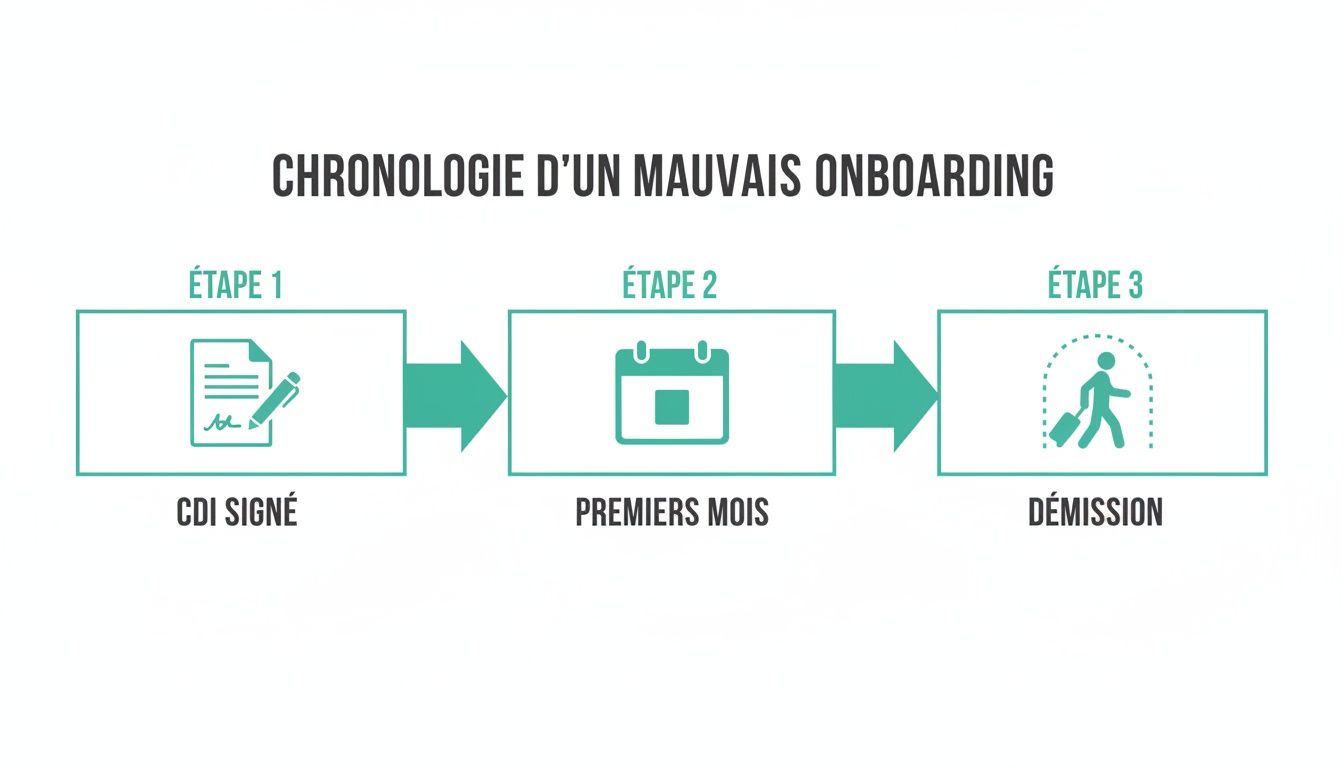
The message is clear: not investing in the first weeks risks nullifying all recruitment efforts.
Pre-boarding: The Crucial Step Between Signing and Day One
Integration starts the moment the contract is signed. We often tend to neglect this period, yet it is fundamental. A radio silence between the hiring promise and the first day can generate a significant amount of anxiety and doubt in your future talent.
The goal of pre-boarding is therefore quite simple: to create a connection and prepare the ground for a smooth arrival.
- A little note from HR: One week before, send a warm welcome email. Share the schedule for the first day, practical information (hours, dress code if there is one, access), and why not a team photo directory.
- The manager's intervention: A short personal message from the direct manager is the little detail that changes everything. A simple “The whole team is looking forward to welcoming you on Monday!” is incredibly effective for reassuring and motivating.
- Logistics is key: Behind the scenes, ensure that IT has prepared the equipment (PC, phone, etc.) and that all accesses are created. There’s nothing worse than spending your first morning waiting for your work tools.
This phase shows that your company is organized, professional, and already values its new employee.
The First Day: Aim for a Memorable Experience
The first day should be a human experience, not an avalanche of paperwork. It’s the moment to make a lasting impression. The goal is not immediate productivity, but the quality of the welcome.
A well-structured schedule is essential to avoid dead time and the feeling of being a ghost in the hallways.
Your checklist for a top-notch Day One:
- A personalized welcome: The manager or a team member should be there to greet the person. No leaving them alone at reception.
- A tour of the premises: A little tour to present the key areas (the coffee machine first, of course!).
- Introductions: A quick meeting with the team so everyone can put a face to a name.
- Team lunch: It’s a classic, but a classic that works. Ideal for breaking the ice and strengthening team cohesion in an informal setting.
- The manager's briefing: Set aside a good hour to discuss the role, set expectations for the first weeks, and answer any questions.
The first day sets the tone for the entire collaboration. Focus on the human connection. The rest will follow.
And of course, don’t forget the famous “welcome pack.” A notebook, a pen, a water bottle in the company colors… These little touches are always appreciated and immediately instill a sense of belonging.
The First Week: A Gentle Immersion
The first week is all about immersion. The goal is to allow the new recruit to find their footing, understand their environment, and meet the right people, while starting to tackle simple tasks.
The key is to provide a clear framework without overwhelming the person with a torrent of information.
- A meeting schedule: Organize 30-minute meetings with key contacts from other teams. This is essential to understand who does what.
- Training on tools: Plan short, targeted sessions on essential software.
- A “buddy” for everyday questions: Designate a mentor. This colleague will be the informal reference for all those little questions that one might not always dare to ask their manager.
A good balance between training, meetings, and initial small independent projects is crucial. A daily 15-minute check-in with the manager at the end of the day is also an excellent practice for debriefing and ensuring everything is going smoothly.
The First Months: Towards Autonomy and Fulfillment
Onboarding is far from over after a week. The first three months are critical for the employee to become fully autonomous and truly feel at home. It is a period of continuous learning.
Here, regular follow-up from the manager is absolutely fundamental.
- Weekly check-ins: Maintain a formal check-in every week to track progress, discuss obstacles, and set goals for the upcoming week.
- Clear objectives for 30/60/90 days: Define SMART objectives (Specific, Measurable, Achievable, Realistic, Time-bound). This provides direction and allows for celebrating early victories.
- Feedback, again and again: Don’t wait until the end of the probation period. Constructive and regular feedback allows for real-time adjustments and shows that you are invested in their success.
Also consider a surprise report at the end of the first month. Asking your new recruit for their fresh perspective on your processes is not only a sign of trust but also a goldmine for improvement.
Digitizing for a More Human Experience

Digitizing to make an experience more human... the idea may seem paradoxical. And yet. At a time when teams are increasingly dispersed and remote work is well established, digital tools have become true allies for successfully integrating new employees.
Far from dehumanizing the welcome, a well-thought-out digital approach creates connections instead. It allows for the automation of soulless tasks to focus on what really matters: human interactions. The goal is not to swap the welcome coffee for a video call, but rather to multiply points of contact and make information accessible in a fun and engaging way.
Tools to Streamline and Automate Welcome
Even before thinking about gamification, technology is a great way to eliminate purely administrative barriers. A successful onboarding journey is first and foremost a smooth journey, and this is where digital excels.
Digitalization involves adopting an Electronic Document Management (EDM) solution to centralize contract signing, collection of administrative documents, and dissemination of key documents such as the internal regulations. No more endless back-and-forth.
Here are some concrete examples of technology at your service:
- Dedicated onboarding platforms: They centralize everything from checklists for the manager to training modules for the new recruit.
- Internal communication tools: A Slack or Teams channel for new arrivals gives them a safe space to ask all their questions and quickly find the right people.
- Shared calendars: Planning meetings and training for the first week can be done in just a few clicks. No more ambiguity, everyone is on the same page.
By automating these steps, you free up valuable time for HR teams and managers, who can finally focus on personal and quality support.
Gamification, the Secret to Creating Connection and Transmitting Culture
You can throw away the 50-page welcome booklet that no one reads. To convey the company culture and the values that drive you, nothing beats interaction and play. Gamification transforms what could be a chore into a memorable experience.
When used well, digital is a powerful accelerator of connections. It does not replace the human element; it provides new playgrounds for connection.
Imagine this: a platform where the new arrival unlocks information about the company’s history by answering quizzes. Or little challenges that encourage them to contact colleagues from other departments to find answers. These mechanisms create natural interactions that might have taken months to occur otherwise.
A platform like ccup.io, for example, can be repurposed from its primary use to energize integration. Organizing an internal prediction contest around a sporting event becomes a golden opportunity for old and new employees to interact and get to know each other in a relaxed context. Other ideas, like a digital advent calendar in the company, can also serve as a social catalyst at key moments of the year.
A Financial and Generational Challenge
The impact of successful integration, whether digital or not, is directly measurable in retention. In France, 75% of recruiters believe that effective onboarding is key to reducing turnover. When you know that replacing an employee can cost up to 20% of their annual salary, it quickly becomes clear that neglecting this step is a very bad calculation.
This expectation is particularly strong among younger generations. Nearly a third of millennials and Gen Z say that a clear training program upon arrival is a major criterion for choosing an employer. A digital, interactive, and educational integration perfectly meets this demand. It sends a strong signal: the company is modern, it invests in its talents, and it understands their expectations.
Measuring What Really Matters in Your Onboarding
Implementing an integration journey for your new employees is one thing. But how can you be sure that your efforts are truly paying off? Without measurement, it is impossible to improve anything. Relying on intuition or waiting until the end of the probation period for initial feedback is a huge risk.
To effectively manage your process, you need to go beyond the classic three-month turnover rate. It is a useful indicator, of course, but it comes too late. It only confirms a failure without giving you the keys to anticipate it. The goal is to multiply points of contact to gauge the experience of your new recruits and be able to adjust course along the way.
The numbers speak for themselves and show that there is urgency. Currently, only 12% of French employees say they are truly satisfied with their onboarding. This disappointment has a cost: 28% of new talents leave their company within three months, often frustrated by a welcome that did not meet expectations. Conversely, a successful integration changes everything. When the experience is good, 78% of employees develop a positive view of their company. If you want to delve into these statistics, take a look at this analysis on the welcome and integration of employees.
Defining Key Quantitative Indicators
To gain an objective view, start by tracking some numerical data. Simple but very revealing, they will give you a first idea of the performance of your program.
- Onboarding completion rate: If you use a digital platform, what percentage of modules or tasks have been completed by your new arrivals on time? A stagnant rate may indicate content that is too heavy or unengaging.
- Time to reach full productivity: This is the time between a new employee’s first day and when they reach the expected performance level. This milestone should be defined in advance with their manager. If this time stretches, it may be a sign of gaps in training.
- Engagement rate on internal tools: Is your new recruit actively connecting on Slack, Teams, or your other business tools? Low adoption may be the first symptom of a feeling of isolation.
These metrics provide a solid foundation, but they do not tell the whole story. To understand the why behind the numbers, you need to add the human dimension.
Gathering Qualitative Feedback
Direct feedback from your employees is your goldmine. The challenge is to create moments of sincere exchange, where the new recruit and their manager can speak freely.
Ultimately, the best indicator of success is a new employee who, after a month, can say: “I know what is expected of me, I know the right people to contact, and I feel at home here.”
To achieve this, the key is to structure the feedback collection.
Regular surveys
Forget the endless questionnaire sent six months after arrival. Opt for short and frequent formats: a quick survey at the end of the first week, then at the end of the first and third months.
Here are some examples of simple and effective questions:
- On a scale of 1 to 10, how well were you welcomed?
- Do you feel you understand what is expected of you in this role?
- Does your manager provide you with regular and constructive feedback?
- What is THE thing that has helped you the most so far?
- What is THE thing you have missed or that we could improve?
Formal milestone meetings
In addition to informal daily exchanges, schedule dedicated interviews. A check-in at 30 days and another at 90 days are essential. These privileged moments allow for discussions about successes, challenges, and areas for improvement, both for the employee and the company. It’s also the perfect opportunity to discuss their surprise report and show them that their first impressions matter.
By combining numerical data and human feedback, you will gain a 360° view that will allow you to make your onboarding a true lever for retention and engagement.
Common Mistakes and How to Avoid Them
Even with the best intentions, an integration program can easily derail. Some missteps, often made due to a lack of time or perspective, can turn a promising arrival into a disappointing experience. By learning from the most common mistakes, you can refine your process. The idea is to ensure that every new arrival feels not only welcomed but also truly integrated.
The goal is not to aim for unattainable perfection. It’s simply about avoiding the pitfalls that undermine the trust and enthusiasm of the first days. A good integration of new employees ultimately relies on a series of well-executed details.

Error 1: Neglecting the Pre-boarding Phase
This is the most common mistake: radio silence between contract signing and the first day. This waiting period can be a source of intense stress for your future recruit, leaving them in doubt and uncertainty.
Not communicating during this phase sends a negative signal: “You’ve been signed, now wait.” It’s a missed golden opportunity to start building a relationship and keep the flame alive.
The pragmatic solution:
Establish a simple but effective communication flow. An email one week before arrival with the program for Day One, practical information, and a welcome note from the manager is enough to make a huge difference. It’s a small effort that shows the arrival is prepared for and expected.
Error 2: Overwhelming the Recruit on the First Day
The other extreme is wanting to do everything on the first day. An avalanche of PowerPoint presentations, administrative documents, and technical training can quickly become overwhelming. The human brain has its limits; no one can absorb so much information in such a short time.
The result? An exhausted, stressed recruit who will only retain a fraction of what you tried to convey. The intention is good, but the execution is counterproductive.
The first day should not be a marathon of information. Its purpose is to create a human connection and lay the foundations of trust. Productivity will come later.
The pragmatic solution:
Think balance. Alternate information sessions with more informal moments.
- Morning: Personalized welcome, tour of the premises, setup of equipment, and a one-hour meeting with the manager to define expectations.
- Lunch: Lunch with the team to break the ice.
- Afternoon: Meeting with the “buddy” (mentor), reading some key documents, and a first contact with a simple tool.
This sequenced and spaced approach is much more digestible and therefore more effective.
Error 3: Thinking Onboarding Ends After a Week
“That’s it, the first week is over, they are integrated.” This is a dangerous illusion. Integration is a process that spans several months. Feeling comfortable with the tools and tasks does not mean being fully integrated into the company culture or having built strong connections.
Confusing the initial welcome with complete integration is a mistake that can leave new employees feeling isolated once the “honeymoon” of the first week is over. Support must continue.
The pragmatic solution:
Structure follow-up beyond the first week with clear milestones.
- 30-60-90 day objectives: Define clear and progressive goals. This provides direction and allows for measuring progress.
- Formal weekly check-ins: Maintain a fixed meeting with the manager to discuss progress, challenges, and next steps.
- Regular feedback: Don’t wait for the end of the probation period. Constructive and regular feedback allows for quick adjustments and shows that you are invested in their success.
Error 4: Isolating the New Arrival
Finally, a frequent mistake, especially in large organizations or remote work, is limiting integration to the immediate team. An employee who only knows their few immediate colleagues will have a fragmented view of the company and its operations.
This isolation hinders inter-team collaboration and limits the new arrival’s ability to understand the company’s overall challenges. To thrive, they need to understand the ecosystem in which they operate.
The pragmatic solution:
Organize a “tour of the departments.” Schedule short meetings (30 minutes is sufficient) with key people in different departments. The goal is not to understand their job in detail but to know who does what and to put faces to names. It’s a minimal time investment for a huge return on investment in terms of fluidity and future collaboration.
Common Questions About Onboarding
Even with a perfectly crafted plan, certain questions keep coming up when it comes to refining the integration of new employees. We’ve gathered here the most frequent inquiries to provide you with clear answers and ready-to-use advice.
What is the ideal duration for good onboarding?
Get out of your head that everything happens in the first week. An onboarding that truly bears fruit does not boil down to a simple welcome party. It is a support process that should span three to six months. The stakes go far beyond just presenting the company.
A longer process ensures a smooth immersion. It allows the new recruit time to absorb not only their tasks but also the culture, codes, and little rituals of the company. This approach avoids drowning the new arrival in a mountain of information and builds the foundations for a solid and lasting collaboration.
A successful onboarding is not a sprint; it’s a well-paced marathon. It’s what transforms a mere recruit into a fully engaged and autonomous team member.
How to Successfully Integrate a Remote Employee?
For a remote colleague, everything relies on two pillars: anticipation and over-communication. It is essential to compensate for the absence of informal coffee machine discussions with intentional actions to build connections.
Logistics is key. Ensure that all IT equipment is delivered and perfectly functional before their first day. There’s nothing worse for starting a new adventure than struggling with a recalcitrant computer.
Then, prepare a packed agenda for their first week:
- Plan regular video conferences with their manager and key team members.
- Organize “virtual coffees” or informal online lunches to regain some spontaneity.
- Leverage collaborative tools to maintain constant contact and allow them to ask questions without hesitation.
The goal is to virtually recreate that sense of belonging and show the newcomer that they are an integral part of the team, even from miles away.
What is the Real Purpose of a “Buddy” in Onboarding?
The “buddy” is a valuable ally, and they should not be confused with the manager. Their role is that of an informal guide, a friendly ear. They are the colleague you dare to turn to for all those little everyday questions that you wouldn’t dare ask your manager.
They answer practical questions (“How do we use this tool again?”) and help decode the unwritten rules of the company culture. The buddy is a true social connector: they introduce the new recruit to others, invite them to coffee breaks, and help them find their place. This trusting relationship accelerates the sense of belonging and makes integration much more human.
Boost your team’s integration with a simple and unifying activity! With ccup.io, organize sports prediction contests to break the ice, strengthen bonds, and create memorable memories from day one. Discover how at https://ccup.io.
From Content To Conversion
Turn your next sports event into a company prediction contest
Discover the platform, explore available competitions, and launch a branded experience that supports engagement, internal communication, and team cohesion.
See available competitions
Latest articles

a day ago
8 Reward Ideas for Adult Birthday Games to Boost Engagement in 2026
Organizing games for a corporate or team birthday is an excellent initiative to strengthen cohesion. But the real driver of participation and enthusiasm lies in the reward. A well-chosen reward transforms a simple game into a memorable and rewarding experience, creating a tangible return on inves...

8 days ago
Create a Budget-Friendly Small Gift Bundle That Leaves an Impression
Before even starting to imagine the ideal gift, let's be clear: the budget is the key factor. To create a real "wow" effect without blowing the budget, the first step is to define a realistic envelope for your budget-friendly small gift bundle. This is the foundation of your enti...





















Contact us
For any question or quotation requests, do not hesitate to reach us by phone at 01 83 79 24 54 or by email : contact@ccup.io
Contact us


Frequently asked questions
What is ccup.io?
Ccup.io is a cohesion tool, allowing firms to gather their collaborators on the occasion of major sporting events, such as World Cup or Olympic Games. We offer an interactive forecasting platform, turnkey and customisable to your company’s colours.
What are you doing with our data?
By deciding to use our services, you decide to entrust us a part of your data – this will allow us to optimise your experience. We place great emphasis on the protection of your data, in compliance with current regulations. Given that it is important to be informed on the issues and challenges of personal data protection, ccup.io provides you with a most complete documentation on this matter.
How much does it cost?
In order to give our clients flexibility, we make a special rate depending on the number of registered players using a degressive system for an important number of participants. This allows firms to organise tailored events, adapted to their capacity. To receive a commercial offer in less than an hour, you only need to fill out the quotation requests form, with just a few clicks.



Don’t miss this opportunity 😍
Start now and enjoy numerous benefits