



The Guide to the Digital Advent Calendar for Businesses to Engage Your Teams
Much more than just a year-end activity, the digital advent calendar in the workplace is a true strategic tool. It’s an opportunity to transform a festive tradition into a lively, measurable, and, above all, memorable internal communication campaign to strengthen the cohesion and engagement of your teams.
Why the Digital Advent Calendar Captivates Businesses
It’s not just a gadget. The advent calendar has left the private sphere to become a powerful management lever. The tradition, which relies on daily anticipation and small rewards, meets a fundamental human need for recognition and connection. This is especially true at the end of the year, a time often synonymous with assessments. Its digital version only amplifies this potential.
This internal communication operation establishes a daily ritual shared by all, perfect for breaking the routine and encouraging informal exchanges. Each day, a new surprise — a quiz, a company anecdote, a small challenge — becomes a pretext for interaction and solidifying the company culture.
A Unifying Tool for All Teams
One of the biggest advantages of the digital advent calendar in the workplace is its ability to break down geographical barriers. Whether your employees are in the office, working remotely, or in a subsidiary on the other side of the world, they experience the same event. It’s a simple and effective way to unite teams and ensure that no one feels left out.

A centralized platform like this becomes a true virtual meeting point, a place to strengthen team spirit on a daily basis.
Moreover, this enthusiasm is based on a well-oiled psychological mechanism. The French market for advent calendars, across all categories, has grown from 10 million to over 35 million units sold per year. This daily opening ritual activates our reward circuits, a powerful mechanism that the company can intelligently leverage.
Much More Than Just an Activity
Launching a digital advent calendar is also a strong signal about your employer brand. You show that your company is connected to new forms of engagement and that it is concretely investing in the well-being of its employees.
The true success of an advent calendar in the workplace is not measured by the value of the gifts, but by the quality of the conversations it sparks. It transforms 24 days in December into 24 opportunities to strengthen human connections.
This type of initiative fully aligns with the digital revolution that pushes us to rethink how we communicate and create connections internally. In the end, we’re not just talking about an activity, but a true campaign that can be managed with key indicators:
- Daily participation rate: to measure interest day by day.
- Engagement by content type: to see what works best (quiz, video, challenge...).
- Social interactions: to evaluate the cohesion generated (comments, likes, shares).
By transforming a popular tradition into a shared digital experience, you’re not just counting down the days until Christmas. You’re building a positive collective memory that will remain etched in minds long after the holidays.
Before even thinking about the design of the first box or writing the first quiz, one thing must be understood: the success of your digital advent calendar in the workplace is determined well in advance. It’s all the preparation that will transform a simple year-end activity into a true strategic project, aligned with your company’s ambitions.
Consider this step as your roadmap. It ensures that every surprise, every interaction, serves a greater purpose and that the impact of your project will be real.
Setting Clear and Measurable Objectives
The first question, and the most important: why are you launching this calendar? The answer will guide all your decisions, from the tone used to the choice of rewards. Without a clear goal, your project risks being just a nice gadget, but without real impact.
Objectives can vary, but they must be specific. Are you looking to:
- Strengthen cohesion between teams that don’t interact much, especially in remote work?
- Celebrate the successes of the year and thank your employees for their involvement?
- Revitalize internal communication by creating a daily anticipated event?
- Introduce the company culture in a more fun and engaging way than a PowerPoint?
Imagine a company in the midst of a merger. Its calendar could serve to present each day, in a quirky way, the members of the new teams. Another company, wanting to affirm its CSR commitments, could propose small daily ecological challenges.
The idea is not just to entertain. It’s to tell a story. A successful calendar weaves a narrative around your company, and each day is a new chapter.
Defining a main objective and one or two secondary objectives will help you sift through your content ideas and game mechanics.
Who Are Your Participants? Think About Your Audience
Your calendar is not aimed at an anonymous crowd. It addresses individuals, each with different jobs, expectations, and habits. For the message to resonate, the tone and content must speak to everyone, from interns to executive committee members.
Take the time to segment your audience. Consider the different populations within your company:
- Field teams: They will likely appreciate quick games, accessible on mobile, and collective challenges.
- Managers: They are your best allies. Involve them so they become ambassadors for the project.
- Newcomers: For them, it’s a golden opportunity to integrate and discover the company in a fun way.
- International teams: The content must be easy to translate and culturally adapted.
Once you know who you’re talking to, the tone becomes obvious. Should you opt for humor, a more formal yet warm style, or something completely quirky? The answer lies in your company culture.
Establish a Solid Budget
A digital advent calendar is an investment. And like any project, it needs a well-structured budget to avoid unpleasant surprises. A clear estimate from the start ensures a quality experience from day one to the last.
Your budget should account for several expense categories.
| Expense Category | Description | Importance |
|---|---|---|
| Technical solution | Cost of the platform (subscription, license, or custom development). | High |
| Content creation | Time spent internally or budget for freelancers (graphic design, writing, video...). | Medium |
| Communication plan | Creation of materials to announce the calendar (teasing, emails, posters...). | Medium |
| Rewards and prizes | The budget for gifts that will motivate the troops to participate. | Variable |
Regarding rewards, don’t underestimate their power. It doesn’t necessarily mean spending a fortune. Experiences to share together or symbolic benefits often have much more impact. If you’re short on inspiration, our guide on rewarding employees is full of creative and relevant ideas.
By carefully establishing these three pillars – objectives, audience, budget – you build a solid foundation. Your project now has direction, a target, and the means to achieve its ambitions. You’re ready to move on to the most exciting step: imagining the experience itself.
Create a Captivating Daily Experience
The secret to a digital advent calendar in the workplace that leaves a mark is not in the value of the prizes, but in its ability to become a true daily rendezvous. The idea is to transform a simple activity into a ritual that is eagerly awaited, a little moment of surprise that breaks the routine and sparks conversations.
To achieve this, variety is your best ally. No one wants to get bored. Offering 24 days of quizzes, for example, would quickly become repetitive. The art lies in scripting the month of December like a mini-series, with its own rhythm, highlights, and little surprises. By intelligently alternating formats, you will keep engagement at its highest.
Scripting Your 24 Days of Activities
To build a memorable experience, think in terms of a "content mix." Each day should bring something new, playing on several fronts: fun, informative, collaborative, and inspirational.
To get started, everything hinges on three fundamental pillars.
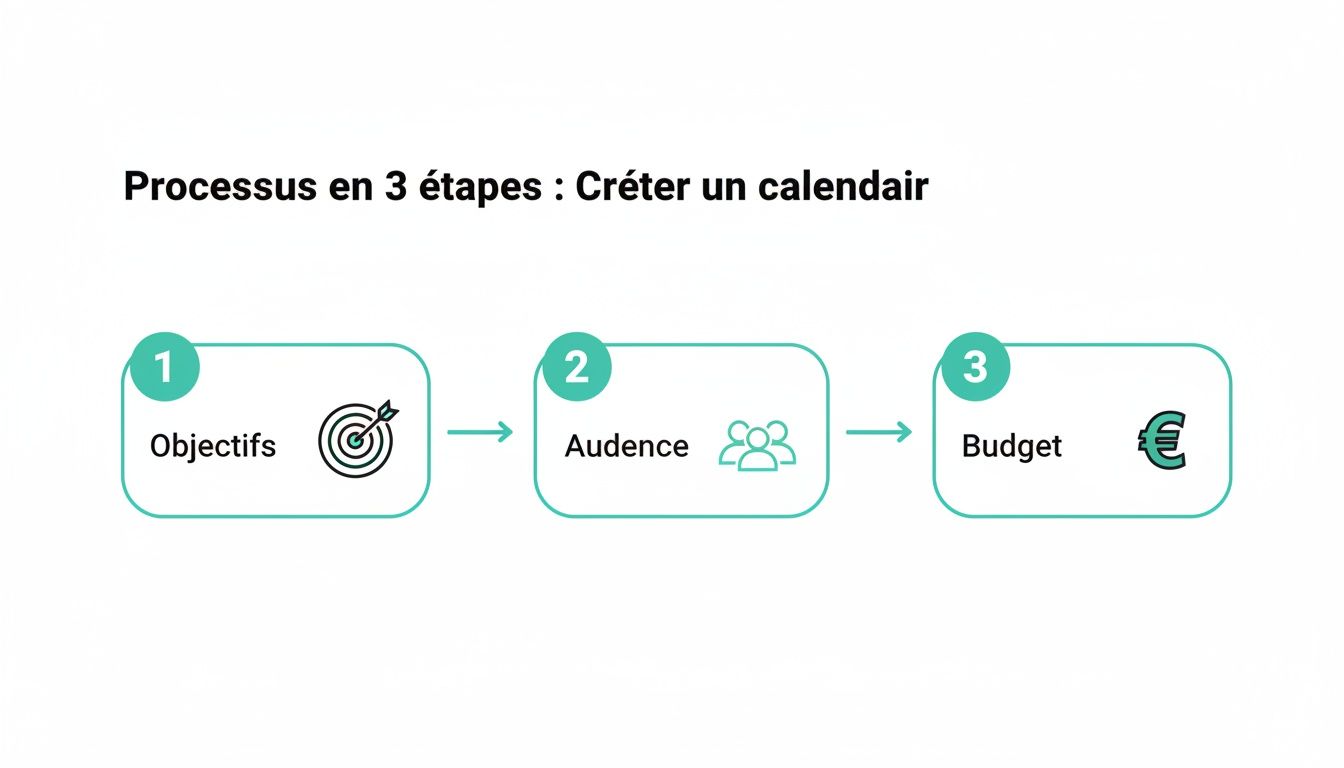
These three elements — objectives, audience, and budget — are the foundations on which you will build your entire scenario. They ensure that each activity is not only fun but also relevant and aligned with a specific goal.
The goal is to create a balanced programming. Here are some concrete content ideas to alternate to keep everyone engaged:
- Quizzes and polls: Perfect for testing knowledge about the company’s history, values, or successes of the year. A light poll ("Prefer pain au chocolat or chocolatine at the office?") can also lighten the mood.
- Creative challenges: Launch a photo contest for the "ugliest Christmas sweater" or ask teams to share a funny anecdote about a project. It’s an excellent way to generate authentic content and value contributions.
- Exclusive content: Offer a video of the management’s holiday wishes, unveil a project for 2025 in advance, or share a collaborative playlist for the holidays.
- Mini-games: Instant wins, a digital wheel of fortune, or simple puzzles are very effective for creating immediate excitement and rewarding participation.
By varying the pleasures, you’re sure to touch different sensitivities and maintain a constant element of surprise.
To help you visualize how this could take shape, here’s a table with some concrete examples of what you could propose each day.
Examples of Daily Content for Your Digital Advent Calendar
| Day | Type of Content | Main Objective | Concrete Example |
|---|---|---|---|
| Day 1 | Launch video | Create the event | Short and dynamic video from the CEO launching the calendar and wishing a good December. |
| Day 5 | Interactive quiz | Reinforce culture | "Do you really know the history of the company?" with 5 questions about key dates. |
| Day 10 | Photo challenge | Encourage interaction | "Share a photo of your most festive office decoration." |
| Day 15 | Fun poll | Create connection | "What is the best Christmas movie of all time?" with a live ranking. |
| Day 20 | Exclusive content | Value teams | Interview with a project team that made an impact this year. |
| Day 24 | Instant win | Celebrate and reward | A digital wheel of fortune with a big prize to finish on a high note. |
These are just suggestions, of course. The most important thing is to vary the types of interactions so that each day brings its own little spark.
Subtly Integrate Your Key Messages
An advent calendar is also a great opportunity for internal communication. The trick is to distill your strategic messages into it, but always in a subtle and engaging way. Let’s be honest, no one wants a lecture on the new CSR strategy on December 15.
For example, instead of a long text, turn your telework policy into a mini-quiz "True or False." To highlight the successes of the year, feature one team each day with a photo and a funny anecdote.
The best content is that which doesn’t feel like corporate communication. It should be perceived as a gift in itself, whether it’s a burst of laughter, useful information, or a moment of sharing.
This approach allows you to strengthen the company culture organically, without ever appearing to impose a discourse. It’s by creating emotion that messages truly take root.
Use Gamification to Stimulate Participation
Gamification is the engine that will keep your calendar running over time. It transforms passive participation into friendly and motivating competition. The idea is simple: introduce game mechanics to encourage employees to return each day.
The gamification elements that work best are often the simplest:
- Points: Each action (opening a box, answering a quiz, participating in a challenge) earns a certain number of points.
- Badges: Reward specific behaviors with fun virtual badges ("Company History Expert", "Ugly Sweater Champion", "Regular Participant").
- Leaderboard: Display an overall ranking (or by team) updated in real-time. This transparency stimulates the spirit of competition and encourages everyone not to miss a day.
These mechanisms create a virtuous engagement loop. The more you participate, the more points you earn, the higher you climb in the ranking, and the more you want to return the next day.
This is also an excellent way to recognize the most engaged. You can award final prizes to participants who have accumulated the most points, ensuring fair recognition of their involvement. And for the prizes, think outside the box! For inspiration, check out this guide on gifts for a winning team, where you’ll find much more original ideas than the traditional mug.
By combining careful scripting, intelligent integration of your messages, and a good dose of gamification, your digital advent calendar will become much more than an activity: it will be the year-end event that everyone looks forward to.
Now that your concept is solidified and your content is ready to be unwrapped, it’s time to move on to the technical side. Choosing the tool that will bring your digital advent calendar for businesses to life is a crucial step. It’s not just about technique: it will determine the success of the project and, believe me, the peace of mind of your teams throughout the period.
You have several possible paths: develop an in-house solution, cobble something together with form or web page tools, or opt for a specialized, turnkey platform. Each option has its merits, but let’s be clear, they are not all equal in terms of reliability, security, and customization.
Criteria You Should Never Neglect for the Ideal Platform
The idea of developing a custom solution is often appealing. One imagines total customization. But in reality, it quickly turns into a complex, costly, and difficult-to-maintain project, especially with the pressure of the year-end holidays. As for “homemade” solutions using repurposed tools, they often lack that professional touch and the features that truly create engagement.
That’s why a dedicated platform is often the best bet. Here are the points on which you should make no compromises before signing:
- A graphic customization in your company’s colors: The tool should allow you to easily integrate your logo, colors, and typography. Your calendar should reflect your company culture, not look like a generic solution pulled from a box.
- An impeccable mobile experience: A good portion of your employees will open the boxes from their smartphones, between meetings or while commuting. The experience must be smooth, fast, and perfectly optimized for small screens. Nothing should be sacrificed.
- A responsive technical support: Imagine: a bug on December 1 at 9:00 AM. The stress. A responsive and effective customer support is your peace of mind to ensure a seamless experience for everyone.
Moreover, if you’re looking for a solution that’s easy to implement, it may be worth understanding what No Code is. Many platforms rely on this technology to offer great flexibility without needing a single line of code.
Data Security: Non-Negotiable
We touch on a sensitive point here: the management of your employees’ data. Using a solution that is not clearly compliant with the General Data Protection Regulation (GDPR) is taking a legal risk and, worse, tarnishing the trust of your teams.
A digital advent calendar inevitably collects personal data, even if it seems basic (name, email, department). GDPR compliance is not just a box to check; it’s a legal obligation and a sign of respect towards your employees.
A serious platform will guarantee data hosting in Europe, clear consent collection, and the ability for users to easily exercise their rights (access, deletion, etc.). This is a point on which no concessions should be made.
Think Globally for Borderless Teams
If your company operates in multiple countries, the question of language becomes central. Offering a calendar only in French would exclude part of your workforce and would go completely against your goal of cohesion.
A good platform should allow you to manage translations with ease. The goal? That every participant, wherever they are, experiences exactly the same event. Dedicated platforms like ccup.io, for example, are designed from the start for large groups and allow for multilingual calendars to be deployed in a flash. Such services often go further by providing communication materials (posters, newsletters) to maximize buy-in and reinforce the image of an inclusive employer.
Ultimately, the tool you choose is much more than just a technical shell. It’s the engine of your engagement campaign. By opting for a robust, secure, customizable, and easy-to-use solution, you give yourself the means to focus on what matters: animating your community and creating memories for your teams. It’s an investment that ensures the success of the operation.
Launch and Animate Your Campaign for Maximum Impact
Your digital advent calendar for businesses is ready. The content is top-notch, and the technical platform is solid. And yet, the biggest challenge lies ahead: ensuring your employees participate and, above all, enjoy it.
A well-executed launch and continuous animation are key to transforming your initiative into a true internal event. This is what makes the difference between a successful project and a quickly forgotten gadget. All your preparation deserves communication that matches its quality.

Orchestrate a Striking Teasing Campaign
The success of your calendar begins well before December 1. A week to ten days prior, it’s essential to pique your teams’ curiosity. The goal is not just to inform but to create real anticipation.
For this, rely on a multichannel teasing campaign. Use the communication tools your colleagues already consult every day.
- On Slack or Teams: A dedicated channel or a short message in general channels works wonders. A simple "7 days until a year-end surprise..." with a mysterious GIF is often enough to spark conversations.
- Via the intranet: Publish a small news item or a prominently visible banner. Highlight the fun aspect and the prizes to be won, without revealing everything.
- By email: Send an email to everyone a few days before to explain the concept, the dates, and how to participate. Keep the tone light and engaging.
The classic mistake is to reveal everything at once. Teasing is the art of mystery. Distill the information gradually. People should wonder what awaits them. It’s this curiosity that will ensure a spike in connections on the first day.
Combine enigmatic visuals, short videos, and intriguing messages for maximum effect.
Engage the Community During the Event
The launch is successful, congratulations! But it’s a marathon, not a sprint. To maintain engagement over 24 days, near-daily animation is essential. You become the conductor of this little community.
The key is to create a rendezvous. Reminders are important, but they must be varied to avoid boredom.
- Daily reminders: Each morning, a little message to announce the opening of the day’s box. Vary the pleasures: "Who will discover today’s surprise first?", "Today’s challenge will get your brain working!".
- Highlight contributions: If you’re organizing photo challenges or contests, showcase the best entries. Share the funniest creations or the most enjoyable anecdotes. Recognition is a powerful motivator.
- Targeted interactions: Don’t just post. Respond to comments, spark conversations around the day’s content. The idea is to keep the space lively.
Mobilize Managers as Ambassadors
Your most valuable allies on the ground? The managers. Their buy-in and participation can significantly boost their teams’ engagement rates. Take the time to present the project to them in advance and explain their role.
Simply invite them to:
- Lead by example: If they play along and share their own contributions, their teams will naturally follow suit.
- Relay the information: A simple reminder during the morning team meeting can make all the difference.
- Encourage healthy competition: They can create a little emulation within their department by tracking the overall ranking.
Their involvement transforms a "corporate" initiative into a team activity. The perception changes completely.
Carefully Close the Campaign
December 24 comes quickly. Your mission is not quite over. A well-managed closure allows you to finish on a highly positive note and capitalize on all the energy created.
Announce the grand winners in a festive manner. A recap video of the best moments, an article on the intranet with the final podium, or even a small virtual event for the award ceremony. It’s time to celebrate.
And above all, warmly thank all participants, not just the top 3. Highlight the spirit of sharing and the good mood that the event generated. It’s this final touch that will leave an excellent memory and encourage participation in your future initiatives.
Analyze Results to Prepare for Future Actions
The 24 days have passed, the gifts have been distributed, and the enthusiasm is still palpable. But the work behind your digital advent calendar in the workplace is not quite finished. Now begins an equally crucial phase: analysis. Measuring the real impact of your campaign is the only way to prove its value, justify the investment, and, above all, do even better next year.
This step is not just a quick glance at the numbers. It’s about transforming raw data into actionable insights to build a true long-term engagement strategy.
Dive into Quantitative Data
Most dedicated platforms, like ccup.io, will provide you with an analytical dashboard. This is your goldmine. Rather than drowning in an avalanche of metrics, focus on a few key performance indicators (KPIs) that tell a clear story about your teams’ engagement.
Here are the essential data points to examine:
- Overall participation rate: The percentage of employees registered who opened at least one box. This is the first thermometer of your campaign’s appeal.
- Daily engagement: The number of unique participants each day. This curve will show you peak days and any potential lulls, helping you understand what really worked (or didn’t).
- Most popular content: Which formats generated the most interactions? Quizzes, photo challenges, instant wins? This information is crucial for guiding your future internal activities.
- Completion rate: How many participants made it through all 24 days? A high rate is a sign of a truly captivating experience.
Analyzing these figures gives you tangible facts. For example, if you notice a spike in participation on the day of the "CODIR Anecdotes Quiz," you know that content that humanizes management is a powerful lever.
Go Beyond Numbers with Qualitative Insights
Quantitative data tells you "what," but qualitative feedback explains "why." To understand what really pleased and what could be improved, nothing beats direct feedback from your participants.
The best insights are not always found in graphs, but in your employees’ words. A simple "I loved discovering my colleagues in a new light" says more than an 80% click rate.
The simplest method is to send a short satisfaction survey right after the calendar ends.
Here are some questions to ask:
- On a scale of 1 to 10, how would you rate your overall experience?
- Which type of activity did you enjoy the most (quizzes, challenges, etc.)?
- What did you like the least?
- Do you have a suggestion for the next edition?
- A word to describe this experience?
The answers to these open-ended questions are a valuable source of information. They will give you concrete ideas, testimonials to share, and a clear vision of your teams’ expectations for future operations.
Build a Convincing Impact Report
Once you’ve collected and analyzed all your data, it’s time to synthesize it into a clear and impactful report. This document is not just for you; it’s intended for your management, managers, and all stakeholders. Its purpose is simple: to demonstrate the return on investment (ROI) of the operation, whether measured in engagement, cohesion, or team morale.
An effective report should include:
- An executive summary: Key figures and major insights in a few sentences.
- A reminder of the initial objectives: Show how the campaign met the goals set at the outset.
- The main KPIs: Present the most telling data in simple graphs. Highlight successes, such as a participation rate of over 75%.
- Qualitative testimonials: Include some striking testimonials to illustrate the human impact of the project.
- Lessons learned and recommendations: Offer concrete suggestions for the future, transforming this analysis into an action plan.
This report is your best argument for sustaining the initiative and securing the budget for the next edition. It proves that this was not an expense, but a strategic investment in your human capital.
Ready to transform your next company activity into a memorable and measurable event? At ccup.io, we provide you with the turnkey platform and expertise to create engaging experiences that strengthen your teams’ cohesion.
From Content To Conversion
Turn your next sports event into a company prediction contest
Discover the platform, explore available competitions, and launch a branded experience that supports engagement, internal communication, and team cohesion.
See available competitions
Related articles

3 weeks ago
Sports Event Animation: 7 Ideas for Team Cohesion
Transform major sporting events into team victories. The Olympics, the World Cup, the Tour de France, or Roland-Garros create a well-known reflex in the workplace. Conversations become lively, exchanges become more spontaneous, and even teams that rarely communicate suddenly find a common topic. The...

last month
Champions Cup Prediction: The Complete Guide for Businesses
The Champions Cup often arrives at the same time as a very concrete need on the HR and internal communication side. It is necessary to reignite collective energy, recreate exchanges between teams that rarely communicate, and propose an activity that resembles neither a disguised meeting nor yet anot...

last month
How to Lead a Remote Team: The Complete Guide
40% of remote workers in France feel lonely , according to a survey by Anact reported here . This is the number that changes everything. It reminds us that how to lead a remote team is not primarily a question of tools, nor even of scheduling. It’s a question of connection. Many companies still trea...




















Contact us
For any question or quotation requests, do not hesitate to reach us by phone at 01 83 79 24 54 or by email : contact@ccup.io
Contact us


Frequently asked questions
What is ccup.io?
Ccup.io is a cohesion tool, allowing firms to gather their collaborators on the occasion of major sporting events, such as World Cup or Olympic Games. We offer an interactive forecasting platform, turnkey and customisable to your company’s colours.
What are you doing with our data?
By deciding to use our services, you decide to entrust us a part of your data – this will allow us to optimise your experience. We place great emphasis on the protection of your data, in compliance with current regulations. Given that it is important to be informed on the issues and challenges of personal data protection, ccup.io provides you with a most complete documentation on this matter.
How much does it cost?
In order to give our clients flexibility, we make a special rate depending on the number of registered players using a degressive system for an important number of participants. This allows firms to organise tailored events, adapted to their capacity. To receive a commercial offer in less than an hour, you only need to fill out the quotation requests form, with just a few clicks.



Don’t miss this opportunity 😍
Start now and enjoy numerous benefits