



The Guide to a Successful Company Roland Garros Prediction
Organizing a Roland Garros prediction at the office is much more than just a distraction. It’s a golden opportunity to energize company life, especially when teams are scattered working from home. Far from being just a game, it’s a real lever to strengthen bonds, create moments of sharing, and inject a good dose of enthusiasm into daily life.
Your Teams' Engagement Goes to the Next Level
Imagine for a moment: the electric atmosphere of Roland Garros invades your internal communication channels. A seemingly innocuous prediction game becomes the perfect excuse for spontaneous interactions, lively discussions, and shared memories. The challenge is not so much to guess who will lift the trophy, but to weave strong ties between colleagues.
This initiative transforms a major sporting event into a collective experience that leaves a mark. It’s the perfect opportunity to break the routine, especially for remote employees who may sometimes feel a bit left out.
Much More Than Just Entertainment
A well-crafted prediction contest is not just a pastime. It’s a full-fledged HR tool, with clear strategic objectives.
- Strengthen team cohesion: The game fosters friendly competition between departments. These light-hearted challenges are an excellent way to strengthen bonds among colleagues.
- Improve internal communication: It’s a ready-made conversation topic, a natural “icebreaker” that facilitates informal exchanges over coffee or on Slack.
- Boost morale and motivation: The excitement of the tournament and internal competition create a positive and energetic atmosphere that reflects on everyone.
Relying on a dedicated platform like ccup.io radically simplifies organization and multiplies the event's impact. By automating all score and ranking management, it frees up time to focus on what really matters: animation and engagement. Thus, everyone feels involved, from the tennis fan to the complete novice.
The goal is not to predict the future with surgical precision. It’s to create a present that we share. Every match becomes an excuse to connect, to share excitement, and to reinforce that precious feeling of belonging to the same team.
Define a Points System That Motivates Everyone
The secret to a successful Roland Garros prediction lies not in its complexity, but in its ability to keep everyone on their toes. A good points system should be simple enough for novices to understand while being strategic enough for true tennis enthusiasts to find their place. Balance is truly the key.
To ensure interest never wanes, think of the contest as a stimulating personal challenge for each participant. The goal? To create a game where a good intuition can compete with an encyclopedic knowledge of tennis.
The Basics of a Balanced Points System
The first thing to do is to vary the sources of points. If you only ask for the winner of the match, you favor the favorites too much and kill the suspense. It’s better to think of a multi-level structure.
- Match winner: This is the base. A simple prediction that should yield a moderate but regular number of points.
- Exact score (in sets): This is where strategy really begins. Awarding a bonus for the correct score (e.g., 3-1) rewards analysis and can create real turnarounds in the ranking.
- Bonus questions: These are perfect for spicing up the game and allowing everyone to score points, even without closely following tennis. Think of questions like “How many games will there be in the first set?” or “Will the match end in a tie-break?”.
The idea is not to turn your colleagues into experts of the little yellow ball, but to give them multiple paths to victory. A varied points system ensures that even after a bad prediction day, a participant can still hope to climb back up.
This type of animation has a direct impact on the atmosphere in the office. As shown in this graph, a well-run contest can really boost key indicators like team cohesion, communication, and, above all, overall morale.
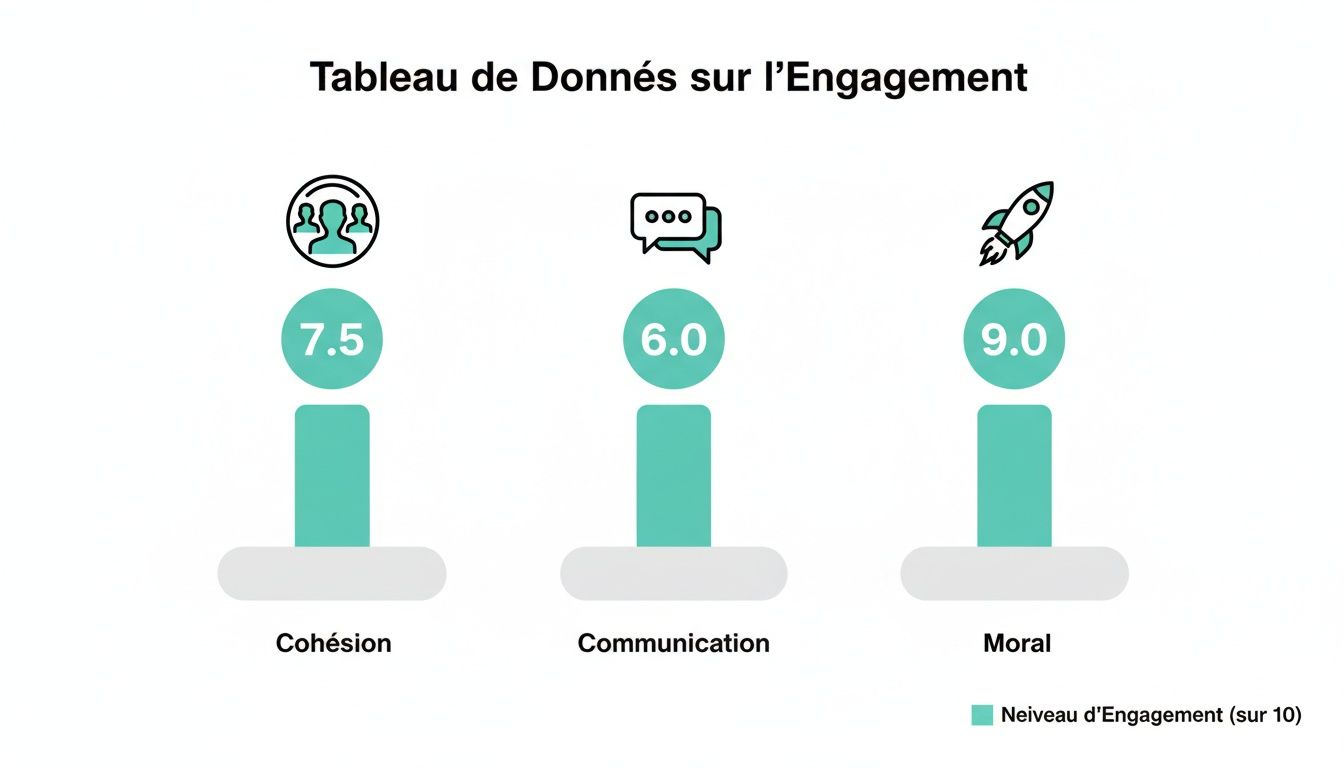
It’s clear that while cohesion and communication improve, it’s the team’s morale that benefits the most spectacularly.
To help you visualize, here are some ideas for your own points system.
Examples of Points Systems for Your Contest
This table gives you some possible structures to design a balanced and engaging game, from the first week to the final phases.
| Type of Prediction | Points (First Week) | Points (Final Phases) | Expert Advice |
|---|---|---|---|
| Good Winner | 10 points | 20 points | The base of the game. Keep it simple and accessible. |
| Exact Score (in sets) | 15 points (bonus) | 30 points (bonus) | Ideal for rewarding connoisseurs and allowing comebacks. |
| Simple Bonus Question | 5 points | 10 points | Perfect for involving novices (“More than 10 aces in the match?”). |
| Difficult Bonus Question | 25 points | 50 points | A joker for the boldest (“Winner of the 1st set but loser of the match?”). |
The important thing is to find the right mix so that the game remains open for as long as possible. Feel free to adjust these values to your audience.
Increase the Stakes Throughout the Tournament
To keep the competition intense until the grand final, it’s essential to implement a progressive points system. It’s quite simple: the further you go in the tournament, the more points are at stake. A first-round match cannot be worth as much as a semi-final.
This approach has a huge advantage: it keeps hope alive, even for those at the bottom of the ranking. Someone who missed their first week of predictions can completely turn things around during the quarter-finals or semi-finals. For example, a match in the round of 16 could be worth 50% more points than a first-round match, and a final could even see its points doubled.
This dynamic creates lasting suspense and prevents leaders from taking an insurmountable lead from the very first days. Every match becomes a new opportunity to shake things up.
Establish Internal Communication for a Strong Launch
Even the best idea in the world can fall flat if no one knows about it. Your Roland Garros prediction is no exception. To ensure this initiative is not just an Excel file that gets lost, but becomes a real company event, you need to orchestrate communication that builds momentum well before the first serve.
The idea is not just to inform. It’s to create anticipation, a little thrill. That’s the difference between a contest that struggles with 5 participants and an event that becomes THE topic of conversation at the coffee machine for two weeks.
Build Anticipation Before the Launch
Everything starts with a good teasing phase. Don’t throw all the information out at once. A few days before registration opens, send out some enigmatic messages on your usual channels, whether it’s Slack, Teams, or elsewhere.
- The Mystery Hook: A simple GIF of a tennis ball with “Ready to play?” is often enough to pique curiosity.
- The Countdown: Launch a “3 days to the big challenge of the year” without saying more. Let people speculate.
- Manager Support: Ask team leaders to relay the information informally. It immediately gives more weight to the message.
This little staging will naturally create conversations and prepare the ground. The day you finally unveil the contest, interest will already be at its peak.
Once the game is launched, your mission changes: you become the chief animator. The regularity of communications is vital to keep the flame alive. Vary the pleasures, the supports, and the tones to avoid boredom. For example, you could establish rituals, like the “Prono Point” in the morning, to announce the big matches of the day and motivate latecomers to bet.
This ongoing communication is essential to keep everyone on board, especially in a hybrid work context where not everyone necessarily crosses paths at the office.
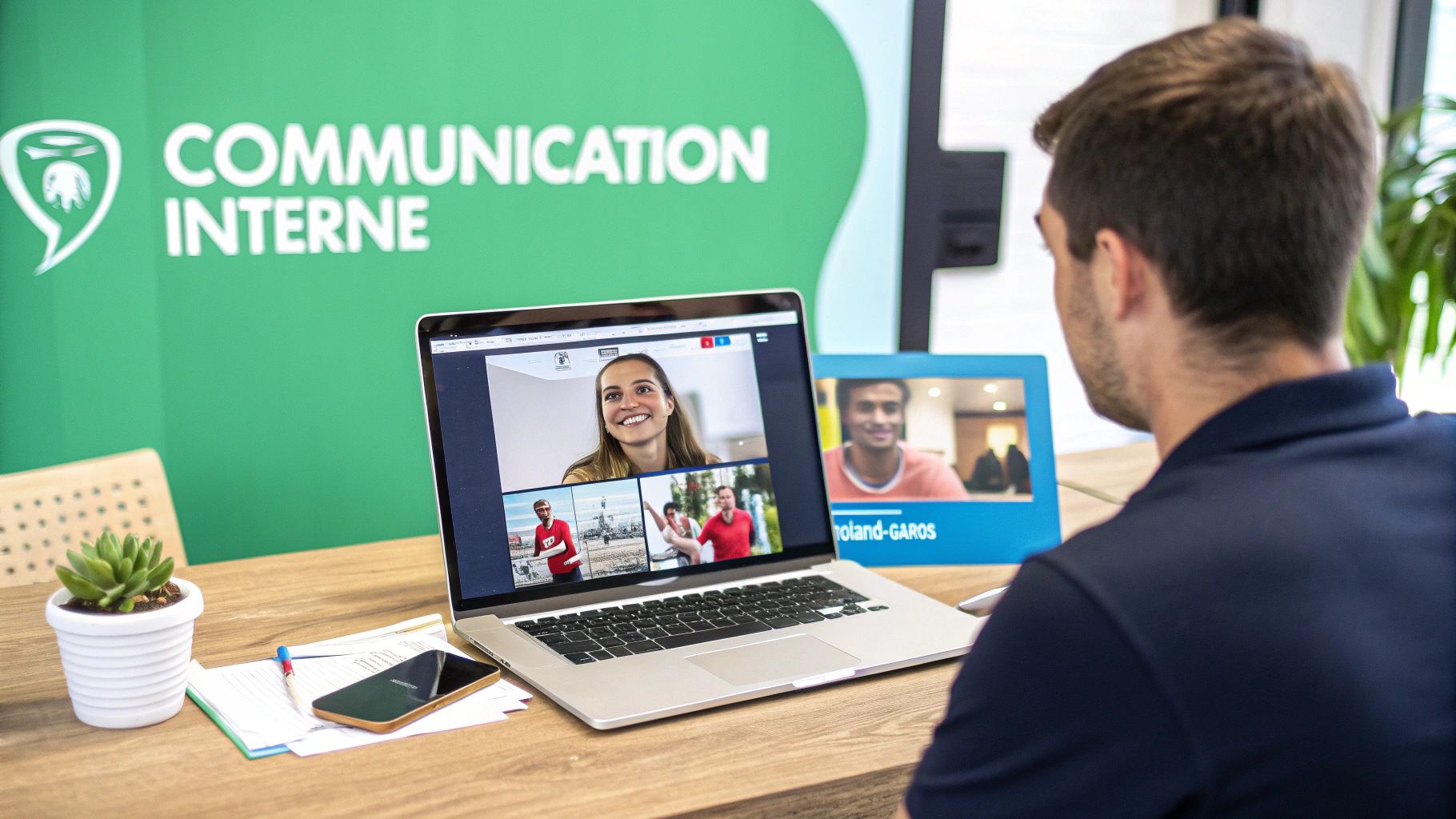
Video calls are a great way to keep in touch and engage the community remotely. No one should feel left out!
Keep the Momentum Throughout the Tournament
The launch is just the warm-up. For your prediction contest to be a real marathon and not just a sprint, constant animation is needed. This is where your creativity will make the difference to keep engagement high until the final match point.
Adopt a light, conversational tone. Forget about top-down and overly formal communications. Ask questions, conduct polls, and make good use (a little) of emojis and GIFs to make messages lively. The goal is to create a small community around the event. For more ideas, this guide on internal communication tools can help you diversify your approaches.
A good communication plan is not a checklist; it’s a script. Each message has a purpose: to inform, motivate, entertain, or reignite the competition. It’s this sequence that creates a memorable experience.
To help you structure things a bit, here are some concrete actions you can implement:
- The Daily Recap: A little message every morning with the previous day's results, the top 3 of the ranking, and a special mention for the “comeback” of the day.
- The “Big Match” Alert: A reminder one hour before the most anticipated matches. This avoids “Oh no, I forgot to predict!”.
- The Weekly Summary: An email or a more detailed post on Friday, with a slightly offbeat analysis of the ranking, the best anecdotes, and a teaser for the upcoming final phases.
And above all, don’t forget the visuals! Create simple banners in your company’s colors and the event’s to accompany your posts. A nice visual captures the eye much faster than a block of text. This visual consistency reinforces the feeling that this Roland Garros prediction is a real internal event, designed and organized for the teams.
When your teams are spread across the globe, a Roland Garros prediction takes on a whole new dimension. It’s no longer just a game; it’s a true cultural bridge. A golden opportunity to transform time zones and miles into a common playground. The challenge is to create an experience that resonates as much in Berlin as in New York or Tokyo.
The language barrier is often the first obstacle that comes to mind. Choosing a platform like ccup.io, which natively manages multilingual capabilities, completely changes the game. Each participant can play, read the rules, and follow the ranking in their own language. No more friction: the experience becomes immediately smoother and more inclusive for everyone.
Create Connections That Go Beyond Tennis
But the real magic happens when we go beyond simple translation. Inclusion lies in the details of the animation. It’s not just about talking about Nadal or Swiatek, but about highlighting players who represent the nationalities present within your company.
- Highlight Local Heroes: Your team in Madrid will be more invested if you zoom in on the performances of Spanish players. Their victories then become somewhat collective successes.
- Share Cultural Anecdotes: Did you know that tennis in Japan has a unique history and traditions? Sharing little fun facts about each country’s relationship with tennis enriches conversations and piques curiosity.
- Create Friendly “Derbies”: A match pits a French player against an American player? Launch a friendly challenge between your offices in Paris and Boston. It creates healthy competition and passionate discussions.
This personalized approach shows that you are not just deploying a tool, but actively seeking to connect people. The conversations that arise often become the starting point for more natural professional collaborations. To explore these engagement strategies, take a look at our article on ways to unite remote teams.
The goal is to transform the contest into a mosaic of cultures. Each prediction then becomes an excuse to discover a colleague, understand another perspective, and realize that despite the distance, the passion for the game is a universal language.
Animate a Global Community
For the magic to happen, a centralized exchange place is essential. A dedicated channel on Slack or Teams is simply indispensable. That’s where your colleagues can share their predictions, tease each other, and react to matches live.
Think about adapting your animations to different time zones. A morning recap for Europe can serve as a teaser for the day starting in America. Vary the content: post photos of teams watching a match together or organize mini-polls. The important thing is to maintain a constant and engaging flow of communication that gives everyone the feeling of being part of a global event, pulsing to the rhythm of the Parisian clay.
Imagine Rewards That Leave a Lasting Impression
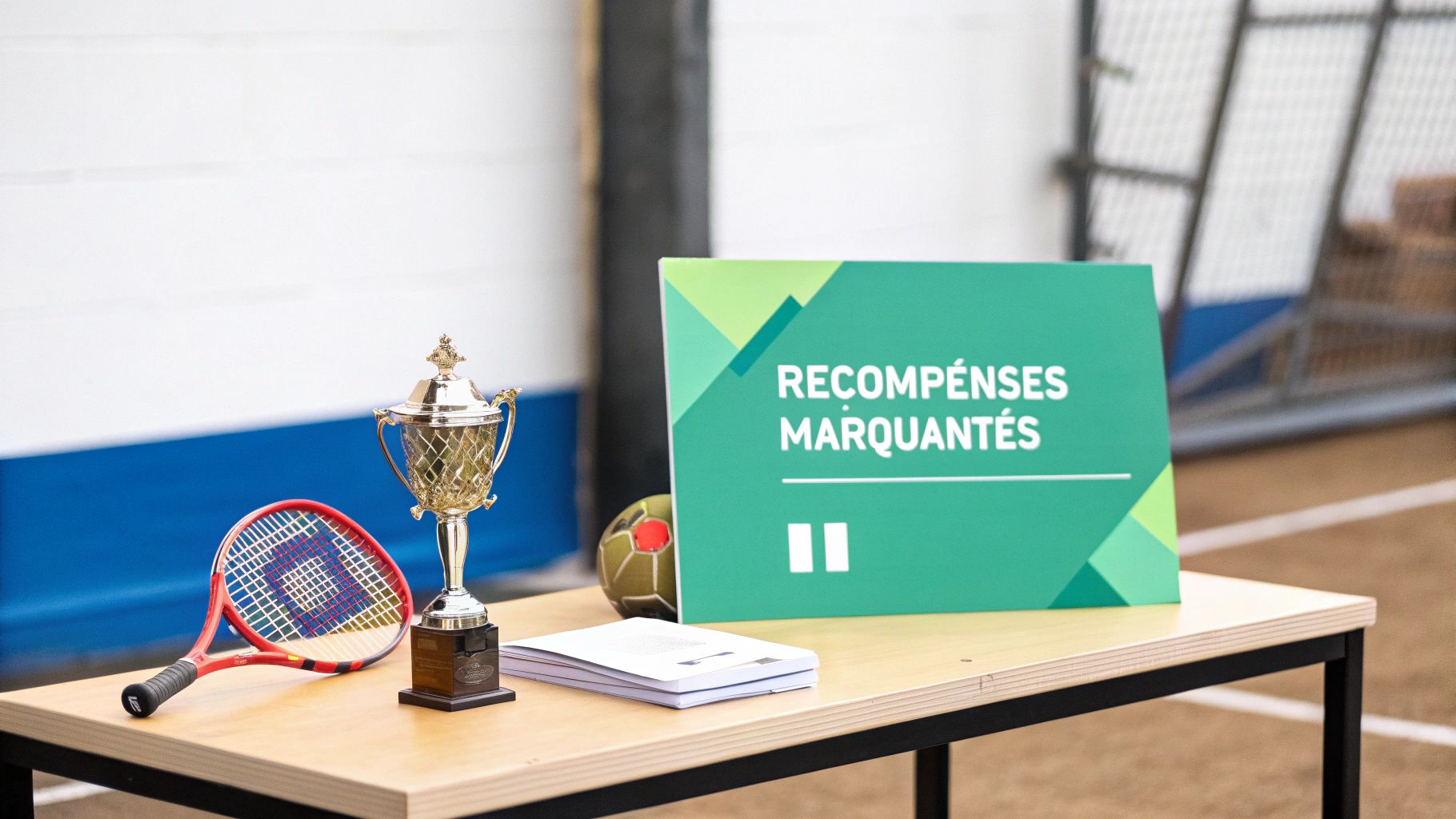
Let’s not kid ourselves: the motivation of participants in your Roland Garros prediction will depend a lot on what’s at stake. Well-thought-out prizes can transform a simple friendly competition into an event that everyone will talk about for months. Forget the traditional gift card and dare to offer prizes that create a real “wow” effect.
The idea is to focus on emotional value, not just material value. Ask yourself what would really please your teams. A successful reward becomes a conversation topic, a source of motivation, and ultimately, a great memory.
Think Outside the Box for Individual Prizes
For the grand winners, a unique experience is often much more memorable than an object. These are memories that money doesn’t always buy.
- An Extra Day Off: This is a classic, but its effectiveness is formidable. The ultimate luxury is often time.
- A Lunch with the CEO: Here’s a reward that offers strong symbolic recognition and a rare opportunity to exchange informally with management.
- Tickets for a Sporting or Cultural Event: Offering tickets for a tennis match, concert, or theater play is an excellent way to extend the experience.
To make your rewards truly stand out, think about more personal options. For example, offering the chance to create a unique personalized book is a really original touch. And if you’re looking for more inspiration, our article on low-cost prize ideas could give you some leads.
Think Collectively and Celebrate Together
Don’t forget the collective dimension! Rewarding the team or department with the best average score is an excellent way to strengthen cohesion. A breakfast treat or a team outing are perfect options for that.
Just like Yannick Noah’s historic victory in 1983 united a whole country, a shared success, even on a small scale, can really create bonds. This event rekindled the flame of tennis in France and illustrates how sports can generate intense moments of sharing.
The awards ceremony is as important as the prizes themselves. Whether in person or virtual, this ceremony is the highlight of your event. It’s the opportunity to celebrate the winners, but also to warmly thank every participant.
Take the time to organize a dedicated moment to announce the final results. A little speech, applause, and a few photos are enough to anchor the event in the company’s memory. This positive final touch will make everyone eager to sign up for the next edition.
Once the trophy is awarded and the applause has died down, the bulk of the work begins. This is where your Roland Garros prediction reveals its true value. Far from being just a formality, the post-event analysis is a goldmine for proving the impact of your initiative and, above all, for sharpening your future engagement actions.
So, let’s dive into the numbers, but with a clear objective: to understand what really worked. Don’t stop at the overall participation rate; that would be too simple. Dig a little deeper. Look at participation by department, by business unit, by team. If a department has been particularly active, it might be a sign of a manager who successfully relayed the information and motivated their troops. A lead to explore for the future!
Transform Numbers into Real Insights
Quantitative data is good, but it doesn’t tell the whole story. To have a complete view, you need to marry it with qualitative feedback, the famous “verbatim”.
- The Post-Event Survey: Launch a small, simple, and quick survey. 3 to 5 questions are enough to gauge the temperature. Ask participants what they liked most, what could be better, and what they felt was missing.
- Analysis of Conversations: Dive back into discussions on your internal channels (Slack, Teams, etc.). What were the highlights? Did the peaks of activity correspond to major matches, your reminders, or bonus questions?
By cross-referencing this information, you will identify the levers that really worked. You might discover that slightly offbeat bonus questions generated more interactions than classic predictions, or that a simple daily ranking recap was enough to keep everyone engaged.
An analysis report is not just a list of numbers. It’s a story. The story of how a simple animation created bridges between departments, stimulated exchanges, and brought a real breath of fresh air to daily life.
Prepare for the Future with Solid Evidence
The ultimate goal? Build a solid case for management. Summarize your findings in a concise and visual report. Highlight 2 or 3 key indicators that speak for themselves: the explosion of activity on the dedicated discussion channel, the participation rate of new hires, or a few well-placed testimonials.
This document is not just a summary. It’s your best argument for making this type of event a must-attend occasion. By demonstrating a clear and net return on engagement, you transform a nice initiative into a pillar of your company culture. And you will have all the cards in hand to make the next event even more successful.
Frequently Asked Questions About Organizing a Company Prediction
Launching a Roland Garros prediction internally always raises a few questions. That’s perfectly normal. We want it to work, to be a success, but we wonder where to start, how to ensure fairness, or simply how to make sure everyone has fun.
This FAQ is here for that. The idea is to give you clear and concrete answers to save you time and allow you to launch your contest with peace of mind.
How much time should I plan to organize such a contest?
This is THE big question, and the answer will reassure you: much less than you think. By using a turnkey platform like ccup.io, most of the technical work is already done. No need to reinvent the wheel.
Ideally, plan for one to two weeks before the tournament starts. This is a comfortable margin that gives you time to take care of a few essential points:
- Customize the platform with your company’s colors and logo.
- Validate the points system and the rules of the game.
- And most importantly: prepare a good internal communication plan to build excitement and ensure everyone is on board from day one.
This little preparation time allows for a smooth launch, without rushing, and lets you focus on animation rather than logistics.
How to ensure compliance with GDPR?
Data protection is a non-negotiable topic. GDPR compliance is a requirement, not an option. But the good news is that you don’t need to be a legal expert to organize your Roland Garros prediction.
By choosing a specialized solution like ccup.io, you delegate this complexity with complete confidence. These platforms are designed to collect only the strict minimum (usually name, first name, and work email) and to ensure the security of this information.
They manage consent, access rights, and data deletion for you. For you, it’s peace of mind assured. And for your colleagues, it’s an essential mark of respect.
What tips do you have for maintaining engagement over two weeks?
A Grand Slam tournament lasts two weeks. That can seem long. The real challenge is to keep the flame alive from the first to the last match point. The secret? Creative and continuous animation.
Don’t stop at the launch. Think of yourself as the sports commentator who brings the event to life.
- Communicate regularly: a little reminder in the morning before the big matches, the updated ranking every day, a fun anecdote about the tournament…
- Use your internal channels: Slack or Teams are perfect for that. Launch little challenges between departments, share the boldest predictions, encourage discussions.
- Spice up the game with bonus questions: halfway through, slip in some surprise questions. This can totally reignite the competition and give lower-ranked participants a chance for a “comeback”.
The important thing is to create little rituals that rhythm the fortnight and remind everyone that the game continues.
Is this type of game suitable for a company without a sports culture?
Absolutely. This is even one of the major advantages of this kind of initiative. The primary goal is not performance or in-depth knowledge of tennis, but to create connections. The Roland Garros prediction is primarily a fun pretext.
By offering a game with simple rules and accessible bonus questions, you include everyone. Tennis enthusiasts will love fine-tuning their strategy, and novices can rely on their intuition and get into the game.
The contest becomes an excellent icebreaker. It offers a neutral and positive conversation topic, allowing colleagues from different departments, who barely cross paths usually, to chat in a natural and relaxed manner.
Ready to transform the excitement of Roland Garros into a powerful engagement lever for your teams? With ccup.io, launch a personalized prediction contest in just a few clicks and create a memorable experience. Discover how to animate your company with ccup.io
From Content To Conversion
Turn your next sports event into a company prediction contest
Discover the platform, explore available competitions, and launch a branded experience that supports engagement, internal communication, and team cohesion.
See available competitions
Related articles

3 months ago
Roland Garros 2026 Game: Organizing It in Your Company to Engage Your Teams
Launching a Roland Garros game in the workplace is not just a distraction. It’s a real opportunity to transform the excitement of the tournament into a driving force for your teams' lives. Why Launch a Roland Garros Game in Your Company? Every year, it’s the same story: France beats to the rhythm of...

4 months ago
Roland Garros Prediction 2026: 8 Tips to Master Your Forecasts
As Roland Garros approaches, the excitement extends beyond the courts at Porte d'Auteuil. It also permeates businesses, where prediction contests have become an essential engagement lever to energize teams. However, to excel in this exercise and establish a roland garros prediction that is reliable,...

5 months ago
Roland Garros Prediction in the Workplace: A Guide to Engage Your Teams
A Roland Garros prediction contest is much more than just a simple activity. Think of it as a tool to energize interactions, strengthen teams, and create memorable moments at the office. Why a Roland Garros prediction contest will transform your work atmosphere Imagine the scene: the coffee break tu...




















Contact us
For any question or quotation requests, do not hesitate to reach us by phone at 01 83 79 24 54 or by email : contact@ccup.io
Contact us


Frequently asked questions
What is ccup.io?
Ccup.io is a cohesion tool, allowing firms to gather their collaborators on the occasion of major sporting events, such as World Cup or Olympic Games. We offer an interactive forecasting platform, turnkey and customisable to your company’s colours.
What are you doing with our data?
By deciding to use our services, you decide to entrust us a part of your data – this will allow us to optimise your experience. We place great emphasis on the protection of your data, in compliance with current regulations. Given that it is important to be informed on the issues and challenges of personal data protection, ccup.io provides you with a most complete documentation on this matter.
How much does it cost?
In order to give our clients flexibility, we make a special rate depending on the number of registered players using a degressive system for an important number of participants. This allows firms to organise tailored events, adapted to their capacity. To receive a commercial offer in less than an hour, you only need to fill out the quotation requests form, with just a few clicks.



Don’t miss this opportunity 😍
Start now and enjoy numerous benefits