



Tennis Rules for Dummies Explained Simply
Are you fascinated by tennis but completely lost as soon as the referee announces "15-30"? Don’t worry, you’re not alone. This guide is a bit like your personal coach to finally decode the tennis rules for dummies, without any complicated jargon. Our mission is simple: to give you the keys to follow every exchange and understand the logic behind this captivating sport.
How to No Longer Be Lost During a Tennis Match
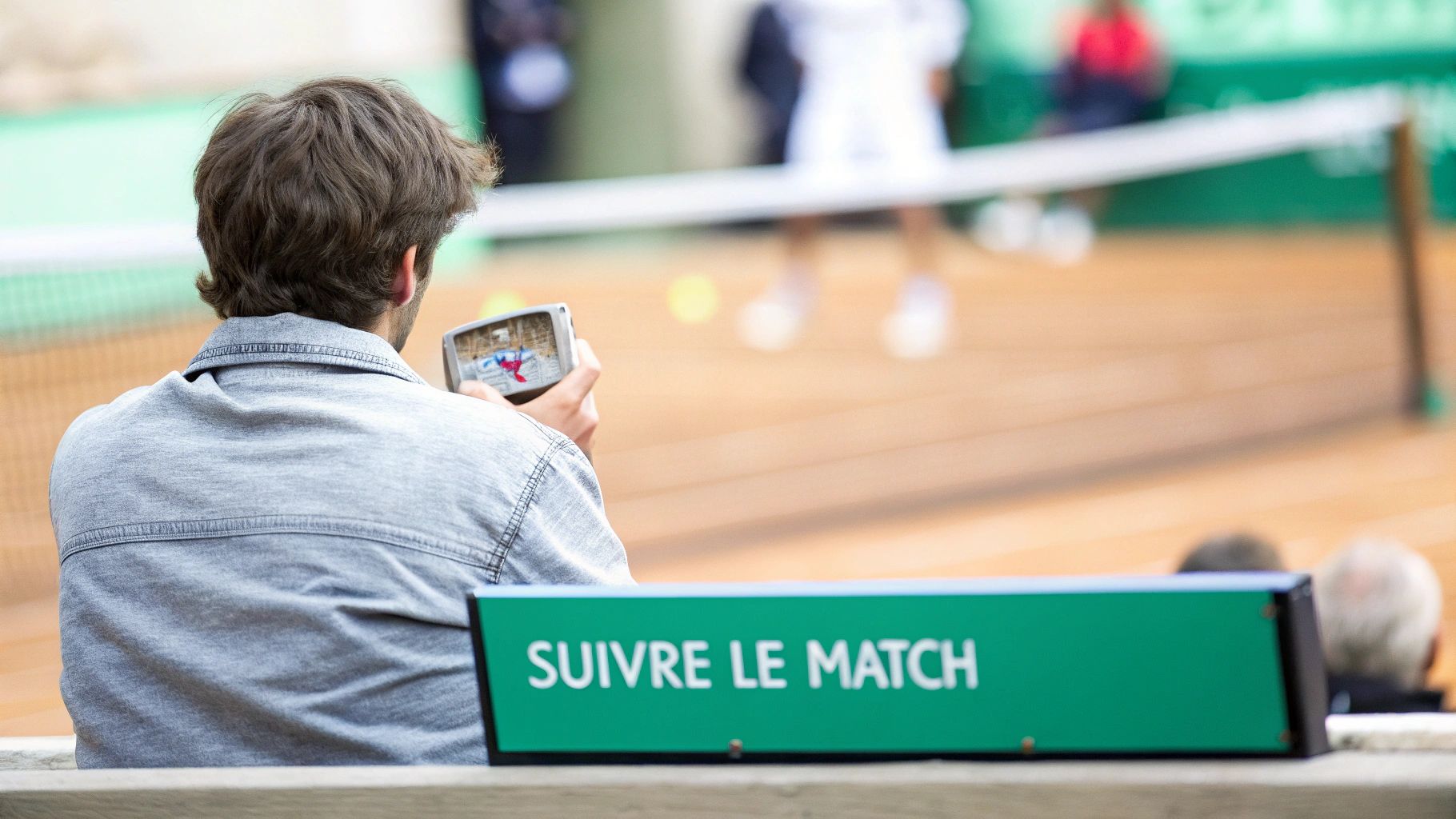
Tennis can seem intimidating with its unique scoring system and expressions. However, once you grasp the basics, everything becomes clear. Think of this guide as a simple and direct conversation that will transform your confusion into confidence.
In just a few minutes, you’ll have the fundamentals to fully enjoy the next match, whether you’re courtside or in front of your TV. We will break down the game step by step, so words like "deuce" or "tie-break" will hold no secrets for you.
The Origins of a Unique Score
To understand this seemingly strange point counting, we need to take a little trip back in time. Imagine France in the 12th century and an ancestor of tennis, the "jeu de paume", where players hit the ball with their hands. It wasn’t until 1599 that the first rules were written, laying the groundwork for this special scoring: 15, 30, 45 (which later became 40). A popular theory even links these numbers to coins of the time.
Tennis is a sport where logic hides behind a fascinating tradition. Understanding the "why" of the score is the first step to never being lost during a match again.
The Keys to Understanding Everything
Our approach will allow you to follow any match, even the biggest tournaments. By the way, if you want to have fun with friends or colleagues, check out our tips for setting up a Roland-Garros prediction contest.
Before diving into the details, here’s an overview of the pillars to master. This table gives you a quick snapshot of what you need to focus on to get started.
The 5 Key Concepts of Tennis Explained Simply
| Concept | Main Objective for a Beginner |
|---|---|
| The Court | Understand the role of each line to know if a ball is in or out. |
| The Score | Learn to follow the points (15, 30, 40), games, and sets to understand who is winning. |
| The Serve | Grasp that it’s the shot that starts each point and that there are two chances to get it right. |
| Faults | Identify the actions that stop a point and give it to the opponent (ball in the net, out of bounds, etc.). |
| Exchanges | Know that the ball must bounce only once in your court before being returned. |
With these elements in mind, you’ve already done the hardest part! Now, let’s detail each of these points so you can go from a confused spectator to an informed observer. Ready? Let’s go.
Before thinking about hitting your first ace, it’s essential to understand the court you’ll be playing on. Imagine the tennis court as your playing field: each line has a specific meaning and directly influences how each point is played.
The court is a large rectangle measuring 23.77 meters long and 8.23 meters wide for singles matches. These lines are your constant reference points. The baseline, from where you will serve, is your starting point, while the sidelines mark the boundaries you must not cross.
The Role of Each Zone on the Court
The court is divided in two by the net, an obstacle that your ball must clear with every hit. Its height is 91.4 centimeters at the center, slightly lower at the ends. This small detail is important when you start aiming for specific areas.
On each side of the net, you will see two rectangles: these are the famous service boxes. This is the target to hit when you start the point. If your ball doesn’t land in the correct box, it’s a fault. These areas are defined by the service line and the center line.
On a tennis court, every line is part of the game. A ball that touches even a millimeter of the line is considered in. This is the golden rule that makes the game both fair and sometimes... a bit frustrating!
Choosing the Right Equipment to Start
Now that you’re more familiar with the court, let’s talk equipment. Having the right gear is key to enjoying yourself and, most importantly, playing safely. You don’t need to break the bank, but three items are essential.
- The Racket: For a beginner, simplicity is your best friend. Choose a racket with a large head (the hitting surface). It will more easily forgive your small centering errors and help you return the ball without forcing.
- The Balls: There are several types of balls. To start, "pressureless" or "training" balls are perfect. They are a bit slower and bounce lower, giving you more time to position yourself and prepare your shot.
- The Shoes: This is a point often overlooked, yet it’s crucial. Tennis shoes are designed for lateral movements and quick stops, typical of this sport. They protect your ankles and help you avoid many injuries. It’s truly the safety investment you shouldn’t skip.
The Tennis Scoring System Finally Decoded
This is often the part that scares beginners the most. You hear about "15", "40", "deuce", and it can quickly sound like gibberish. But breathe, it’s much simpler than it seems.
To never be lost again, imagine the score as a Russian doll, with three levels nested within each other: points, games, and sets.
Victory is built brick by brick. First, you win points to win a game. Then, you accumulate games to win a set. And finally, the holy grail: you win sets to win the match. It’s this structure that creates the unique suspense of tennis.
The Logic of Points: 15, 30, 40
The point counting in a game is unique. Instead of counting "1, 2, 3", we use a distinct sequence: "15, 30, 40". This is an old tradition inherited from the ancestor of tennis, the jeu de paume. The goal is simple: be the first to score four points to win the game.
Here’s how it breaks down:
- Zero points = "Love" (or "Zéro" in French, for the purists)
- First point = "15"
- Second point = "30"
- Third point = "40"
- Fourth point = "Game"
For example, if the server wins the very first point of the exchange, the referee announces 15-0. If the receiver wins the next point, it goes to 15-15 (often said "15A"). It’s that simple. A little tip to remember: the referee always announces the server's score first.
This diagram helps you visualize the hierarchy of elements in tennis, from the court itself to the player.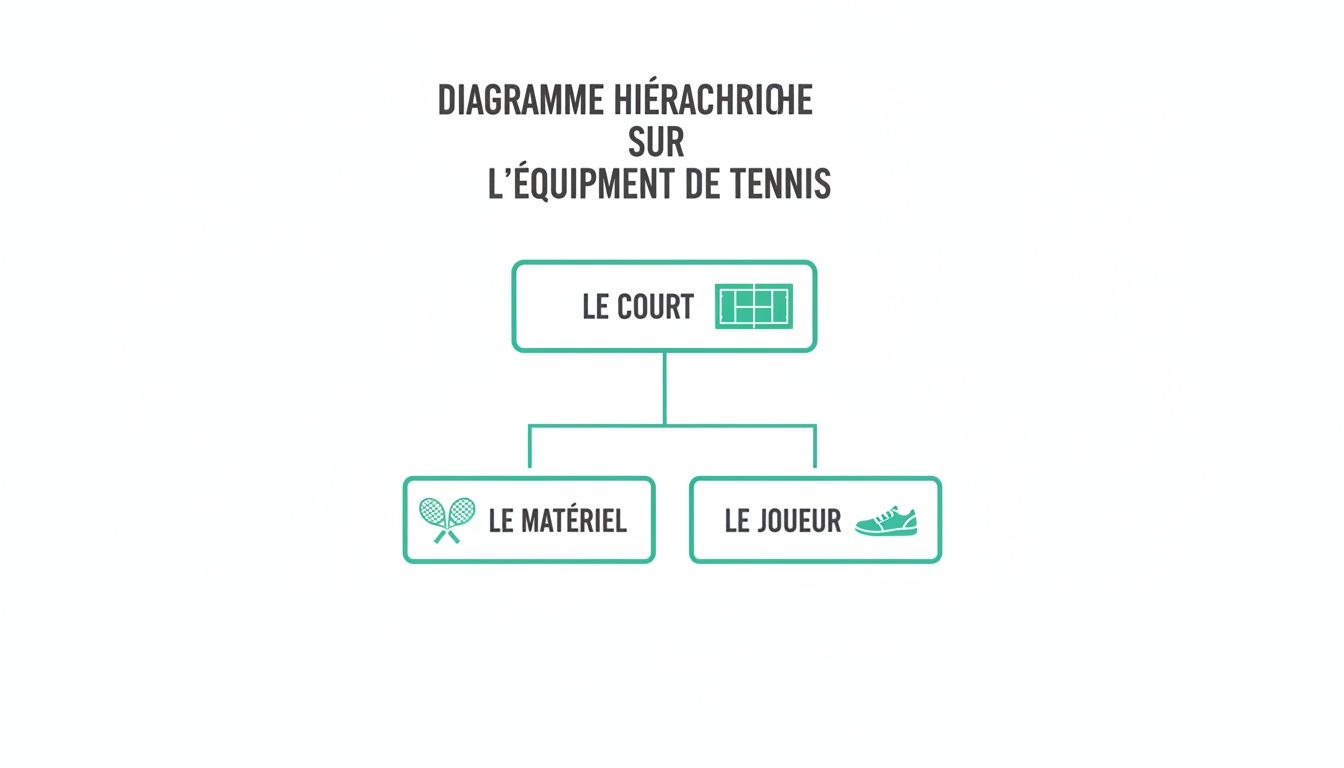
Each element is an essential layer, but it’s the understanding of the score that brings the game on the court to life.
Deuce and Advantage: The Heart of Suspense
Things get really interesting when both players reach the score of 40-40. This situation has a name: "deuce". At this precise moment, the rule changes slightly. To win the game, a player must now score two points in a row.
Deuce is a mini-match within the match. A moment of pure tension where a single point is no longer enough. The psychological dynamic shifts, and every racket stroke weighs a ton.
The player who wins the point after deuce gains an "advantage". If they continue and win the next point as well, they win the game. But if their opponent wins that point, the score returns to "deuce". This back-and-forth can last a long time and create completely crazy turnarounds!
To visualize better, here’s a concrete example of a very contested game.
Progression of a Classic Tennis Game
| Point Won By | Score Announced by the Referee | Explanation |
|---|---|---|
| Player A (server) | 15-0 | The server wins the first point. |
| Player B | 15-15 (15A) | The receiver equalizes. |
| Player A | 30-15 | The server takes the lead again. |
| Player B | 30-30 (30A) | New equality. |
| Player B | 30-40 | The receiver has a game point. |
| Player A | Deuce | The server saves the game point, we are at 40-40. |
| Player A | Advantage A | The server takes the advantage. |
| Player B | Deuce | The receiver comes back, we return to deuce. |
| Player B | Advantage B | This time, it’s the receiver who has the advantage. |
| Player B | Game B | The receiver confirms and wins the game. |
This example clearly shows how a single game can become a true mental and physical battle.
From Games to Sets: The Road to Victory
Once you understand how to win a game, the next objective is to win a set. A set is a bit like a round. It is won by the first player to reach 6 games, but be careful, they must have at least a two-game lead over their opponent (for example, 6-4 or 6-3).
If the score reaches 6-5, the suspense continues. If the player leading at 6 wins the next game, they win the set with a score of 7-5.
But what happens if both players find themselves at 6-6? That’s where a special rule comes into play to separate them: the "tie-break". This final game has a different scoring system (counting 1, 2, 3...) and allows the set to conclude more quickly. To win a match, you generally need to win two sets (for regular tournaments) or three sets (for men in Grand Slam events).
Mastering the Serve and Avoiding Common Faults
In tennis, the serve is a unique moment. It’s the only shot where you have total control, without your opponent having a say. You start the point, putting the ball into play. Think of it like the kickoff of a football match: everything starts from there, and there are specific rules to follow for the game to begin.
To serve, the player stands behind the baseline, without stepping on it. The goal? To send the ball diagonally so that it lands in the opposite service box, just behind the net. The ball must pass over the net without touching it.
If you succeed, the game is on. But if you miss, don’t panic! This is where one of the most famous rules of tennis comes into play: you have a second chance.
The Second Chance and Service Faults
Your first serve misses its target? That’s called a "fault". This happens if the ball lands in the net, if it goes out of the correct service box, or even if you step on the baseline before hitting.
After this first fault, you get a second serve. This is a golden opportunity to still start the exchange. Often, players take fewer risks on this second ball to ensure the shot. But if you also miss this second serve, it’s a "double fault". The verdict is clear: you lose the point.
Managing the two serves is an art. The first is often a risk-taking attempt to score a direct point (an "ace"). The second is more strategic, its main goal is to launch the exchange under good conditions.
There’s also a special case: the "let". Imagine your serve is perfect, but the ball grazes the white band of the net before landing in the correct box. In this case, the serve is simply replayed. You don’t lose either your first or your second serve. The counters are reset to zero for this shot only.
Other Faults That Stop the Game
Of course, faults aren’t limited to serving. Once the exchange is underway, several actions can end it and give the point to your opponent. You need to know them to follow a match well.
Here are the most common errors that stop a point:
- The ball is "out": This is the most frequent fault. You hit the ball, but it lands outside the court boundaries (behind the baseline or on the sides).
- The ball in the net: Your shot lacks power or height, and the ball doesn’t make it over to the other side. Point for the opponent.
- The double bounce: You fail to hit the ball before it bounces a second time in your half of the court.
- Touching the net: Be careful, this is forbidden! Neither your body nor your racket should touch the net while the point is in play. If it happens, you lose the point immediately.
- The ball hits you: If the ball touches any part of your body or clothing (except the racket) before hitting the ground, the point automatically goes to your opponent.
These rules are the skeleton of each exchange. Keeping them in mind, you will instantly understand why a point stops and how players adjust their game to avoid making these fatal errors.
The Key Differences Between Singles and Doubles Play

Now that you’ve mastered the basics, the question arises: is it better to play solo or in a team? Tennis offers both options, singles (one-on-one) and doubles (two-on-two). Each has its charm and its own subtleties. While the goal remains to score points, the strategy and some rules change radically.
The most obvious difference is the size of the court. In singles, the game is confined to the inner lines. In doubles, the court expands to include the "alleys", the two strips located on each side. This additional area changes the entire geometry of the court and opens up new angles of attack.
In doubles, the court becomes a true chessboard. The placement and anticipation of the movements of four players at the same time take precedence over the brute power of a single individual.
The love story between the French and these two formats is not new. The French Tennis Federation (FFT) standardized the rules for singles and doubles as early as 1920, paving the way for millions of players. In 2021, the FFT counted 947,294 licensed players in over 7,340 clubs, proving that both disciplines are still very popular. For the curious, the key figures of tennis in France say a lot about this popularity.
The Serve and Communication: Pillars of Doubles
Beyond the playing surface, serving in doubles follows a very precise rotation. Each player on a team serves in turn, one complete game each. Specifically, at the start of a match, it goes like this:
- Player 1 from Team A serves.
- Player 1 from Team B serves.
- Player 2 from Team A (the partner) takes over.
- Player 2 from Team B serves next.
This order remains unchanged for the entire set. The same goes for the receivers, who choose their receiving side (right or left) at the beginning of each set and stick to it.
But the biggest difference isn’t in the rules. It’s a human skill: communication. Talking to your partner is vital to decide who takes a ball in the center, announce your intentions, or coordinate at the net. This team dynamic makes doubles particularly effective for team building, a topic we address in our article on sports predictions as a cohesion tool.
In the end, whether you are drawn to the psychological duel of singles or the strategic collaboration of doubles, tennis surely has something to offer you.
The Questions Everyone Asks About Tennis Rules
Even after understanding the basics, certain situations during a match can leave you puzzled. This is perfectly normal! To clear up any lingering doubts, we’ve gathered here the questions that all beginners have asked at one time or another.
The idea is simple: to give you clear and direct answers so that you feel more comfortable, whether watching a match on TV or preparing to hit your first balls.
What does "love" mean in tennis scoring?
You’ve definitely heard the referee announce "fifteen-love" for a score of 15-0. But where does this particular word for zero come from? The most likely explanation comes from France, from the ancestor of tennis: the jeu de paume.
The word "love" is actually a distortion of "l'œuf". Yes, the egg! Simply because the number zero has an oval shape. When the game spread to our English neighbors, they would have adapted the word to their language, and "l'œuf" became phonetically "love".
Another, slightly more poetic theory suggests that it comes from the expression "to play for love", meaning to play for pleasure, with no money at stake. Regardless of the true origin, the rule to remember is simple and universal on all courts around the world: in tennis, "love" means zero.
Can a player touch the net during a point?
The answer is a categorical no. This is a fundamental rule, one of the first to grasp to avoid losing points foolishly. As long as the ball is in play, neither your body, nor your racket, nor even a part of your shirt should touch the net or the posts holding it.
If it happens, the point stops immediately and goes directly to your opponent. This rule is in place to ensure that no one interferes with the game in the opponent's court. It forces players to control their movements, especially when approaching the net to finish a point.
The net is a sacred boundary. Crossing or touching it during the exchange is an immediate fault. This rule imposes discipline and self-control, even in the most intense moments of the match.
The only small exception is when the point is already over. For example, if the ball has already bounced twice in the opponent's court, the point is finished. If you touch the net in the momentum of your run after the shot, it’s not a fault.
What happens if a ball touches the line?
This is THE situation that creates the most heated debates on the courts among friends! Yet, the rule is clear: a ball that touches any part of a line is considered in ("in", as the English say).
Whether it’s the baseline, the alleys on the sides, or the lines of the service box, even the smallest contact, of about a millimeter, is enough to validate the shot. For a beginner, this is an essential principle: the lines are part of the court.
For professionals, the "Hawk-Eye" technology settles the debate with millimeter precision. For us amateurs, the golden rule is simple: when in doubt, the ball is in. It’s a matter of fair play.
Am I allowed to hit the ball before it bounces?
Absolutely! Not only is it allowed, but it’s a major tactical shot in tennis. Hitting the ball before it touches the ground on your side is called a "volley". The only condition is that you and your racket must be on your side of the net at the moment of impact.
It is strictly forbidden to cross over the net to hit the ball in the opponent's court. The volley is a formidable offensive weapon, often used to surprise the opponent and give them less time to react. It’s particularly effective when positioned near the net, or in doubles play.
Understanding these specific rules will help you not only appreciate matches better but also have more fun on the court. By the way, if organizing sporting events interests you, you might be interested in our guide on how to organize your sports prediction contest among friends.
Ready to transform the energy of sports into a powerful cohesion lever for your company? With ccup.io, create personalized prediction contests and engage your teams like never before.
Discover how to energize your employees with ccup.io
From Content To Conversion
Turn your next sports event into a company prediction contest
Discover the platform, explore available competitions, and launch a branded experience that supports engagement, internal communication, and team cohesion.
See available competitions
Latest articles

2 days ago
Women's Euro Prediction: Women's Euro 2026 Prediction: The Def
You probably already have the scene in mind. The tournament is approaching, management asks you for a unifying activity, teams are scattered between offices, remote work, and subsidiaries, and you have no desire to manage a prediction contest in a makeshift spreadsheet at the last minute.
...

2 days ago
Football Predictions Among Friends: Create and Run a Successful Contest
You probably have the same scene in mind as many P&C teams before a big competition. The Teams or Slack thread comes alive, a few colleagues throw out predictions "for fun," an Excel spreadsheet circulates, and then no one knows which version is correct, who responded, or how to break ties. T...





















Contact us
For any question or quotation requests, do not hesitate to reach us by phone at 01 83 79 24 54 or by email : contact@ccup.io
Contact us


Frequently asked questions
What is ccup.io?
Ccup.io is a cohesion tool, allowing firms to gather their collaborators on the occasion of major sporting events, such as World Cup or Olympic Games. We offer an interactive forecasting platform, turnkey and customisable to your company’s colours.
What are you doing with our data?
By deciding to use our services, you decide to entrust us a part of your data – this will allow us to optimise your experience. We place great emphasis on the protection of your data, in compliance with current regulations. Given that it is important to be informed on the issues and challenges of personal data protection, ccup.io provides you with a most complete documentation on this matter.
How much does it cost?
In order to give our clients flexibility, we make a special rate depending on the number of registered players using a degressive system for an important number of participants. This allows firms to organise tailored events, adapted to their capacity. To receive a commercial offer in less than an hour, you only need to fill out the quotation requests form, with just a few clicks.



Don’t miss this opportunity 😍
Start now and enjoy numerous benefits