



Tennis Game Rules and Beginner's Guide
The tennis game rules can be seen as a system of Russian dolls: to win, you need to string together points to win games, then games to win sets. The first to assemble the required number of sets wins the match. It’s this simple logic that turns every rally into a crucial step towards victory.
Understanding the Basics of Tennis Game Rules
Even though tennis may seem complex, its basic principle is very simple: hit the ball into the opponent's court so they cannot return it properly. The objective is clear, but to truly follow a match, you need to understand how the scoring is built, somewhat like a pyramid.
At the base of everything is the point, the unit of measurement for each rally. Win enough points, and you win a game. Accumulate games, and you pocket a set. Finally, the first to reach the required number of sets (two or three, depending on the tournament) wins the match. Once you have that in mind, everything becomes clearer.
The Scoring Pyramid Explained
Imagine you are building something:
- Points are your bricks.
- Games are the walls you build brick by brick.
- Sets are the completed floors.
- The match? It’s the entire building. Your victory.
This simple image is perfect for never losing track of the score. If you want to dig a little deeper, our complete guide on tennis rules for beginners is made for that.
At its core, tennis is a duel of strategists where each point is a small victory. The secret is to understand how all these small victories add up to win the big prize.
This passion for strategy and competition can be found all over France. In 2023, the French Tennis Federation shattered its record for registered players since 2012 with over 1,115,000 registered. With more than 7,340 clubs and 32,560 courts, tennis is a sport that continues to fascinate.
Singles vs. Doubles: A Key Difference
A small but important clarification: it’s essential to distinguish between the two formats of play. Singles pits two players against each other, one-on-one. Doubles, on the other hand, features four players, in teams of two. This not only changes the number of people on the court but also the size of the court used and, of course, the entire strategy.
To clarify, this table summarizes the steps to win, whether in singles or doubles.
Steps to Win a Tennis Match
| Scoring Unit | Objective to Achieve | Important Note |
|---|---|---|
| Point | Win the rally | The first point is worth "15", the second "30", the third "40". |
| Game | Win at least 4 points | You must have at least a two-point lead over your opponent. |
| Set | Win at least 6 games | A two-game lead is necessary (e.g., 6-4). A tie-break is played at 6-6. |
| Match | Win 2 or 3 sets | The format depends on the tournament (Grand Slam in 3 winning sets for men). |
This structure is the skeleton of any tennis match. Once you master it, you are ready to appreciate every nuance of the game.
Deciphering the Score in Tennis
The scoring system in tennis may seem a bit strange at first glance.## Deciphering the Score in Tennis
The scoring system in tennis may seem a bit strange at first glance. However, once you grasp its logic, everything becomes clear. You forget the classic counting (1, 2, 3...) for a progression of its own, which gives each rally a real sense of suspense. It’s one of the signatures of the tennis game rules.
To put it simply, imagine that to win a game, you must climb a small staircase of four steps. Each point won moves you up one step.
The Progression of Points in a Game
This quirky counting actually comes from the game of handball, the ancestor of tennis. Each point scored allowed players to physically advance on the court back in the day.
- No points: You are at the starting line, the score is "zero".
- First point won: First step, we announce "15".
- Second point won: Second step, the score is "30".
- Third point won: Third step, the score is "40".
- Fourth point won: You are now at the top of the staircase, you win the "game".
With this system, every point counts immensely and can turn a game in the blink of an eye.
To visualize how all this fits together, this diagram perfectly summarizes the hierarchy of scoring in tennis.
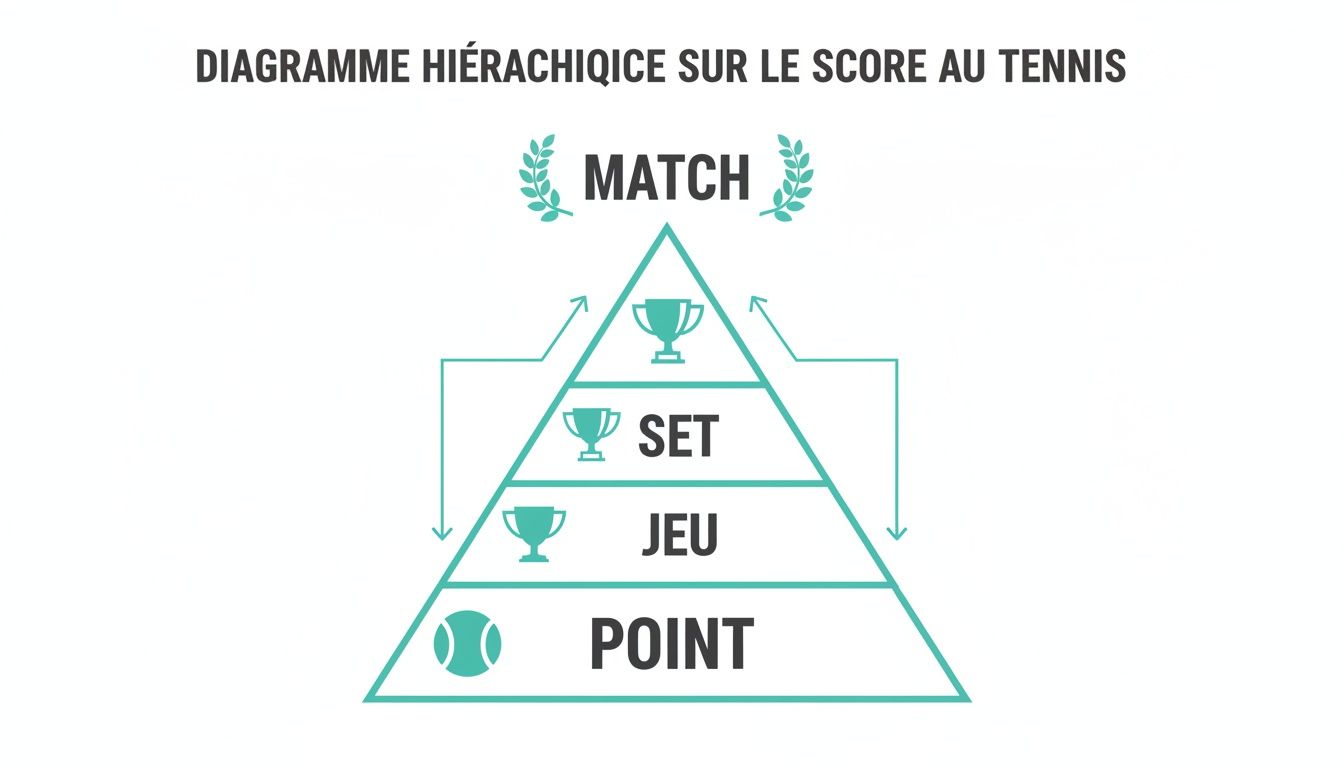
It is clear that the match is the ultimate goal, but everything starts from the base: points, which accumulate to form games, which in turn build sets.
What Happens in Case of a Tie?
This is where the tension rises a notch. If both players find themselves on the third step at the same time, at 40-40, we do not announce "forty-all", but "deuce".
From deuce, the rules of the game change: you now need to win two consecutive points to win the game. A mini-duel ensues, where every shot becomes decisive.
The first point scored after "deuce" gives the advantage to the player who won it. If they also win the next point, the game is theirs. But if they lose it, the score returns to "deuce", and everything starts over. The game continues until one player finally manages to string together those two famous points. For a deeper analysis, take a look at our article on the rules of a point in tennis.
Building Sets to Win the Match
Once the principle of the game is understood, the rest flows naturally. The goal now is to collect games to win a set.
To win a set, a player must win at least six games, but more importantly, they must have a two-game lead over their opponent.
Here are some examples of scores that validate a set:
- 6-0, 6-1, 6-2, 6-3, or 6-4
- 7-5
- 8-6, 9-7, etc. (this scenario occurs in tournaments where there is no tie-break in the last set)
But what happens if both players are neck and neck and the score reaches 6 games all (6-6)? This is precisely when the famous tie-break comes into play.
The Special Case of the Tie-Break
The tie-break is a somewhat special game, invented to separate players at 6-6 and prevent sets from dragging on. Here, we change the scoring system.
- The score is standard: Points are counted normally: 1, 2, 3, 4...
- The objective: The first player to reach 7 points wins the tie-break (and thus the set at 7-6), with one condition: they must have at least a two-point lead.
- The process: If the score reaches 6-6 in the tie-break, the game continues until one player establishes that two-point lead (for example, 8-6, 9-7, 12-10...).
This format is a true concentration of pressure. The entire tension of a set is played out in just a few points, making it one of the most thrilling moments of a tennis match.
In summary, the score in tennis is a cascade: you win points to take a game, you win games to win a set, and you accumulate sets to celebrate victory. This progressive structure is truly at the heart of every tennis game rule.
Mastering the Serve and Return
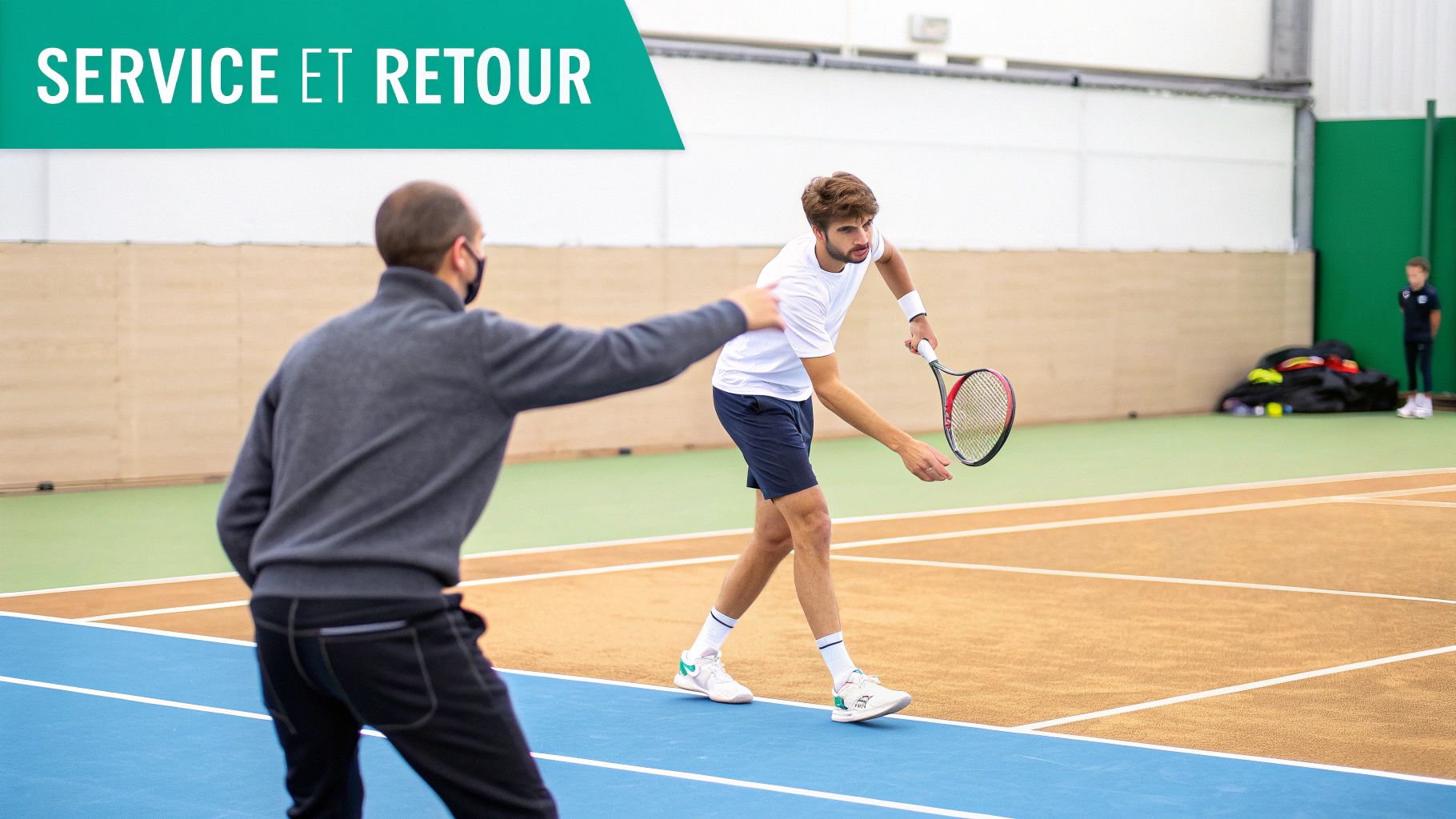
In tennis, every point starts the same way: with a serve. But be careful, this shot is much more than just a serve. It’s a true strategic weapon. A well-executed serve can put the opponent on their heels or even give you the point directly. That’s why understanding the tennis game rules for serving is the first step to taking control of the match.
The serve and return are two sides of the same coin. One seeks to dominate, the other to break that dominance to regain the advantage. If you master these two phases, you dictate the rhythm of the game.
The Step-by-Step Serving Procedure
Serving in tennis is a whole ritual, with very specific rules. The server must stand behind their baseline, never touching it before hitting the ball. This is called a foot fault, a silly mistake that immediately nullifies the attempt.
The direction is also imposed. The server must always aim for the service box that is diagonally opposite on the other side of the net. If serving from the right, they aim for the left service box of their opponent, and vice versa.
This alternation is the basis of everything:
- First point of the game (0-0): Serve from the right, towards the left service box.
- Second point (15-0 or 0-15): Switch to the left to serve towards the right service box.
- And so on... The server switches sides after each point played.
Service Faults and the Second Chance
No one is perfect, and the rules of tennis know this well. Each player has two attempts to get their serve in play. If the first serve is a fault, no worries, they get a second chance.
So, what constitutes a service fault?
- The ball hits the net and falls outside the correct box.
- The ball lands directly outside the boundaries of the targeted service box.
- The server commits a foot fault by stepping on the baseline before hitting.
If the player also misses their second attempt, it’s a disaster: they commit a double fault and automatically lose the point. That’s why the second serve is often played with more safety, less power, but more spin.
The right to a second serve offers a perfect balance between risk-taking and safety. The first serve is often the moment to attempt a powerful shot, a bold ace. The second is more tactical, its primary goal is to start the rally without giving away the point.
Understanding the Let Rule
There is a somewhat special case where the serve is neither good nor a fault: the let. We refer to a "let" when the ball touches the top of the net before falling... into the correct service box.
In this situation, the point is not played, and the serve is simply replayed. The server does not lose their first serve if they were playing it and does not commit a double fault if they were on their second. It’s a sort of "reset" to ensure that the point is not won or lost due to bad luck.
The Service Return, An Offensive Opportunity
Facing a powerful server, one sometimes feels that returning is just an act of survival. But this is a very limited view! An effective return does not just put the ball back in play; it transforms a defensive situation into an attack.
To be valid, the return must be hit after a single bounce, and the ball must land anywhere within the boundaries of the opponent's court. The objective is simple: neutralize the server's advantage as quickly as possible.
To achieve this, there are several strategies:
- A deep return to the center to push the server back and prevent them from coming to the net.
- A short and cross-court return to force them off the court and open angles.
- A blocked return on a powerful serve to use the speed of the opponent's ball against them.
Mastering your serve gives the initiative, that’s true. But a good return can snatch that advantage in the blink of an eye and turn a game, a set, and even the match. It’s in this balance that the strategic beauty of tennis lies.
Faults and Penalties: What Can Make You Lose the Point
In tennis, scoring a point is good. Not giving away points to your opponent is even better! Beyond serving and returning, there is a whole range of faults that can abruptly stop a rally. These are traps to be aware of to play with a clear mind and not sabotage your own efforts.
Each rally is a small war of nerves. It’s not enough to hit hard or aim accurately; you must also respect a very precise framework of play that ensures the match remains fair.
And in competition, these rules take on a whole new dimension. Tennis in France is a sport where tournaments are plentiful. To give you an idea, in 2017 alone, 19,198 official tournaments were organized, representing nearly 2 million matches! Out of over a million registered players that year, about 36% entered competition, a world where every fault is scrutinized closely. If you are interested in tennis statistics in France, there are detailed analyses on the subject.
Common Errors During the Rally
Some faults are glaring, like sending the ball into the net or seeing it land three meters behind the baseline. Others are more subtle and deserve attention, as they can be costly at all levels.
- Double hit: It’s simple, only one contact is allowed between the racket and the ball. If, in one motion, the ball bounces twice on your strings, the point goes to the opponent. And yes, even if it’s unintentional.
- The ball hits the player: If the ball touches you or your clothing before bouncing, you lose the point. It doesn’t matter whether you are within the court boundaries or outside.
- The ball did not cross the net: You must wait for the ball to cross the net before playing it. Hitting the ball from the other side of the net before it arrives in your court is prohibited. No cutting off its trajectory on your opponent's side!
These few examples clearly show the rigor of the game. Tennis is a precision sport where every detail matters.
The Net, This Boundary Not to Cross
During a rally, consider the net as a high-tension line. Touching it is one of the most common faults, but its subtleties are sometimes unknown. The basic rule is clear: if you, your racket, or even a part of your shirt touches the net or the posts while the ball is in play, the point stops and goes to your opponent.
This prohibition applies to the entire structure, including singles posts. It is lifted as soon as the point is officially over, that is, when the ball has bounced twice or a fault has been called.
Imagine the net as an invisible electric barrier. As soon as the point starts, it lights up. The slightest contact, and there’s a penalty. It’s a good mental image to stay vigilant, especially when coming to the net with enthusiasm.
This strict rule has a purpose: to prevent a player from gaining an unfair advantage by encroaching on the opponent's side. The net is there to separate the two worlds.
Other Faults and Special Cases
Tennis is full of little rules that can surprise you during a match. They are crucial for managing unexpected situations and preserving the spirit of the game.
Here are some other situations that will cause you to lose the point:
- Deliberate interference: It’s forbidden to deliberately disturb your opponent. A loud shout just as they strike? That’s a fault. The idea is to win through talent, not by destabilizing the other.
- Throwing the racket: If you throw your racket to hit the ball, the point is lost. The ball must always be struck by a racket you are holding.
- Double bounce: It’s basic, but it’s worth reminding. The ball must be hit before its second bounce. If it bounces twice on your side, the point is over.
Mastering these faults is not only about avoiding giving away free points, but also about understanding an umpire's decisions or simply playing friendly matches within the rules. This fine knowledge of the tennis game rules makes the difference between a casual player and a true competitor.
The Playing Field and Equipment
To truly grasp the tennis game rules, everything starts with the court itself and the equipment. A court is not just a rectangle with lines; it’s a true strategic chessboard where every centimeter counts. Similarly, the equipment is calibrated to the millimeter to ensure fair competition for all.
Whether you are in your neighborhood club or on the central court of Roland-Garros, the framework is the same. It’s this uniformity that guarantees that, no matter where you play, the basic rules and sensations remain constant.
The Official Dimensions of the Court
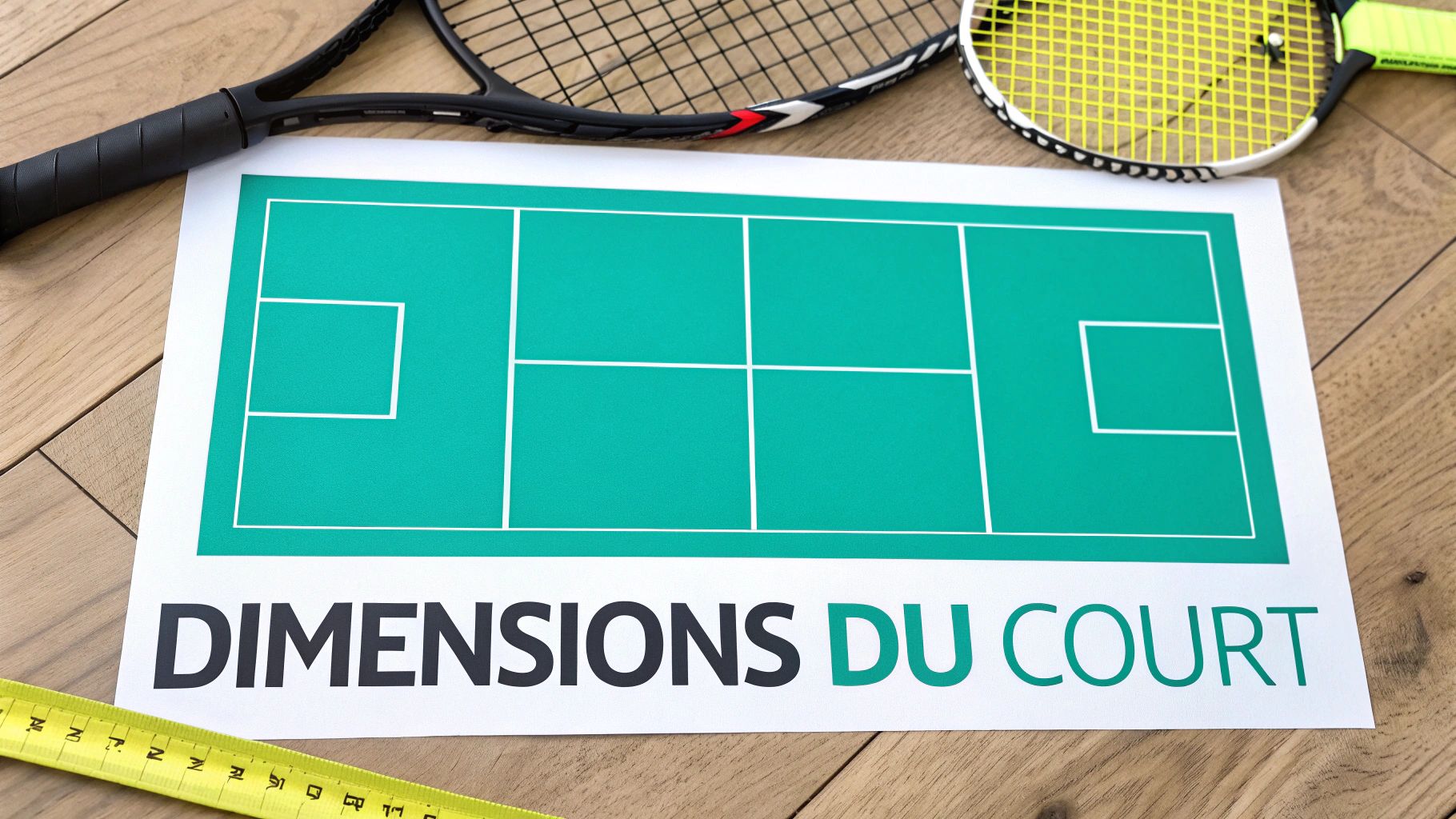
A tennis court measures precisely 23.77 meters long. But it’s its width that changes everything, as it depends on the match format. For a singles match, it is 8.23 meters.
In doubles, the game expands. The famous "alleys" are added, these two strips on each side measuring 1.37 meters each. The total width then rises to 10.97 meters. This extra space completely changes the game, opening up new angles and tactics.
Here are the areas every player must know by heart:
- The baseline: This is the line farthest from the net. The server must stand behind it, and it marks the length limit of the court.
- The service boxes: The two rectangles just behind the net. This is the mandatory target: a serve must land in the diagonally opposite box to be valid.
- The alleys: These side strips are only in play for doubles matches. In singles, if your ball lands there, it’s a fault.
Every rally is dictated by these measurements. They set the boundaries not to be crossed and create strategic zones, like the service boxes, which are at the center of the battle to win the point.
Imagine the court as a game board. Each line is not just a simple boundary; it’s a marker that influences your positioning, shot choices, and your entire strategy. Mastering these dimensions is already starting to read your opponent's game.
The Player's Regulatory Equipment
Beyond the court, the equipment is also subject to very strict standards. The goal? To ensure fair and balanced competition. It’s not enough to have a racket and balls; the equipment must be approved.
The tennis racket
It’s the extension of the player's arm. Its characteristics (weight, head size, string pattern) have a direct impact on power and control. To prevent technological drift, official rules impose limits. For example, the total length must not exceed 73.7 cm and the width 31.7 cm.
The tennis balls
Not all yellow balls are the same! An approved ball must meet very specific criteria: a weight between 56 and 59.4 grams, a specific diameter, and above all, a calibrated bounce capacity. If dropped from a height of 2.54 meters, it must bounce between 1.35 and 1.47 meters. This standardization is crucial to ensure the consistency of rallies.
This rigor, whether for court dimensions or equipment specifications, is the foundation upon which the integrity of the tennis game rules rests.
Singles vs. Doubles: Much More Than Just Two Extra Players
Switching from a singles match to a doubles match is not just about adding two people to the court. It’s a whole different discipline. The geometry of the court, the pace of play, the strategy... everything changes. The tennis rules adapt to turn a duel into a true collaboration exercise.
The first change that stands out is, of course, the size of the court. In doubles, you play with the alleys. These two side strips, each 1.37 meters wide, are added to the playing area. The court thus expands from 8.23 meters to 10.97 meters wide. This opens up completely new angles and requires covering a much larger space.
This extension of the court changes the entire tactical game. A singles player focuses on their half of the court. In doubles, they must think as a team, anticipate their partner's movements, and communicate constantly to leave no space for the opponent.
Who Serves? Who Returns? A Well-Oiled Mechanism
The serving in doubles follows a very logical rotation to ensure fairness. At the beginning of each set, the serving team chooses which of the two players will start. The same goes for the opposing team, which designates who will receive the first serve.
Once decided, this order is set in stone for the entire set:
- Game 1: Player A1 (team 1) serves to Player B1 (team 2).
- Game 2: Player B2 (team 2) serves to Player A2 (team 1).
- Game 3: Player A2 (team 1) serves to Player B1 (team 2).
- Game 4: Player B1 (team 2) serves to Player A1 (team 1).
And so on. You cannot change before the next set. It’s a strategic decision from the very first game: who is the best server to start? Who is most comfortable returning?
Communication, the Secret of Great Teams
While in singles, you are alone with your choices, doubles is a constant dialogue. Communication, whether verbal or through signals, is key. Partners talk before each point to agree on tactics, the type of serve, the area to target...
In doubles, the best shot is not always the one that wins the point, but the one that puts your partner in an ideal position to finish. It’s a four-player chess game, where anticipation and trust in each other matter as much as technique.
This collaborative dynamic makes doubles a brilliant parallel to team-building in business. Victory does not rest on one talent but on the ability of two people to synchronize their actions, anticipate each other's needs, and adjust their strategy to achieve a common goal.
This collective dimension of tennis, just like its rich history, is a source of inspiration for extraordinary corporate events. The evolution of the rules, such as the establishment of equal prize money for men and women at Roland-Garros in 2006, shows how the sport adapts to its time. Imagine teams predicting the rules of singles or doubles, earning points through quizzes and integrated chat... We transform these game dynamics into true engagement. To learn more about the history of tennis in France and its impact, feel free to check out this detailed retrospective.
FAQ on Tennis Game Rules
Even after dissecting the basics, some more nuanced questions about the tennis game rules often arise. No worries, this FAQ is here to clear up any remaining doubts with clear and direct answers. The goal? To ensure you can approach any match situation with unwavering confidence.
What happens if a ball touches the line?
This is one of the most fundamental rules, and sometimes one of the most frustrating, in tennis. If a ball touches even a fraction of a millimeter of one of the lines that define the court, it is considered good ("in").
This rule applies to absolutely all lines: baseline, side lines, or even those of the service boxes. A point can thus be played to a hair's breadth, but the rule is unequivocal: the line is an integral part of the court.
When do players change sides?
To ensure perfect fairness against external conditions (wind, sun...), players change sides at specific moments in the match. The change occurs after the very first game, then every two games.
Specifically, the sequence is as follows:
- After the 1st game (score of 1-0)
- After the 3rd game (score of 2-1 or 3-0)
- After the 5th game (score of 3-2 or 4-1), and so on.
A small nuance to know: during a tie-break, it changes much more frequently! Players change sides every six points to maintain perfect balance during this high-pressure decisive game.
Is it allowed to touch the net during a point?
The answer is a categorical no. It is strictly forbidden to touch the net, the posts, or even your opponent's half of the court with your racket, body, or clothing as long as the ball is in play.
If a player commits this error, they immediately lose the point. Of course, this prohibition stops as soon as the point is over, for example, after a double bounce or a called fault. To spice up your sports evenings, why not organize a prediction contest for Roland-Garros 2025 and test your colleagues' knowledge on such details?
What is an ace in tennis?
An ace is the server's ultimate weapon. It’s simply a perfect serve that lands in the correct service box, but the opponent cannot even touch it with their racket. It’s the ultimate winning point, synonymous with power and surgical precision.
The umpire announces it proudly, and there’s no discussion possible: the point is won before the rally could even begin.
Engage your teams and strengthen cohesion through the magic of sport. With ccup.io, launch personalized prediction contests for the biggest sporting events and transform every match into an unforgettable collective experience. Discover how at ccup.io.
Latest articles

12 hours ago
Nations League 2026 Predictions: 7 Match Analyses to Excel
The UEFA Nations League is back, offering a premier international football spectacle and an exceptional opportunity to engage teams. Whether you are a passionate fan looking to refine your analyses or a manager wanting to boost internal cohesion, this guide is designed for you. We will break down...

2 days ago
Top 14 Rugby Predictions: 2026 Guide to Analyze Matches and Boost Your Team
The Top 14 is much more than just a sports competition. For enthusiasts, it’s a weekly appointment for analysis and predictions. For businesses, it’s a golden opportunity to strengthen cohesion and engage teams around a common passion. Whether you’re looking to refine your bets or organize an eng...





















Contact us
For any question or quotation requests, do not hesitate to reach us by phone at 01 83 79 24 54 or by email : contact@ccup.io
Contact us


Frequently asked questions
What is ccup.io?
Ccup.io is a cohesion tool, allowing firms to gather their collaborators on the occasion of major sporting events, such as World Cup or Olympic Games. We offer an interactive forecasting platform, turnkey and customisable to your company’s colours.
What are you doing with our data?
By deciding to use our services, you decide to entrust us a part of your data – this will allow us to optimise your experience. We place great emphasis on the protection of your data, in compliance with current regulations. Given that it is important to be informed on the issues and challenges of personal data protection, ccup.io provides you with a most complete documentation on this matter.
How much does it cost?
In order to give our clients flexibility, we make a special rate depending on the number of registered players using a degressive system for an important number of participants. This allows firms to organise tailored events, adapted to their capacity. To receive a commercial offer in less than an hour, you only need to fill out the quotation requests form, with just a few clicks.



Don’t miss this opportunity 😍
Start now and enjoy numerous benefits