



Sense of Belonging in the Workplace: A Practical Guide to Strengthening Your Teams
What is the sense of belonging in the workplace? It is the psychological and emotional bond that ties an employee to their organization. It’s about feeling accepted, respected, and valued, not just for your work, but for who you truly are.
Why the Sense of Belonging is an Invisible but Essential Foundation
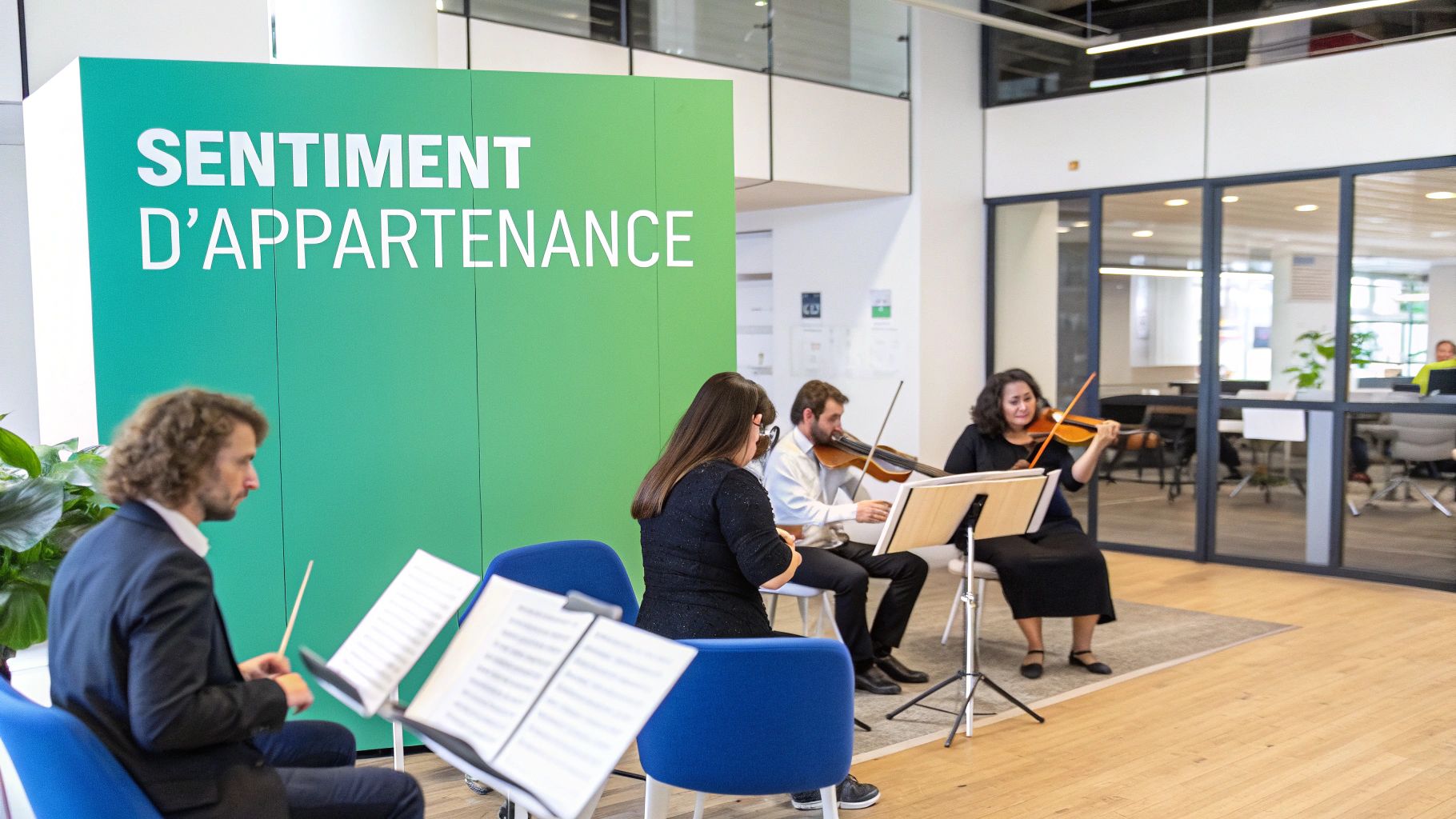
Imagine a company as an orchestra. You can recruit the most talented musicians in the world, but if each one plays their own score without listening to the others, the result will be cacophony.
Individual talent is not enough. It is the cohesion, harmony, and conviction to create something great together that transforms noise into symphony. The sense of belonging is that invisible conductor that aligns energies.
For HR and internal communication managers, this image resonates with very real challenges: disengagement, high turnover, or the difficulty of maintaining a strong culture in the era of hybrid work. These problems are often symptoms of a fragile foundation, where human connections have eroded.
The sense of belonging is not an abstract concept or just a "nice-to-have." It is a tangible performance lever that directly influences retention, innovation, and productivity.
This guide is designed as a roadmap to help you move from theory to action. We will break down what forges a true sense of belonging in the workplace and provide you with concrete strategies to build, measure, and sustain it.
What Will You Find in This Guide?
This article will provide clear answers and ready-to-use tools for:
- Precisely defining what the sense of belonging is and its psychological components.
- Understanding its direct impact on your key performance indicators (KPIs).
- Implementing methods to measure and track this sentiment within your teams.
- Discovering proven strategies, from onboarding new hires to organizing unifying rituals like sports activities.
The goal is not just to reassure you in your intuitions but to equip you to transform your company culture. You will learn to make this sentiment a strategic force, turning a group of individuals into a cohesive and high-performing community.
Decoding the Sense of Belonging Beyond Buzzwords
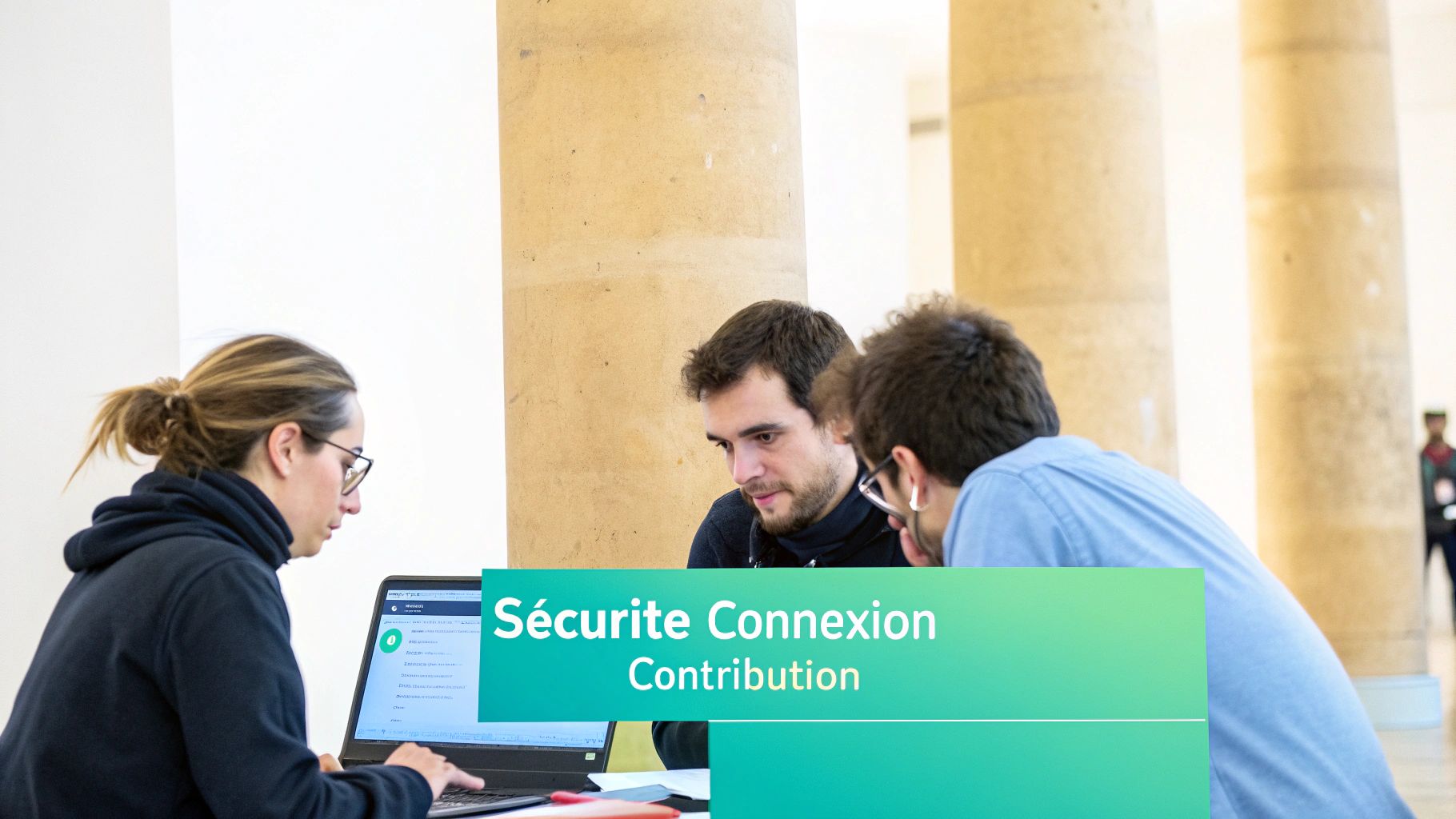
The sense of belonging in the workplace is on everyone's lips, but it is often treated as a somewhat vague concept. However, behind this term lies a very concrete psychological mechanism, based on three essential pillars.
Understanding these pillars is the first step to transforming a simple cultural ambition into a true operational strategy.
This need to be part of a group is ingrained in us. It’s not just about occupying an office, but about feeling connected to a common mission and to colleagues who accept us as we are.
Unfortunately, in France, this connection seems to be eroding. The sense of belonging is at an all-time low: only 6% of employees truly feel invested in their company, far from the European average of 14%. This massive disengagement is costly, with a loss of profitability that can reach 21%. To delve deeper into the subject, the findings on workplace attachment from tnpconsultants.com are enlightening.
To turn the tide, we must address the roots of the problem.
The Three Pillars of the Sense of Belonging
Rather than an abstract notion, the sense of belonging is actually the result of three distinct experiences that work together.
- Psychological safety
It is simply the permission to be oneself, without having to wear a mask. Being able to give a different opinion, ask a question that seems "silly," or acknowledge a mistake without fear of being judged, humiliated, or sidelined. - Connection
This refers to the authentic bonds we weave with our colleagues. It goes beyond mere professional relationships; we talk about mutual respect, empathy, and the feeling of being part of a real community. - Contribution
It is the certainty that our work truly matters. Each person in the team must clearly see how their daily tasks fit into the overall mission of the company and contribute to its success.
Imagine a team of developers. Psychological safety is when a junior developer dares to challenge a senior's technical approach. Connection is the natural help to solve a complex bug. Contribution is the pride of seeing the feature they coded being used and appreciated by thousands of customers.
These three elements, once combined, create an environment where people come not just to work, but to grow within a collective.
Belonging, Engagement, and Satisfaction: Beware of Confusing Them
It is easy to confuse these three notions, but they respond to very different levers. Engagement can be stimulated by external factors (a bonus, a promotion), while belonging comes from within; it is a deeply emotional motivation.
To clarify, nothing beats a little comparative table. It helps to understand the nuances between these three key concepts and to better target your actions.
Comparison Between Belonging, Engagement, and Satisfaction
| Concept | Main Definition | What It Means for the Employee | Example Indicator |
|---|---|---|---|
| Belonging | The feeling of being accepted, included, and valued for who you are. | "I feel at home here. I can be myself and I am part of the team." | Rate of voluntary participation in internal events. |
| Engagement | The level of investment and motivation in one's work and the company's objectives. | "I am motivated to give my best to achieve our goals." | eNPS (Employee Net Promoter Score). |
| Satisfaction | The contentment related to working conditions (salary, benefits, environment). | "My working conditions are good. My salary is fair and my hours are flexible." | Turnover rate. |
This framework is a very powerful diagnostic tool. An employee can be very happy with their salary (satisfaction) and very productive (engagement), but feel completely isolated and end up leaving due to a lack of connection (belonging).
By making the right diagnosis, you can deploy much more targeted and therefore much more effective actions. By mastering these pillars, you have all the cards in hand to build a culture where every person feels not only useful but truly in their place.
Why the Sense of Belonging is Your Best Business Asset
The sense of belonging in the workplace is not just a checkbox on the workplace well-being list. It is a true performance driver, with direct and concrete returns for the business. Investing in human connections is not an expense, but a strategic choice that pays off at all levels.
When your employees truly feel at their place, they do not just clock in in the morning. They invest themselves, body and soul, in collective success. This emotional connection changes everything, from individual engagement to the financial results of the company.
A Direct Impact on Reducing Turnover
The real cost of replacing an employee is often underestimated: recruitment, onboarding, the time to ramp up, lost productivity... A strong sense of belonging is the best defense against this talent hemorrhage.
A study by BetterUp has put numbers on this reality: companies that actively cultivate this bond see their turnover decrease by 50%. That’s huge. Employees who feel connected to their colleagues and the company’s mission simply won’t look to see if the grass is greener elsewhere. They forge strong ties, develop loyalty that goes beyond the paycheck, and become pillars you can count on.
To delve into this topic, it is essential to understand the role of company culture in talent retention, which clearly shows how a positive environment becomes the key to keeping your best elements.
Increased Productivity and Engagement
An employee who feels like a member of a team, a community, is naturally more motivated. This is not just an impression; the numbers are clear. The same report from BetterUp reveals that a strong sense of belonging can increase work performance by 56%.
But what does that mean in practice?
- Smoother collaboration: Cohesive teams communicate better, share information without withholding, and find solutions faster. It’s as simple as that.
- More initiative: When you feel safe, you dare. You propose ideas, take calculated risks, without fear of being reprimanded.
- Unwavering resilience: A united collective withstands tough times better. Mutual support helps overcome obstacles and bounce back faster after a difficult period.
Imagine a sales team where everyone shares their failures of the week without filters. This transparency, which can only exist thanks to trust, allows them to adjust their strategies together, learn from each other's mistakes, and ultimately boost the overall conversion rate. That’s the strength of the collective.
A Catalyst for Innovation
Innovation never arises in an environment where fear of judgment reigns. It needs fertile ground, where the diversity of opinions is not only tolerated but actively sought. The sense of belonging creates exactly this climate.
When employees feel they can be themselves, they dare to think outside the box. Constructive confrontation of ideas becomes the norm, and the walls between departments fall in favor of collective intelligence. Diverse and inclusive teams are, by nature, more creative because they tackle problems from completely different angles.
A Pillar for Your Employer Brand
Finally, a strong sense of belonging in the workplace transforms your employees into your best ambassadors. An employee proud of their company talks about it, shares it on their networks, and discusses it with others. It’s natural.
This authentic advertising can never be bought. It attracts talent that is not just looking for a job, but for a culture, an environment where they can thrive. You become more attractive and gain a major competitive advantage in a tight labor market. To explore the topic further, take a look at our comprehensive guide on what employer branding is and how to build it.
Measuring the Sense of Belonging to Make It Tangible
A feeling, even as strong as belonging, remains a vague notion if it is not measured. To move from the abstract to a real strategic lever, it must be quantifiable. The idea is not to box human emotions but to capture signals, trends, to act in an informed manner.
The best approach? Combine quantitative indicators (the famous KPIs) with qualitative analyses. It is by crossing these two types of data that you obtain an accurate and, above all, actionable view of cohesion within the company.
Quantitative Indicators to Track
Numbers provide an essential first glimpse. They allow tracking changes, comparing periods, and justifying actions to management with data that speaks for itself.
Here are some key indicators to assess the sense of belonging in the workplace:
- Employee Net Promoter Score (eNPS): This indicator measures the likelihood that your employees would recommend your company as a good place to work. A simple question like “On a scale of 0 to 10, would you recommend our company to a friend?” says a lot about their pride.
- Participation rate in internal events: Whether it’s a seminar, a year-end party, or a sports competition, the rate of voluntary participation is a very reliable barometer. A low registration rate often signals an eroding bond.
- Voluntary turnover rate: A voluntary departure, especially if frequent, can signal much more than just a salary or mission issue. It is often a symptom of a lack of connection to the team or company culture.
This infographic summarizes the concrete benefits of a strong sense of belonging, benefits that these indicators allow you to track.
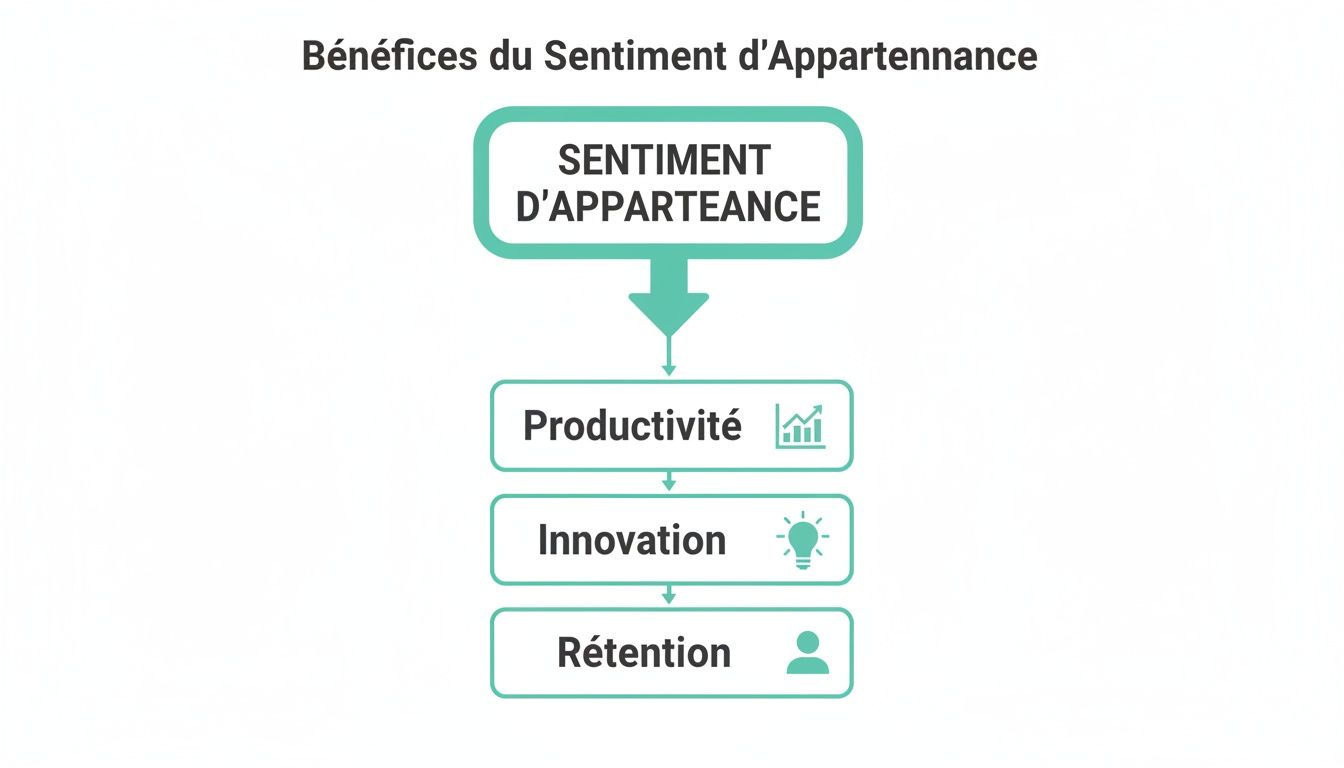
It is clear how the sense of belonging acts as a foundation that directly supports productivity, innovation, and talent retention – the pillars of performance.
The Importance of Qualitative Data
Numbers tell you what, but rarely why. To understand the roots of a problem or identify invisible friction points, there’s no secret: you must listen to what employees have to say. This is where qualitative methods become essential.
They allow capturing the nuances, emotions, and context that lie behind the statistics.
“Pulse” surveys, short and regular, are an excellent tool. Rather than asking generic questions, target specific aspects of belonging with formulations like: “Do you feel comfortable expressing a differing opinion in meetings?”
In the same vein, analyzing comments during exit interviews is a true goldmine. The words chosen by a departing employee (“isolation,” “lack of recognition,” “cliques”) are valuable weak signals that reveal fractures in the culture.
Lack of Recognition as a Warning Signal
If there is one destructive factor for the sense of belonging, it is the lack of recognition. Feeling invisible or that one’s efforts are not valued creates an almost insurmountable emotional distance from the company.
Unfortunately, this is still a widespread problem. Indeed, only 26% of French employees report receiving regular recognition. This valuation deficit fuels a vicious circle: 41% of employees feel isolated and 39% feel a weak attachment to their organization.
By combining these different tools, HR managers can build a true dashboard. This monitoring not only measures the impact of initiatives implemented but also anticipates problems before they escalate. Measuring the sense of belonging is giving yourself the means to sustainably improve the quality of work life. If you are interested in the topic, discover action paths in our dedicated article on how to improve quality of work life.
Concrete Strategies to Build a Strong Culture of Belonging

Making the sense of belonging a tangible reality goes far beyond good intentions. It requires a thoughtful approach, targeted actions, and a commitment at all times. Fortunately, several powerful levers are within our reach.
Building a solid culture is a bit like building a house. Each pillar must be laid with care so that the structure withstands the test of time and challenges. Let’s explore four of these essential pillars together.
From welcoming the newest arrival to celebrating collective successes, these strategies weave the social fabric that connects individuals to each other and, ultimately, to the entire company.
1. An Onboarding Process That Creates Bonds from Day One
The first impression is crucial. That’s why a well-crafted onboarding process is the very first stone of the edifice. We’re not just talking about providing a computer and passwords.
The idea is to immerse the new recruit in the company culture, give them the keys to understand the codes, and above all, create immediate human connections. A good onboarding transforms the apprehension of the first day into genuine enthusiasm.
Here are some concrete ideas:
- Establish a buddy program: Pairing a newcomer with an experienced "buddy" facilitates their social and professional integration. It’s an informal entry point to ask all the questions they might not dare to ask their manager.
- Create welcome rituals: Organizing a team breakfast, sending a personalized welcome kit, or simply making a warm announcement on internal communication channels. Simple gestures, but they make all the difference.
- Plan meetings: Scheduling exchange points with key people from different departments helps the new recruit grasp the overall ecosystem and start weaving their network.
A successful onboarding sends a strong and clear message: "We are happy you are here, and you already have your place among us."
2. Transparent and Two-Way Internal Communication
The sense of belonging cannot be born in silence or opacity. Effective internal communication is the nervous system of the company: it ensures that information flows freely and that every voice can be heard.
Being transparent about strategic decisions, successes, and difficulties builds trust. Employees then feel respected and considered true partners, not just executors.
To achieve this, it is necessary to encourage two-way communication, where team feedback is not only solicited but also taken into account. This can be done through regular surveys, suggestion boxes, or Q&A sessions with management. To go further, mastering intercultural communication in the workplace is a major asset to ensure that everyone feels understood and valued, regardless of their background.
True communication is not what is said, but what is understood. When employees feel that their opinion matters, their involvement in the life of the company takes off.
3. Recognition as a Driver of Valuation
Feeling valued is a fundamental human need. Implementing recognition programs, whether formal or informal, is one of the most direct ways to nurture the sense of belonging.
And we’re not just talking about bonuses! It’s about celebrating efforts, behaviors that embody the company’s values, and successes, big and small. To be effective, recognition must be specific, sincere, and regular.
Here are some avenues to explore:
- Peer-to-peer programs: Allowing employees to congratulate each other strengthens horizontal ties and highlights contributions that might go unnoticed by management.
- Celebrating key milestones: Career anniversaries, completion of important projects... Every milestone is an opportunity to highlight commitment and loyalty.
- Public positive feedback: Highlighting an individual or collective achievement during a team meeting has a multiplied impact.
Recognition transforms daily work into a visible and appreciated contribution. It strengthens the pride of being part of a company that truly sees and values its members.
4. Unifying Rituals to Create Shared Memories
Shared moments outside the strict work framework are the cement of human relationships. Rituals and internal events create shared memories, break down hierarchical barriers, and allow personalities to express themselves.
According to an OpinionWay study, 67% of French employees reported loving their company in 2022. Yet, while 87% expect support from their employer, 30% still feel indifference, which is a major barrier to the sense of belonging.
This is where fun events come into play and act as powerful catalysts. Organizing a sports prediction contest, for example, provides a great excuse to interact differently. A platform like ccup.io, customized to the company’s colors, reinforces brand identity while creating a space for play and exchange. Whether you’re a sports expert or a novice, everyone can participate, comment on results, and challenge each other in good spirits. To explore the topic further, discover how sports predictions can become a team-building tool.
These moments of relaxation are vital for bonding teams, especially in a hybrid work context where water cooler discussions are becoming rarer. They prove that the company is much more than a workplace: it is a true community.
To help you take action, here’s a summary table of the strategies we just discussed.
Action Plan to Strengthen Belonging
This table synthesizes concrete actions by strategic pillar, with examples of tools and associated KPIs.
| Action Pillar | Main Objective | Example of Concrete Initiative | Follow-Up KPI |
|---|---|---|---|
| Onboarding | Create a sense of welcome and integration from day one. | Implement a buddy or mentoring program. | Satisfaction rate of new recruits (30-day survey). |
| Internal Communication | Ensure transparency and encourage feedback. | Launch monthly 'Ask Me Anything' sessions with management. | Participation rate in sessions; semantic analysis of questions. |
| Recognition | Value contributions and efforts of everyone. | Use a dedicated Slack/Teams channel for peer-to-peer recognition. | Number of recognition messages exchanged per month. |
| Unifying Rituals | Create shared memories and strengthen informal ties. | Organize a sports prediction contest during a major event. | Registration rate for the contest; number of interactions on the platform. |
This plan is just a starting point. The essential thing is to choose initiatives that resonate with your culture and to animate them authentically to make the sense of belonging the true heart of your organization.
Absolutely! Here’s the rewrite of this section in the requested style, with a more human, expert, and natural touch.
Belonging is a Journey, Not a Destination
The sense of belonging is not a box to check off on a to-do list. It is something that is cultivated day by day, through interactions, projects, and shared moments. It should be seen as a continuous effort, a collective journey rather than a final destination.
Every managerial decision, every team meeting, and even the simplest conversation at the coffee machine contributes to weaving the fabric of your culture. The strategies we have explored, from onboarding to recognition, are not isolated actions. They are the threads that make this fabric stronger.
Become the Architect of Your Company Culture
As HR or communication leaders, you are the architects of this environment. You have the power to transform a simple workplace into a true community where everyone feels seen, heard, and valued. The true strength of a culture of belonging is its ability to make every employee a proud ambassador for their company.
The greatest changes often start with the smallest actions. Don’t wait for the perfect plan to begin.
So, get started today. Organize a virtual coffee for a team, send a truly personal thank-you message, or share a collective success in a visible way. Every small initiative is a seed you plant to strengthen the bonds.
To bring these moments of connection to life that transform a group into a cohesive team, certain tools can give you a real boost. This is where ccup.io comes in, not just as a platform, but as a partner. Our mission is to help you create these unifying rituals that generate shared memories and sustainably strengthen the sense of belonging, whether your teams are in the office or miles apart.
We Answer You: Frequently Asked Questions About the Sense of Belonging
Do you have questions about the sense of belonging? That’s normal. Here are clear and direct answers, designed for managers and HR professionals who want to take action.
How to Quickly Improve the Sense of Belonging?
The quickest lever is recognition. No need for grand speeches or complex budgets to get started.
Publicly thank an employee for their valuable help on a project. Establish a small ritual at the beginning of team meetings where everyone shares a success, even a modest one. These simple gestures show that everyone’s work is seen and appreciated. It’s the most direct way to strengthen the feeling of being an important member of the group.
What is the Manager's Role, Specifically?
The manager is the cornerstone of all this. It is they who, on a daily basis, weave the psychological safety net for their team. It is thanks to them that every member feels safe enough to share a slightly crazy idea or even admit a mistake without fear of being judged.
A management style that gives everyone a voice and values diverse viewpoints is absolutely essential. It ensures that no one ever feels sidelined.
Company Events: Gadgets or Real Benefits?
They are a real plus, but on one condition: that they create authentic interactions. A formal dinner where everyone remains polite at their table will have far less impact than a fun activity that breaks down hierarchical barriers.
For example, a sports prediction contest during a major competition. Suddenly, we’re not talking about files anymore, but about football or rugby. It creates play, informal conversations, and shared memories. That’s the cement that transforms a group of colleagues into a true community.
Does Remote Work Kill the Sense of Belonging?
Not necessarily, but it forces us to be much more creative and intentional. When we no longer cross paths at the coffee machine, we need to reinvent those moments of connection.
We need to multiply informal touchpoints, like virtual coffees without a specific agenda, and rely on collaborative tools that make communication fluid. The secret is to compensate for physical distance with greater human proximity and tailored communication.
To transform these moments of connection into a true cohesion lever, ccup.io helps you organize fun and unifying activities that sustainably strengthen your company culture. Discover how at https://ccup.io.
From Content To Conversion
Turn your next sports event into a company prediction contest
Discover the platform, explore available competitions, and launch a branded experience that supports engagement, internal communication, and team cohesion.
See available competitions
Related articles

2 weeks ago
Olympic Games 2026 Animations: Team Building Ideas
The Olympics: a gold medal for your company culture. Many HR and internal communication teams, however, start with a bad reflex. They reduce Olympic Games activities to an office olympiad, an improvised quiz, or an evening in front of a final. This creates a highlight, but rarely a true engagement m...

2 weeks ago
Rugby Contest: 7 Formats to Engage Your Teams
Transform the try. Many companies still think that a rugby contest is just about "guessing a score" and giving away a prize at the end. That's too short. The real issue is to convert a major sports moment into a long-lasting engagement device that is easy to join and does not create legal or operati...

2 weeks ago
Sports Event Poster: 7 Models and Tips 2026
Your next sports event poster probably doesn't look like what you had in mind yet. You have a date, a location, maybe an interdepartmental tournament, a charity run, or a prediction contest to launch. But between the management brief, brand constraints, printing deadlines, and the fear of producing...





















Contact us
For any question or quotation requests, do not hesitate to reach us by phone at 01 83 79 24 54 or by email : contact@ccup.io
Contact us


Frequently asked questions
What is ccup.io?
Ccup.io is a cohesion tool, allowing firms to gather their collaborators on the occasion of major sporting events, such as World Cup or Olympic Games. We offer an interactive forecasting platform, turnkey and customisable to your company’s colours.
What are you doing with our data?
By deciding to use our services, you decide to entrust us a part of your data – this will allow us to optimise your experience. We place great emphasis on the protection of your data, in compliance with current regulations. Given that it is important to be informed on the issues and challenges of personal data protection, ccup.io provides you with a most complete documentation on this matter.
How much does it cost?
In order to give our clients flexibility, we make a special rate depending on the number of registered players using a degressive system for an important number of participants. This allows firms to organise tailored events, adapted to their capacity. To receive a commercial offer in less than an hour, you only need to fill out the quotation requests form, with just a few clicks.



Don’t miss this opportunity 😍
Start now and enjoy numerous benefits