



Sense of Belonging Definition: Understanding and Boosting Team Engagement
The sense of belonging in the workplace is much more than just a checkbox on a satisfaction survey. It is that emotional connection, almost invisible, that an employee weaves with their workplace. It is feeling like a full member of a team, valued, respected, and above all, free to be oneself. It is not just about comfort; it has become a true pillar of collective performance.
But what exactly is the sense of belonging?
This need to belong is deeply human. Psychologist Abraham Maslow placed it just after our primary security needs. In the workplace, it is what transforms a simple group of colleagues into a real cohesive team, moving in the same direction, driven by shared values.
Think of a sports team. The players do not just share a jersey. They share trust, strategy, and collective pride. It is exactly the same dynamic in business. The spark happens when each person feels that their contribution matters, but also that their unique personality is welcome.
The Pillars of Authentic Belonging
To truly understand the definition of belonging, one must look beyond the concept. It is an experience that relies on several concrete pillars. An employee will truly feel at home if:
- They feel psychologically safe: They can express an idea, ask a question, or even voice a disagreement without fear of being judged or penalized.
- They feel connected to others: They build authentic relationships with their colleagues and managers, creating a real support network on a daily basis.
- Their contribution is recognized: They have the conviction that their work has a real impact and that it is valued appropriately by the company.
These three elements are inseparable. It is their combination that creates an environment where employees do not just come to "put in their hours," but invest in a mission that makes sense to them.
The sense of belonging is not a luxury; it is a driver of sustainable performance. A study by BetterUp showed that a strong sense of belonging can reduce turnover by 50% and decrease absenteeism by 75%.
This emotional connection has a direct effect on everyone's motivation. An employee who feels at home will take more initiatives, collaborate more naturally, and become a spontaneous ambassador for the company. This is a major asset for the attractiveness of your organization. To delve deeper into the topic, take a look at our article on what employer branding is. Cultivating this sense is therefore a key approach to attracting and, above all, retaining the best talents.
The Three Pillars of Belonging at Work
To truly build a company culture where it is good to work, one must first understand what the sense of belonging rests upon. Far from being an abstract concept, it revolves around three concrete and totally interdependent pillars. Each plays a key role in ensuring that an employee does not feel just like an employee, but like a full member of the team.
Imagine your company as a kind of modern-day "tribe." For someone to feel good there, they must first feel safe, then build connections with other members, and finally, have the conviction that their actions matter to the group. It is precisely these dynamics that form the foundations of the sense of belonging.
The diagram below clearly illustrates this logic: starting from the concept of belonging to arrive at concrete actions and their associated benefits.
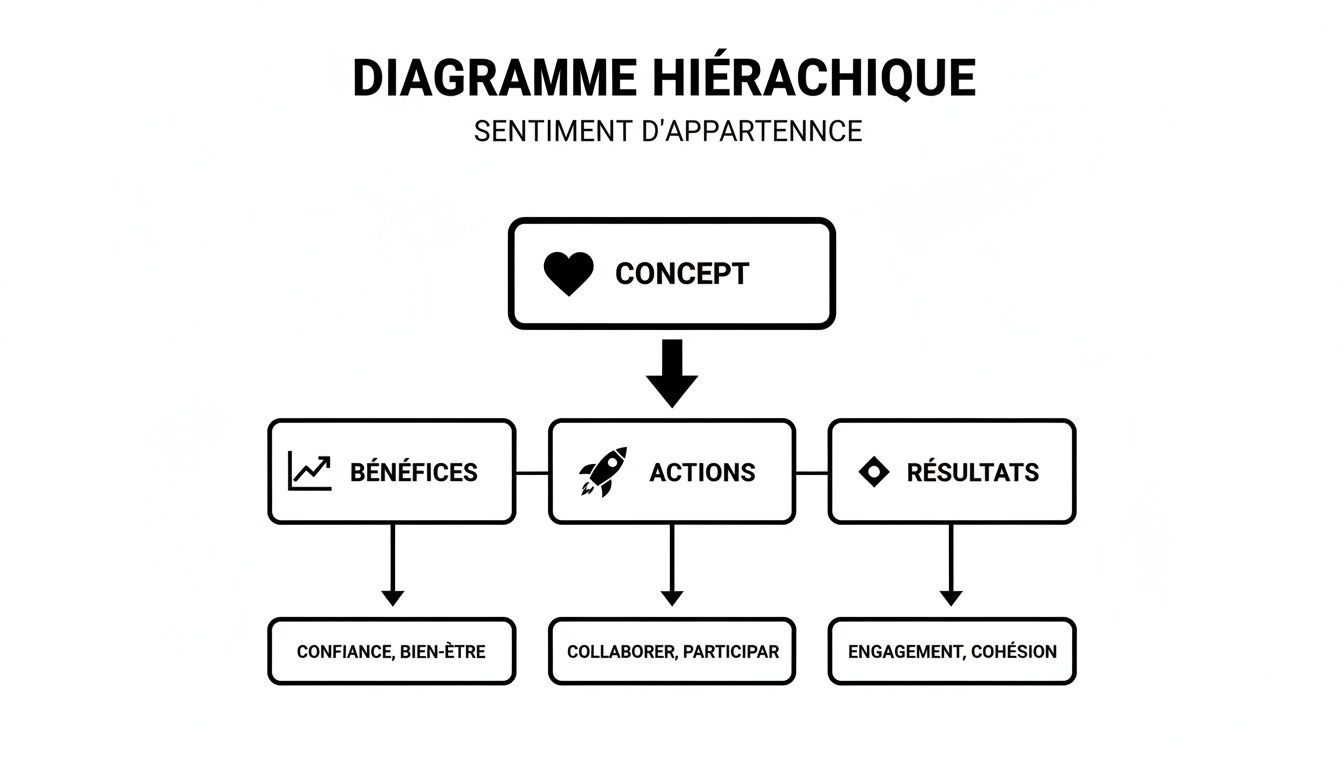
What you need to remember is that targeted actions, based on solid principles, are the only way to achieve measurable results in terms of engagement and performance.
1 Psychological Safety
The first pillar, and probably the most crucial, is psychological safety. It is the foundation upon which everything else rests. It involves creating an environment where each person feels free to be themselves, without fear of being judged, mocked, or penalized.
Very concretely, this means being able to:
- Express a different opinion in meetings without fearing being sidelined.
- Ask questions that may seem simple without feeling ridiculous.
- Openly acknowledge a mistake, focusing on the solution rather than on finding a culprit.
When psychological safety is present, innovation takes off. Teams dare to take calculated risks and share new ideas because they know that failure is seen as an opportunity to learn. Without this foundation of trust, it is impossible to build authentic relationships.
2 Social Connection
Once safety is established, the second pillar can truly develop: connection. It is the feeling of being a valued member of a close-knit community, where shared values, experiences, and sincere human relationships exist. This pillar addresses our fundamental need for social connection.
This connection is nourished by both formal and informal moments. It strengthens when employees celebrate collective successes, but also during lighter and more convivial moments. A simple coffee taken together or a discussion that does not revolve around work can have a huge impact.
An employee can be excellent at their tasks without feeling connected. It is this human link that transforms purely professional engagement into a true emotional attachment to the company.
This is where rituals and shared moments make all the difference. They forge common memories and break down barriers between departments, transforming simple colleagues into true allies.
3 Contribution and Recognition
The third and final pillar is contribution. To feel fully at home, an employee must see that their work has a real impact and that they are recognized for it. It is the feeling that their personal efforts serve a collective goal greater than themselves.
This pillar is activated when:
- The link between daily tasks and the company's overall strategy is clear.
- Successes, big and small, are celebrated publicly and sincerely.
- Feedback is constructive and regular, showing everyone that their professional development matters.
Without this sense of contribution, work can quickly become a series of soulless tasks. Recognition, whether from a manager or peers, is the fuel that powers this pillar and gives deep meaning to everyone's investment. Together, these three pillars create a virtuous circle where every talent can thrive.
The Measurable Impact of Strong Team Cohesion

A true sense of belonging does not just create a good atmosphere in the office. It is a powerful lever for performance, and its effects are directly visible in your company's figures. When employees feel at home, listened to, and connected to their colleagues, their mindset changes. And that produces very concrete results.
This emotional connection far exceeds mere personal well-being; it transforms into a real competitive advantage. Cohesive teams are simply more resilient, more agile, and better equipped to face the unexpected. Therefore, it is essential to understand how this sense translates into measurable benefits.
Less Turnover and Better Talent Retention
One of the most visible and easily quantifiable impacts is the drop in turnover. It makes sense: an employee who feels good, respected, and listened to will be much less inclined to look elsewhere. We often forget the cost of a departure, between recruitment, onboarding the replacement, and the temporary loss of productivity.
Studies show that a strong sense of belonging can reduce turnover by up to 50%. This is a direct saving, but it is also a way to retain key skills and knowledge within the company.
This loyalty makes your employees your best ambassadors. Proud to work for you, they speak positively about your company, which naturally boosts your employer brand and attracts talents who already share your values.
Increased Productivity and Engagement
Employees who are happy in their team are simply more motivated. This emotional bond transforms into stronger daily engagement. They no longer settle for doing the bare minimum; they want to participate in collective success.
This positive dynamic leads to several things:
- Smoother collaboration: Trust facilitates the sharing of ideas and mutual support. Projects progress better, with less friction.
- More initiative-taking: Employees feel safe enough to propose new ideas, to dare.
- A decrease in absenteeism: The pleasure of seeing colleagues and feeling useful reduces absences. Some studies even mention a 75% reduction in sick days in companies with a strong culture of belonging.
Creating convivial moments is an excellent way to nurture these bonds that boost performance. For out-of-the-ordinary ideas, take a look at our guide explaining how sports prediction contests in the workplace can create a pleasant and productive work environment.
A Fertile Ground for Innovation
Innovation does not thrive in an environment where fear and distrust prevail. It needs a climate of trust, where employees feel free to try, share a few crazy ideas, and even make mistakes. This is precisely the psychological safety framework that a strong sense of belonging helps create.
When teams are cohesive, there is no hesitation in questioning what already exists and working together creatively. This collective intelligence allows problems to be solved faster and solutions to be found that no one had thought of. Companies that invest in belonging are often the ones that adapt best to change.
To visualize the gap concretely, the table below compares key performance indicators between two types of company cultures.
Impact of the Sense of Belonging on Company Performance
| Key Performance Indicator (KPI) | Low Sense of Belonging Culture | High Sense of Belonging Culture |
|---|---|---|
| Turnover Rate | High, frequent departures | Up to 50% lower |
| Employee Engagement | Low, minimal involvement | High, strong proactivity |
| Productivity | Stagnant or declining | Notable increase |
| Absenteeism | High absence rate | Up to 75% reduction |
| Collaboration Quality | Silos, lack of communication | Fluid exchanges and mutual aid |
| Innovation Capacity | Low, resistance to change | High, culture of experimentation |
| Talent Attraction | Difficult, weak employer brand | Strong, natural talent attraction |
The numbers speak for themselves. Investing in team cohesion is not an expense; it is a strategic decision that has a direct and positive impact on all aspects of performance.
Absolutely. Here is the section rewritten in a natural, human, and expert style, closely following the provided examples and guidelines.
How to Measure the Sense of Belonging in Your Teams
The sense of belonging, even though it touches on emotion, is anything but a vague idea. To develop it intelligently, one must first know how to measure it. Without a thermometer, it is impossible to know if your actions have a real impact or if a change of course is needed.
The idea is not to hand out grades to judge, but to decode the human dynamics that animate your teams. By transforming feelings into tangible data, you move from instinctive management to informed steering, capable of clearly seeing what works and where it falters.
Direct Quantitative Indicators
To get a first overall picture, quantitative tools are perfect. They allow you to take the pulse on a large scale and track changes over time.
Two approaches really stand out:
- Pulse Surveys: Imagine very short questionnaires sent regularly (every week or every month), with just a few well-targeted questions. Gone are the days of the massive annual survey that arrives too late! Here, we capture the atmosphere almost in real-time and immediately see the effect of what we implement.
- Employee Net Promoter Score (eNPS): This indicator is remarkably simple and effective. It measures the likelihood that your employees would recommend your company as a great place to work. A single question, such as "On a scale of 0 to 10, would you recommend our company to a friend?" gives you a score that speaks volumes about the pride of belonging to the team.
Of course, it is essential to include specific questions about inclusion and connection. For example: "Are you comfortable sharing an opinion different from that of the group?" or "Do you think your work is recognized at its true value?".
A high eNPS is not just a number that feels good. It is often a sign of better talent retention and a solid employer brand, because your teams become your best spokespersons.
Analyzing Behavioral Signals
Numbers are good, but they do not tell the whole story. Daily actions and reflexes are often much more revealing. It is these small signals that, when assembled, paint the true picture of your group's cohesion.
Here are some areas to observe closely:
- The rate of voluntary participation: Who shows up at non-mandatory events? Afterworks, breakfasts, team-building activities... If people come on their own, it is an excellent sign of connection.
- Activity on collaborative tools: Is there discussion on informal channels like the "virtual coffee" on Slack or Teams? Do people react to the company's posts on social media? This is a sign of team life that goes beyond the strict framework of work.
- Spontaneous initiatives: Are employees launching projects between teams, creating book clubs, or organizing lunches on their own? When it comes from them, it means the company culture truly belongs to them.
Qualitative Methods for Deeper Insights
To understand the "why" behind the numbers and behaviors, nothing replaces a qualitative approach. It is this approach that gives substance to your data by collecting personal stories and feelings.
Individual interviews, conducted confidentially, are perfect for allowing people to speak freely on sometimes sensitive topics. Meanwhile, focus groups (small discussion workshops) are great for bringing out collective ideas and identifying concrete areas for improvement.
By crossing these three perspectives – quantitative, behavioral, and qualitative – you obtain a 360-degree view. It is this fine understanding that will give you all the keys to build an action plan that hits the mark and truly works.
Concrete Actions to Strengthen Bonds Among Employees
Once you have taken the pulse of the sense of belonging, it is time to take action. Developing team cohesion is not a magic formula. It is rather an accumulation of small attentions and well-thought-out initiatives that, when put together, create an environment where everyone truly feels at home. The most effective strategies target key moments in an employee's journey.
Imagine building a bridge. It does not stand thanks to a single massive pillar, but thanks to dozens of cables and supports that collaborate. Similarly, strengthening bonds in the workplace relies on several complementary actions that, together, build a solid and lasting structure.
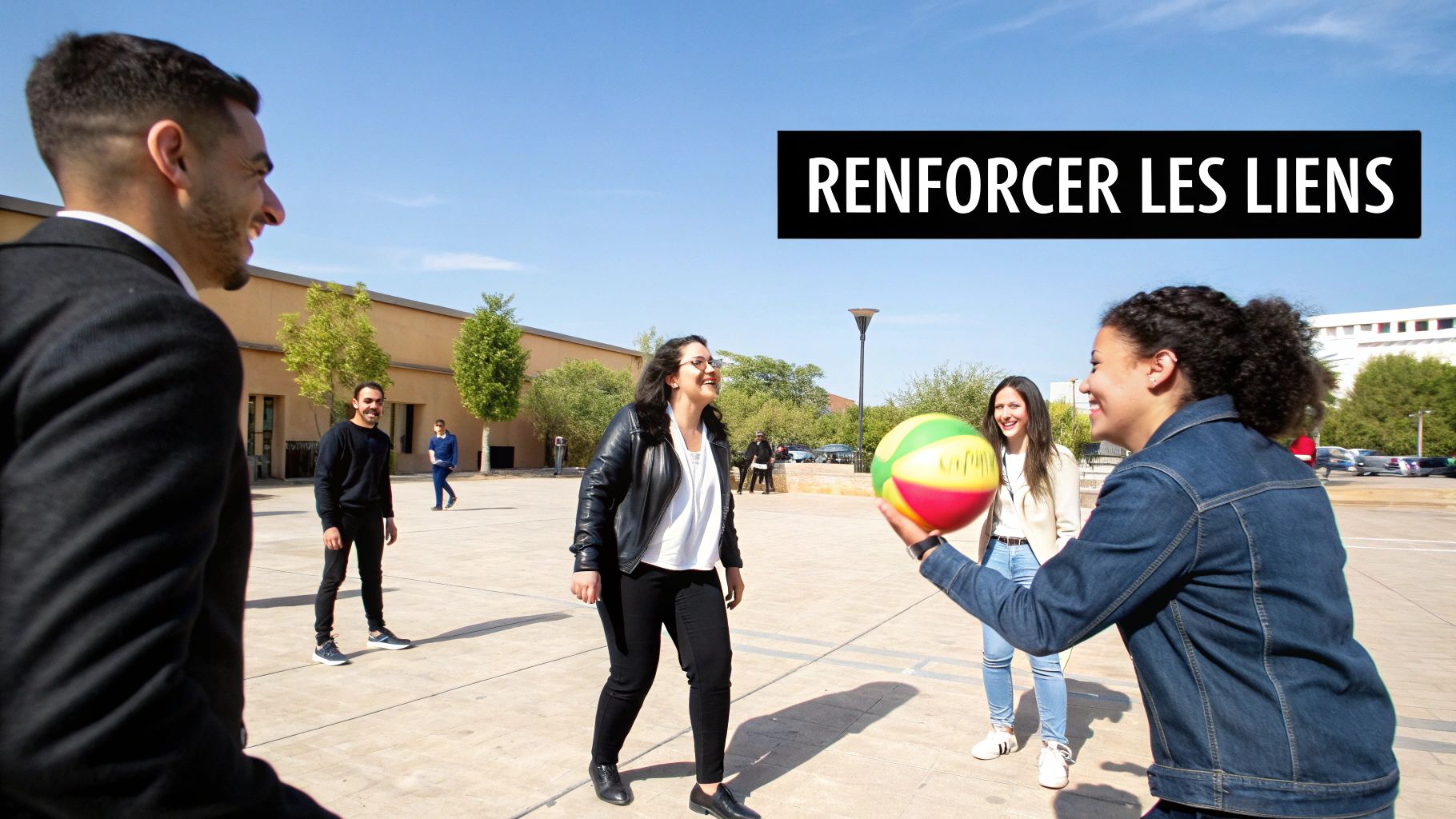
These actions revolve around four main axes: caring for onboarding, communicating transparently, celebrating successes, and creating strong shared moments.
Caring for Integration from Day One
Onboarding is the first impression you leave. And it is crucial. A new talent who feels a bit lost or isolated in the first weeks will have much more difficulty integrating later on. The goal is simple: to transform this often stressful period into a warm and well-structured experience.
Some good practices make all the difference:
- Anticipate the arrival: Equipment is ready, access is created, and the team is informed. A simple welcome email from the manager a few days before arrival changes everything.
- Designate a “buddy”: Assigning a reference colleague (who is not their manager) allows the newcomer to ask all the informal questions they might not dare to ask their supervisor.
- Plan the first week: A clear agenda with scheduled meetings, training points, and team lunches. This avoids the feeling of being left to fend for oneself.
A successful onboarding is much more than just an administrative checklist. It is the first strong gesture that shows an employee that they were expected and that they already have their place among you.
Establish Transparent and Caring Communication
The way information flows within the company directly shapes its culture. Opaque or purely top-down communication breeds distrust and creates silos. In contrast, open and honest communication nurtures trust, the basic ingredient of the sense of belonging.
This involves simple but regular gestures. Setting up weekly team meetings where everyone can speak, or organizing Q&A sessions with management, are excellent ways to show that every voice matters. Encouraging constructive feedback, whether from a manager or a peer, also contributes to creating a climate of safety where everyone can grow together.
Transparency is not about telling everything to everyone, all the time. It is about providing the necessary context for everyone to understand decisions and feel involved in the overall project.
Implement Recognition Programs
For an employee to feel truly invested, they must know that their work is seen and appreciated. Recognition is the fuel of motivation and a powerful lever for belonging. And it goes far beyond annual bonuses; it also involves more frequent and personal gestures.
Recognition can take several forms:
- Peer recognition: Create a channel (on Slack, for example) where colleagues can thank each other for a helping hand.
- Managerial recognition: A simple, sincere, and specific "thank you" from a manager after a particular effort can have a huge impact.
- Celebrating successes: Whether it is a completed project or an important milestone, taking the time to celebrate collective victories strengthens team pride.
Create Rituals and Unifying Moments
It is often outside the strict framework of work that the strongest bonds are forged. By creating rituals and moments of sharing, we break down hierarchical barriers and discover colleagues from a different angle. These shared experiences become the cement of the team.
Sports, for example, are a universal vector of emotions. If voting is a pillar of the sense of civic belonging in France, athletes are cited by 81% of French people as a unifying group. For a company, appropriating a sporting event through a platform like ccup.io allows for recreating this powerful bond. A friendly competition transforms into a true unifying act that brings teams together.
Organizing a sports prediction contest with a solution like ccup.io is the perfect example. It is a fun activity, very easy to set up, that engages everyone, from interns to CEOs, regardless of their level of sports knowledge. Discussions around results and rankings naturally create exchanges and healthy competition. To delve deeper into the topic, read our article on sports predictions as a team-building tool. These shared moments are the key to transforming a group of colleagues into a truly united team.
Creating Lasting Bonds Within Your Teams
Ultimately, the sense of belonging is experienced much more than it is explained. It is a true strategic investment, one that transforms a group of colleagues into a close-knit, innovative, and loyal community. We have seen that this sense rests on three essential pillars: psychological safety, social ties, and recognition.
We also understood that it is entirely possible to measure it. By combining targeted surveys, analyzing certain behaviors, and having informal discussions, we can track its evolution and actively encourage it. Above all, we know that it is cultivated through concrete actions, carried out with intention.
The real challenge is not so much to understand the concept as it is to live it daily. It is a commitment at all times, but its fruits are harvested in the long term.
The power of belonging lies in the experiences lived together. Never underestimate the strength of collective rituals and moments of conviviality to bond your employees, whether they are in the office or thousands of miles away.
Transforming Bonds into Performance
This is precisely where platforms like ccup.io come into play. By creating unifying and fun experiences around sporting events, you offer your teams much more than just a distraction. You give them an opportunity to resonate in unison, forge common memories, and weave authentic bonds.
These shared moments become the cement of your company culture. They give everyone a tangible reason to be proud to be part of your organization, beyond daily tasks. By investing in these human connections, you build an advantage that your competitors cannot replicate: a united, motivated team ready to take on any challenge.
The Questions You Have About the Sense of Belonging
Even when one understands the concept well, the sense of belonging brings its share of very concrete questions. We have gathered here the most frequent inquiries from managers and HR teams, with direct answers to take action.
How does remote work impact the sense of belonging?
Remote work, as convenient as it may be, can weaken the informal bonds that naturally form in the office. Without coffee machine discussions or impromptu lunches, a sense of isolation can set in, and gradually, team cohesion can erode.
To avoid this, it is essential to intentionally create virtual rituals. The idea is not to overload schedules but to recreate online those spontaneous connection opportunities that we miss so much.
Here are some simple ideas:
- Virtual coffees of 15 minutes without an agenda, just to chat.
- Discussion channels on Slack or Teams dedicated to non-work-related topics (movies, sports, hobbies).
- Fun online events, such as quizzes or friendly competitions.
The key is to maintain human contact that goes beyond the strict framework of professional objectives.
What is the manager's role in all this?
The immediate manager plays an absolutely central role. They are the first link in the chain, the one who brings the company culture to life daily with their team. Their behavior has a direct, immediate impact on the work atmosphere.
What are their main missions? They can be summarized in three points:
- Ensure psychological safety: They must actively encourage speaking up, even in the case of disagreement, and view mistakes as opportunities to learn, not to blame.
- Recognize contributions: Value everyone's work, sincerely and regularly, so that each person feels seen and appreciated at their true worth.
- Facilitate interactions: Organize team meetings that do not just limit themselves to a task list but also leave room for human connection.
An inclusive and attentive management style is the most powerful driver of the sense of belonging. It is what transforms a beautiful intention of the company into a reality experienced by employees.
How long does it take to see results?
There is no magic wand or fixed timeline. It all depends on your starting culture and everyone's involvement. Strengthening belonging is not a sprint; it is a marathon that requires consistency.
However, targeted and regular actions can produce measurable improvements in 3 to 6 months. Consistency is much more effective than intensity. A small convivial event each month will have more impact than a large annual seminar without any follow-up.
In the current context, the company is becoming an increasingly important social refuge. A recent study shows that only 22% of French people feel they belong primarily to the national community, and 59% feel lonely. This erosion of social ties highlights how urgent it is for companies to become places of connection. To go further, you can explore the full results of this trust study.
The initiatives you launch internally can actively counter this trend, offering a solid community that employees may no longer find outside. Investing in connection is a response to a very deep societal need.
Ready to transform the atmosphere of your teams with fun and unifying moments? With ccup.io, organize sports prediction contests in just a few clicks and create unforgettable shared memories. Discover how to energize your company on ccup.io.
From Content To Conversion
Turn your next sports event into a company prediction contest
Discover the platform, explore available competitions, and launch a branded experience that supports engagement, internal communication, and team cohesion.
See available competitions
Related articles

3 weeks ago
Sports Event Animation: 7 Ideas for Team Cohesion
Transform major sporting events into team victories. The Olympics, the World Cup, the Tour de France, or Roland-Garros create a well-known reflex in the workplace. Conversations become lively, exchanges become more spontaneous, and even teams that rarely communicate suddenly find a common topic. The...

last month
Champions Cup Prediction: The Complete Guide for Businesses
The Champions Cup often arrives at the same time as a very concrete need on the HR and internal communication side. It is necessary to reignite collective energy, recreate exchanges between teams that rarely communicate, and propose an activity that resembles neither a disguised meeting nor yet anot...

last month
How to Lead a Remote Team: The Complete Guide
40% of remote workers in France feel lonely , according to a survey by Anact reported here . This is the number that changes everything. It reminds us that how to lead a remote team is not primarily a question of tools, nor even of scheduling. It’s a question of connection. Many companies still trea...





















Contact us
For any question or quotation requests, do not hesitate to reach us by phone at 01 83 79 24 54 or by email : contact@ccup.io
Contact us


Frequently asked questions
What is ccup.io?
Ccup.io is a cohesion tool, allowing firms to gather their collaborators on the occasion of major sporting events, such as World Cup or Olympic Games. We offer an interactive forecasting platform, turnkey and customisable to your company’s colours.
What are you doing with our data?
By deciding to use our services, you decide to entrust us a part of your data – this will allow us to optimise your experience. We place great emphasis on the protection of your data, in compliance with current regulations. Given that it is important to be informed on the issues and challenges of personal data protection, ccup.io provides you with a most complete documentation on this matter.
How much does it cost?
In order to give our clients flexibility, we make a special rate depending on the number of registered players using a degressive system for an important number of participants. This allows firms to organise tailored events, adapted to their capacity. To receive a commercial offer in less than an hour, you only need to fill out the quotation requests form, with just a few clicks.



Don’t miss this opportunity 😍
Start now and enjoy numerous benefits