



Roland Garros Prediction in the Workplace: A Guide to Engage Your Teams
A Roland Garros prediction contest is much more than just a simple activity. Think of it as a tool to energize interactions, strengthen teams, and create memorable moments at the office.
Why a Roland Garros prediction contest will transform your work atmosphere
Imagine the scene: the coffee break turns into a lively debate about yesterday's exploits or today's predictions. Launching a Roland Garros prediction contest is the perfect excuse to break the routine and inject a good dose of positive energy.
This event, so dear to French culture, becomes a perfect opportunity to reignite informal conversations and create bridges between departments that barely cross paths otherwise.

A powerful tool for cohesion
Tennis speaks to everyone. There are the enthusiasts who know every player, and then there are the curious who get into the game. A prediction contest levels the playing field, as the intuition of a novice can easily prevail. It's this simplicity that makes all the difference.
- It strengthens bonds: Discussions arise spontaneously. Colleagues who rarely interact suddenly discover a fascinating topic of conversation.
- It improves communication: Following rankings and results creates daily rituals that make exchanges smoother and more cross-functional.
- It connects remote teams: For companies with remote workers or colleagues spread across the globe, it's a golden opportunity to share a common experience, despite the miles.
This collective fervor is also explained by the impact of the tournament itself. Did you know that Roland Garros represents 85% of FFT's revenue? The profits are then reinvested in French tennis, making it a major national event and a topic that naturally unites.
Simplifying organization to maximize impact
For a manager or HR department, the idea may seem nice but time-consuming. Who will manage the points? The rankings? The reminders? This is precisely where dedicated platforms like ccup.io change the game. They handle everything: score management, real-time rankings, communications… You just need to focus on what matters: running the game and motivating the troops.
The goal is not to find the tennis expert in the office. The objective is to create healthy competition and shared memories that will last long after the match point. A successful contest is one that people still talk about in the hallways months later.
By using the game as a positive management tool, you polish your employer brand and show that your company values well-being and friendliness. Ultimately, you are not just organizing a game; you are building a stronger company culture. If this topic interests you, discover how sports prediction contests create a pleasant work environment.
Game rules that encourage participation
The secret to a good Roland Garros prediction contest is not to create a complex system for tennis experts. The idea is to set up a fun and accessible competition, where the suspense remains until the end.
Clear rules are essential to avoid frustrations. Everyone, from the die-hard fan who follows the Challenger circuit to the casual observer, should feel comfortable and have a chance to shine.
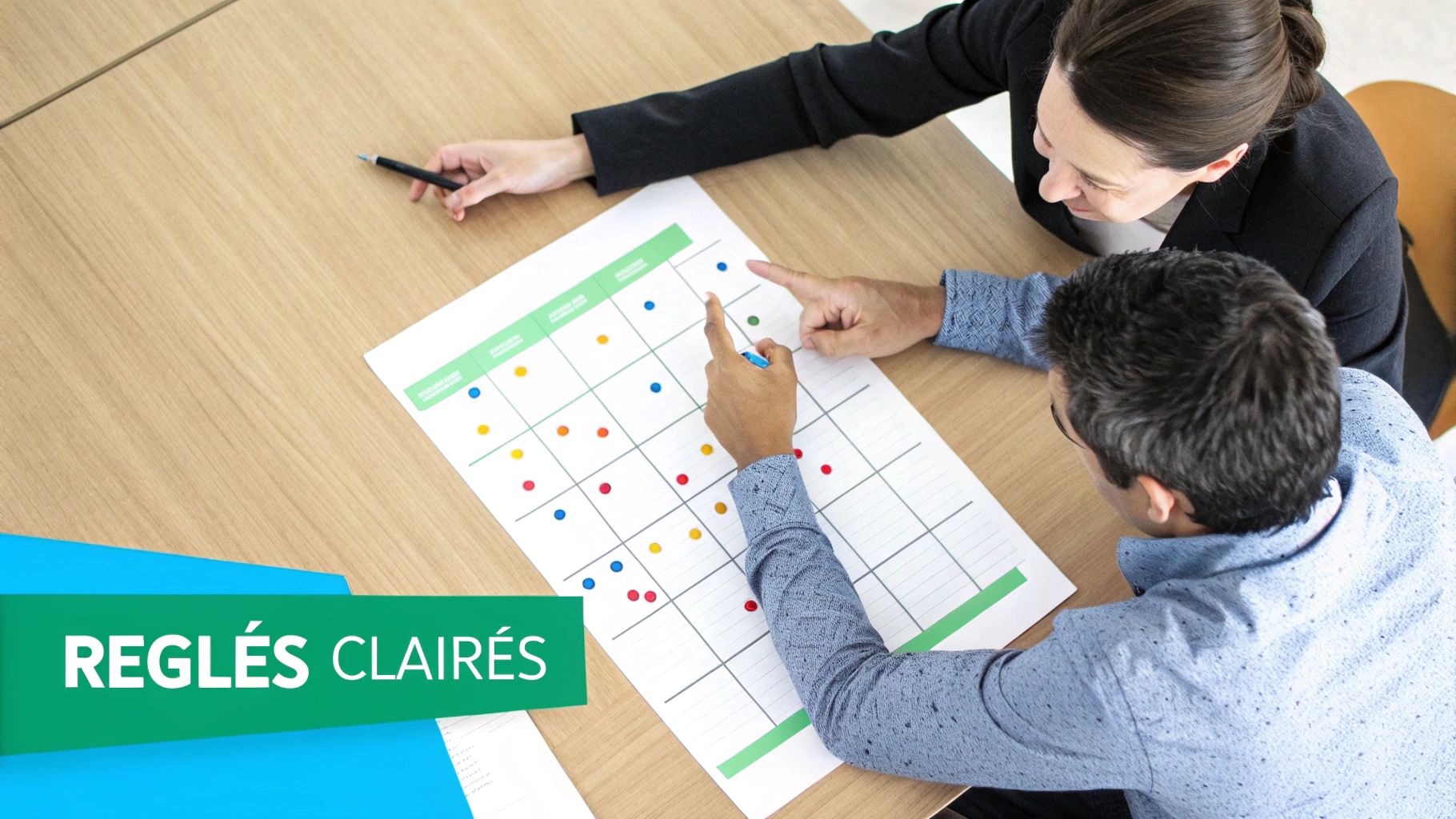
A points system that spices up the game
The heart of the matter is your points system. A good scale should reward accurate predictions but also leave room for surprises. That's the spirit of the Parisian clay court!
A tip I often recommend is to adopt a progressive scale. Matches in the early rounds, often more predictable, earn fewer points. In contrast, finding the right winner in the quarter-finals, semi-finals, or finals should yield big rewards. This keeps everyone in the game for the 15 days and allows for fantastic comebacks in the rankings.
To add some spice, consider bonus points:
- Exact score bonus: A small reward for those who not only find the winner but also the score in sets (for example, 3-1).
- The outsider's bet: Offer a jackpot of points for a bold bet that pays off, like the victory of a player ranked beyond 50th place against a top 10.
- The champion's flair: Ask everyone to name the male and female tournament winners before the very first match. A significant bonus awaits those who have a good instinct!
To give you a concrete idea, here’s a simple yet effective points scale model you can adapt.
Example of a points scale for your contest
A simple model to distribute points and encourage participation throughout the tournament.
| Tournament Phase | Points for the correct winner | Bonus points for the exact score (in sets) |
|---|---|---|
| 1st round | 1 point | 1 point |
| 2nd and 3rd rounds | 2 points | 2 points |
| Round of 16 | 4 points | 3 points |
| Quarter-finals | 8 points | 5 points |
| Semi-finals | 12 points | 8 points |
| Final | 20 points | 10 points |
This type of progressive scale ensures that the last days of the tournament are decisive and that no one is out of the game too early.
Clear rules to avoid headaches
To ensure everything goes smoothly, you need to be very clear on a few fundamental points. Transparency is your best friend for a healthy competition.
For example, set a specific deadline for each prediction. If you use a platform like ccup.io, the problem is solved: predictions automatically close at the start of the match. If you do it manually, be direct: "all predictions must be submitted by 10 AM." Simple and effective.
The goal is simple: create a game where strategy can prevail over pure tennis knowledge. A good points system allows someone who predicts just one major surprise to compete with an expert who finds all the favorites.
Also, think about managing ties. This is the kind of detail that can create tension if not planned. What happens if two people finish with the same number of points?
- We can look at who found the most exact scores during the tournament.
- We can give the advantage to who predicted the final winner the earliest.
- Or, a fun "tie-breaker": ask everyone to bet on the duration (in minutes) of the men's final. The closest wins.
Once these rules are set, you have the backbone of your activity. Everyone knows how to play and how to win, which transforms this Roland Garros prediction contest into a true unifying moment.
The keys to successfully launch and promote your contest
A good launch sets the tone. Your goal is simple: make your Roland Garros prediction contest a real internal event, one that everyone talks about at the coffee machine. To achieve this, your communication must be as impactful as a Carlos Alcaraz forehand.
Forget formal emails and corporate announcements that get lost in the shuffle. Opt for a friendly, direct tone. A well-crafted announcement on Slack or Teams will always have more impact than a long email. Imagine a simple and engaging message: "Ready to challenge your colleagues? The big Roland Garros prediction contest is on! Who will succeed Iga and Novak this year? Prove your skills (or your luck!) and sign up here with one click."
Visually create the event
Communication is not just about text. To really make an impression, you need to be creative and visible. No one should miss the information.
Here are a few simple ideas to implement:
- Posters in the break room: A nice visual with a QR code that links directly to the registration page is simple and effective.
- Banners for the intranet: A colorful banner at the top of your internal homepage is an excellent daily reminder.
- Virtual backgrounds for video calls: Offer a tournament-themed background that participants can use. It creates a sense of belonging.
This launch process can be summarized in three key moments: announce, register, and remind.
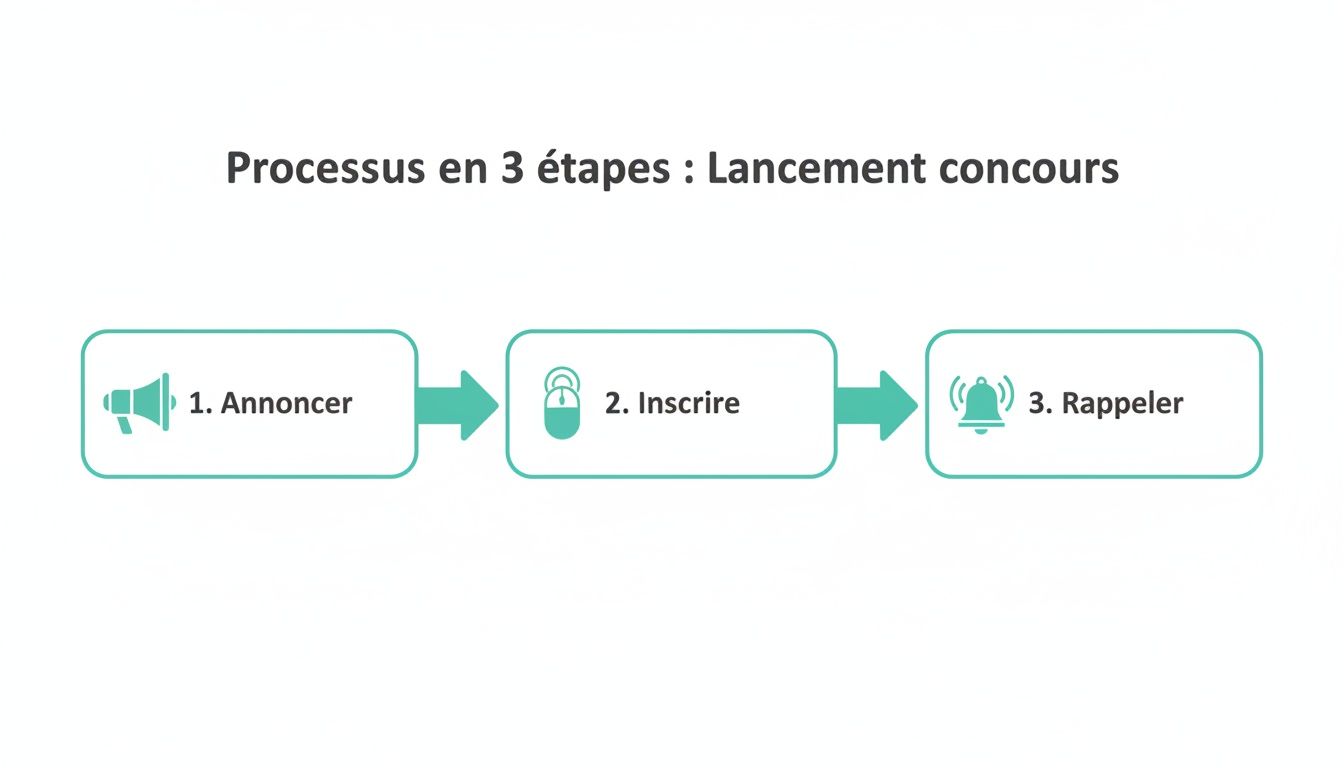
This diagram shows it well: the key is simplicity and automation. Facilitating registrations and reminders maximizes participation rates without drowning you in organization.
Simplify participation as much as possible
The biggest enemy of participation? Complexity. If signing up takes more than two minutes, you lose half your troops along the way. This is where dedicated tools completely change the game.
The goal is to minimize friction. Registration should be done in one click, and reminders should be automatic. The smoother the process, the higher the number of participants.
A platform like ccup.io takes care of all this for you. Registration is done via a unique link, and the system sends automatic notifications before important matches. No more "Oh no, I forgot to make my prediction!" This automation frees up valuable time for you to focus on what really matters: running the contest. If you're still unsure about which tool to adopt, our guide on choosing the best internal prediction platform can enlighten you.
By combining engaging communication, eye-catching visuals, and an ultra-simple registration process, you stack the odds in your favor. The first week is crucial for creating a momentum that will carry the contest throughout the fortnight.
During the tournament, keep your contest alive daily
The launch is done, participants are registered. Congratulations! But the hardest part begins: keeping the flame alive during the intense two weeks of the tournament. A good Roland Garros prediction contest is not a sprint; it's a marathon.
Your mission, should you choose to accept it, is to transform a simple score tracking into a true daily ritual for your teams. Well-thought-out and regular communication is your best asset to keep everyone in the game, even those whose predictions from the first day went up in smoke.
Animate your communication channels
Your everyday tools like Slack, Teams, or your intranet are the heart of the reactor. That's where everything happens. The idea is to create small appointments, habits that your colleagues will look forward to.
- The morning brief: Start the day with a quick recap of the highlights from the previous day. Highlight the big surprise, the craziest match, or the unexpected performance that shook everything up.
- The "predictor of the day": Each day, identify and publicly congratulate the person who excelled the day before. It's a great way to value everyone, not just the one leading the overall ranking.
- The tournament anecdote: Share an unusual stat, a record that just fell, or a juicy little story about Roland Garros. It feeds the tennis culture and provides material for discussions at the coffee machine.
A simple message on Teams can work wonders: "A big shoutout to Sophie from accounting, our champion of the day with a perfect score yesterday! Special mention to the surprise victory of [Player's Name] who knocked out 75% of our predictors. Who will dare to do better today?"
Spice up the competition with mini-challenges
To break the routine, nothing beats small occasional games with bonus points at stake. These challenges reignite interest and give players who are lagging behind a chance to catch up.
The key is to vary the pleasures and create interactions. Don't settle for a cold and impersonal ranking. Tell the story of your contest, with its one-day heroes, its twists, and its suspense.
Launch quick and fun questions:
- "How many aces will be served tonight in the Alcaraz-Zverev clash?" (The closest wins 5 bonus points).
- "Which player will commit the most double faults today?"
- "Will the night session match end in 3, 4, or 5 sets?"
This is where a platform like ccup.io greatly simplifies your life.
The interface allows not only real-time ranking tracking but also launching quizzes and polls in just a few clicks. Managing the contest then becomes a true strategic animation, not an administrative chore.
If you opt for the manual method, good mastery of Excel is essential. You can even learn to automate point calculations with SUMIFS to save valuable time.
The tournament's own history is a goldmine for your animations. With his 13 titles, Rafael Nadal is a legend of the Parisian clay. Use it to create quizzes: "Who was the only player to beat Nadal at Roland Garros between 2005 and 2014?" This kind of question, super easy to integrate on ccup.io, revives memories and sparks passionate debates.
By mixing these daily communications and fun challenges, you are no longer managing a simple contest; you are creating a true collective, dynamic, and memorable experience.
Choose rewards that truly create an event
The final touch for a successful Roland Garros prediction contest? The rewards. We're not talking about a simple prize, but a real conversation starter in the hallways, an objective that turns the award ceremony into a moment awaited by all.
The classic mistake is to fall back on the impersonal gift voucher. It's convenient, yes, but it lacks soul. The goal is to find prizes that are enjoyable, of course, but that also reflect your company culture and strengthen bonds.
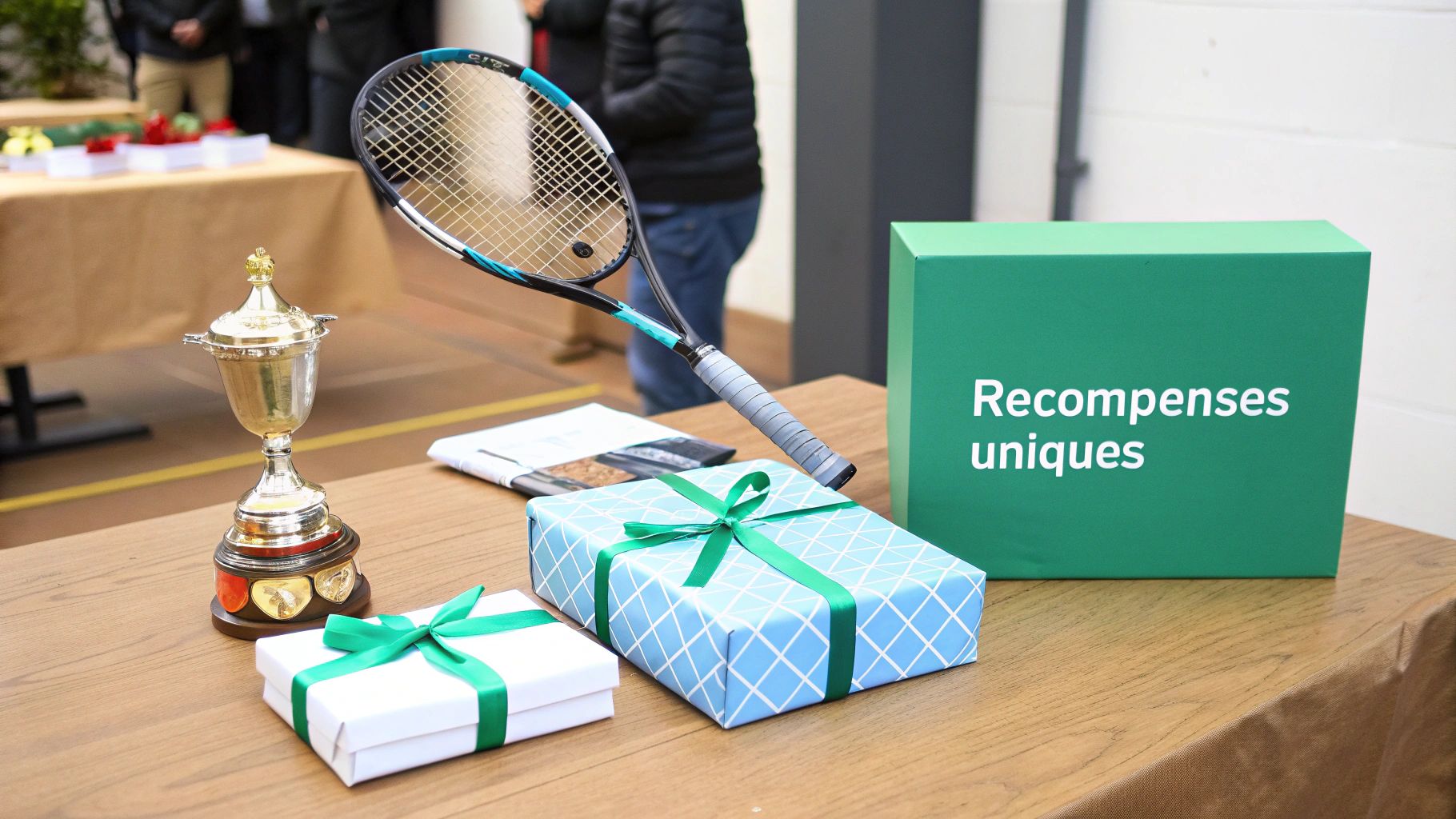
Go beyond the simple trophy
To really make an impression, think in terms of experiences and recognition. Often, the most memorable rewards are those that create shared memories.
Here are some ideas to inspire you:
- Tennis-themed prizes: A nice racket, tickets for a local tournament, or even a lesson with a pro coach. It's a nice nod to the event and a quality gift, whether one is a passionate fan or a simple novice.
- Collective experiences: What if the best reward was one that is shared? Offering the winning team's department a team lunch at the company's expense, for example. It's an excellent way to celebrate an individual victory while strengthening cohesion. An extra day off is also a highly motivating prize. If you're lacking inspiration, take a look at our gift ideas guide for a winning team.
- Symbolic and quirky rewards: A personalized trophy, presented with great fanfare during a meeting, can have a huge impact. Don't hesitate to add a touch of humor with an engraving like "King of the Clay 2024".
The important thing is not so much the monetary value of the prize but the recognition it represents. How you celebrate the winner matters as much, if not more, than the gift itself. Make it a highlight of the company's life.
Reward more than just the winner
To keep everyone motivated until the end, don't just reward the first place. A podium with prizes for second and third places is already a great start.
But you can go further. Think of more original prizes that celebrate different forms of participation. This allows everyone to feel valued and shows that the important thing is to play the game.
Some ideas for special prizes:
- The "Comeback" prize: For the person who made the most impressive rise in the rankings during the second week of the tournament.
- The "Impossible Prediction": For the person who made the craziest bet, like predicting the victory of an outsider that no one expected.
- The "Red Lantern" prize: A little humorous gift for the last in the rankings, to encourage participation with a bit of self-deprecation.
By diversifying the rewards, you ensure that every participant feels involved and has a chance to walk away with something. Your contest then transforms into a true collective celebration, where the spirit of the game is as important as victory.
Here’s the section rewritten in a natural and human style, following the provided examples and instructions.
Any questions before you dive in?
Organizing a Roland Garros prediction contest may seem complicated at first glance. You might imagine a complex setup, colleagues who know nothing about tennis, or a colossal budget for prizes.
Rest assured, it’s much simpler than it seems. Here are the answers to the questions you’re probably asking.
"I don’t have time; this will take me hours to organize"
This is a legitimate concern, but completely unfounded with the right tools. If you start from scratch with an Excel file, yes, it can quickly become a full-time job.
But with a platform like ccup.io, most of the work is already done. The basic setup? Count on one to two hours, at most. That’s the time to choose your rules, adjust the points scale if you wish, and write the little launch email that will set the mood.
Once the tournament starts, daily management is really light. Plan 15 minutes a day, the time for a coffee, to glance at the rankings, send a little note about the previous day's results, and animate discussions. No need to spend hours calculating points; everything is automated.
"Great idea, but half my team doesn’t know who Nadal is"
And that’s exactly what’s great! The goal is not to find the future consultant for L'Équipe, but to create connections and have fun. Prediction contests are an excuse for exchange.
The point of the game is participation, not performance. The best contest is one where everyone feels comfortable trying their luck, even by betting on the player with the best headband.
Here are a few tips to include everyone:
- Give a little boost to novices: a short list of favorites or outsiders to watch is enough.
- Think of quirky rewards, like the "most improbable comeback" prize or the "boldest prediction" prize.
- Remind everyone that tennis is full of surprises! An unknown player knocking out the big favorite happens every year and can completely overturn the rankings. The famous "beginner's luck" is not a myth.
"And what about the prizes? I don’t have an expandable budget"
Don't panic; there's no need to break the bank. The important thing is not the value of the prize but the recognition and the little moment of glory for the winner. The celebration often matters more than the gift itself.
A symbolic trophy that will sit on the winner's desk, a day off offered by the company, or even a lunch with management are highly appreciated rewards that don't cost much. It's the gesture that leaves a mark.
Ready to make your company vibrate to the rhythm of aces and drop shots? With ccup.io, you have all the cards in hand to launch a prediction contest that will leave a lasting impression. Discover how simple it is at https://ccup.io.
From Content To Conversion
Turn your next sports event into a company prediction contest
Discover the platform, explore available competitions, and launch a branded experience that supports engagement, internal communication, and team cohesion.
See available competitions
Related articles

4 months ago
Roland Garros Predictions to Energize Your Business
A Roland Garros prediction contest is not just a game. It’s a real management tool to transform the atmosphere in the office. Imagine the lively conversations at the coffee machine, no longer about the latest files, but about the next match at Porte d'Auteuil. How a Roland Garros prediction contest...

3 weeks ago
Sports Event Animation: 7 Ideas for Team Cohesion
Transform major sporting events into team victories. The Olympics, the World Cup, the Tour de France, or Roland-Garros create a well-known reflex in the workplace. Conversations become lively, exchanges become more spontaneous, and even teams that rarely communicate suddenly find a common topic. The...

last month
Champions Cup Prediction: The Complete Guide for Businesses
The Champions Cup often arrives at the same time as a very concrete need on the HR and internal communication side. It is necessary to reignite collective energy, recreate exchanges between teams that rarely communicate, and propose an activity that resembles neither a disguised meeting nor yet anot...




















Contact us
For any question or quotation requests, do not hesitate to reach us by phone at 01 83 79 24 54 or by email : contact@ccup.io
Contact us


Frequently asked questions
What is ccup.io?
Ccup.io is a cohesion tool, allowing firms to gather their collaborators on the occasion of major sporting events, such as World Cup or Olympic Games. We offer an interactive forecasting platform, turnkey and customisable to your company’s colours.
What are you doing with our data?
By deciding to use our services, you decide to entrust us a part of your data – this will allow us to optimise your experience. We place great emphasis on the protection of your data, in compliance with current regulations. Given that it is important to be informed on the issues and challenges of personal data protection, ccup.io provides you with a most complete documentation on this matter.
How much does it cost?
In order to give our clients flexibility, we make a special rate depending on the number of registered players using a degressive system for an important number of participants. This allows firms to organise tailored events, adapted to their capacity. To receive a commercial offer in less than an hour, you only need to fill out the quotation requests form, with just a few clicks.



Don’t miss this opportunity 😍
Start now and enjoy numerous benefits