



Strengthening Team Cohesion: 5 Concrete Strategies for Your Culture
For team cohesion to become a reality, it’s not enough to put people in the same room. Real bonds must be woven, going beyond mere work collaboration. This requires an intentional approach, concrete actions that build trust, streamline communication, and create a true sense of belonging. This is how a group of individuals transforms into a cohesive and high-performing team.
Why Team Cohesion is Your Best Asset

A team is not just an addition of talents. It’s a living ecosystem where human dynamics make all the difference between success and failure. Too often, we focus on technical skills and numerical objectives, forgetting that sustainable performance is rooted in the quality of human relationships.
Imagine the scenario: you assemble a project team with the best experts in the field. On paper, success is guaranteed. But after a few weeks, nothing is going well. Deadlines are stretching, tensions are rising, and communication boils down to cold emails. Everyone works in their corner, protecting their turf. The project struggles, not due to a lack of skills, but because there is no glue.
Conversely, a cohesive team, even with more junior profiles, can move mountains. When trust reigns, people dare to take risks, share their ideas without fear of being judged, and support each other when things get tough. A good atmosphere transforms obstacles into challenges and failures into collective lessons.
The Financial Impact of Neglected Cohesion
Neglecting team cohesion is not just a simple management oversight. It’s a direct risk, both financially and humanly. Employee disengagement is a real plague in France, and its consequences are far from trivial.
A recent analysis showed that 93% of French employees feel disengaged at work, and worse, 48% of them experience such intense stress that it paralyzes all collective potential. This phenomenon has a huge cost for companies and frustrates managers who see wasted talent. Fortunately, the trend is not irreversible. Initiatives like seminars or friendly competitions can trigger a virtuous circle: cohesion strengthens communication, which in turn boosts motivation. To delve deeper into the subject, feel free to check the details of the employee engagement survey.
Neglecting cohesion is like trying to build a house with excellent bricks but without cement. Sooner or later, the structure collapses under pressure.
Benefits Beyond Productivity
Investing in team cohesion is not just for show. The benefits are concrete and spread throughout the organization, far beyond just increasing productivity.
- Reduced turnover: Employees connected to their colleagues and the company are simply less tempted to look elsewhere.
- Improved well-being: A healthy and supportive work climate reduces stress and protects against burnout.
- More innovation: Trust and psychological safety are the breeding ground for creativity and initiative-taking.
- Better conflict management: United teams know how to handle disagreements constructively before tensions escalate.
Understanding these issues is the first step. This guide will now give you the keys to build a concrete and tailored engagement program for your culture, moving from a sense of efficiency to real and lasting performance.
Diagnosing the Real Health of Your Team

Before even thinking about launching any engagement activities, you need to take the pulse of your team. This is the first step, and perhaps the most important. Going in blind is the best way to spend energy for disappointing results. The idea is simple: move from subjective impressions to concrete facts.
This diagnostic phase is fundamental. It will allow you to pinpoint the real friction points, but also the unsuspected strengths of your collective. Only by understanding these dynamics can you build a program that truly makes sense.
Going Beyond Perceptions
It’s easy to misjudge the real atmosphere of a team. A recent survey revealed that 90% of employees in France consider their team effective. This is great news, but it remains a perception. It doesn’t tell the whole story about daily collaboration dynamics. To learn more, you can check the details of this survey on team effectiveness.
To have an accurate view, you need to cross these feelings with more tangible indicators. Don’t settle for a superficial “everything is fine.” Dig a little deeper.
An honest diagnosis is not a judgment; it’s a snapshot. It captures the situation as it is, giving you a clear starting point to build a stronger and more united team.
Tools for Objective Evaluation
To assess cohesion, the secret is to mix qualitative and quantitative approaches. The goal is to gather information from different angles to get a 360-degree view.
The Targeted Anonymous Survey
This is your best ally for getting honest feedback. Anonymity frees speech, especially on somewhat sensitive topics. Get straight to the point with short, clear questions focused on the pillars of cohesion.
- Trust and psychological safety: "Do you feel comfortable expressing a differing opinion during a team meeting?" (On a scale of 1 to 5)
- Communication: "Do you believe that information flows smoothly and transparently within the team?" (On a scale of 1 to 5)
- Support and help: "When facing a difficulty, do you know who to turn to for help within the team?" (Yes / No / Sometimes)
These few questions are already enough to quantify perceptions and identify trends. It’s an excellent starting point to build an environment where the sense of belonging to the company can truly flourish.
Constructive Feedback Workshops
Organize short sessions in small groups, preferably led by a neutral person (a manager from another team, an HR...). The goal is not to settle scores but to discuss collective functioning. The “Start, Stop, Continue” method is perfect for this: what should we start doing, stop doing, and continue doing to work better together?
Identifying Weak Signals and Key Indicators
Some HR data are real barometers of your team’s health. Keep an eye on them, as their variations are often the first symptom of deteriorating cohesion.
- The voluntary turnover rate: If it rises, it’s a major alarm signal.
- The absenteeism rate: Short but repeated absences can hide real distress.
- The fluidity of communications: Simply observe how information circulates. Are there silos? Systematic blockages?
To help you situate your team, the table below compares the typical behaviors of a cohesive team versus a more fragmented team. It’s a simple yet effective tool to refine your diagnosis.
Indicators of Strong vs. Weak Team Cohesion
| Indicator | Signs of Strong Cohesion | Signs of Weak Cohesion |
|---|---|---|
| Communication | Open, honest, and respectful. Ideas are debated without animosity. | Limited to the bare minimum. Frequent rumors and off-the-record conversations. |
| Collaboration | Proactive and spontaneous. Members help each other without being asked. | Everyone works in their corner. Lack of support and internal rivalries. |
| Conflict Management | Disagreements are addressed directly and resolved constructively. | Conflicts are avoided, ignored, or escalate into personal attacks. |
| Engagement | Members are involved, propose initiatives, and celebrate collective successes. | Lack of motivation, low participation in projects, and pervasive cynicism. |
By crossing these different elements, you will obtain a factual and solid basis. You will know precisely where to focus your efforts, allowing you to build an engagement program that meets the real needs of your employees.
Building an Engagement Program That Reflects You
Once the diagnosis is made, the most interesting part begins: building your engagement program. The big mistake is to want to copy-paste ready-made solutions without asking whether they make sense for your teams. To strengthen team cohesion sustainably, the program must align with your culture, your objectives, and, most importantly, the desires of your employees.
The idea is not to aim for a grand spectacular event once a year, but rather to weave a red thread that maintains the connection throughout the year. A good program is a clever mix of simple and regular rituals, and stronger moments that leave a mark.
We aim to create a coherent experience that encourages participation, not an additional burden in already overloaded schedules. The key is variety, so that every personality can find their place.
Creating Engaging Low-Cost Rituals
The most effective activities are not always the most expensive. It’s the regularity of rituals that anchors good habits and fosters informal exchanges, that famous cement that binds a team.
Think of simple moments that naturally fit into the week. The goal is to create friendly breaks where we don’t talk (only) about work. Treat moments are perfect for this.
- Weekly Team Breakfast: It’s a classic, but its effectiveness is formidable. A coffee and some pastries on Monday morning, and the week starts on a positive and relaxed note.
- Monthly Themed Lunches: Each month, organize a lunch around a theme (world cuisine, regional specialties...). It’s an excellent excuse for employees from different departments to mingle and share more than just a meal.
- Surprise Snack Break: Once a quarter, an unexpected sweet break to celebrate a small victory or just to relieve pressure. It’s a simple gesture that shows the company cares for its teams.
A successful engagement program is not a list of events. It’s an ecosystem of interactions that nourishes human relationships daily. It’s the accumulation of all these little things that forges real cohesion.
Organizing Challenges and Competitions to Stimulate Team Spirit
A healthy and benevolent spirit of competition is a powerful driver for tightening bonds. Challenges create collective excitement, encourage collaboration, and leave memorable memories.
The advantage is that these activities can be adapted to all profiles, whether they are sporty, creative, or cerebral. The important thing is to vary the pleasures so that everyone feels included.
- Creative Challenges: Launch a monthly photo contest on a given theme, organize an internal “hackathon” to solve a problem innovatively, or set up an office decoration challenge for the holidays.
- Company Olympics: One day a year, prepare a series of fun and accessible sports challenges (petanque, Mölkky, giant quiz...). Forming inter-department teams is the best way to break down silos.
- Prediction Contests: During major sporting events, a prediction contest always works. It’s easy to set up, super engaging, and perfectly suited for hybrid teams, as everyone can play, wherever they are.
Integrating Remote Teams into Every Initiative
With the rise of remote work, it’s impossible to overlook inclusivity. Every initiative must be designed to fully integrate remote employees. The goal: avoid creating a divide between those in the office and others.
Digital tools are obviously your best allies. Virtual team building has become essential for strengthening team cohesion in a hybrid work environment.
Here are some ideas to adapt your activities:
| In-Person Activity | Adaptation for Remote |
|---|---|
| Team Breakfast | Organize a virtual “e-coffee” meeting. To mark the occasion, have breakfast delivered to remote workers. |
| Physical Escape Room | Participate in an online escape room, where teams collaborate virtually to solve puzzles. |
| Cooking Workshop | Send a box with all the ingredients and organize a live cooking class with a chef. |
| Company Olympics | Set up online challenges (quizzes, collaborative video games) and connected individual challenges (number of steps, etc.). |
The key to success is to never consider remote employees as mere spectators. They must be full participants in the life of the company. By varying formats and ensuring that each activity is accessible to all, you will build a lively and unifying program that truly reflects your culture.
Transforming Major Sporting Events into Unifying Moments
Major sporting events like the World Cup or the Olympics generate a unique collective energy. For a company, these are real gems for reviving team spirit, provided you know how to seize them. Far from being just a distraction, a well-orchestrated prediction contest becomes a powerful cohesion tool.
It transforms a common passion into a playing field accessible to all, regardless of position, hierarchical level, or even workplace (hello remote work!). It’s an incredibly simple and effective way to spark conversations, break the ice, and forge bonds that go well beyond the professional framework.
Launching Your Internal Prediction Contest
Organizing a prediction contest is truly the turnkey solution to animate a period and unite teams without complicating things. With specialized tools like ccup.io, setting it up literally takes just a few clicks. This leaves you time to focus on what really matters: the engagement.
Here’s a glimpse of what a prediction interface might look like. The idea is for it to be intuitive and engaging from the very first second. With a clear interface like this, participants can immediately see upcoming matches, their rankings… The experience is smooth, and that motivates!
The number one goal is to make participation ultra-simple. A good platform eliminates all technical friction. This way, everyone, from the most tech-savvy to the most novice, can easily get into the game.
A Communication Plan for a Successful Launch
Enthusiasm is built well before kickoff. Clear and fun communication is key to ensuring everyone is informed and, most importantly, eager to play. Think about broadcasting your announcement across multiple channels to reach as many people as possible.
Here’s an example of a message you can fully adapt:
Email Subject: ⚽️ Ready to Become the Best Predictor at [Company Name]?
Hello Team,
The [Name of the competition, e.g., Euro 2024] is fast approaching, and we thought it was the perfect opportunity to spice up our days!
We are officially launching our big internal prediction contest. The principle is simple: predict the match results, accumulate points, and try to win the title of champion of [Company Name]!
It’s open to everyone, whether you’re a soccer expert or a total beginner. The most important thing is to have fun together.
To participate, click here: [Link to the platform]
May the best win!
This kind of initiative is an excellent driver for informal interactions. In fact, studies show that 77% of companies organize team-building activities to strengthen cohesion. These moments create genuine friendships that, according to Gallup, make employees twice as engaged.
Animating the Competition to Keep the Flame Alive
The launch is just the beginning of the adventure. To keep the magic alive throughout the event, you need to maintain the flame. It’s the animation that transforms a simple game into a memorable collective experience.
Here are some simple and effective ideas:
- Weekly Newsletters: On Mondays, send a brief recap with the top 3, the week’s “comeback,” or the most improbable prediction that came true.
- Virtual Badges: Celebrate achievements with fun badges like “First Round Oracle,” “Draw Specialist,” or “Supporter’s Heart.”
- Displaying Rankings: Project the real-time ranking on the break room screen or share it on your Slack/Teams. It’s simple, but it works!
- Inter-Department Challenges: Create mini-leagues by department to add a touch of friendly competition and boost collaboration.
The idea is to create many little touchpoints that remind everyone of the game and spark discussions. It’s by seeing their name or their colleague’s name rise (or fall!) in the rankings that people truly feel involved. Looking for ideas for other competitions? Check out our guide to organizing a prediction contest for Ligue 1.
Choosing Meaningful Rewards
And finally, recognizing the winners. There’s no need to break the bank for rewards. What matters is that they are motivating and value participation.
Here’s a small selection of ideas for all budgets:
| Type of Reward | Concrete Examples |
|---|---|
| Experiential | Tickets to a match, a cooking class, a day of tree climbing. |
| Symbolic | A personalized trophy, the jersey of their favorite team. |
| Practical | Gift cards, a voucher for a team lunch. |
| Free Time | A half-day or a full day of additional leave (always very appreciated!). |
Also consider rewarding beyond just the grand winner. A prize for the “best sportsmanship” or even a draw among all those who participated until the end is an excellent way to keep everyone motivated. Ultimately, these fun initiatives create shared memories. It’s a direct investment in a stronger and more united human capital.
Measuring the Real Impact of Your Actions on Cohesion
Launching an engagement program is good. But to truly strengthen team cohesion in the long term, you need to know how to measure what works and what can be improved. Without this, you’re navigating blindly, relying solely on impressions.
Proving the impact of your actions is not just about numbers to defend a budget. It’s mainly a way to decode the human dynamics of your company, adjust your approach, and show your employees that their well-being is a priority.
By adopting this approach, your initiatives move from being one-off events to a genuine lever of performance for the entire organization.
Defining the Right Performance Indicators
To evaluate the effectiveness of your program, you need to go beyond just the participation rate. Yes, it’s a useful indicator, but it doesn’t say anything about the quality of the bonds being created. A good measure always combines quantitative data (the “what”) and qualitative data (the “why”).
Here are some essential KPIs to integrate into your dashboard:
- Employee Net Promoter Score (eNPS): Simply and regularly ask the question: “On a scale of 0 to 10, how likely are you to recommend our company as a great place to work?” An increase in this score is a very strong signal that the social climate is improving.
- Absenteeism Rate: A slight decrease in unplanned absences can indicate reduced stress and stronger engagement. It’s a very concrete and telling HR metric.
- Interactions on Your Collaborative Tools: Take a look at the increase in informal exchanges on your discussion channels like Slack or Teams. More GIFs, light conversations, or spontaneous congratulations are signs that cannot be mistaken.
These indicators will give you a factual and clear view of the evolution of group dynamics.
Measuring cohesion is not about policing teams. It’s about ensuring that the energy and resources invested create real and tangible value for employees and the company.
Collecting Qualitative Feedback
Numbers are essential, but they don’t tell the whole story. Direct feedback from your teams is a true goldmine for understanding the emotional impact of what you implement.
Consider deploying post-event surveys, but keep them very short. Two or three questions are enough: “Did you enjoy this event?”, “Did it allow you to connect with colleagues you know less?”, “What did you like most?”. This feedback will help you refine your next initiatives with surgical precision.
This infographic summarizes the three pillars of a successful event, from initial communication to participant recognition.
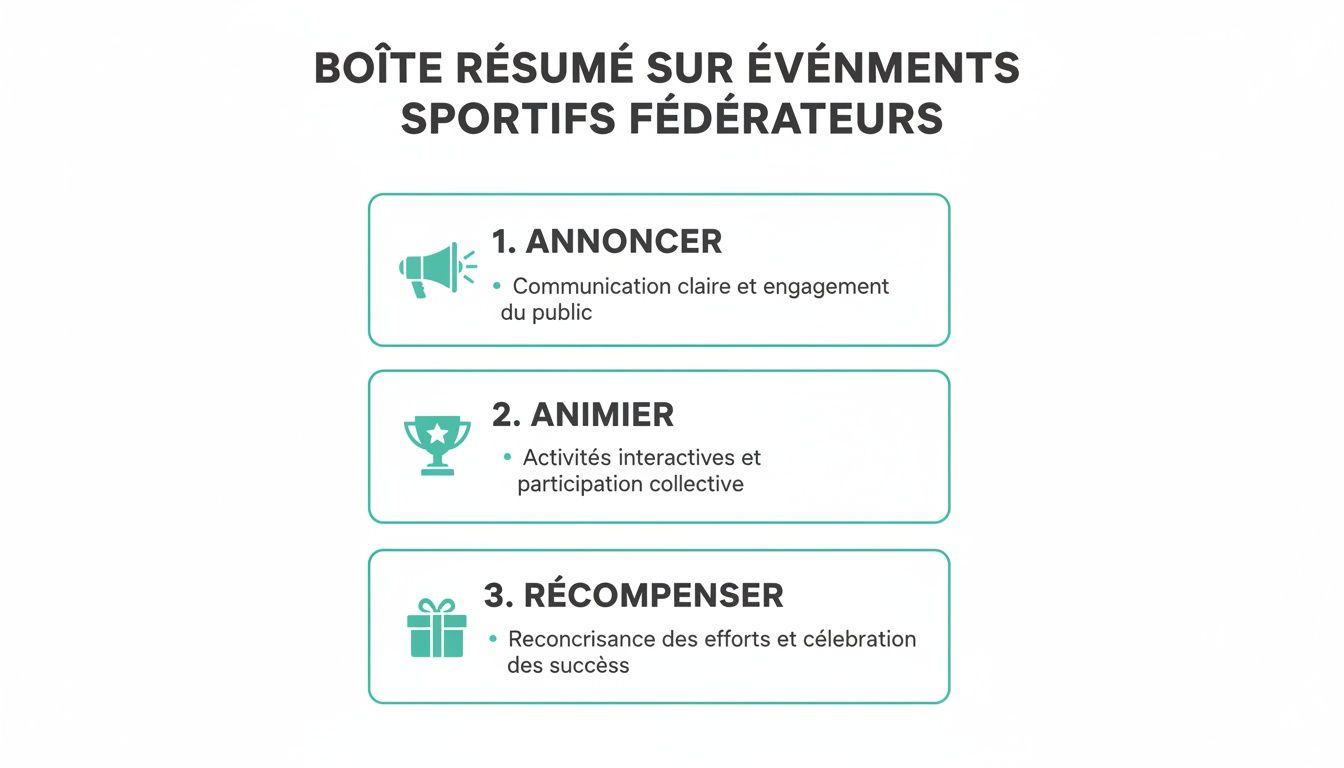
Each step, from announcement to reward, plays a key role in the perception and overall success of the initiative.
Building a Monitoring Dashboard
Centralizing all this data in a simple dashboard is key. This will allow you to visualize trends over time and effectively communicate your results to management. A quarterly follow-up is often a good rhythm to observe significant changes without exhausting yourself.
Here’s a simple template to get started, which will help you structure your monitoring.
Dashboard for Monitoring Team Cohesion
A dashboard template with essential KPIs to measure the impact of your cohesion initiatives.
| KPI Category | Key Indicator | Measurement Tool | Monitoring Frequency |
|---|---|---|---|
| Engagement | Participation rate in events | Registration platform | Per event |
| Satisfaction | eNPS Score | Internal survey | Quarterly |
| Collaboration | Interactions on informal channels | Tool analysis (e.g., Slack) | Monthly |
| Well-being | Absenteeism rate | HR software | Quarterly |
| Direct Feedback | Post-event satisfaction rating | Form (e.g., Google Forms) | Per event |
This rigorous monitoring gives you solid arguments to sustain your actions and adjust your program over time. Moreover, recognition is a powerful driver; to go further, check out our comprehensive article on how to effectively reward employees.
By measuring, you move from instinctive management to a strategy of cohesion that is guided and optimized for maximum impact.
The Questions You May Have (and Our Answers)
Once the diagnosis is made and the first ideas are on the table, it’s perfectly normal to have very concrete questions. This is even a sign that the project is progressing! Here are the most common concerns among managers and HR teams, with direct answers to help you gain clarity.
The idea? Transform doubts into actions.
What budget should be planned for a truly effective cohesion program?
The temptation is great to aim for a global figure, but it’s much smarter to think in terms of investment per person. And no, a good budget doesn’t necessarily mean a huge budget. It’s all about balancing small regular attentions with stronger moments that leave a mark.
A strategy that works well is often a mix of:
- Low-cost small rituals: breakfasts, online challenges, virtual coffees… enough to keep the flame alive daily.
- One or two major highlights per year: a seminar, a day of Olympics, something that creates lasting shared memories.
My advice: start by allocating resources where your diagnosis showed the biggest gaps. This guarantees that every euro invested will have a real impact. And don’t forget that this money is not an “expense” but a direct investment in the motivation and retention of your teams.
Team cohesion is not a cost center. It’s a strategic investment in your human capital. The budget is simply the fuel that powers this strategy.
How to include remote colleagues?
In the age of hybrid work, this is THE crucial question. An initiative that leaves part of the team out is worse than no initiative at all. The key is to think “digital-first” or, at a minimum, hybrid.
The simplest approach is to prioritize activities where the connection location doesn’t matter. An online prediction contest, for example, is perfect for this. Whether in the office or at home, the experience is exactly the same, on their computer or mobile. It’s the perfect equality.
Also consider creating informal virtual meetings, like “e-coffees” of 15 minutes to regain the spontaneity of discussions at the coffee machine. And for physical events? A simple gesture like sending an “event kit” (goodies, snacks) to remote participants makes all the difference in making them feel truly integrated.
What if some simply do not want to participate?
Above all, do not force anyone. That would be completely counterproductive. Forcing participation kills the very spirit of cohesion. If some employees are hesitant, the first step is to try to understand why, without judgment. There are a thousand valid reasons: introversion, shyness, or simply a lack of interest in this specific activity.
The best countermeasure is to vary the pleasures. Offer a wide range of activities so that everyone can find something they enjoy:
- For the competitive spirits: sports challenges or prediction contests.
- For the more creative profiles: a cooking workshop, a photo contest.
- For the more introverted: asynchronous online activities that do not require direct and immediate interaction.
Highlight those who participate, but never point fingers at others. Use their feedback, even negative, to adjust your approach next time. The goal is simple: to ensure everyone feels respected in their choices.
Ready to transform the energy of major sporting events into a powerful lever for cohesion? Discover how ccup.io helps you launch an engaging prediction contest in just a few clicks. Request your free demo and unite your teams like never before.
From Content To Conversion
Turn your next sports event into a company prediction contest
Discover the platform, explore available competitions, and launch a branded experience that supports engagement, internal communication, and team cohesion.
See available competitions
Latest articles

a day ago
8 Reward Ideas for Adult Birthday Games to Boost Engagement in 2026
Organizing games for a corporate or team birthday is an excellent initiative to strengthen cohesion. But the real driver of participation and enthusiasm lies in the reward. A well-chosen reward transforms a simple game into a memorable and rewarding experience, creating a tangible return on inves...

8 days ago
Create a Budget-Friendly Small Gift Bundle That Leaves an Impression
Before even starting to imagine the ideal gift, let's be clear: the budget is the key factor. To create a real "wow" effect without blowing the budget, the first step is to define a realistic envelope for your budget-friendly small gift bundle. This is the foundation of your enti...



















Contact us
For any question or quotation requests, do not hesitate to reach us by phone at 01 83 79 24 54 or by email : contact@ccup.io
Contact us


Frequently asked questions
What is ccup.io?
Ccup.io is a cohesion tool, allowing firms to gather their collaborators on the occasion of major sporting events, such as World Cup or Olympic Games. We offer an interactive forecasting platform, turnkey and customisable to your company’s colours.
What are you doing with our data?
By deciding to use our services, you decide to entrust us a part of your data – this will allow us to optimise your experience. We place great emphasis on the protection of your data, in compliance with current regulations. Given that it is important to be informed on the issues and challenges of personal data protection, ccup.io provides you with a most complete documentation on this matter.
How much does it cost?
In order to give our clients flexibility, we make a special rate depending on the number of registered players using a degressive system for an important number of participants. This allows firms to organise tailored events, adapted to their capacity. To receive a commercial offer in less than an hour, you only need to fill out the quotation requests form, with just a few clicks.



Don’t miss this opportunity 😍
Start now and enjoy numerous benefits