



Mastering Tennis Scoring Rules: From 15-0 to the Deciding Game
The sequence "15, 30, 40" intrigues you? It almost sounds like a secret code, doesn't it? In reality, it's the heart of the scoring system in tennis, a simple mechanism that transforms each rally into a crucial step towards victory. Think of it as a staircase: each point won takes you one step closer to winning the game.
Breaking Down the Tennis Scoring System
Whether you are a beginner player, a fan who doesn't miss a moment of Roland-Garros, or even a sports event organizer, understanding how points are counted is the foundation of it all. It's the universal language of tennis, the one that gives rhythm and tension to every match.
This guide is here to walk you through step by step, from the fundamentals to more complex situations. We will proceed logically:
- First, how points become games.
- Next, how games accumulate to win a set.
- Finally, how sets chain together to win the match.
Where Does the Famous 15-30-40 Come From?
This unique way of counting in tennis doesn't come from nowhere. Its origin traces back to the game of handball, the French ancestor of tennis. Back then, the court was marked with lines at 15, 30, and 45 feet. Each point won allowed a player to advance to the next line to serve. The "40"? It likely comes from a simplification of "45," which is easier to announce in the heat of the action.
The goal is not just to know how we count, but also to understand why each point is so important. A single well-played rally can turn an entire game around.
This system, inherited from centuries of history, is the foundation of every match. Once you finish this guide, you will follow each rally with the eye of an expert, ready to decipher subtleties like advantage or the deciding game.
If you want a quick overview before diving into the details, take a look at our article on tennis rules for beginners. Now, let’s get to the heart of the matter: the mechanics of each game.
From Point to Game: How to Win a Game
In tennis, each game is a little story, a mini-battle with its own suspense. The basic objective is simple: you need to score four points to win the game. But be careful, you also need to have at least a two-point lead over your opponent. That’s where all the magic of tennis happens.
The progression of the score may seem a bit strange at first, but you get used to it very quickly. We don’t count 1, 2, 3... but like this:
- 0 points = "Love"
- 1st point = "15"
- 2nd point = "30"
- 3rd point = "40"
If a player reaches 40 while their opponent has 30 or less, the next point is a "game point." A golden opportunity to close it out.
Tension Rises at 40-40: Deuce
The real excitement of a tennis game comes when both players reach a score of 40-40. The umpire then announces "deuce". From this point, the rules change a bit. One point is no longer enough.
To win the game, you now need to score two consecutive points. This rule creates long games filled with twists and turns that test nerves.
- The first point scored after "deuce" gives the player the "advantage". The umpire announces "Advantage" followed by the player's name.
- If that same player wins the next point, they win the game. Victory!
But if they lose that point, everything resets. The score goes back to "deuce" and the battle begins again. This loop can repeat, turning a simple game into a true psychological marathon.
In tennis, a game is never over until the match point. Deuce is the moment when the mental game takes over. Every shot can lead you to victory or send you back to square one.
This pattern perfectly illustrates how points stack up to build the victory of a game, then a set, and finally the match.
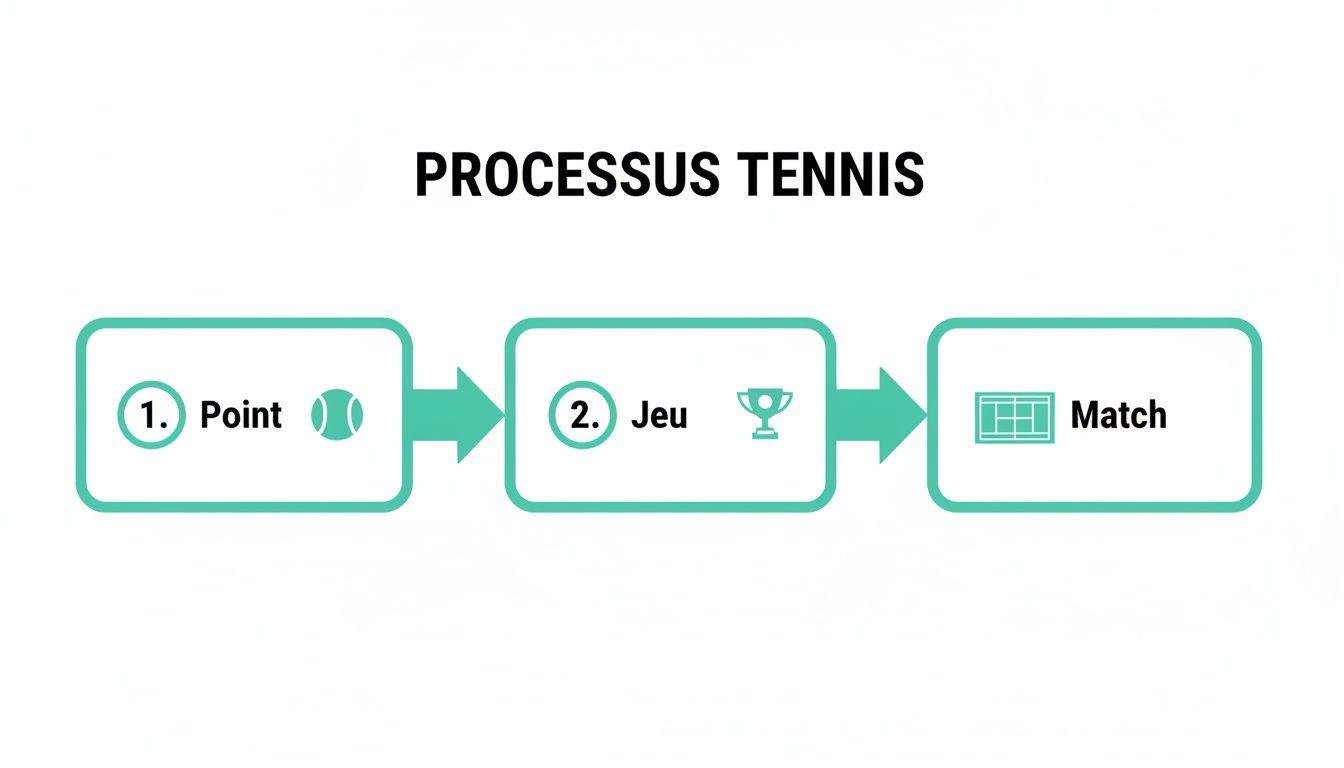
You can clearly see this pyramid structure: each point is a brick. You need to lay enough bricks to build a game, then assemble the games to win the match.
To clarify even further, here’s a small table summarizing the typical progression of a score within a game.
Score Progression in a Tennis Game
| Points won by Player A | Points won by Player B | Announced Score |
|---|---|---|
| 1 | 0 | 15-0 |
| 1 | 1 | 15-15 |
| 2 | 1 | 30-15 |
| 3 | 1 | 40-15 |
| 3 | 2 | 40-30 |
| 3 | 3 | Deuce |
| 4 | 3 | Advantage A |
| 3 | 4 | Advantage B |
This table clearly shows how the score evolves up to the famous turning point of deuce, where the game can drag on.
What Does a Game Look Like in Practice?
Let’s take a concrete example with Paul serving against Marie.
- Paul hits a good serve, Marie can’t return it. 15-0.
- The next rally is long, but Marie hits a winning forehand. 15-15.
- Marie follows up with a powerful return. 15-30.
- On the next point, Paul comes to the net and finishes with a volley. 30-30.
- Marie forces Paul into an error. She leads 30-40. It’s a "break point" for her, the chance to take her opponent’s serve.
The next point is crucial. If Marie wins it, she wins the game. But if Paul defends well and wins the point, we reach 40-40, "deuce". That’s where the real mental battle begins to see who has the composure to string together the two points for victory.
Absolutely! Here’s a rewrite of this section in a more human and natural style, respecting the voice of the provided examples.
From Games to Sets: How to Build Your Victory
Okay, now that you’ve mastered counting points in a game, let’s move to the next level: how to win a set. It’s a bit like a construction game. Each game you win is a brick, and you need several to build the solid wall that is the set. The logic is simple, but with a little twist that makes all the difference in tennis.
To win a set, the first player to reach six games wins. But be careful, it’s not that straightforward. You must have a lead of two games over your opponent. This is a golden rule to ensure that the victory is clear, without any dispute.
In practical terms, a score of 6-4? That’s a win, the set is in the bag. However, if the score shows 6-5, the battle continues. The leading player must still win the next game to conclude at 7-5.
Tension Rises at 5 Games All
When the score reaches 5-5, the atmosphere on the court changes. You can feel that the moment is crucial. At this stage, it’s impossible to win the set on a small 6-5. The famous two-game lead rule remains in place, meaning the winner of the set will be the one who reaches seven games.
- If Player A leads 5-4 and wins the next game, they win the set 6-4.
- If the score is 5-5, whoever wins the next two games wins 7-5.
- And if both players find themselves at 6-6? Then a special rule comes into play: the famous tie-break, which we will break down just after.
Winning a set isn’t just a race to be the first to six. It’s a battle to create a decisive gap. The requirement of a two-game lead ensures that the winner has truly taken control at the end of the set, adding a good dose of strategic suspense.
This structure is the foundation of all matches, but the total duration of a match will depend on the format of the competition.
Match in 3 or 5 Sets: The Endurance Test
Most tournaments, whether for women (WTA) or men (ATP), are played in a "best of 3 sets" format. It’s simple: the first player to win two sets wins the match.
However, men’s Grand Slam tournaments (Roland-Garros, Wimbledon, US Open, Australian Open) are a different story. They are played in a "best of 5 sets" format. To lift the trophy, you need to win three sets. This marathon format is known to be a true physical and mental test, and it’s often where we witness legendary matches with memorable comebacks.
Decoding the Tie-Break
When the scoreboard shows 6-6 in a set, the court holds its breath. This is the moment when the tension rises a notch and a special rule comes into play to close out the set: the tie-break. This crucial phase completely changes the dynamics of point counting.
We forget the traditional "15-30-40." In a tie-break, the tennis scoring rule is much more straightforward. Points are counted one by one: 1, 2, 3… The objective is simple: be the first to reach 7 points, but with at least a two-point lead over your opponent.
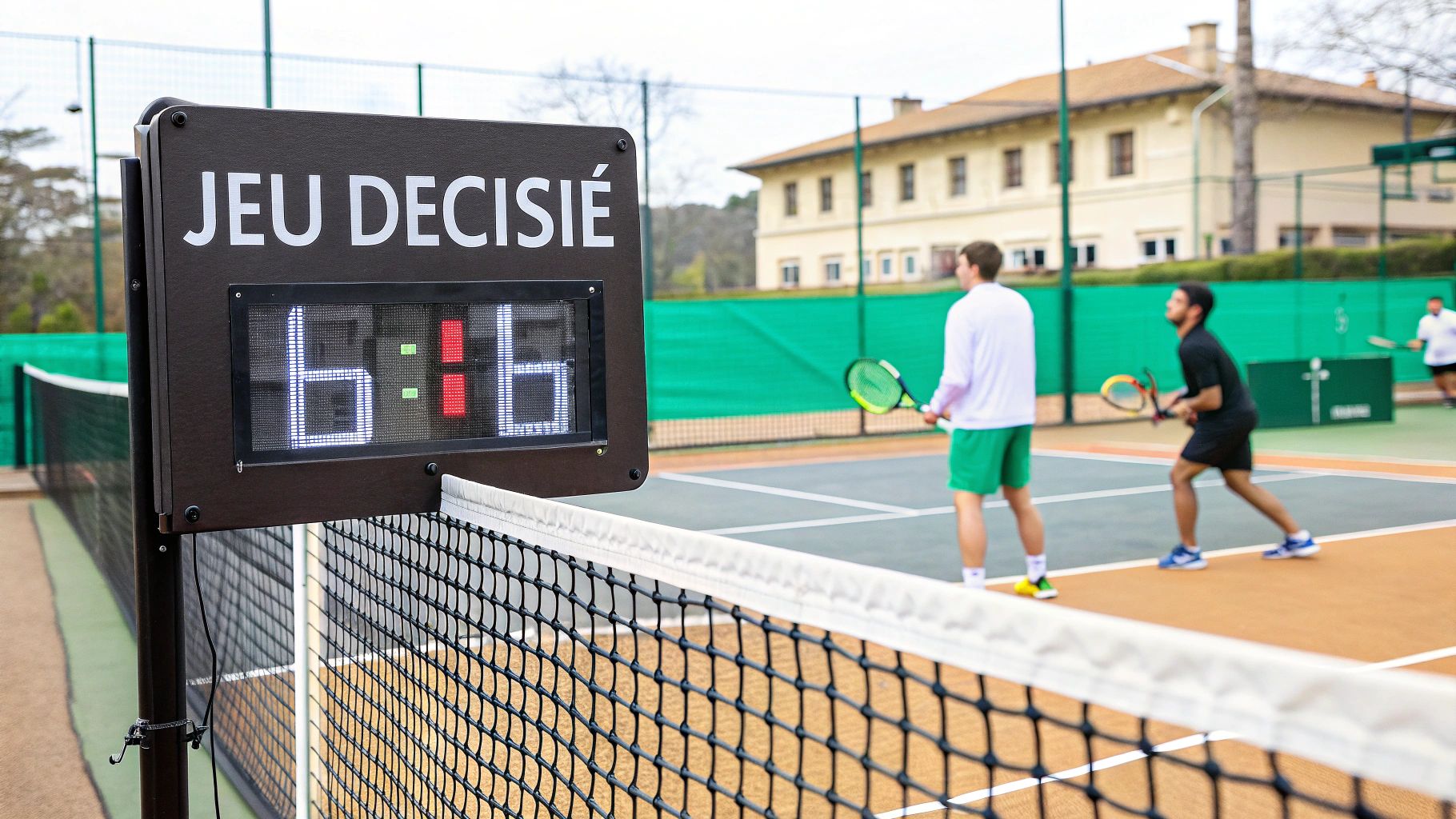
The Functioning of the Tie-Break
The tie-break follows a very precise protocol, especially for serving.
- First point: The player who was supposed to serve after the twelfth game (at 6-6) serves for the very first point.
- Subsequent points: Immediately after, the serve goes to their opponent for the next two points.
- Alternation: The alternation continues every two points until the end.
- Change of sides: Players change sides every six points.
To win the tie-break (and thus the set at a score of 7-6), you must reach those famous 7 points with a two-point lead. If the score reaches 6-6 in the tie-break itself, the game continues until one player creates that gap. Scores can then become 8-6, 9-7, or even 12-10!
The tie-break is a true test of composure. Every point weighs a ton, and the slightest lapse in concentration can cost you the set. This is often where the greatest champions show their mental strength.
The tension of a tie-break at Roland-Garros, for example, can transform into a powerful engagement tool in business. Some companies energize their teams by organizing prediction contests based on these key moments, strengthening cohesion around sports. By the way, discover how organizing a prediction contest for Roland-Garros can boost your employer brand.
The Special Case of the Super Tie-Break
There is also a variant, the super tie-break. It is mainly seen in doubles or in some exhibition tournaments to replace the final deciding set. Its purpose? To speed up the end of matches and ensure an intense spectacle.
The principle is almost identical, but with one major difference: the first player to reach 10 points (still with a two-point lead) wins not only the super tie-break but also the entire match. It’s a quick and brutal conclusion that leaves no room for error.
Tennis Jargon at Your Fingertips
To truly enjoy a match, you need to speak the same language as the players and commentators. Knowing the key terms of the tennis rule allows you to decode not only the score but also all the tension and strategy behind a rally.
Think of this little lexicon as your pocket translator. No more feeling lost!
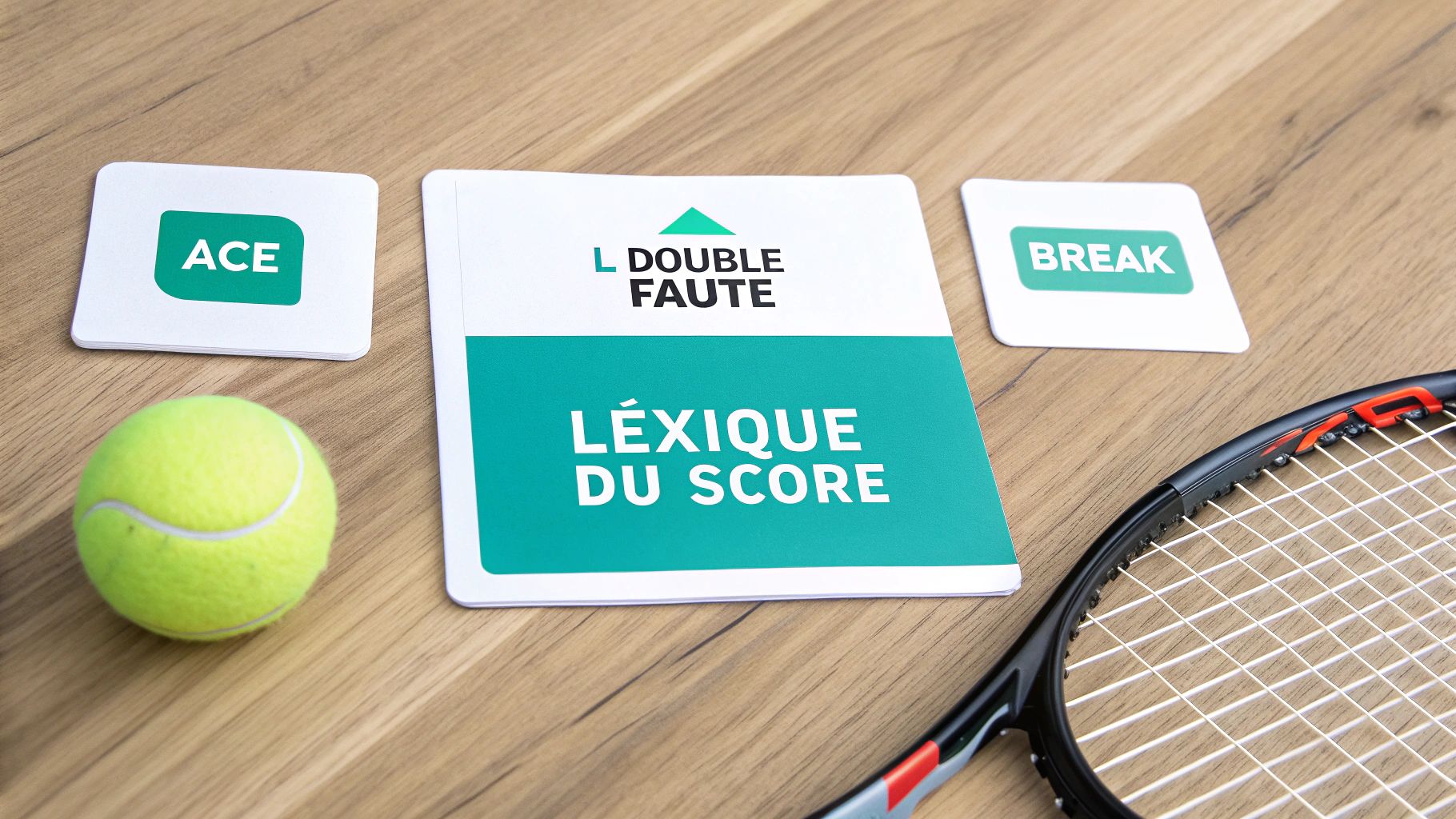
At the Heart of the Serve
The serve is the kickoff of each point. Naturally, it has its own vocabulary, oscillating between perfection and fatal error.
- Ace: The perfect serve, the genius shot. The ball lands in the box, and the opponent can’t even touch it with their racket. It’s a direct, clean point.
- Let: A little twist of fate. The ball hits the net before falling into the correct box. No worries, the point is neither won nor lost. The server simply gets to redo this serve.
- Double fault: It’s the nightmare of every server. A player misses both of their service attempts in a row, and it’s an immediate penalty. The point is awarded to the opponent.
Moments That Shift a Match
Some points weigh much more than others. They can turn a game, a set, or even the entire match. This is where all the drama of tennis unfolds.
A tennis match is a series of high-pressure moments. If you understand what a "break point" or a "match point" is, you understand where the real battle lies, both psychological and strategic.
Here are the situations to absolutely watch for to feel the pulse of the match:
- Break point: This is the golden opportunity for the returner to take their opponent’s serve. Winning this point is to "break." A often decisive advantage.
- Set point: The point that can conclude the set. The tension is at its peak for both players, one to finish the job, the other to survive.
- Match point: The ultimate point, the one that can end the match. You hold your breath. For one, it’s victory at the end of the racket; for the other, it’s the last chance to stay in the match.
By mastering this vocabulary, you will never watch a match the same way again. You will be able to anticipate key moments and experience each point with a whole new intensity.
The Questions Everyone Asks About Scoring in Tennis
Even with the basics in mind, counting points in tennis often raises its share of questions. That’s perfectly normal! So let’s take the time to unravel the most frequent queries so that everything becomes clear. Ready to become an expert?
But where does this famous 'love' for saying zero come from?
It’s one of the most charming quirks of tennis! The most widespread theory comes from... French. The term "love" is actually a distortion of "l'œuf." Visually, the shape of an egg resembles a zero. As it spread to England, the word gradually transformed into "love" in the ears of English speakers.
Another, slightly more romantic explanation tells that the expression comes from "playing for the love of the game." When you play for love, you’re not playing for money, hence a score of zero. In France, even though "love" is often heard on the pro circuit, we simply use the word "zero."
Tie-break or super tie-break: what’s the difference?
Excellent question, as confusion is common. The big difference lies in their role in the match and the number of points needed to win them.
- The classic tie-break: It occurs when players are at 6-6 in a set. It’s a deciding game to determine who will take the set. The first to score 7 points (with at least a two-point lead) wins this game and takes the set 7-6.
- The super tie-break: This one completely replaces the last deciding set to prevent matches from dragging on. It’s often seen in doubles. Instead of playing a full set, a large tie-break is played to 10 points (still with a two-point lead). The one who wins it wins the match, not just a set.
This is a crucial detail to understand how the most closely contested matches end.
"The super tie-break is a true final sprint. There’s no room for error. Every point is potentially a match point, making the tension absolutely electric, both for the players and the spectators."
What is this 'No-Ad' rule?
The "No-Ad" rule (short for no-advantage) is a brilliant invention to make games faster and more intense. When the score reaches 40-40, what’s called "deuce," the suspense is at its peak. With the No-Ad rule, the next point is simply decisive.
The one who wins this single point wins the game. No more endless phases of advantage and deuce! A small nuance: for this crucial point, it’s the returner who chooses which side of the court the serve will be made from. This rule is widely used in doubles or in college tennis to energize matches.
Can a match really end with a score of 7-6, 7-6?
Absolutely! And it’s actually a fairly common scenario in matches where both players are very close to each other. In a best of three sets format, if one player wins the first two sets in a tie-break, the final score will indeed be 7-6, 7-6.
And the match stops there. No need to play a third set, as victory is already secured. It’s the perfect proof that a match can be extremely tight from start to finish, with each set being played on a razor’s edge.
For any other questions about how to set up sports competitions, feel free to check out our FAQ section on organizing contests, which is full of useful information. Every detail matters, whether on the court or behind the scenes.
Engage your teams and strengthen cohesion around the biggest sporting events. With ccup.io, create personalized prediction contests in your company’s colors and transform each match into an unforgettable collaborative experience.
From Content To Conversion
Turn your next sports event into a company prediction contest
Discover the platform, explore available competitions, and launch a branded experience that supports engagement, internal communication, and team cohesion.
See available competitions
Latest articles

2 days ago
Women's Euro Prediction: Women's Euro 2026 Prediction: The Def
You probably already have the scene in mind. The tournament is approaching, management asks you for a unifying activity, teams are scattered between offices, remote work, and subsidiaries, and you have no desire to manage a prediction contest in a makeshift spreadsheet at the last minute.
...

2 days ago
Football Predictions Among Friends: Create and Run a Successful Contest
You probably have the same scene in mind as many P&C teams before a big competition. The Teams or Slack thread comes alive, a few colleagues throw out predictions "for fun," an Excel spreadsheet circulates, and then no one knows which version is correct, who responded, or how to break ties. T...





















Contact us
For any question or quotation requests, do not hesitate to reach us by phone at 01 83 79 24 54 or by email : contact@ccup.io
Contact us


Frequently asked questions
What is ccup.io?
Ccup.io is a cohesion tool, allowing firms to gather their collaborators on the occasion of major sporting events, such as World Cup or Olympic Games. We offer an interactive forecasting platform, turnkey and customisable to your company’s colours.
What are you doing with our data?
By deciding to use our services, you decide to entrust us a part of your data – this will allow us to optimise your experience. We place great emphasis on the protection of your data, in compliance with current regulations. Given that it is important to be informed on the issues and challenges of personal data protection, ccup.io provides you with a most complete documentation on this matter.
How much does it cost?
In order to give our clients flexibility, we make a special rate depending on the number of registered players using a degressive system for an important number of participants. This allows firms to organise tailored events, adapted to their capacity. To receive a commercial offer in less than an hour, you only need to fill out the quotation requests form, with just a few clicks.



Don’t miss this opportunity 😍
Start now and enjoy numerous benefits