



Master Every Tennis Rule to Win on the Court
The principle of tennis is disarmingly simple: you hit a ball over a net into the opponent's side, and you make sure they cannot return it. Each point won is a step closer to victory, and it is this logic that drives the game, whether you are a complete beginner or just a spectator.
Dive into the Heart of the Game: The Fundamental Rules of Tennis
Before getting lost in the subtleties of scoring or technical faults, we must return to the essentials. Imagine a match not as a list of rules, but as a rhythmic conversation between two (or four) players. The ball is their only means of communication. The goal? To pose a "question" so difficult with your racket that the opponent cannot answer.
This conversation always starts with a serve. A player stands behind their baseline and must propel the ball into the opposite service box diagonally, without it touching the net. If they miss, no panic, they have a second chance. But be careful, a second failure means a double fault: the point is lost automatically.
The Rally, the Heart of the Action
Once the serve is in play, the rally begins. This is the moment when players hit the ball back and forth, each taking turns, allowing it to bounce only once in their court. The point ends as soon as one of the players makes a mistake.
Here are the most classic situations that conclude a point:
- The ball goes out of bounds: If your shot lands outside the lines that define the court, you lose the point. This is called a direct fault.
- The ball hits the net: If your shot does not clear the net and falls back on your side, the point goes to the opponent.
- Two bounces: Did you fail to hit the ball before its second bounce in your court? Too bad, the point goes to the other player.
Scoring, a Story Not from Yesterday
This famous point system (15, 30, 40) may surprise you, but it is deeply rooted in the history of the sport. Each tennis rule today is a nod to its French ancestor, the "jeu de paume", which was already played in the 12th century. Monks used the palm of their hand to hit a ball back and forth, inventing a scoring system that still intrigues us. A popular theory links this system to the French currency of 1340, where players bet multiples of 15 sous. To delve deeper, feel free to check the history of tennis on Wikipedia.
The beauty of tennis is this gradual construction. You win a point, then a game, then a set, and finally the match. Each step is a small victory that leads to final success.
By understanding this structure, you have already done the hardest part. You can now appreciate the tension and strategy of a match, as each rally becomes a mini-challenge. You are no longer just a spectator; you analyze the tactics. And this is the starting point for any discussion about the tennis rule.
Absolutely! Here is the section rewritten in a natural, human, and expert style, following the guidelines and examples provided.
Decoding the Court and Game Equipment
To truly understand tennis, even before discussing scoring or faults, you must first take a look at the court. It is not just a rectangle with a net in the middle; it is a true chessboard where each line has a specific mission. Think of it as the game board: knowing your zones is the very first step to building a winning strategy.
The standard singles court measures 23.77 meters long by 8.23 meters wide. These dimensions, which may seem a bit arbitrary, actually create a space where every square centimeter matters. In the center, the net divides the court into two sides and is the first obstacle to overcome to score a point.
The Essential Role of Each Line
Every white line you see on the court is not there just for decoration. It has a function that directly impacts the serve, the rally, and ultimately, the score. Knowing how to identify them is crucial to understanding why a ball is in or "fault".
Here are the fundamental lines to know by heart:
- The baseline: This is the back boundary of the court. This is where you serve from, and it is the limit not to be crossed during the rally. If the ball lands behind it, the point is lost.
- The service boxes: These two rectangles next to the net are the targets to aim for during the serve. The server must send the ball into the diagonally opposite box for their serve to be valid. This is the most strategic area at the start of the point.
- The service line: It marks the back of the service boxes. A serve that goes beyond this line is too long; it is a fault.
- The sidelines: They define the width of the court. In singles, you play with the inner lines. In doubles, you add the "alleys" on the sides, which widens the court to 10.97 meters and completely changes the angles of play.
Mastering this geometry is a bit like learning to read a map. It allows you to visualize the action, anticipate the opponent's shots, and correctly apply each tennis rule.
A small table to clarify and memorize the role of each zone:
| Zone / Line | Main Role | Impact on the Game |
|---|---|---|
| Baseline | Defines the length of the court. Starting point for the serve. | A ball that falls behind is a fault. Serves as a reference for positioning. |
| Service Line | Back limit of the service boxes. | A serve landing behind this line is a fault. |
| Service Box | Mandatory reception area for the serve. | The server's number one target. A missed serve results in a fault. |
| Sideline (singles) | Defines the width of the court for one-on-one matches. | Any ball outside this line is a fault in singles. |
| Sideline (doubles) | Defines the width of the court for two-on-two matches. | Widen the court by including the alleys, opening new angles. |
| The Net | Divides the court in two and must be cleared by the ball. | Touching the net with your body or racket results in losing the point. |
With these markers in mind, the flow of a match becomes much clearer.
The Impact of Equipment on the Game
Beyond the court, the equipment you hold is not just an accessory. The choice of racket and balls directly influences your way of playing and, consequently, your ability to adhere to the rules of the game.
A lightweight racket with a large head (the string surface) will more easily forgive off-center hits, which is ideal for a beginner. Conversely, an experienced player will seek a heavier and thinner racket for maximum control and precision, qualities essential for keeping the ball within the lines.
The equipment is an extension of the player. A well-chosen racket not only facilitates hitting but also allows executing a strategy while respecting the physical and regulatory constraints of the game.
The same goes for the balls! They are not all the same. Those used on clay courts are often a bit slower and bounce higher than those designed for hard surfaces. This small detail radically changes the dynamics of a match, favoring longer and more tactical rallies.
In short, knowing how the court is defined and how your equipment interacts with the rules gives you a 360° view. You no longer just see players hitting a ball, but strategists using every element at their disposal to win the point.
Decoding the Score in Tennis: From the Famous 15-30-40 to the Tie-Break
The scoring system in tennis may seem confusing at first glance. Where do these 15, 30, and then 40 points come from? Far from being a simple whim of history inherited from the jeu de paume, this sequence is the heart of the suspense. It structures each rally and injects a dose of drama into every moment of the match.
Once you master its logic, you will see that each point takes on a whole new dimension. It is not an arbitrary count, but the engine that transforms a simple hit into a strategic duel. Grasping this mechanism is the key to feeling the rhythm of the match, point by point.
This infographic illustrates the journey of a tennis ball: from the lines that define the court to the net it must clear, through the racket that brings it to life.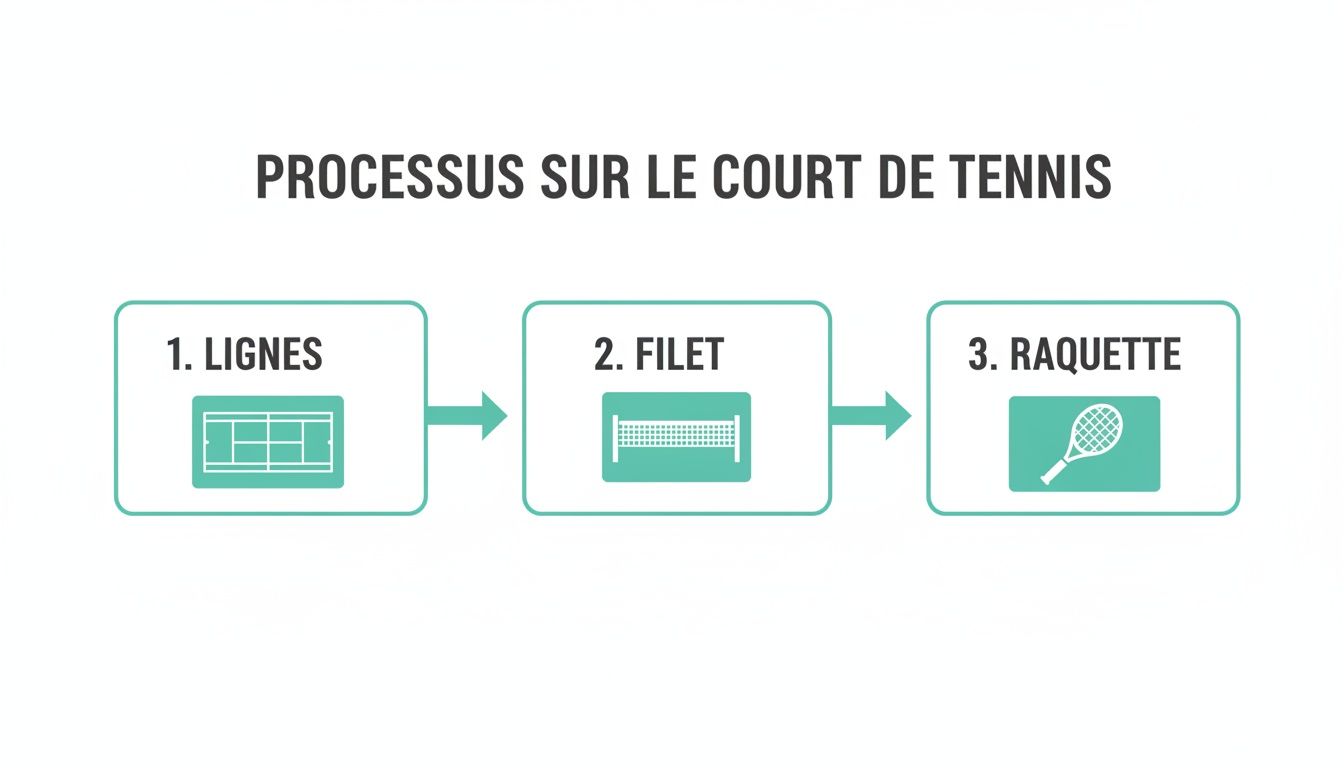
Every element of the court plays a precise role and creates an environment where every hit obeys strict rules.
The Basics of the Game or "Game"
Imagine a tennis match as a series of small battles. The smallest of these battles is the game. To win one, you must score four points, but be careful, there is a crucial condition: you must have at least a two-point lead over your opponent.
The count goes as follows:
- First point won: The score goes to 15.
- Second point won: It is announced 30.
- Third point won: The score reaches 40.
- Fourth point won: It is the game! Unless, of course, the opponent is also at 40.
This structure makes every point decisive. A player trailing 0-30 feels the pressure rise, while at 40-15, they can almost touch victory in the game.
Deuce, the Moment of High Tension
Things get tense when both players find themselves at 40 points each. You never hear "40-40" on a court, but rather "deuce". This is where the famous two-point rule comes into play.
Deuce is a bit like a psychological reset. All the work done to get to 40 is called into question. It is no longer enough to score just one point; you must prove your superiority by winning two consecutive points.
To escape this situation, a player must therefore score two points in a row. The first point after "deuce" gives them the "advantage". If they win the next point, they win the game. But if they lose it, the score returns to "deuce", and the struggle begins anew. This mechanism can lead to endless games, true physical and mental marathons.
To learn everything about the tennis rule governing the point, our detailed guide explores every nuance of this essential phase of the game. Feel free to delve deeper by checking our article on the point rule in tennis.
The Tie-Break, the Decisive Game
When the score of a set reaches 6-6, a special game is called to separate the players: the tie-break, also known as the decisive game. Its goal? To avoid sets that drag on and ensure a high-tension end to the set. In a tie-break, we forget the traditional counting.
Here, points are counted one by one: 1, 2, 3... The first player to reach 7 points wins the tie-break (and thus the set), provided, once again, they have a two-point lead. If the score reaches 6-6 in the tie-break, the game continues until one player establishes that lead (for example, 8-6, 9-7, and so on).
The order of service is also completely different:
- The player who was supposed to receive in the next game serves the very first point.
- The opponent takes over and serves the next two points.
- Then, each serves two points in turn until the end.
The tie-break is a true test of nerves. Its fast pace and direct counting raise the pressure with each rally. The slightest lost point weighs heavily, making this moment as captivating for spectators as it is intense for players.
Decoding Common Faults and Violations

In tennis, every shot follows specific rules to ensure that the game remains fair and fluid. Understanding the most common errors is essential, not only for players but also for spectators who want to grasp why a point suddenly stops. These faults, from the most obvious to the most subtle, are at the heart of officiating.
The majority of points end with a direct fault, such as a ball in the net or out of bounds. But there are many other violations that can occur, especially during the serve, that crucial moment, or in the midst of a rally. Let’s learn to recognize them to better appreciate all the nuances of the game.
Service Faults to Avoid
The serve initiates the point, but it is also a nest for potential errors. The pressure to serve well can lead to faults that give a "free" point to the opponent. Each tennis rule governing the serve aims to ensure a balanced start.
The two main faults in serving are:
- Service "fault": The ball simply does not land in the correct service box, the one diagonally opposite the server. It may be too long, too wide, or touch the net before falling out of the zone.
- Foot fault: A pure placement error. The server must not step on or over the baseline with their foot before hitting the ball. This rule is often taken lightly among amateurs but is strictly enforced in competition.
After a first service fault, the player is entitled to a second chance. If they make another error on this second attempt, it is a double fault. The point is then automatically lost.
A double fault is much more than just a technical error; it is a true psychological turning point. It often betrays a loss of confidence or rising pressure, giving an immediate mental advantage to the opponent.
The "Let", This Ball to Replay
Sometimes a serve grazes the net before falling into the correct box. In this specific case, the serve is neither good nor a fault. The umpire announces a "let": the player simply has the right to replay this serve (their first or second, depending on the case). Be careful, if the ball touches the net and falls outside the box, it is indeed a classic fault.
This "let" rule also applies during a rally if an external event disrupts the game, such as a ball from a neighboring court entering the field. The umpire interrupts the action, and the point is entirely replayed.
Violations During the Rally
Once the ball is in play, other types of faults can end the action. They are often related to prohibited contact or interference.
- Touching the net: A player (or their racket) must never touch the net or the posts supporting it while the point is in progress. If this happens, they lose the point immediately.
- Crossing the net: It is forbidden to hit the ball before it has crossed the net into your own side. There is one exception: if the ball bounces on your side with such spin that it goes back to the opponent's side, you are allowed to reach over the net with your racket to play it.
- Deliberate or involuntary interference: A player must not deliberately interfere with their opponent, for example, by shouting while the other is about to hit. The umpire can then penalize them with a warning or make them lose the point.
- Double hit: It is forbidden to hit the ball twice with your racket in one motion. The gesture must be unique and fluid.
Mastering these infractions is fundamental. For an even more comprehensive overview, feel free to check our guide on tennis rules for dummies that will help you put everything in order. Each tennis rule has its reason for being and contributes to making this sport a magnificent duel where technique and respect reign supreme.
Doubles in Tennis: Change Dimensions
Doubles is not just tennis with one more player on each side of the net. It is a discipline in its own right, a different way of thinking about the game. If singles is a solo, doubles is a duo where communication and synchronization become the keys to success.
Playing as a pair is primarily about teamwork. You must constantly anticipate your partner's movements, communicate, and adapt. For this choreography to work, the rules of the game evolve, particularly regarding court size, service organization, and the flow of rallies.
A Wider Playing Field
The first thing that stands out in doubles is the court. It widens. The two alleys, these 1.37 meters bands on each side, which are "fault" in singles, are now an integral part of the court. The total width thus increases from 8.23 meters to 10.97 meters.
This extra space completely changes the game. New angles open up, ball trajectories intersect differently, and placement strategies become crucial. This is the fundamental tennis rule that redefines the entire tactical approach to doubles.
In doubles, the wider court is not a luxury; it is a tactical puzzle. The alleys create new opportunities but also new vulnerabilities, forcing teams to cover more space and think about their movements in tandem.
This configuration forces pairs to coordinate perfectly to leave no gaps in their defense. Good placement often outweighs a powerful hit.
The Well-Oiled Mechanics of Serving and Returning
The order of serving and returning in doubles resembles a musical score. Nothing is left to chance. Before the start of each set, each team makes two crucial decisions.
For the serving team:
- Who starts serving? Team A decides whether player A1 or A2 will serve in the first game.
- The alternation is then set in stone. If A1 serves in the first game, it will be a player from team B who serves in the second. In the third game, it will be A1's partner, so A2, who serves. The order (for example: A1, B1, A2, B2) cannot change until the end of the set.
For the returning team:
- Who stands where? Team B must choose which player will receive serves in the right box and who will take the left box.
- This position is fixed for the entire set. The designated player for the right side will return all serves coming from that side, and vice versa for their partner.
This organization is strict. It is forbidden to change the order of servers or the position of receivers during the set.
Once the Ball is in Play, Total Freedom!
As soon as the serve has crossed the net and the rally is underway, the rule becomes much simpler: any player can hit the ball. There is no need to alternate hits between partners.
This freedom opens the door to an infinite number of strategies. Most often, the player in the best position, often the one who moves to the net, takes charge of intercepting the ball to finish the point quickly. This is where communication becomes crucial: a well-timed "mine!" or "leave!" avoids collisions and optimizes every shot. Success in doubles is primarily about this synergy and blind trust in your partner.
Far more than a sport, tennis is an incredible vector of emotions and social connection. Far from being limited to the courts, it can become a powerful tool to energize your company's life and strengthen team cohesion, well beyond the usual discussions at the coffee machine.
Capitalizing on the excitement of major tournaments like Roland-Garros, Wimbledon, or the Australian Open is a golden opportunity to bring your employees together. The idea is not to turn offices into playgrounds but rather to use this shared passion as a lever for friendly and unifying management.
Create Simple and Effective Activities
Launching activities around tennis is much simpler than one might think. The goal is to offer fun and accessible activities that stimulate interaction, even for those who are not experts in the little yellow ball. Sometimes a simple quiz is enough to kick off a great dynamic!
Here are some concrete ideas that are easy to implement:
- Organize a prediction contest: Who will win today's match? During a major tournament, invite employees to bet on the results. It’s an ultra-simple way to create friendly competition and follow sports news together.
- Launch interactive quizzes: Test your teams' knowledge on a specific tennis rule, the history of great champions, or anecdotes from legendary matches. These short formats are perfect for animating a lunch break.
- Create themed challenges: Dare to come up with more creative challenges, like the most original "dress code" inspired by tennis or a contest for the best imitation of a player's shout. Guaranteed laughs!
These light activities encourage informal exchanges and allow employees to discover each other from a different angle. It’s an excellent way to break down silos and strengthen ties between different departments.
Sports in the workplace is not a distraction; it is an investment in human capital. It transforms the work environment into a place where collaboration and well-being are truly valued.
Enhance Your Employer Brand Through Sports
Using tennis to unite does not just boil down to simple entertainment. These initiatives reflect a dynamic company culture that cares about the well-being of its employees. They directly contribute to strengthening your employer brand, a crucial asset for attracting and retaining talent. To go further, discover how to succeed in your contests for Roland-Garros and maximize engagement.
Even with a slight decline in the number of licensed players, tennis remains a pillar of the economy and culture in France, generating 36% of the sports GDP in the country. With its thousands of clubs, it continues to bring together millions of enthusiasts. It is an incredibly fertile ground for successful business initiatives. By integrating this passion into your internal communication, you show that your company is a place where it is good to live and work.
The Questions We All Ask on the Court
Even with the basic rules in mind, certain game situations can quickly become puzzles. This section is a bit like your cheat sheet for moments of uncertainty. We have gathered here the most frequently asked questions to give you clear, concise, and precise answers.
This is the perfect tool to settle a debate during a match among friends or simply to be sure of your shot. Let’s dive into these concrete scenarios that sometimes sow doubt, even among the most seasoned players.
Can I hit the ball before it bounces?
Yes, of course! This is called a volley. Hitting the ball before it touches your side of the court is not only allowed, but it is also a formidable weapon, especially when moving to the net to finish the point.
The only exception, and it is a significant one, is on the service return. There, it is non-negotiable: you must necessarily let the ball bounce once before playing it. Attempting a volley on a serve is a direct fault, and the point goes to your opponent.
What happens if the ball touches a line?
If a ball touches even a millimeter of a line, it is considered in. This is a golden rule in tennis, even if it is the source of many heated discussions on amateur courts!
For a ball to be called "fault", there must be a clear space between its point of impact and the line. When in doubt, the great tradition of tennis dictates that the point is given to the opponent. It’s all about fair play.
What if my racket slips from my hands?
If your racket slips from your hands and lands in the opponent's court or touches the net, the point is lost instantly. It’s simple and indisputable.
However, if it falls on your side of the court without touching the net, the game continues... technically. But good luck returning the next ball without your main tool!
Can a player touch the net post?
Absolutely not. As long as the ball is in play, it is forbidden to touch the net or the posts that hold it. Whether with your body, your clothing, or your racket, contact means a lost point.
The net is a sacred boundary. It separates the two sides, and touching it during the rally is a fault that ends the point immediately.
What if you turned your passion for sports into a moment of cohesion for your teams? With ccup.io, organize engaging prediction contests to energize your company during the biggest sporting events. Discover how at ccup.io
From Content To Conversion
Turn your next sports event into a company prediction contest
Discover the platform, explore available competitions, and launch a branded experience that supports engagement, internal communication, and team cohesion.
See available competitions
Latest articles

21 hours ago
Your Guide to Organizing Corporate Sports Events
The next big sports competition is approaching. Internally, the idea seems simple. Gather the teams, create a highlight, break the routine, and circulate some energy between offices, sites, and remote workers. Then the real questions arise. What format to choose, who to invite, how to avoid an ev...

2 days ago
Guide: Your Optimal Free Prize Request in 2026
The management's message is often the same. There needs to be internal engagement that creates momentum, unites multiple sites, and encourages participation, but the rewards budget is almost non-existent. In many companies, this is when motivation drops. This is a mistake.
A well-t...





















Contact us
For any question or quotation requests, do not hesitate to reach us by phone at 01 83 79 24 54 or by email : contact@ccup.io
Contact us


Frequently asked questions
What is ccup.io?
Ccup.io is a cohesion tool, allowing firms to gather their collaborators on the occasion of major sporting events, such as World Cup or Olympic Games. We offer an interactive forecasting platform, turnkey and customisable to your company’s colours.
What are you doing with our data?
By deciding to use our services, you decide to entrust us a part of your data – this will allow us to optimise your experience. We place great emphasis on the protection of your data, in compliance with current regulations. Given that it is important to be informed on the issues and challenges of personal data protection, ccup.io provides you with a most complete documentation on this matter.
How much does it cost?
In order to give our clients flexibility, we make a special rate depending on the number of registered players using a degressive system for an important number of participants. This allows firms to organise tailored events, adapted to their capacity. To receive a commercial offer in less than an hour, you only need to fill out the quotation requests form, with just a few clicks.



Don’t miss this opportunity 😍
Start now and enjoy numerous benefits