



Roland Garros Predictions to Energize Your Business
A Roland Garros prediction contest is not just a game. It’s a real management tool to transform the atmosphere in the office. Imagine the lively conversations at the coffee machine, no longer about the latest files, but about the next match at Porte d'Auteuil.
How a Roland Garros prediction contest Can Really Change the Work Atmosphere
Launching a prediction challenge during the grand Parisian tournament is a powerful strategy to unite teams. This iconic event, which captivates well beyond just tennis fans, becomes a golden opportunity to create bridges between different departments of the company.
Suddenly, colleagues from marketing, accounting, and logistics discover a common interest. They share tips, debate the performances of Carlos Alcaraz or Iga Swiatek, and follow the overall ranking together. It is precisely these informal interactions that build a strong and friendly corporate culture.
Breaking the Routine and Awakening Engagement
The professional daily grind can quickly become monotonous. A prediction contest on Roland Garros injects a good dose of fun and friendly competition that disrupts the routine. Every morning, discovering the new ranking becomes a little anticipated ritual, generating very healthy excitement.
- Breaking Down Departmental Silos: Teams naturally mix around a neutral and entertaining subject.
- Strengthening the Sense of Belonging: Employees feel engaged in a collective event that celebrates friendliness.
- Improving Communication: The game opens new informal discussion channels, essential for a good atmosphere.
By riding the wave of a major sporting event, you transform an external passion into positive and unifying energy for your organization. It’s a simple way to show that well-being and good humor are at the heart of your priorities.
A Real Impact on Motivation
Organizing this type of event is not just a distraction. The impact on motivation is direct. We know that an engaged and happy employee is a more productive employee. The mere act of offering a fun activity is perceived as a sign of recognition from the company, which strengthens loyalty and employee involvement.
The benefits far exceed the realm of entertainment. The spirit of competition, when channeled positively, can translate into a renewed energy for professional projects. To go further, discover other strategies to unite your teams through sports.
In summary, organizing a Roland Garros prediction contest is a low-cost investment for a potentially high return on atmosphere and engagement. An intelligent managerial tool disguised as a game.
Establishing the Rules of the Game for a Successful Contest
For your Roland Garros prediction contest to be a true success, it all starts with solid foundations. Before even sending the first invitation, it is essential to define a clear and motivating game framework. The goal? To ensure that everyone, from the clay court enthusiast to the casual observer, starts on equal footing.
This preparation is the secret to a fair, transparent, and hassle-free experience. The first question to ask yourself is simple: what is your goal? Is it to energize the atmosphere within a department, to create a bond with a subsidiary abroad, or simply to spice up daily life? Your answer will directly guide the complexity of the rules to be implemented.
Designing a Balanced Scoring System
The heart of the reactor is the scoring system. It is what will maintain suspense until the last match point. A good scoring system should be easy to understand while rewarding the accuracy of predictions.
Here are some ideas that you can, of course, combine:
- Correct Winner: This is the base. Award points for correctly identifying the winner. Simple, effective, and allows everyone to participate without feeling overwhelmed.
- Exact Score: For the knowledgeable, offer a nice bonus of points to those who predict the exact score in sets (for example, 3-1). This is the little extra that rewards expertise without penalizing novices.
- Bonus Predictions: To spice up the game, throw in some additional questions. "Who will make the most aces in the match?" or "Will there be a white game in the first set?" Fun guaranteed!
Balance is really the key. A system that is too simplistic risks boring players, while a too complex scoring system can discourage many. The ideal is to mix easy wins to keep everyone in the race and bonuses for the more astute analysts.
As this infographic shows, a simple contest can trigger a real virtuous circle. It starts with a friendly competition to strengthen bonds, and in the end, it improves the overall atmosphere and even productivity.
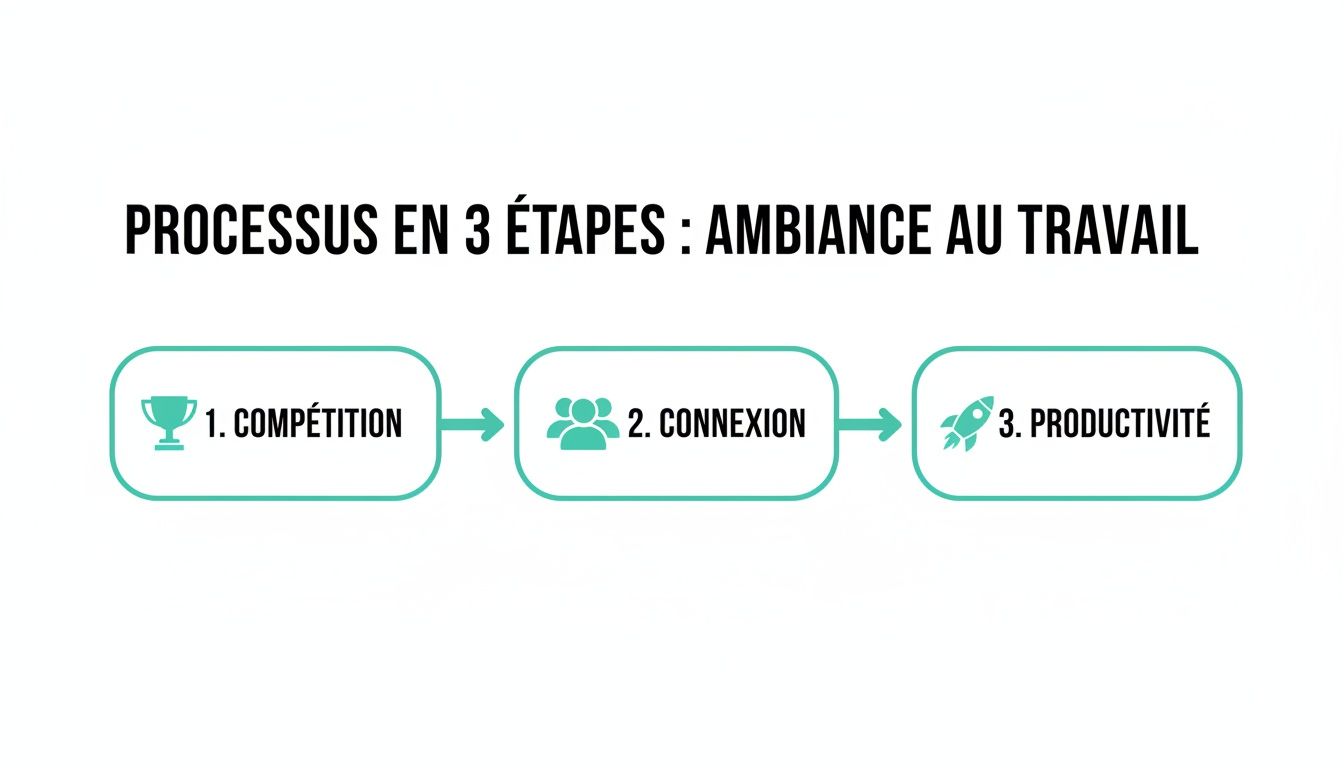
This is not just a game; it’s a real lever for your corporate culture.
Integrating Original Questions to Surprise
To step off the beaten path, draw from the richness of the tournament itself. Did you know that Roland Garros is an economic powerhouse? The revenue of the French Tennis Federation has increased by 53% in ten years to reach 192 million euros, with 85% of this amount coming directly from the tournament.
So why not propose predictions on these figures? "How many spectators in total over the fortnight (the goal is 685,000 in 2025)?" or "What will be the longest match of the tournament?" For more juicy figures, take a look at this article on the economic impact of Roland Garros on TennisAddict.fr.
Whatever rules you choose, the essential thing is to communicate them clearly from the start and to make them accessible at all times. A well-crafted set of rules guarantees a healthy competition and a memorable event.
Choosing the Right Tool to Manage Your Predictions
Gone are the days of shared spreadsheets, endless manual updates, and rankings sent by email in dribs and drabs. To organize Roland Garros predictions that truly engage your teams, the choice of tool is crucial. It’s what will make the difference between a time-consuming project and a real success internally.
Spending hours compiling results is anything but productive. The goal is to create a smooth and dynamic animation, not to turn you into a tennis accountant. The ideal solution should therefore automate as many tasks as possible so that you can focus on what matters: animating and uniting.
Comparison of Available Solutions
In general, the choice boils down to two main approaches. Each has its advantages and disadvantages, depending on your resources and ambitions.
- The "homemade" system: Often based on a shared Google Sheets or Excel, it has the advantage of being free and seemingly simple. But its limits quickly become apparent: risk of input errors, tedious point calculations, no real-time ranking, and an interface that, let’s be honest, is not very motivating.
- Dedicated platforms: Turnkey solutions like ccup.io are specifically designed for this. They manage everything from A to Z: player registration, inputting predictions, automatic point calculation, and instant ranking display.
The huge advantage of a specialized platform is that it transforms an administrative task into a really enjoyable user experience. In just a few clicks, you create a professional gaming space, accessible on mobile and computer, without any technical skills.
Creating an Experience That Reflects Your Brand
A dedicated platform does much more than manage scores. It’s a true employer branding tool. You can customize it with your logo, your colors, and thus strengthen the sense of belonging to a unique event, specific to your company.
See how a clear and personalized interface can centralize everything.

Thanks to this centralization, participants can track their progress, check upcoming matches, and easily interact, all in an environment that reflects their company’s colors.
And that’s not all. These tools allow for even more engagement. Integrate quizzes about the history of Roland Garros for bonus points, launch surprise challenges via notifications, or use real-time statistics to animate discussions on Slack or Teams. To delve deeper into the topic, take a look at our guide to choosing the best internal prediction platform.
With the right tool, you’re not just managing predictions; you’re creating a true unifying event.
Keeping Your Contest Alive Throughout the Tournament
Launching your Roland Garros prediction contest is done. Congratulations! But the hardest part begins: keeping the flame alive during the intense two weeks of the tournament. Once the initial excitement has faded, it takes a bit of elbow grease to ensure interest doesn’t collapse like a house of cards.
The secret? Create regular little appointments. Well-timed and well-thought-out communication can transform a simple competition into a real internal soap opera. The idea is that even participants at the bottom of the ranking have a good reason to connect every day.
Animating with Engaging Communications
For your contest to really come to life, your communications need to be more than informative: they need to be fun. Forget purely factual and impersonal emails. Adopt a lighter, more conversational tone, like at the coffee machine.
- The Morning Recap: Send a little message every morning on Slack or Teams. Highlight the "predictor of the day before", the most impressive comeback in the ranking, or the wildest prediction that turned out to be correct. It’s simple, quick, and sets the tone for the day.
- Key Moments Not to Miss: Anticipate the big clashes of the tournament. The day before a highly anticipated match, like a potential Alcaraz vs. Sinner, send a little reminder for everyone to lock in their predictions.
- The Midway Reminder: At the beginning of the second week, things get serious. It’s the perfect time to take stock of the overall ranking and highlight those who can still turn everything around. Take the opportunity to remind everyone of the great prizes to be won and reignite the troops' motivation.
Good animation is not just about giving scores. It’s about telling a story: that of your internal competition, with its heroes of the day, its twists and turns, and its suspense. That’s what makes people want to follow the adventure to the end.
Multiplying Chances to Win with Mini-Challenges
Let’s be honest, not everyone can be at the top of the overall ranking. To keep everyone in the game, mini-challenges are a powerful weapon. They create little competitions within the competition and give everyone a chance to shine, even for a day.
These challenges can take all sorts of forms, let your creativity flow:
- The Set Prophet: Who will guess the exact score of the most tightly contested match of the day?
- The Talent Scout: Who will be the first to predict the victory of an outsider against a seeded player?
- The Legends Quiz: Ask questions about the history of the tournament to earn bonus points.
The story of the French Musketeers, for example, is a fantastic playground for this. Between 1922 and 1932, the quartet Cochet, Lacoste, Borotra, and Brugnon won 10 singles titles, while Suzanne Lenglen won six. You could launch a quiz: "Who will break the record of six consecutive doubles titles held by Roy Emerson?" For even more ideas, check out a century of Roland Garros history, it’s a goldmine.
By varying the pleasures and celebrating the small daily victories, you ensure that every participant, no matter their ranking, stays connected and attentive. This is really the key to making your contest an event that will be talked about for a long time.
Imagining Rewards That Create the Event
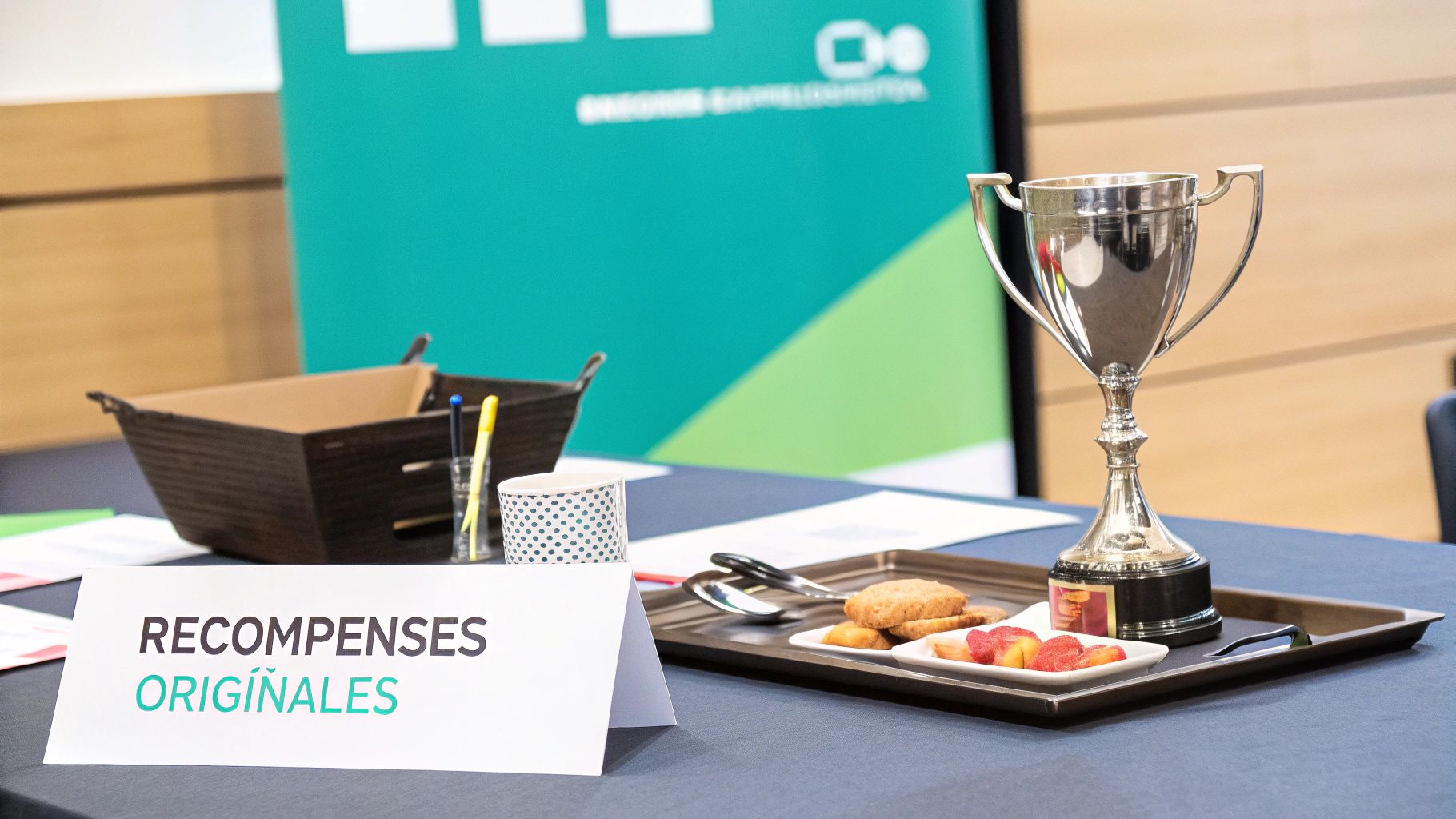
Rewards are a bit of the highlight of your Roland Garros prediction contest. They transform a simple game among colleagues into a true memorable experience. The classic mistake? Jumping on gift cards, which are a bit impersonal and quickly forgotten. To really make an impact, you need to think differently.
What really matters is generating enthusiasm. Often, the perceived value of a prize far exceeds its actual cost. The goal is to create a little "wow effect" that will motivate everyone until the last match point.
Going Beyond Material Rewards
The best rewards are often experiences or perks that change (a little) life at the office. These are the prizes that get talked about in the hallways and strengthen bonds long after the tournament is over.
Here are some ideas for all budgets:
- Exclusive Experiences: Tickets for next year’s tournament, a private lesson with a tennis coach, or even a behind-the-scenes tour of a local sporting event. Simple, but incredibly effective.
- Internal Benefits: An extra day off. Believe me, this is often the most coveted prize. Also consider a "voucher" for an extra half-day of remote work, or the director's parking space for a week.
- Collective Rewards: To unite a team, nothing beats offering a breakfast or a full lunch to the department of the grand winner. It encourages teamwork and celebrates a shared victory.
Even more symbolic prizes, like a quirky trophy or company-branded goodies, can have a very strong impact. If you’re short on inspiration, our guide on cheap prize ideas is full of gems that are always appreciated.
Using the Tournament's History for Bonus Prizes
Don’t stop at the overall ranking! The history of the tournament is a true goldmine for creating side challenges with small prizes at stake. For example, everyone knows Rafael Nadal's record with his 14 titles in Paris, including a crazy series of 39 consecutive wins between 2010 and 2015.
Why not offer a special prize to whoever guesses whether the tournament favorite will lose a set before the semifinals? These micro-challenges keep everyone in the race, even those who are lagging behind in the overall ranking.
And finally, pay attention to the award ceremony. Organizing a small ceremony, even very informal over coffee, allows you to conclude the event beautifully. It’s an opportunity to bring everyone together, congratulate the winners, and prolong the positive impact of your initiative.
Your Questions, Our Answers for a Successful Contest
You have the idea, the enthusiasm, but a few questions are still on your mind before launching your Roland Garros prediction contest. That’s completely normal. We’ve gathered here the most frequently asked questions to help you clarify and anticipate the little challenges.
Organizing such an event may seem intimidating at first. However, with the right tools and a minimum of preparation, it’s much simpler than one might think. The essential thing is to never lose sight of the goal: to create connections and have fun.
How much time should be allocated to set everything up?
This is THE big question, and the answer will reassure you. If you use a specialized platform, the purely technical part will only take you a few hours. The bulk of the work, in reality, is done in advance.
Count on one to two weeks in total to be safe. One week for the strategic part: fine-tuning the rules, choosing the prizes, and sketching out your communication plan. Then, a few days are enough to set up the platform and prepare your visuals.
Pro Tip: Launch your internal communication at least a full week before the start of the tournament. This gives everyone time to register without rushing, to get familiar with the tool, and ensures maximum participation from the very first exchanges.
How to involve colleagues who know nothing about tennis?
This is the secret to an event that truly brings everyone together. The goal is not to create a club of insiders, but to engage the entire company. For that, simplicity is your best ally.
- Favor simple predictions. The winner of the match, for example. Forget about exact scores, which can quickly become a headache and discourage novices.
- Include fun quiz questions. "Which player holds the record for titles in Paris?" This is a great way to score points without any knowledge of tactics or topspin backhands.
- Activate team rankings. This is a great option for teamwork. Novices can rely on the "experts" in their department, and the game becomes a true collective effort.
Remember: the goal is to have fun together. Inclusivity should be the compass for each of your choices.
What indicators to track to measure the impact of the contest?
To showcase your initiative and prepare well for future editions, it’s always good to measure what worked. Success can be assessed on several levels.
The first is quantitative. The participation rate is the most obvious indicator. Set a realistic goal and track its evolution. Next comes the qualitative: listen, observe the conversations that the contest generates on Slack, Teams, or at the coffee machine. This is often the best barometer.
Finally, to go further, a little post-event survey works wonders. Ask participants what they liked, what could be improved. This feedback is a goldmine for proving the relevance of your action.
Ready to transform the atmosphere of your company with an unforgettable prediction contest? With ccup.io, launch your animation in just a few clicks and offer a fun and engaging experience to your teams. Discover how ccup.io can simplify your organization.
From Content To Conversion
Turn your next sports event into a company prediction contest
Discover the platform, explore available competitions, and launch a branded experience that supports engagement, internal communication, and team cohesion.
See available competitions
Latest articles

8 hours ago
How to Lead an Engaging Team Meeting
Let's be honest: we've all experienced meetings that drag on for no reason. This infamous "meetingitis" is not a fatality. It's just a symptom of bad habits and outdated methods.
The idea is to transform this often-dreaded appointment into a real moment of exchange and decision-making. A g...

3 days ago
Your Serie A Prediction Guide for the 7 Best Tools 2026
The Serie A, with its tactical duels and twists, is an exciting playground for prediction enthusiasts. But how do you move from intuition to structured analysis? To succeed in your next Serie A prediction, it is essential to rely on effective tools that combine advanced statistic...




















Contact us
For any question or quotation requests, do not hesitate to reach us by phone at 01 83 79 24 54 or by email : contact@ccup.io
Contact us


Frequently asked questions
What is ccup.io?
Ccup.io is a cohesion tool, allowing firms to gather their collaborators on the occasion of major sporting events, such as World Cup or Olympic Games. We offer an interactive forecasting platform, turnkey and customisable to your company’s colours.
What are you doing with our data?
By deciding to use our services, you decide to entrust us a part of your data – this will allow us to optimise your experience. We place great emphasis on the protection of your data, in compliance with current regulations. Given that it is important to be informed on the issues and challenges of personal data protection, ccup.io provides you with a most complete documentation on this matter.
How much does it cost?
In order to give our clients flexibility, we make a special rate depending on the number of registered players using a degressive system for an important number of participants. This allows firms to organise tailored events, adapted to their capacity. To receive a commercial offer in less than an hour, you only need to fill out the quotation requests form, with just a few clicks.



Don’t miss this opportunity 😍
Start now and enjoy numerous benefits