



Ligue 1 Predictions: The Guide to Analyzing Matches and Engaging Your Teams
What if the coffee break became the stage for heated debates and genuine camaraderie? That’s the whole point of a Ligue 1 prediction contest in the workplace. Forget about just playing a game: it’s a real management tool that builds connections and energizes the daily atmosphere.
An Unexpected Cohesion Tool for Your Company
Launching a prediction contest on Ligue 1 is much more than just a simple activity. It’s a playful initiative that, quietly, strengthens your company culture. We’re not just talking about football; we’re talking about creating a common topic of conversation that’s accessible to everyone, whether you’re a football expert or just a casual observer.
Very quickly, this friendly competition breaks down hierarchical barriers and shatters silos between departments. The accountant, the developer, and the manager suddenly find themselves debating the chances of Stade Brestois or the form of Olympique de Marseille. It’s precisely these informal exchanges that cement a smoother collaboration and a better work atmosphere.
Stimulating Healthy Competition
A good prediction contest injects just the right amount of friendly competition to motivate the troops. Following the standings each week, celebrating good moves, and gently teasing each other about judgment errors… These little rituals breathe new life into office life. This positive dynamic allows you to:
- Strengthen team spirit around a shared experience.
- Boost employee engagement naturally.
- Provide a real break from the routine, ideal for unwinding.
Organizing a prediction contest isn’t just for fun. It’s a clever strategy to build stronger relationships. By sharing emotions around sports, teams develop a bond that will inevitably be felt in their professional projects.
This guide has been designed to give you all the tools you need. We will explore together how to analyze a match to make good predictions and, most importantly, how to organize an event that will leave a lasting impression. To delve deeper into the benefits of this type of initiative, take a look at our article on how to strengthen team cohesion. The goal is simple: to make each matchday a new opportunity to unite your teams.
Key Factors for Decoding a Ligue 1 Match
To succeed in a Ligue 1 prediction, you need to step into the shoes of an analyst rather than remain just a supporter. Forget about passion for a moment. The game is about piecing together the puzzle to guess the outcome of a match even before the kickoff.
Rather than relying on a club’s prestige or its position in the standings, a good predictor looks for finer signals. These indicators allow you to detect trends and make more informed choices. You turn randomness into reasoned probability.
The Current Dynamics and Form
The overall standings are a snapshot of the season. The dynamics are the film of the last few weeks. And believe me, the film often tells a much clearer story.
A team ranked 12th but coming off three consecutive victories steps onto the field with a steel mentality. Conversely, a leader who has suffered two defeats and a draw may start to seriously doubt. This recent form is a much more reliable barometer of the group’s state of mind, level of fatigue, and tactical effectiveness at the moment. It’s a decisive factor in a league as tight as Ligue 1.
Never underestimate psychology in sports. A positive streak creates a virtuous circle where players take more risks and succeed more, while a negative spiral can paralyze even the best teams.
The Impact of Absent Players
Imagine a Formula 1 team without its best driver or missing a key engine component. It’s exactly the same in football. An injury or suspension can completely destabilize a team, especially if it involves a key player.
The absence of the top scorer, the starting goalkeeper, or the captain has direct consequences on the final score. Before each prediction, take the time to check the list of absentees. It’s a simple reflex that can save you from unpleasant surprises and radically refine your analysis.
The Match Schedule and Context
Not all matches have the same flavor. A league match sandwiched between two rounds of European cup play will never have the same intensity. The coach will likely rotate the squad to rest key players, completely reshuffling the cards.
Similarly, a regional derby or a relegation battle generates enormous pressure. These high-stakes matches often defy purely logical predictions. Also, take a look at the history of confrontations. Some teams are true “boogeymen” for others, regardless of their current form.
This individual analysis is good. But sharing it is even better! A prediction contest transforms these reflections into a real moment of exchange.
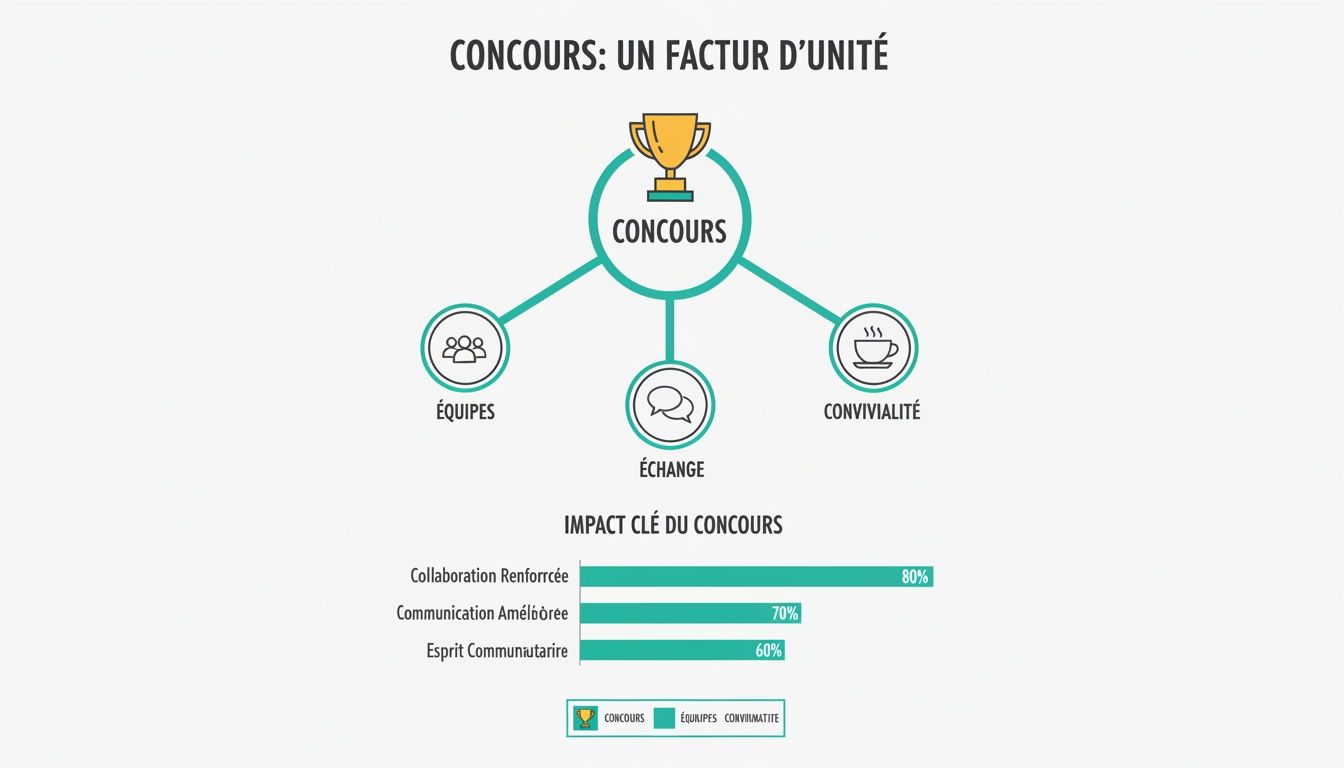
As this diagram shows, a contest becomes a catalyst for friendliness, a perfect excuse to chat and laugh with colleagues.
To help you remember everything, here’s a quick summary of the points to check before finalizing your predictions. It’s a sort of mental checklist to quickly run through before each match.
Quick Analysis Checklist for Your Predictions
| Analysis Factor | Key Points to Check | Impact Level (High/Medium/Low) |
|---|---|---|
| Current Form | Results of the last 5 matches, goals scored/conceded. | High |
| Absences | Injuries or suspensions of key players (scorer, goalkeeper, captain). | High |
| Match Context | Derby, title/relegation match, European stakes. | High |
| Head-to-Head Matches | Results of the last 3 encounters between the two teams. | Medium |
| Schedule | Post-European cup match, sequence of matches. | Medium |
| Location of the Match | Home vs away team statistics. | Medium |
| Overall Standings | Position and point gap between the two clubs. | Low |
By keeping these elements in mind, you will never watch a match the same way again. Your analysis will be more structured, more relevant, and your predictions will only get better. Ready to dive in?
How to Let the Numbers Speak to Refine Your Predictions

While current form or last-minute absences are crucial, the numbers tell a cold but terribly objective story. For a Ligue 1 prediction that holds up, you need to go beyond the simple raw result and dive into the data. That’s where the real trends of a team hide.
Thanks to statistics, you can transform a simple intuition into a calculated probability. It’s a bit like clues left at a crime scene: taken separately, they don’t mean much, but once assembled, they often paint a very clear picture.
Key Indicators to Keep an Eye On
To start, there’s no need to be a data science expert. Focus on a few simple but incredibly effective metrics to get an overview.
- Home or Away Performance: This is a classic. Some teams are real fortresses at home but collapse as soon as they hit the road. Analyzing points earned in each context is an excellent indicator of their mentality.
- Average Goals Scored and Conceded: This simple number tells you whether you’re dealing with an offensive machine that takes risks (more than 2 goals scored on average) or a wall (less than one goal conceded per match).
- Number of Shots per Match (on target or conceded): This stat measures a team’s ability to create chances and, conversely, the pressure they are under. A team that shoots a lot on goal always ends up scoring statistically.
This numerical approach works just as well for lower divisions. If you’re interested, take a look at our detailed guide on predictions for Ligue 2 football.
Spotting Habits and Recurring Patterns
Beyond averages, the gold lies in the specific patterns of each team. A general statistic about Ligue 1 tells us that 47% of matches end with a home victory, compared to 33% away wins and 20% draws. The average of 2.98 goals per match is also a good benchmark.
But some teams are exceptions, like Le Havre, which holds the record for draws with 38% of their matches ending in a tie. Digging into these trends will give you a definite advantage.
The art of statistical analysis isn’t about finding certainties, but about identifying strong probabilities. A team that never scores in the first quarter-hour isn’t suddenly going to change its habits without a good reason.
For those who want to go further and create their own simple models, exploring the Excel statistical formulas category can be a goldmine.
By combining this data with an analysis of human factors, your prediction becomes much more solid. You’re no longer relying solely on your instinct, but on tangible facts that significantly increase your chances of hitting the mark and climbing the leaderboard of your workplace contest.
Decoding Odds to Read the Match Before It Happens
You don’t need to be a seasoned gambler to benefit from the odds. Just think of them as a thermometer measuring the confidence of experts and the market in the outcome of a match. An odd is nothing more than a probability of victory translated into numbers.
The principle is both simple and a bit counterintuitive: the lower the odds, the higher the perceived probability that the event will occur. Very low odds indicate that a team is a clear favorite. Conversely, soaring odds designate an outsider with, on paper, little chance of winning.
Transforming Odds into Probability is Easy!
To convert odds into percentage chances, the calculation is straightforward: (1 / odds) x 100. It’s a brilliant reflex to quickly assess the strengths at play without diving into hours of analysis.
- Odds of 2.00? That corresponds to (1 / 2.00) x 100 = 50% chance of winning.
- Odds of 1.25? That’s (1 / 1.25) x 100 = 80% chance of winning.
- Odds of 5.00? Only (1 / 5.00) x 100 = 20% chance of winning.
For your Ligue 1 prediction contest among colleagues, this is a major asset. This tool allows you to immediately spot the logical favorite for each match. It gives you a solid foundation for making your choices, especially when you lack information about a particular match.
The dominance of Paris Saint-Germain, for example, is perfectly reflected through this lens. The club is often displayed with very low odds for the title, around 1.10, which represents an overwhelming probability of final victory of over 90%. Its pursuers, like OM (odds of 15.00) or Monaco (odds of 12.00), show much lower probabilities, illustrating the perceived gap in level by analysts. For more details on these evaluations, you can check out the season analyses on MightyTips.
Using odds isn’t gambling; it’s informing yourself. It’s a bit like checking the weather before a hike: you take the experts’ advice to make your own decision, but in a much more informed way.
Even though surprises are what make football exciting, understanding the odds gives you an undeniable strategic advantage. It’s an effective shortcut to know what the consensus expects, and then it’s up to you: either you follow the logic, or you take a gamble with full knowledge of the facts.
Common Mistakes to Avoid to Stay in the Race
Succeeding in a Ligue 1 prediction isn’t just a matter of luck. It’s primarily a discipline that requires avoiding a few classic traps that can cost you dearly in points. Every matchday has its share of surprises, but by identifying the most common mistakes, you can turn a risky bet into a real analysis.
The first mistake, by far the most common, is letting your heart as a supporter speak. Your favorite team is playing this weekend? The urge to bet on their victory is quite natural, but it’s often anything but rational. Putting your emotions aside is the very first golden rule for an objective prediction.
Relying Solely on Overall Standings
The standings are a snapshot of the season at a given moment, but they say absolutely nothing about current form. A well-ranked team can easily go through a rough patch, while a bottom-table club may be on an incredible streak.
Ignoring this dynamic is a costly mistake. Before making your decision, always take a look at the results of the last three to five matches. A team on a winning streak, even against weaker opponents, approaches its next match with a much higher confidence capital.
Thinking like an analyst means prioritizing recent trends over past reputations. Confidence is an invisible factor that weighs heavily on the field.
Underestimating the Impact of a Single Absence
We often think that a team is primarily a collective. That’s true, but the absence of a single key player, like the top scorer or the starting goalkeeper, can completely change the game. A suspension for accumulating yellow cards or a minor injury can be enough to throw the whole machine off balance.
Here’s a little checklist to avoid falling into these traps:
- The Supporter Bias: Is your prediction based on facts or your attachment to the club? Be honest.
- The Current Form: Have you checked the ongoing streak of both teams (wins, draws, losses)?
- Major Absentees: Have you consulted the list of injured or suspended players before the match?
Not relying solely on the prestige of big names is also crucial. Every season, giants like PSG can drop points against teams deemed “weaker” on paper. That’s why every prediction should be a new analysis, free from any preconceived notions.
By adopting these few reflexes, you will avoid the most elementary mistakes and significantly increase the reliability of your predictions. You will be much better equipped to shine in your workplace contest and, who knows, maybe finish on the top step of the podium.
Launch Your Prediction Contest in a Few Simple Steps

Now that the theory is covered, let’s move to action. Organizing a Ligue 1 prediction contest that excites your teams is much simpler than you might think.
The idea is to create a friendly moment, not a fierce competition. The key to success? Minimal preparation and communication that makes people want to participate.
Just define a clear framework, accessible even to those who only know football from afar. This involves clear rules and a points system that everyone can understand at first glance. A good launch announcement will do the rest to create enthusiasm.
Establish the Rules of the Game
Keep it simple. A convoluted points system is likely to discourage more than one participant before the first match. It’s better to opt for a proven, intuitive method so that everyone feels comfortable.
Here’s a classic points system that works every time:
- 3 points for the exact score (you predict 2-1, the match ends with that score).
- 1 point if you have the right winner, but with a different score (you predict 2-1, the team wins 3-0).
- 0 points if everything is wrong.
This scoring system is perfect: it rewards both the precision of experts and the intuition of those who play by feel. To make your life easier, platforms like ours automate all points and ranking management. You just need to focus on the engagement!
Communicate and Animate Your Contest
Once the rules are set, it’s time to kick things off. A well-crafted announcement email, a message on the company Slack, or a small poster next to the coffee machine, and the anticipation begins to build.
The animation is what will keep the contest alive throughout the season. Don’t hesitate to share the standings each week, celebrate the “predictor of the day,” or create fun badges for the best performances.
The important thing is not so much the competition but the discussions it will create. The standings become an excuse to exchange, tease, and share moments that strengthen bonds.
And finally, think about rewards. No need to break the bank. Symbolic prizes are often the most appreciated: a voucher for lunch, a gift card, or even a humorous trophy presented in style during a meeting. For more ideas, our complete guide for a successful prediction contest will give you plenty of other leads.
Questions About Your Ligue 1 Prediction Contest in the Workplace?
Are you getting started and have a few questions on your mind? That’s perfectly normal. Here are some answers to help you clarify things and make your activity a real success.
How to Create a Points System That Is Both Fair and Simple?
The key is not to lose anyone along the way. The simplest is often the most effective, and the classic system has proven itself: 3 points for an exact score, 1 point if you have the right result (win, draw, loss) but not the right score, and of course 0 points if everything is wrong.
This is an easy-to-understand method for everyone. It rewards the precision of the most knowledgeable while giving a chance to the intuition of beginners. No one feels left out, and the game remains fun.
Do You Need to Be a Football Pro to Play?
Absolutely not! The primary goal is to have fun together and strengthen bonds. A Ligue 1 prediction contest is primarily an excuse to chat and laugh, not an exam to become a sports consultant.
By providing some analytical tips like those in this guide, you level the playing field for everyone. The element of chance and unpredictability, so typical of football, makes the game exciting for all profiles.
The essential thing is not to know by heart the record of FC Nantes, but to share a good moment as a team. The magic really happens when debates about the results animate the Monday morning coffee break.
How to Ensure Interest Doesn’t Wane After a Month?
The secret is to keep the contest alive. There’s no need to bring out the heavy artillery; a few small touches are enough to maintain the flame throughout the season.
Here are some very simple ideas:
- Send a little email or a message on your dedicated channel each week with the updated standings.
- Highlight the “predictor of the day” to congratulate great performances and gently tease others.
- Launch mini-challenges from time to time (for example: guess the total number of goals scored on a matchday).
These little attentions are more than enough to rekindle interest and turn your contest into an event that everyone looks forward to.
Ready to spice up office life? With ccup.io, you can launch a turnkey and personalized prediction contest in just a few clicks. Discover how to engage your teams on ccup.io
From Content To Conversion
Turn your next sports event into a company prediction contest
Discover the platform, explore available competitions, and launch a branded experience that supports engagement, internal communication, and team cohesion.
See available competitions
Latest articles

14 hours ago
Women's Euro Prediction: Women's Euro 2026 Prediction: The Def
You probably already have the scene in mind. The tournament is approaching, management asks you for a unifying activity, teams are scattered between offices, remote work, and subsidiaries, and you have no desire to manage a prediction contest in a makeshift spreadsheet at the last minute.
...

a day ago
Football Predictions Among Friends: Create and Run a Successful Contest
You probably have the same scene in mind as many P&C teams before a big competition. The Teams or Slack thread comes alive, a few colleagues throw out predictions "for fun," an Excel spreadsheet circulates, and then no one knows which version is correct, who responded, or how to break ties. T...





















Contact us
For any question or quotation requests, do not hesitate to reach us by phone at 01 83 79 24 54 or by email : contact@ccup.io
Contact us


Frequently asked questions
What is ccup.io?
Ccup.io is a cohesion tool, allowing firms to gather their collaborators on the occasion of major sporting events, such as World Cup or Olympic Games. We offer an interactive forecasting platform, turnkey and customisable to your company’s colours.
What are you doing with our data?
By deciding to use our services, you decide to entrust us a part of your data – this will allow us to optimise your experience. We place great emphasis on the protection of your data, in compliance with current regulations. Given that it is important to be informed on the issues and challenges of personal data protection, ccup.io provides you with a most complete documentation on this matter.
How much does it cost?
In order to give our clients flexibility, we make a special rate depending on the number of registered players using a degressive system for an important number of participants. This allows firms to organise tailored events, adapted to their capacity. To receive a commercial offer in less than an hour, you only need to fill out the quotation requests form, with just a few clicks.



Don’t miss this opportunity 😍
Start now and enjoy numerous benefits