



How to Choose the Right Internal Communication Tools for Your Team
Internal communication tools are simply the platforms and systems that allow a company to communicate with its teams, motivate them, and create connections. Today, especially with the rise of hybrid work, they have become the cornerstone of a strong company culture and perfect alignment.
Why Internal Communication Has Become Your Best Asset
Let’s be clear: internal communication is no longer just a checkbox on the HR list. It is the true nervous system of the modern company. With teams increasingly scattered, maintaining a sense of unity and sharing a common vision is a real challenge. Internal communication tools are no longer just a "nice to have"; they are a strategic necessity.
These platforms do not just disseminate memos or corporate announcements. Their real strength lies in their ability to weave human connections, even through a screen. They enable the transformation of a group of employees into a true, cohesive community.
From Information Tools to Engagement Drivers
Think of your communication strategy as the architect of your culture. Without the right tools, even the brightest plans remain dead letters. Effective communication today is two-way, lively, and measurable in its impact.
The challenge is no longer just to ensure that information flows downwards, but to create channels where ideas, feedback, and recognition flow freely in all directions. It is this constant flow that nourishes innovation and trust.
A well-crafted strategy, supported by the right technology, can solve very concrete problems that hinder your growth. To delve deeper into this topic, take a look at our tips for strengthening team cohesion.
The Concrete Impact on Company Performance
Effective internal communication has a direct and measurable effect on several performance indicators:
- Reduced turnover: Employees who feel connected and well-informed are 57% less likely to want to leave.
- Increased productivity: Well-aligned teams spend less time searching for the right information and make better decisions, faster.
- Improved employer brand: A strong and positive internal culture is palpable and naturally attracts top talent.
Ultimately, investing in the right internal communication tools is investing in your company’s most valuable asset: your employees.
Mapping the Universe of Internal Communication Tools
Feeling a bit lost among all the options available? That’s normal. To clarify things, the simplest approach is to group internal communication tools into major families. Each addresses specific needs, and often, they complement each other perfectly.
This is a good way to demystify technical jargon. But before diving into complex solutions, don’t forget the basics. Having structured internal communication often starts with knowing how to create a professional email address, an essential starting point.
The Pillars of Information: Structured Tools
These tools are the foundation. They are there to disseminate official information, the kind that should last and remain accessible to everyone, all the time.
Think of your intranet as the "central library" of your company. It is the place where one goes to find HR policies, process guides, and important documents. Its mission is simple: to centralize knowledge and ensure that everyone refers to the same source.
The internal newsletter is like the company’s "logbook". It sets the pace, shares successes, departmental news, and messages from management regularly and clearly.
And yes, even with all the new tools, email remains a heavyweight. In France, it is the most used internal communication tool, present in 94% of companies. With nearly 1.4 billion professional emails sent each day in the country, it’s clear that it is far from dead for formal communications.
The Catalysts of Connection: Collaborative Tools
This second category includes tools designed to make everyday exchanges smoother and to forge strong bonds between employees.
A good communication tool does not just convey a message. It creates a space where company culture grows and human connections strengthen, even when working remotely.
Instant messaging (like Slack or Teams) is your "virtual coffee machine". It’s where quick, informal discussions happen, and where collaboration on daily projects takes place in real-time.
Enterprise social networks (ESN) act like a "digital village". They break down silos, create interest-based groups, celebrate successes visibly, and ultimately strengthen the sense of belonging.
This concept map clearly shows how these different pillars of internal communication unite to boost cohesion, engagement, and talent retention.
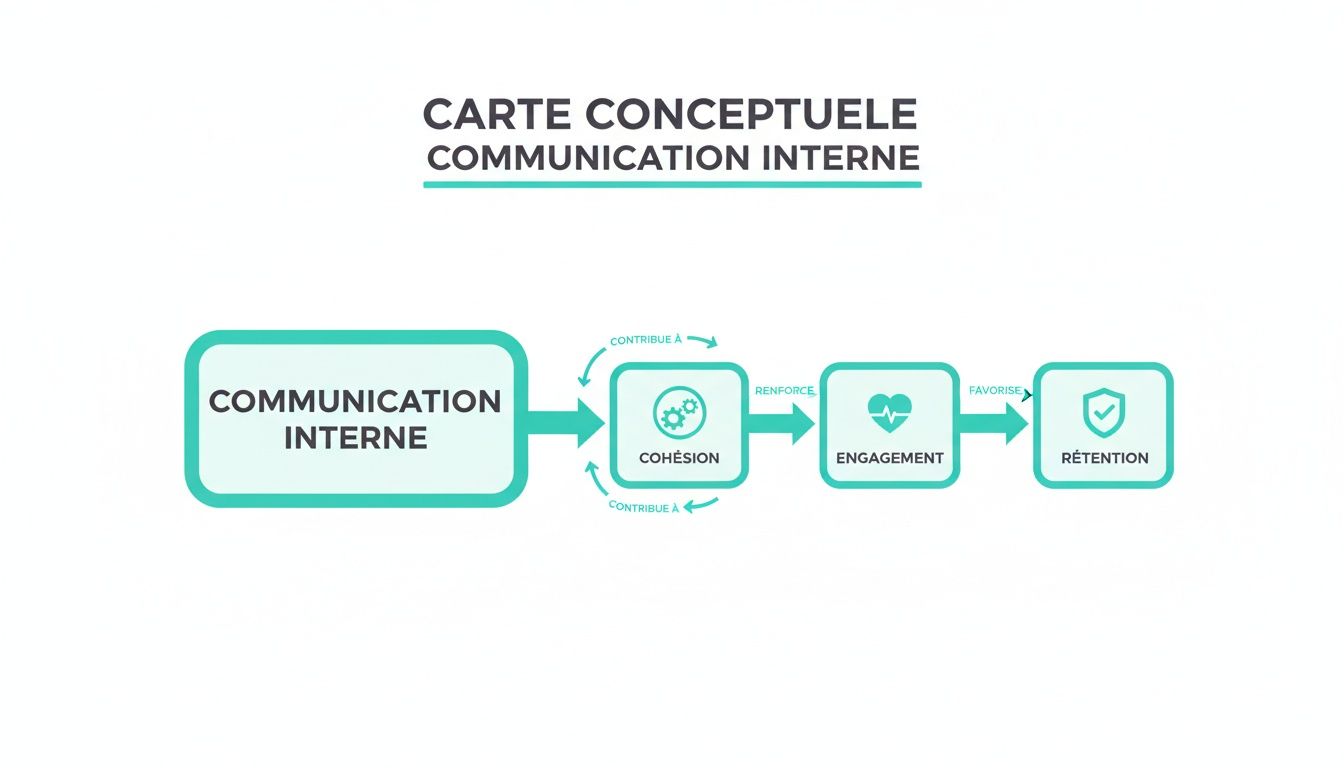
It is clear that these three strategic objectives are interconnected: by improving one, you strengthen the others through effective communication.
The New Wave: Engagement Platforms
Finally, a new generation of tools is transforming the employee experience, making it more fun and interactive.
- Engagement and gamification platforms: This is where solutions like ccup.io come into play. They use friendly competition and games to turn a sports event, for example, into a unifying moment for the entire company.
- Survey and feedback tools: They give employees a voice. This is the best way to gauge the pulse of the organization in real-time and show everyone that their opinion truly matters.
- Digital signage: Highly effective for teams that are not behind a desk all day. This tool displays impactful visual information in common areas, making communication visible and accessible to all.
To help you visualize where each tool fits, here’s a summary table.
Comparison of Types of Internal Communication Tools
This table compares the main categories of tools based on their primary objective, ideal use case, and potential limitations to aid decision-making.
| Type of Tool | Main Objective | Ideal for... | Potential Limitations |
|---|---|---|---|
| Intranet | Centralize official and lasting information | Sharing policies, procedures, and reference documents. | Can quickly become static, unengaging, and difficult to maintain. |
| Newsletter / Email | Disseminate structured and downward information | Management announcements, weekly summaries, important news. | Risk of information overload ("infobesity") and low interactivity. |
| Instant Messaging | Facilitate real-time collaboration and quick exchanges | Quick Q&A, project coordination, informal conversations. | Can become distracting and create a culture of constant urgency. |
| Enterprise Social Network | Create connections, strengthen culture, and break silos | Sharing successes, creating interest communities, encouraging cross exchanges. | Requires active management to avoid becoming a "digital desert". |
| Engagement Platform | Animate company life and strengthen the sense of belonging | Organizing challenges, prediction contests, unifying events. | Often focused on one-off events, must integrate into a broader strategy. |
| Digital Signage | Communicate with non-connected employees | Sharing KPIs, safety messages, news in factories or warehouses. | Initial material cost and need to regularly update content. |
Each tool thus has its place. The secret is to clearly understand your objectives to choose the combination that will have the most impact on your company culture.
How to Choose the Tool That Truly Fits You
A powerful tool that no one uses is just an expensive failure. When choosing a new internal communication tool, the trap is to be blinded by long lists of features. However, the only real criterion that matters, the one that will make your investment a success, is adoption by your teams.
Imagine your current ecosystem of tools as a well-organized kitchen. Each utensil has its place. If you add a complicated gadget that doesn’t fit in any drawer, it will end up at the back of a cupboard. The idea is to find the solution that naturally integrates into your employees' habits without disrupting everything.
Placing User Experience at the Center of Decision-Making
Before even discussing budget or advanced features, the first question to ask is simple: is it pleasant to use? A clear interface and immediate usability are non-negotiable. If your employees have to endure a three-hour training just to send a message, you’ve already lost the adoption battle.
The best technology is the one that is forgotten. A good internal communication tool should be as simple as an app that we use every day on our smartphones. That’s the secret to getting everyone on board, from the technician in the field to the executive team member.
To assess this, don’t rely on a slick sales demo. Request access to test the tool in real conditions. Give it to a small group of employees with varied profiles and needs. Their unfiltered feedback will be your best compass.
Check Integration and Technical Compatibility
A communication tool never lives in isolation. It must be able to communicate with other software you use daily, whether it’s your HRIS for team management or your project tools. This ability to connect is vital to avoid creating new information silos and complicating everyone’s life.
Here are some technical points to keep in mind:
- User synchronization: Can the tool connect to your company directory (like Azure AD or Google) to automatically manage arrivals and departures? That’s a huge time saver.
- APIs and connectors: Does it offer native integrations with the tools your teams already love (Microsoft suite, Google Workspace, Slack, etc.)?
- Multi-device accessibility: Is the solution as smooth on a desktop computer as it is on a smartphone or tablet? This is a crucial point to ensure no one is left behind, especially your field teams.
Never Skimp on Security and Compliance
Data security is no joke, especially in the age of GDPR. Your internal communications contain confidential information and personal data. Therefore, it is imperative to choose a solution that locks all this down securely.
Don’t hesitate to grill providers on these specific points:
- Data hosting: Where is the information stored? Preferably choose hosting in Europe to be safe regarding GDPR.
- Access management: How are rights managed? Can you create custom permissions so that each group only sees what concerns them?
- Security policy: What concrete measures are in place to guard against cyberattacks and prevent data leaks?
Ultimately, choosing the right tool is about finding the right balance between a user-friendly experience, seamless technical integration, and robust security. It’s this alchemy that will transform your investment into a true lever of cohesion and performance for the entire company.
Ensuring Successful Adoption of Your New Tool
Have you found the right internal communication tool? Great. But that’s only the first step. The real challenge, the one that guarantees a return on investment, is ensuring that your teams adopt it, use it daily, and, most importantly, find value in it.
Thinking that employees will flock to a new tool just because it’s there is a classic mistake. Without a well-crafted launch plan, even the best platform is likely to gather dust. You need to create desire, guide the first steps, and demonstrate added value from the start.

Define Clear Objectives and Create Buzz
Before the big day, the first question to ask is simple: "Why are we doing this?" Set concrete goals, such as achieving 75% active users within the first month. By communicating these figures, you give meaning to the change. It’s no longer a constraint; it’s a shared project.
Next, it’s time for some teasing. Launch a small internal campaign to pique curiosity. A few short and intriguing messages on your usual channels are enough to create positive anticipation. The goal? To make the launch an anticipated event, not a new directive that falls from the sky.
A good launch does not focus on the tool’s features but on the concrete benefits for each employee. Highlight the time saved, simplified collaboration, or easier access to information.
Train and Identify Ambassadors
Of course, training is crucial. But forget the two-hour monologue. Opt for short, interactive sessions, and most importantly, tailored to different roles. Show use cases that directly relate to their daily work.
In each team, identify the most enthusiastic employees. Invite them to become tool ambassadors. These internal champions will be your best allies in answering questions, sharing tips, and relaying initial feedback from the field. This approach is particularly powerful for integrating new employees, a moment when peer support makes all the difference.
Gather Feedback and Celebrate Victories
Once the platform is launched, the work is just beginning. Set up a very simple way for everyone to give their feedback or ask questions. A quick survey or a dedicated discussion channel can work wonders.
Be attentive and show that you take this feedback into account. Finally, and this is essential, celebrate the first successes. Highlight a team that has embraced the tool well, share a success achieved thanks to it, and communicate on reaching launch objectives. These small victories create a positive dynamic and encourage the last skeptics to take the plunge.
Measuring the Real Impact on Your Teams' Engagement
How do you know if your new internal communication tool is truly making a difference? It is crucial to move from impressions to numbers. This will allow you to justify the investment, of course, but more importantly, to continuously adjust your strategy for maximum impact.
Tracking engagement is not just about counting "likes". The real challenge is connecting the use of the platform to concrete business results. It is by making this link that internal communication stops being seen as a cost center and becomes a true lever of performance. To go further, discover in detail how to measure your employees' engagement.
Defining the Right Performance Indicators (KPIs)
To start, there’s no need to drown in data. It’s better to focus on a few simple metrics that are rich in insights. They can be classified into two main families: adoption and engagement.
Adoption metrics:
- Active user rate (daily/weekly/monthly): The king indicator! It tells you if the tool is becoming a daily reflex for your teams. A high rate is a sign that the platform has found its place.
- Profile completion rate: A well-filled profile shows that the employee is personally invested. They feel confident enough to share information and "play the game".
Engagement metrics:
- Number of posts, comments, and reactions: These figures measure the pulse of your community. They show that information is not just flowing downwards: it circulates, it lives, it creates conversations.
- Participation rate in events or surveys: This is an excellent barometer to see if employees are mere spectators or true actors in the company’s life.
Linking Data to the Company’s Strategic Objectives
The second step is where the magic happens. It’s about cross-referencing these figures with the company’s major indicators. This is where you prove the value of your work.
Internal communication is no longer a "soft skill". When you can prove that a 10% increase in engagement on the tool is linked to a 5% decrease in turnover, you’re speaking the language of performance.
Connect your KPIs to issues that everyone understands:
- Talent retention: Compare activity on the platform with departure rates. You will often find that the most active teams are also the most loyal.
- Employee satisfaction: Analyze the results of your surveys (like eNPS) in light of usage data. If both curves rise together, you have a solid argument.
To translate all this into euros, it is essential to know how to calculate the return on investment of your projects. This approach transforms your communication actions into solid results that you can proudly defend before your management.
A Unifying Event to Transform Engagement
Theory is all well and good. But nothing beats a concrete example to grasp the power of a good internal communication tool. Let’s see how it can literally change the game, especially when teams are scattered across the country.
Imagine a consulting firm with employees based at multiple sites. The challenge? To create real cohesion beyond video conferences and emails. As a major football competition approached, HR had an idea: find a way to bring everyone together around a fun moment and inject a good dose of enthusiasm.

The Challenge: Connecting Remote Teams
The challenge seemed simple in appearance but complex in practice. How to ensure that the engineer in Lyon feels as involved as the salesperson in Lille? How to break the routine and hierarchical barriers so that everyone feels part of the same adventure? The solution was to turn to a gamification platform like ccup.io.
The idea? An internal prediction contest. Each employee was invited to bet on the scores of the matches from a simple platform, accessible on mobile and desktop. Far from being just a gimmick, the initiative acted as a real catalyst.
Gamification as a Driver of Interactions
What started as a game quickly became the number one topic of conversation. The tool created a healthy emulation and triggered a wave of exchanges that hadn’t been seen in a long time.
That’s the magic of gamification. It provides an excuse to interact. Suddenly, the accountant and the developer had a reason to chat, to tease each other gently, and to share something outside the strict work framework.
The results exceeded all expectations:
- Silos fell: Team rankings encouraged departments that rarely spoke to exchange and support each other.
- Communication exploded: The integrated chat became a real living space, replacing radio silence with jokes and encouragement.
- Engagement skyrocketed: Over 85% of employees actively participated. A score well beyond what newsletters or usual communications achieve.
This use case clearly shows: a well-chosen tool, deployed at the right time, can transform a simple communication initiative into a memorable experience that permanently strengthens company culture.
The Final Questions Before You Dive In
You’re almost there, but a few questions linger? That’s perfectly normal. Choosing an internal communication tool is a real project. Here are some answers to help you clarify and make your decision with peace of mind.
What Budget Should You Allocate for an Internal Communication Tool?
The price range is as wide as the offer itself. You can find everything: solutions for a few euros per month per user, up to comprehensive platforms that represent a much more significant investment.
Rather than looking for a magic number, start from your actual needs. Once you’ve defined your specifications, request personalized quotes. Be sure to include the total cost: the license, of course, but also team training and technical support.
How to Convince Management to Invest?
To speak to your management, talk about return on investment (ROI). The trick is to translate the benefits into concrete numbers. Don’t settle for a vague "improve engagement"; show how the tool will help "reduce turnover", "increase productivity", or "strengthen the employer brand".
Rely on data: the results of your latest internal surveys, case studies from your sector, reliable statistics. The goal is to prove that internal communication tools are not just an expense but a strategic investment that will pay off.
Can You Use Multiple Tools Without Creating Chaos?
Absolutely! With one condition: that each channel has a well-defined role. The secret is to write a very simple usage charter so that everyone knows where to find what, and where to post what. This is your best defense against information overload.
A concrete example: instant messaging for quick daily exchanges, the intranet for official documentation that doesn’t change, and a platform like ccup.io to animate company culture and key moments.
This clarity ensures that each tool is used to its full potential, without one cannibalizing the other.
Ready to make your internal communication a true lever for engagement? With ccup.io, create unifying events that leave a mark, strengthen cohesion, and encourage your teams to invest.
From Content To Conversion
Turn your next sports event into a company prediction contest
Discover the platform, explore available competitions, and launch a branded experience that supports engagement, internal communication, and team cohesion.
See available competitions
Latest articles

a day ago
8 Reward Ideas for Adult Birthday Games to Boost Engagement in 2026
Organizing games for a corporate or team birthday is an excellent initiative to strengthen cohesion. But the real driver of participation and enthusiasm lies in the reward. A well-chosen reward transforms a simple game into a memorable and rewarding experience, creating a tangible return on inves...

8 days ago
Create a Budget-Friendly Small Gift Bundle That Leaves an Impression
Before even starting to imagine the ideal gift, let's be clear: the budget is the key factor. To create a real "wow" effect without blowing the budget, the first step is to define a realistic envelope for your budget-friendly small gift bundle. This is the foundation of your enti...





















Contact us
For any question or quotation requests, do not hesitate to reach us by phone at 01 83 79 24 54 or by email : contact@ccup.io
Contact us


Frequently asked questions
What is ccup.io?
Ccup.io is a cohesion tool, allowing firms to gather their collaborators on the occasion of major sporting events, such as World Cup or Olympic Games. We offer an interactive forecasting platform, turnkey and customisable to your company’s colours.
What are you doing with our data?
By deciding to use our services, you decide to entrust us a part of your data – this will allow us to optimise your experience. We place great emphasis on the protection of your data, in compliance with current regulations. Given that it is important to be informed on the issues and challenges of personal data protection, ccup.io provides you with a most complete documentation on this matter.
How much does it cost?
In order to give our clients flexibility, we make a special rate depending on the number of registered players using a degressive system for an important number of participants. This allows firms to organise tailored events, adapted to their capacity. To receive a commercial offer in less than an hour, you only need to fill out the quotation requests form, with just a few clicks.



Don’t miss this opportunity 😍
Start now and enjoy numerous benefits