



How to Measure Employee Engagement Without Getting It Wrong
Measuring employee engagement is no longer just a "nice to have"; it has become an absolutely strategic approach. It is the best way to take the pulse of your organization, understand what motivates or hinders your teams, and directly link employee well-being to the overall performance of the company.
Why Measuring Engagement Has Become Essential
Ignoring your employees' engagement is a bit like navigating blindly in the middle of a storm. You move forward, certainly, but without knowing if you are heading straight for success or if you are heading towards serious difficulties. By measuring engagement, you equip yourself with a precise roadmap that transforms intuitions into factual data to make truly informed decisions.
This approach allows you to shift from reactive management, where you only endure problems like unexplained turnover, to a much more proactive attitude. By regularly listening to your teams, you anticipate weak signals before they turn into real crises.
Identifying Hidden Risks and Opportunities
A fine measurement of engagement reveals all those invisible dynamics that weigh heavily on productivity. A department that is lagging can be a warning sign of a managerial conflict, an unsustainable workload, or a glaring lack of recognition. Without a thermometer, these problems remain swept under the rug until they explode into the open.
Conversely, spotting the most engaged teams also means understanding what really works well in your organization.
- What are their managerial practices?
- How do they collaborate?
- What is their relationship with work?
These "pockets of excellence" then become true models to replicate throughout the organization. The ultimate goal is to create an environment where every talent can thrive, thereby strengthening the sense of belonging to the company, a fundamental pillar of retention.
An engaged employee is not simply someone who works harder. It is someone who invests their energy and creativity into the collective project because they feel deeply connected to the mission and values of the company.
A Major Economic Challenge for French Companies
Disengagement has a cost, and it is far from trivial. A lack of involvement translates very concretely into decreased productivity, increased absenteeism, and higher turnover, leading to considerable recruitment and training costs.
The French context is particularly striking. A recent study showed that in France, only 7% of employees feel fully engaged, placing us at the bottom of the European rankings. This figure is alarming, well below the European average of 14%, and it highlights the urgency for our companies to take action. To delve deeper into the subject, I invite you to consult the results of the Gallup 2024 study.
Measuring engagement is therefore no longer an option but a necessity to remain competitive. It is a strategic investment that protects your most valuable asset – your employees – while stimulating innovation and ensuring healthy and sustainable growth.
Choosing the Indicators That Really Matter for Your Company
You have decided to measure your employees' engagement. Great. But the inevitable question that follows is: where to start? The classic trap is to want to track everything, ending up drowned in a deluge of data that tells you nothing. To avoid this, a targeted approach is needed: clear objectives first, then a handful of key performance indicators (KPIs) that will give you an accurate picture of the situation.
Above all, do not settle for copy-pasting trendy metrics. Your dashboard must reflect your culture and strategic issues. If your main challenge is retaining young talent, your indicators will not be the same as those of a company looking to streamline collaboration between its departments.
The visual summary below illustrates the pillars of a successful approach to measuring engagement.
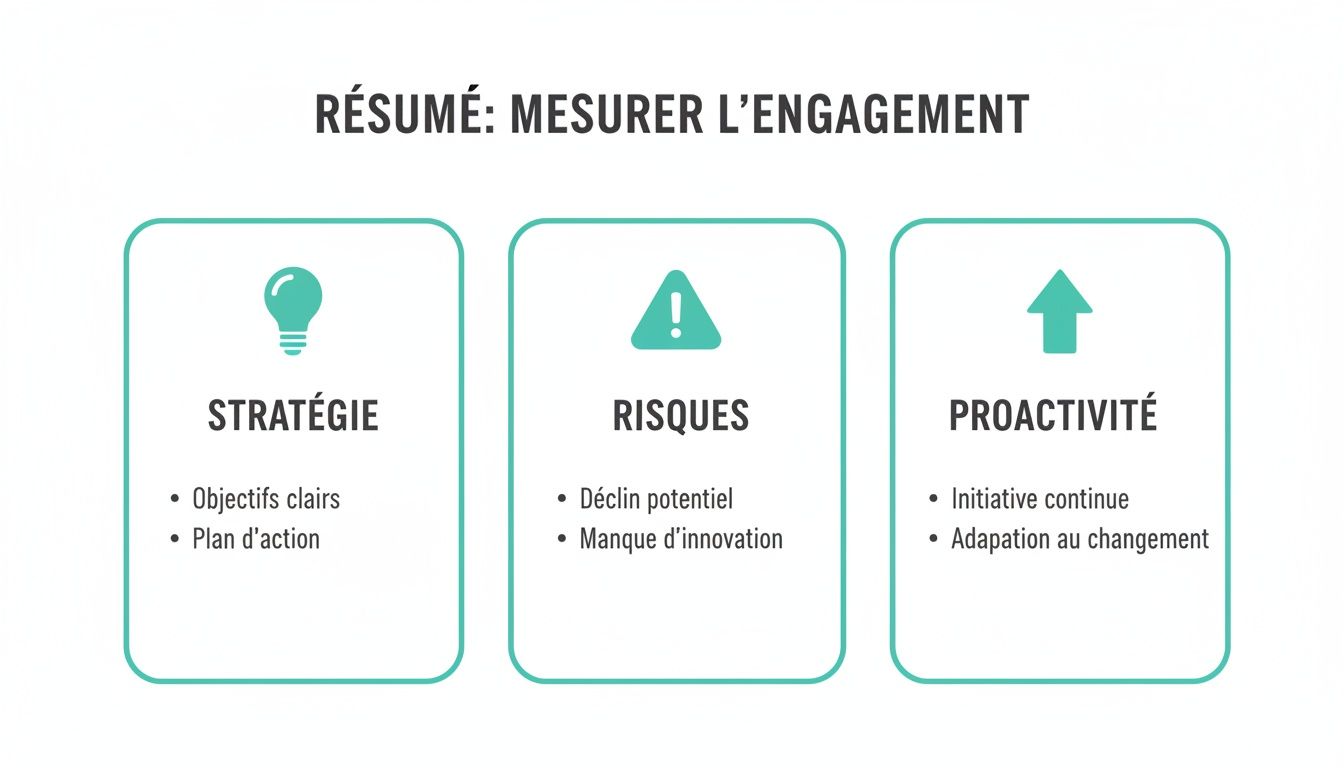
It clearly shows the importance of aligning strategy with the risks you have identified. This is what allows you to act in a truly proactive manner and have an impact.
Quantitative Indicators for a Solid Foundation
To start, certain numerical indicators are essential. They provide concrete data, perfect for tracking trends over time and even comparing yourself to industry benchmarks.
Here are the top three:
- eNPS (Employee Net Promoter Score): This is undoubtedly the simplest and most powerful to start with. One question: "On a scale of 0 to 10, would you recommend our company as a good place to work?" The responses classify your teams into three groups: promoters (9-10), passives (7-8), and detractors (0-6). The final score, obtained by subtracting the percentage of detractors from that of promoters, gives you an immediate insight into the level of pride and loyalty.
- Survey Participation Rate: This figure is a metric in itself. A rate of 85%? It indicates that your teams feel heard and believe their opinions can make a difference. A rate that caps at 30% is a real warning sign. It may reflect an ambient skepticism, "survey fatigue," or a lack of trust in the process.
- Retention Rate (or its inverse, turnover): This is a decisive indicator. If your best talents stay, it is a strong sign of healthy engagement. To be truly informative, segment it. Analyze the turnover of new hires, high-potential employees, or within a specific department. A high turnover in a single team may well point to a localized managerial problem.
Going Beyond Numbers with Qualitative Indicators
Numbers are essential, but they do not tell the whole story. To understand the "why" behind a dropping eNPS score or rising turnover, you need to dig deeper with qualitative indicators.
Sentiment analysis, derived from open comments in your surveys, is a true goldmine. With semantic analysis tools, you can transform hundreds of verbatims into clear trends. You identify recurring themes, whether positive (recognition, collaboration) or negative (workload, lack of prospects).
Measuring engagement is primarily about initiating a conversation. The numbers give you the topic of discussion, but it is the qualitative feedback that fuels a constructive dialogue and allows for real improvements.
The cost of disengagement is colossal. Recent studies show that it costs an average of €13,250 per employee per year in France. While the national engagement score struggles to reach 26%, the infamous "quiet quitting" reportedly affects nearly two-thirds of employees.
Creating a Meaningful Dashboard
Your ultimate goal is to build a balanced dashboard. Combine 2 to 3 quantitative indicators with 1 or 2 qualitative indicators to obtain a 360-degree view.
To help you choose, here is a quick comparison of the most common indicators.
Comparison of Key KPIs for Measuring Engagement
This table compares the most common key performance indicators, their purpose, calculation method, and their advantages/disadvantages to help you choose the most relevant ones.
| Indicator (KPI) | What It Measures | Advantages | Limitations |
|---|---|---|---|
| eNPS | Loyalty and sense of belonging. | Simple, quick to deploy, easy benchmarking. | Does not explain the "why" behind the score. |
| Retention Rate | The company's ability to keep its talents. | Direct indicator of satisfaction and stability. | It is a lagging indicator (it is already too late). |
| Participation Rate | Employees' trust in the feedback process. | Easy to calculate, reveals overall trust level. | A good rate does not guarantee the sincerity of responses. |
| Sentiment Analysis | Recurring themes and emotions in verbatims. | Provides context to the numbers, identifies real issues. | Can be complex to analyze without the right tools. |
It is only by mixing these approaches that you will obtain a complete vision. For example, a declining eNPS coupled with sentiment analysis pointing to management issues in a specific team gives you a very clear course of action.
By adopting a thoughtful approach, you transform the measurement of engagement into a true strategic management tool. You are no longer just collecting data; you are gathering information that helps you make better decisions. This approach directly contributes to improving the quality of life at work, an inseparable factor of engagement.
The Tools and Methods to Gauge Your Teams' Engagement
To truly measure employee engagement, you need to go beyond mere feelings. You need concrete data. And for that, the secret is to intelligently combine several tools and methods. The idea is not to bombard your teams with questionnaires but to create a relevant listening system that captures both major trends and the small signals of daily life.
Each approach has its strengths. The annual survey remains a solid foundation for having an overview, but more agile tools provide the responsiveness we need today. The real talent lies in assembling all these pieces to obtain a complete and authentic picture of your employees' mindset.
The Annual Survey: The Complete Family Photo
We all know it: the annual engagement survey is the quintessential traditional tool. Long considered the norm, it offers a deep and detailed analysis at a given moment. It is the time to ask fundamental questions about satisfaction, the relationship with management, company culture, career prospects, or work-life balance.
Its major advantage is its depth. It generates a wealth of data that, once segmented (by department, seniority, etc.), allows you to detect underlying trends and significant friction points. It is an excellent basis for building a long-term strategic action plan.
But its low frequency is also its biggest drawback. The world of work moves quickly, and waiting a year to take the pulse of the company risks missing problems that do not wait.
Pulse Surveys for Continuous Monitoring
To compensate for the inertia of the annual survey, pulse surveys have become a must. Shorter, much more frequent (often monthly or quarterly), they allow you to track engagement evolution in almost real-time.
These mini-surveys generally focus on one or two specific themes, often related to recent actions. For example, after launching a new training program for managers, a pulse survey can quickly assess its impact on the teams' perception of management.
- Immediate Reactivity: You detect and respond much faster to a drop in morale or an emerging problem.
- Feedback Culture: Their regularity trains employees to give their opinions and shows them that their voice matters, not just once a year.
- Less Fatigue: A 5-question questionnaire is much less likely to create "survey fatigue" than a 50-question survey.
This agility is increasingly sought after. In 2023, 66% of French companies deployed a structured employee experience approach, compared to barely 25% in 2019. To learn more about this impressive progress, I invite you to consult the 2023 employee experience barometer.
Individual Interviews: The Richness of Qualitative Feedback
Numbers are good. But to understand the "why" behind them, nothing beats a real dialogue. Individual interviews, whether annual reviews or more regular exchanges, are an irreplaceable channel for obtaining qualitative feedback.
This is where you can dig deeper, understand the nuances, frustrations, and aspirations of each individual. It is the perfect time for a manager to truly listen, ask open-ended questions, and show empathy.
An eNPS score of -10 in a team is an alert. But it is only by talking to its members that you will discover that a poorly structured project or inadequate tools are the source of the problem.
Of course, this method takes time, and feedback can be biased by the quality of the manager-employee relationship. That is why it needs to be complemented with tools that ensure anonymity.
Indirect Approaches: Analyzing Behaviors
Measuring engagement is not just about asking questions. Observing daily behaviors provides equally strong, and often more spontaneous, clues.
Analyzing interactions on your collaborative tools (like Slack or Teams) can say a lot. A discussion channel that was once very lively becoming silent? A drop in interactions between teams? These are weak signals not to be ignored. Be careful, this is not about spying on people, but analyzing global and anonymized trends to understand group dynamics.
Another, more innovative approach is to use gamified platforms. A tool like ccup.io, for example, transforms measuring engagement into a fun experience. By organizing a sports prediction contest, you do much more than entertain your teams; you collect very telling indirect data.
A high participation rate in such events is an excellent indicator of team cohesion and sense of belonging. The discussions in the integrated chat, the number of predictions placed, the debates around the results... all of this shows that a collective is alive and united. It is a much more natural and positive way to take the temperature than a simple survey.
Ultimately, the best strategy relies on complementarity. Combine the annual survey for strategic vision, pulse surveys for agility, interviews for human depth, and indirect tools for authentic feedback. This 360-degree vision will give you the keys to act justly and effectively.
From Raw Data to Action Plan: Shifting Gears
Collecting data on engagement is good. But that is only half the journey. A dashboard filled with numbers, no matter how pretty, is useless if it gathers dust in a folder. The real magic happens when we transform this raw material into a concrete, realistic action plan that is, above all, shared by everyone.
It is at this precise moment that your teams see that their opinions truly matter. That they have an impact. If you skip this step, you risk creating frustration and seeing the participation rate in your next surveys plummet. So, how do we move from measurement to action?

Diving Deeper Than Averages
The first mistake would be to stop at the overall average. An overall eNPS of +20, for example, can hide completely different realities from one team to another. To uncover the real friction points (and the great successes!), you need to segment the results. It is by refining the view that you identify where to focus your efforts.
Here are some filters that speak for themselves:
- By department or team: You might discover that your sales team is crushing engagement scores, while the IT department seems to be struggling. The information is clear: you know where to act first.
- By seniority: Are newcomers less engaged than the "old-timers"? If so, it may be a weak signal about your onboarding process.
- By location: Teams based in Lyon do not necessarily have the same expectations as those at the Paris headquarters, whether regarding work-life balance or available tools.
- By role: Do frontline managers experience the same reality as their teams? Their perceptions can diverge radically.
This segmentation transforms a vague observation ("we have a recognition problem") into a precise diagnosis ("the lack of recognition is mainly felt by tech teams with 2 to 4 years of seniority"). And that is much easier to address.
Analyzing engagement data is not about finding scapegoats. It is about understanding the dynamics of your organization to act in the right place, with the right solution.
To go further, try cross-referencing engagement data with your business indicators. Is there a link between a team's eNPS and its commercial performance? Are the departments with the best retention rates also those where managerial satisfaction is highest? These correlations give enormous strategic weight to your approach and justify future investments.
Prioritizing Initiatives for Maximum Impact
Once the issues are on the table, the temptation is great to want to solve everything at once. This is the best way to scatter efforts and accomplish nothing. The key is prioritization.
A simple matrix can help you: evaluate each potential initiative on two axes: its likely impact on engagement and its ease of implementation.
Start with the "quick wins": actions that have a high impact and are easy to launch. For example, if the lack of regular feedback emerges everywhere, quickly organize workshops for managers. These initial successes create a positive dynamic and reinforce trust in the process.
Building a Solid Action Plan
A good action plan is not a list of wishful thinking. For each initiative, there must be concrete steps.
- Measurable objective: What do we want to achieve? (E.g., "Increase the satisfaction score on recognition in the IT team by 15 points within 6 months.")
- Specific actions: How do we get there? (E.g., Launch a Slack channel #victories, train managers on constructive feedback, etc.)
- Identified responsible person: Who is leading the subject? Spoiler: it is not always HR. Involving managers and employees themselves is the best way to ensure real progress.
- Realistic deadline: By when?
- Necessary resources: What do we need? (Budget, time, tools...)
The best advice I can give you: co-create solutions with the concerned teams. Organize workshops to brainstorm with them. Their ideas are often the most relevant because they come directly from the field. It is a lever for engagement in itself.
Communicating Transparently to Close the Loop
The last step, often overlooked, is crucial: communication. It is essential to share the survey results (even if they sting a bit), your analysis, and the resulting action plan.
Play the card of transparency and honesty.
- Thank people for their participation.
- Present the strengths and areas for improvement.
- Announce the 2 or 3 priority initiatives you are launching.
- Explain why these priorities were chosen.
This feedback proves that the time spent responding was not wasted. It reinforces trust and prepares the ground for the next measures. It is also the perfect time to introduce initiatives to recognize efforts, a topic we explore in depth in our guide on rewarding employees fairly and motivatingly.
By acting on the feedback, you transform a simple measurement exercise into a true engine of continuous progress.
Here is the section rewritten in a natural and human style, inspired by the provided examples.
Establishing a Feedback Culture: More Than a Measure, a Conversation
Measuring engagement is not just ticking a box once a year. It is a living process, a conversation that must naturally integrate into the daily life of the company. The idea is not to monitor but to create a sustainable and caring dialogue. The real challenge? Finding the right rhythm to capture useful information without overwhelming the teams.
It is a question of balance. Too many solicitations, and you risk "survey fatigue": employees end up responding on autopilot, or worse, stop responding altogether. Conversely, a radio silence for twelve months is equally perilous. It opens the door to unspoken issues and problems that fester in the shadows.
Finding the Right Cadence: The Key to Successful Dialogue
To avoid these pitfalls, the secret is to vary formats and frequencies. An intelligent approach combines in-depth diagnostics with more regular check-ins. This creates a continuous flow of information, much richer than a simple annual snapshot.
Here is a rhythm that has proven effective in the field:
- The large annual survey: This is the pillar, the key moment of your strategy. Once a year, it provides a complete overview. It defines the major areas of work and will serve as a reference point to measure progress from one year to the next.
- Quarterly pulse surveys: Shorter, more targeted. They are perfect for tracking evolution on specific themes, often identified in the large survey. For example, if the lack of recognition has emerged, a quarterly "pulse" allows you to see if the actions taken are starting to bear fruit.
- Continuous feedback: This is the art of integrating listening into daily life, particularly through managers. Weekly team meetings or monthly individual interviews are golden opportunities to openly discuss successes, but also blocking points.
By juggling these different rhythms, you show that listening is not a one-off exercise but a genuine concern at all times.
Building Trust: The Master Asset of GDPR
Let’s be clear: no feedback strategy can work without absolute trust. Your employees will only share their true feelings if they are certain that their responses will be treated confidentially and ethically. This is where the General Data Protection Regulation (GDPR) comes into play. And it is not a constraint; it is a true lever of trust.
Transparency is not an option. It is the basic condition for obtaining honest feedback. If your teams doubt the anonymity or the use that will be made of their responses, they will remain silent or provide superficial answers.
To build this foundation of trust, certain principles are simply non-negotiable.
Ensuring Total and Credible Anonymity
Anonymity must be guaranteed, both technically and organizationally. Use specialized third-party platforms that aggregate the data.
Communicate the rules of the game very clearly. For example, specify that results will never be displayed for teams of fewer than five people. This is a detail that changes everything, as it makes individual identification impossible.
Obtaining Informed Consent
Each participant must know why they are responding, how their data will be used, who will have access to it, and for how long. This consent must be explicitly requested, never assumed. Clear and proactive communication before each survey is therefore essential.
Securing Data
Ensure that data is stored on secure servers, preferably in Europe. Access must be drastically limited to authorized personnel, often one or two people within the HR team. That’s it.
Closing the Loop: Communicating Results
Feedback is a dialogue. Once you have listened, you must respond. Communicate transparently about the overall results and, especially, about the concrete action plans that follow. When employees see that their voice has a direct impact on the company's decisions, their trust is multiplied. And their motivation to participate next time as well.
Questions About Measuring Engagement? We’re Here to Help.
You are ready to launch an initiative to measure your employees' engagement, but a few questions are still on your mind? That is completely normal. We have gathered here the most frequent questions from HR teams and managers to provide clear and directly applicable answers. The idea is to clear up any remaining doubts so you can start on solid ground.
How often should you survey your teams?
There is no magic recipe; the right rhythm depends primarily on your company culture and objectives. Experience shows that a mixed approach is often the most relevant. The large annual survey still holds its value for providing a foundational view, a true state of affairs that allows you to outline major strategic priorities.
But for more agile tracking, nothing beats pulse surveys. Shorter, more targeted, they can be conducted every quarter or even every month. It is the perfect tool to take the temperature on a hot topic or to measure the impact of a new initiative almost instantly. The secret is to combine both to have the complete picture without bombarding your teams with questionnaires.
How to ensure anonymity for honest responses?
Trust is the foundation of everything. Without it, there is no sincere feedback. And to build it, anonymity is non-negotiable. Using a third-party platform is an excellent starting point, as it provides technical guarantees and reassuring neutrality.
Then, it’s all about communication. Be clear about the rules of the game and confidentiality.
A tip that works every time: clearly state that results will never be analyzed for groups of fewer than five people. It’s simple, but incredibly effective in ensuring no one fears being identified.
And the ultimate proof of your seriousness? Action. When employees see that their feedback leads to concrete and positive changes, trust builds itself. The honesty of subsequent responses will directly reflect this.
What to do if no one responds to my surveys?
A low participation rate is not a failure; it is information in itself. It is even a very clear message. It can reveal a lack of communication, "survey fatigue" if previous editions led to nothing, or simply an ambient skepticism about the usefulness of the initiative.
Fortunately, the trend can be reversed. Here are some suggestions:
- Engage your managers: they are your best ambassadors. They can explain the stakes and motivate their teams like no one else.
- Communicate what has been done: show the impact of past surveys. Share action plans, even small victories. Nothing is more powerful than proof by example.
- Keep it simple: a short, clear questionnaire that works perfectly on mobile. Every extra click is a potential participant lost.
Ultimately, a low participation rate is almost always a symptom of a lack of trust. Show that you listen and that you act, and you will see the numbers rise sustainably.
Want to unite your teams around a fun and engaging moment? With ccup.io, organize sports prediction contests in your company’s colors. Transform major sporting events into catalysts for cohesion and indirectly measure engagement through enthusiasm and participation. Request your demo at https://ccup.io to see how it works.
From Content To Conversion
Turn your next sports event into a company prediction contest
Discover the platform, explore available competitions, and launch a branded experience that supports engagement, internal communication, and team cohesion.
See available competitions
Latest articles

a day ago
8 Reward Ideas for Adult Birthday Games to Boost Engagement in 2026
Organizing games for a corporate or team birthday is an excellent initiative to strengthen cohesion. But the real driver of participation and enthusiasm lies in the reward. A well-chosen reward transforms a simple game into a memorable and rewarding experience, creating a tangible return on inves...

8 days ago
Create a Budget-Friendly Small Gift Bundle That Leaves an Impression
Before even starting to imagine the ideal gift, let's be clear: the budget is the key factor. To create a real "wow" effect without blowing the budget, the first step is to define a realistic envelope for your budget-friendly small gift bundle. This is the foundation of your enti...





















Contact us
For any question or quotation requests, do not hesitate to reach us by phone at 01 83 79 24 54 or by email : contact@ccup.io
Contact us


Frequently asked questions
What is ccup.io?
Ccup.io is a cohesion tool, allowing firms to gather their collaborators on the occasion of major sporting events, such as World Cup or Olympic Games. We offer an interactive forecasting platform, turnkey and customisable to your company’s colours.
What are you doing with our data?
By deciding to use our services, you decide to entrust us a part of your data – this will allow us to optimise your experience. We place great emphasis on the protection of your data, in compliance with current regulations. Given that it is important to be informed on the issues and challenges of personal data protection, ccup.io provides you with a most complete documentation on this matter.
How much does it cost?
In order to give our clients flexibility, we make a special rate depending on the number of registered players using a degressive system for an important number of participants. This allows firms to organise tailored events, adapted to their capacity. To receive a commercial offer in less than an hour, you only need to fill out the quotation requests form, with just a few clicks.



Don’t miss this opportunity 😍
Start now and enjoy numerous benefits