



Organize Roland Garros contests that truly engage your teams
Organizing a Roland Garros contest is much more than just a simple activity. It’s a golden opportunity to capture the energy of this legendary tournament and turn it into a real driver of cohesion within your teams. The idea is to create a fun sharing moment that will energize the company culture, even for employees who are not necessarily tennis fans.
Transforming the excitement of Roland Garros to unite your teams
Imagine being able to channel all this national passion for the tournament at Porte d'Auteuil and infuse it directly into your employer branding strategy. Roland Garros is not just a sporting event; it’s a true cultural phenomenon that everyone knows. It’s the perfect opportunity to strengthen bonds between colleagues, whether they are in the office or working remotely.
A naturally unifying event
Every year, the tournament captivates millions of French people. In 2022, for example, France Télévisions accumulated over 32.1 million viewers during the fortnight. This figure speaks for itself. The event is an integral part of our culture. By leveraging such a peak of attention, you create a collective dynamic almost effortlessly. To delve into these figures, you can take a look at detailed analyses of Roland Garros audience.
Launching an internal contest on this theme is therefore about relying on a common foundation and transforming a shared passion into an effective and caring management tool.
Organizing a prediction contest during Roland Garros is not just about entertainment. It’s about creating conversations, stimulating healthy competition, and ultimately strengthening the sense of belonging.
What impact on company culture?
A well-crafted Roland Garros contest can have very concrete effects on the atmosphere and motivation. It’s a subtle way to:
- Break the routine with an extraordinary activity.
- Encourage informal discussions between departments that usually barely cross paths.
- Integrate new hires by giving them an easy and friendly conversation topic.
- Enhance team spirit, for example, with rankings by department or business unit.
The goal is not to turn your employees into clay court experts. It’s more about using a simple and intuitive platform so that everyone, even the most novice, can participate and have fun, for example, with quizzes about the tournament's history or simplified predictions.
Design a captivating game mechanic for all profiles
The key to the success of your Roland Garros contest? A mechanic that speaks to everyone. The real challenge is here: how to excite both the enthusiast who can quote the score of the last set of the 1999 final and the novice who is just discovering the names of the players? The answer lies in two words: diversification and balance.
It is essential to go beyond just predicting the final winner. It’s a classic, of course, but it often favors the knowledgeable. To keep everyone in the game during the fortnight, consider integrating more original and accessible questions.
Diversify the types of challenges
To ensure that every profile feels included, it’s important to vary the pleasures. By mixing different types of questions and predictions, you allow everyone to find their playing field and score points, regardless of their level of knowledge.
Here are some concrete avenues to explore:
- Historical and cultural quizzes: Draw from iconic moments of the tournament. “In what year did Yannick Noah win the tournament?” or “Which player holds the record for most victories at Roland Garros?”. These are questions that appeal to general knowledge.
- Statistical challenges: Launch predictions on precise but fun data. “How many aces will be served during the Women’s final?” or “What will be the longest match of the tournament (in minutes)?”.
- Predictions on surprises: Put bonus points at stake for those who anticipate an “upset,” meaning the defeat of a seeded player against a lower-ranked player.
The goal is not to test tennis expertise, but to create a shared experience. A good game is one where intuition and a bit of luck have as much place as pure knowledge.
The history of the tournament is a true goldmine for this. The statistics specific to Roland Garros are ideal material. The Rafael Nadal era, with his 14 titles and 112 victories, has left a mark. Similarly, the fact that the last French winner, Yannick Noah, triumphed in 1983 offers a powerful narrative angle. Integrating these facts into your games is capitalizing on a sports culture that many share.
Establish a motivating points system
A well-crafted points system is crucial for maintaining engagement over time. It should reward both performance and consistency.
Think of a dynamic scale that maintains suspense:
- Base points: Awarded for each correct prediction (for example, 10 points).
- Daring bonus: Additional points for risky but successful predictions, such as betting on the victory of an outsider.
- Participation badges: Unlock virtual badges for participants who log in every day or complete all predictions for a day.
This gamified approach transforms a simple contest into a true daily adventure. To delve deeper into the topic, you can explore our guide on organizing prediction contests that details other strategies to energize the competition. The important thing is that every participant feels they still have a chance to win, even until the last day of the tournament.
Select rewards that create real excitement
The appeal of rewards is the true engine of your Roland Garros contest. To generate maximum enthusiasm, one must think beyond the simple gift voucher, which is often a bit impersonal and quickly forgotten. The key is to offer prizes that have a high perceived value and that leave a lasting impression on employees.
The real magic happens when the rewards are directly connected to the event. Offering unique and exclusive experiences around the tournament completely transforms the perception of the game. Just imagine the impact of a pair of tickets for the final, a private behind-the-scenes tour of the stadium, or even an item signed by a player.
Focus on exclusivity and experience
These prizes, often perceived as “otherwise inaccessible,” greatly enhance motivation and engagement. They create much stronger memories than a standard material prize.
This strategy relies on the growing economic dimension of the tournament; with a prize money exceeding 23 million euros for singles in 2025, VIP experiences and hospitality become valuable assets. For a company, offering such access allows justifying a larger budget for activities to management. For more details, feel free to consult detailed information on Roland Garros prizes.
The value of a reward is not only measured by its financial cost but by the emotion it provides. A memorable experience will always have more impact than a gift card of the same amount.
This approach allows building a game with multiple levels, where everyone feels involved.
Adapt prizes to all budgets and profiles
No need to reserve all rewards for the big winners. To maintain engagement throughout the two weeks, it’s wise to plan a varied range of prizes.
- Big prizes for champions: These are the flagship rewards that make dreams come true. Think of a unique experience like a private lesson with a tennis coach, premium tickets, or high-quality sports equipment.
- Intermediate rewards: Perfect for weekly winners or the best predictors of a day. Branded Roland Garros polos, tennis books, or subscriptions to sports magazines are excellent options.
- Participation prizes: Small tokens to reward consistency and simply playing the game. This could be company goodies, free coffees, or bonus points for a future game.
This pyramid structure ensures that interest does not wane and that every participant feels valued. If you’re looking for more ideas on how to structure your recognition programs, take a look at our article on strategies to effectively reward employees. A good reward strategy is one that motivates every day.
Orchestrate internal communication that captivates your audience
Even the most brilliant Roland Garros contest will fall flat without effective and well-timed internal communication. The challenge is simple: to transform your initiative into a true company event, a meeting eagerly awaited by all. To achieve this, you need to think of your communication in three phases.
This approach allows building anticipation, ensuring a successful launch, and, above all, maintaining engagement throughout the fortnight. The idea is not to bombard your teams with information but to create a narrative thread that accompanies them from the first serve to match point.
Create anticipation with a teasing phase
The first step is to pique curiosity well before the first racket stroke. A well-executed teasing campaign is key to generating interest and encouraging registrations from the start. The goal: to get people talking about the game before it even starts.
Use your internal communication channels creatively:
- Messages on Slack or Teams: Launch small polls like “Who will lift the Musketeers' Cup this year?” or share enigmatic GIFs announcing “Something big is coming for Roland Garros...”.
- Targeted emails: A short email a week before, with a nice visual and a simple “Get ready, the challenge is coming!” is often enough to make an impression.
- Physical displays: If your teams are in the office, a few mysterious posters near the coffee machine can spark conversations and amplify word-of-mouth.
This phase should remain short and impactful, generally over a week, to create a peak of curiosity just before the official launch.
Animate the game daily to keep the flame alive
Once the contest is launched, animation becomes your number one mission. A living game is an engaging game. Therefore, you need to create small daily rituals that remind everyone of the contest's existence without ever becoming overwhelming.
Think about pacing the competition with light and regular communications. For example, a morning recap of the rankings on Slack can establish healthy competition. Highlight the “top 3” of the day or the “spectacular comeback” of a colleague to spice things up.
A good communication plan does not just inform; it tells a story. Each day of the tournament is a new chapter, with its heroes, surprises, and suspense. It’s this storytelling that makes the experience truly memorable.
Push notifications via a dedicated platform like ccup.io are perfect for this. A little alert like “Only 30 minutes left to validate your predictions for the day!” can significantly boost the daily participation rate. The idea is to maintain a strong dynamic without it becoming a hassle for the organizers.
The timeline below gives you an idea of how to structure the distribution of prizes to keep everyone motivated.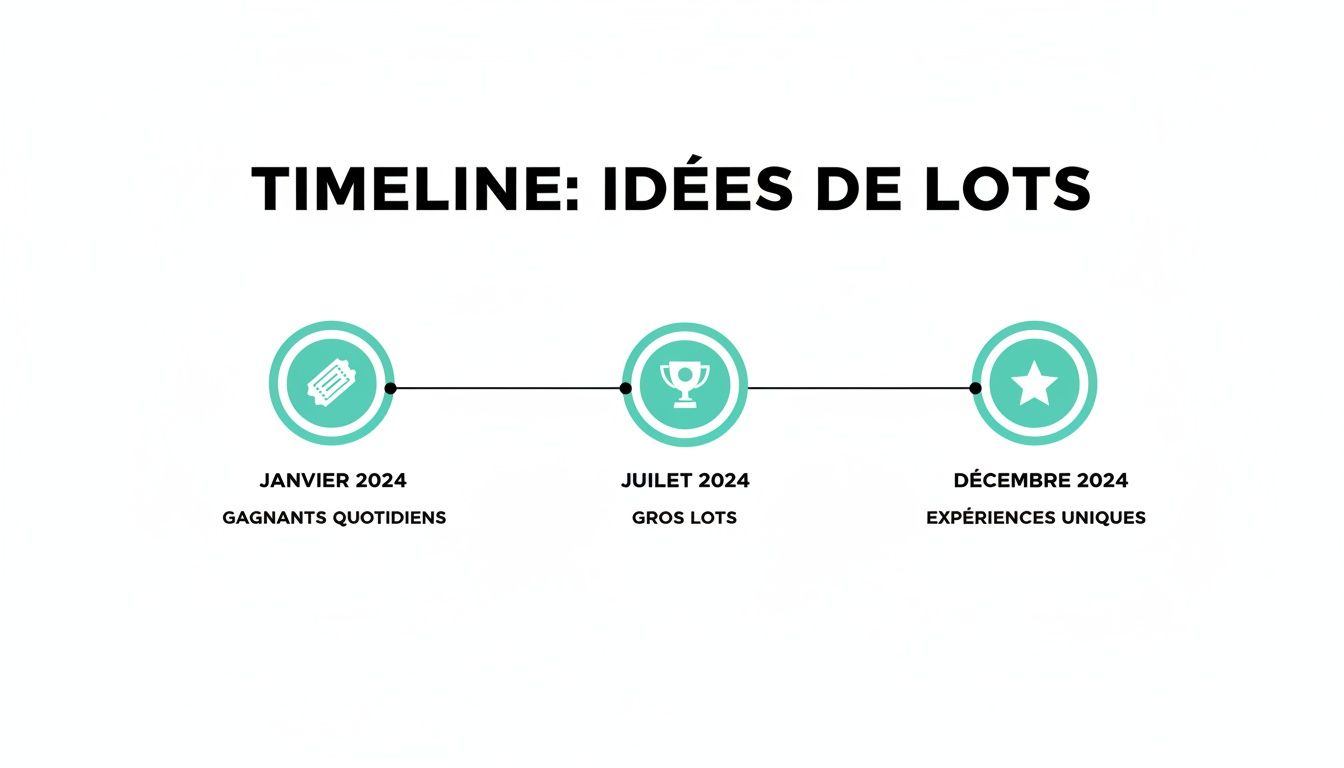
By planning daily gains, mid-term rewards, and beautiful final prizes, you create multiple peaks of interest and give everyone a reason to stay in the race until the end.
To help you visualize the process, here’s an example of a communication calendar.
Typical communication calendar for your contest
A week-by-week action plan to perfectly orchestrate the communication of your internal event, from teasing to debriefing.
| Phase | Key Actions | Recommended Channels | Objective |
|---|---|---|---|
| Week -1 (Teasing) | Mystery messages, polls “Who will win?”, countdown. | Slack/Teams, email, display. | Create curiosity, get people talking about the event. |
| Launch Day | Official email with registration link, rules, and prizes. Post on the intranet. | Email, Intranet, Slack/Teams. | Clearly inform, maximize registrations. |
| Week 1 | Daily match reminders, share rankings, highlight the “predictor of the day”. | Slack/Teams, push notifications. | Maintain engagement, create a game routine. |
| Week 2 | Announce mid-term winners, anecdotes about the tournament, recap surprises. | Email, Slack/Teams. | Reignite interest, value participation. |
| Day +1 (Closure) | Email announcing the grand winners, share fun stats. | Email, Intranet. | Celebrate winners, thank everyone. |
| Day +7 (Post-event) | Share photos of the awards ceremony, satisfaction survey. | Intranet, internal newsletter. | Anchor positive memory, gather feedback. |
This schedule is just a base, of course. Feel free to adapt it to your company’s culture and tools for maximum impact.
Celebrate victories and conclude beautifully
The end of the tournament is as crucial a moment as its launch. It’s an opportunity to celebrate all participants and put the grand winners in the spotlight. A well-thought-out closing communication leaves a positive impression that lasts.
Organize an official announcement of the results, whether during a brief team meeting, via a friendly recap email, or even with a small awards ceremony. Share some fun statistics: the boldest prediction, the most active department, or the total number of points scored. This values the collective effort and reinforces the feeling of having experienced something together, turning your Roland Garros contest into a true success of cohesion.
Measure the success of your operation, beyond the number of participants
Once the cup is raised and the last predictions validated, the match is not quite over. The real question arises: what was the actual impact of your Roland Garros contest? To truly prove the value of your initiative, you need to look beyond the simple participation rate. Of course, a high number is a good start, but it doesn’t tell the whole story about your teams' engagement.
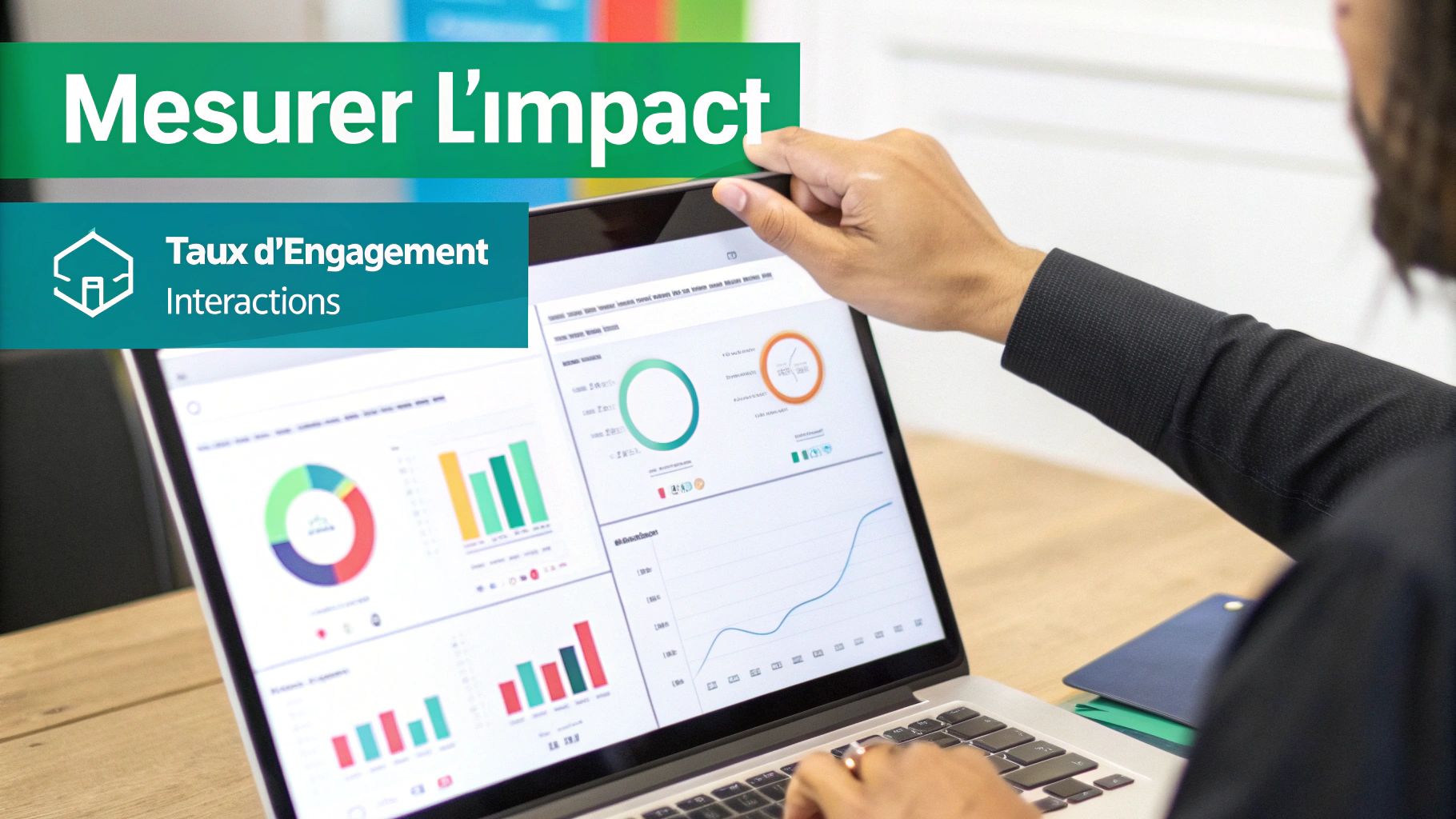
The idea is to transform this raw data into a story that speaks for itself. A story about the atmosphere, about team spirit. That’s what will allow you to showcase the operation internally and justify future budgets for similar activities.
The right performance indicators under the microscope
For an analysis that makes sense, focus on indicators that measure the quality of engagement, not just the quantity. That’s what will give you an accurate view of the return on engagement (ROE) of your operation.
Here are the KPIs that really matter:
- Daily engagement rate: This is the percentage of participants who logged in and interacted each day. If this rate is high, congratulations! Your game has succeeded in creating a nice and expected routine.
- Number of interactions per participant: Beyond predictions, count comments, reactions, and exchanged messages. This reflects the social and collaborative dimension of the game.
- Challenge completion rate: Look at the percentage of players who completed their predictions or quizzes. This is an excellent marker of motivation.
These figures are the solid foundation of your analysis. But for it to really carry weight, you need to add a more human touch.
A good report does not just align numbers. It tells how a simple activity created moments of sharing, strengthened bonds, and infused positive energy into the daily office life.
Let participants have their say
Numbers are good, but they can’t measure everything. Especially not the impact on morale and cohesion. That’s where qualitative feedback becomes your best ally.
Consider sending a short post-event survey. Not a 30-minute questionnaire, just a few simple and open questions to gather immediate impressions. For example:
- What did you like most about this contest?
- Did the activity facilitate discussions with your colleagues?
- Any ideas or wishes for next time?
The responses you receive are a true goldmine. They will provide you with strong verbatims, perfect for illustrating your summary report for management. A testimonial like “It was great to be able to talk about something other than work with my team” often has more impact than a graph. It’s the concrete proof that your Roland Garros contest fulfilled its mission.
Answers to your questions about Roland Garros contests
You have the idea, the desire, but some questions are still holding you back? That’s completely normal. Organizing a Roland Garros contest for your teams always raises some very concrete concerns.
Don’t panic, this section is here to answer them directly. The goal: to give you practical advice to lift the last doubts and allow you to focus on what matters: creating a real moment of cohesion and fun for everyone.
How to ensure that novices participate?
This is the number one concern: creating a game that will only speak to tennis experts and leave most employees on the sidelines. The solution is simple: just diversify the mechanics so that everyone has a chance to shine.
Think about mixing approaches:
- Quizzes on tournament culture: “What color is the clay at Roland Garros?” or “What is the nickname of the main court?”. These questions appeal to general knowledge, not to sharp expertise.
- Predictions on the line: The classic “Who will win the match?” remains a safe bet. It allows everyone to jump in, even if it’s just by betting on a player’s popularity.
- A points system that rewards consistency: Why not award bonus points just for participating each day? This values engagement beyond pure performance.
The game-changing tip: set up a team ranking (by department, by business unit...). You’ll see, collaboration will happen naturally. Enthusiasts will brief novices, and every participation, even the most modest, will count for the collective.
What legal aspects should be considered internally?
The question of legality is crucial, but the answer is rather reassuring in an internal context. Unlike a public contest, a game exclusively reserved for employees of the same company benefits from much looser rules in France. There’s no need, for example, to file regulations with a bailiff.
However, transparency is non-negotiable. Take the time to draft a clear, simple, and accessible regulation for all. This document should at least specify:
- The conditions for participation.
- The exact mechanics of the game and the points tally.
- The nature and value of the prizes at stake.
Finally, an essential point: ensure that the platform used complies with GDPR for managing your employees' data. To delve deeper into the topic, our detailed article on the legality of organizing a sports prediction contest will give you all the keys.
What budget should be planned?
The budget is much more flexible than one might think. In reality, it depends on two main items: the cost of the platform (if you decide to use one) and the value of the rewards offered.
For the rewards, creativity is your best ally. Remember that perceived value is often more important than actual cost. An extra day off, a lunch with the CEO, or tickets for a local event can have a huge impact without breaking the bank.
The important thing is to align your budget with your objectives and offer prizes that truly appeal to your teams.
Ready to transform the energy of Roland Garros into a powerful lever for cohesion? With ccup.io, launch your prediction contest in just a few clicks. Request your personalized demo today.
From Content To Conversion
Turn your next sports event into a company prediction contest
Discover the platform, explore available competitions, and launch a branded experience that supports engagement, internal communication, and team cohesion.
See available competitions
Latest articles

14 hours ago
Your Guide to Organizing Corporate Sports Events
The next big sports competition is approaching. Internally, the idea seems simple. Gather the teams, create a highlight, break the routine, and circulate some energy between offices, sites, and remote workers. Then the real questions arise. What format to choose, who to invite, how to avoid an ev...

2 days ago
Guide: Your Optimal Free Prize Request in 2026
The management's message is often the same. There needs to be internal engagement that creates momentum, unites multiple sites, and encourages participation, but the rewards budget is almost non-existent. In many companies, this is when motivation drops. This is a mistake.
A well-t...




















Contact us
For any question or quotation requests, do not hesitate to reach us by phone at 01 83 79 24 54 or by email : contact@ccup.io
Contact us


Frequently asked questions
What is ccup.io?
Ccup.io is a cohesion tool, allowing firms to gather their collaborators on the occasion of major sporting events, such as World Cup or Olympic Games. We offer an interactive forecasting platform, turnkey and customisable to your company’s colours.
What are you doing with our data?
By deciding to use our services, you decide to entrust us a part of your data – this will allow us to optimise your experience. We place great emphasis on the protection of your data, in compliance with current regulations. Given that it is important to be informed on the issues and challenges of personal data protection, ccup.io provides you with a most complete documentation on this matter.
How much does it cost?
In order to give our clients flexibility, we make a special rate depending on the number of registered players using a degressive system for an important number of participants. This allows firms to organise tailored events, adapted to their capacity. To receive a commercial offer in less than an hour, you only need to fill out the quotation requests form, with just a few clicks.



Don’t miss this opportunity 😍
Start now and enjoy numerous benefits