



How to Motivate Employees: Concrete and Sustainable Strategies
Motivating employees is much more than just an annual bonus. It is a true strategic investment that directly impacts productivity, talent retention, and the company's ability to innovate. The key is to create an environment where meaning, recognition, and autonomy become the true drivers of daily engagement.
Understanding Why Motivation is a Performance Lever

In a constantly changing work environment, viewing motivation as a mere "bonus" is a costly mistake. An engaged team is not only a more productive team. It is also a more creative team, more resilient to unforeseen events, and becomes the best ambassador for your employer brand. Ignoring signs of disengagement risks losing your best employees.
The numbers speak for themselves. In 2023, 18.3% of private sector employees changed employers, and 62% of employees are considering leaving their jobs. The reasons? They are very revealing: 34% point to management issues and 18% to the content of their job itself. Salary is no longer the only criterion.
Beyond the Paycheck
Let’s be clear: fair compensation is the foundation. But it is no longer enough to retain employees. Employee expectations have changed profoundly. Today, they seek:
- Meaning in their work: They want to understand how their daily tasks contribute to the overall vision of the company.
- Clear career advancement opportunities: Knowing that they can grow, learn, and develop skills is a powerful motivator.
- A healthy work environment: Trust in management and colleagues is non-negotiable.
- Flexibility and autonomy: Having control over their work organization and being able to take initiatives makes all the difference.
This quest for meaning is directly linked to personal fulfillment. Just as good exam preparation is vital for a student's success, a stimulating professional framework is essential for an employee's performance.
A demotivated employee does not just do the minimum. Unintentionally, they can hinder the entire dynamics of a team. The stakes are therefore not only individual; they are deeply collective.
Investing in motivation is thus investing in the sustainable performance of your company. This involves a strong managerial culture, transparent communication, and genuine attention to team well-being. By understanding these mechanisms, you transform what could be seen as an expense into a major competitive advantage. To go further, check out our tips for improving quality of life at work in our comprehensive guide.
Identifying Signs of Demotivation in Your Teams
Before even considering implementing an action plan, the first reflex is to learn to observe and listen. Demotivation rarely sets in overnight. It is more of an accumulation of small weak signals that, when put together, create a real break in engagement.
Ignoring these early signs is like leaving a crack in a wall untouched. Over time, it widens and threatens the entire structure. For a manager, decoding these signals is a key skill, much more than a simple administrative task.
Looking Beyond Appearances
An employee who no longer smiles at the coffee machine or participates less in team discussions may just be having a bad day. But when this behavior becomes the norm, it’s time to ask questions. Demotivation manifests in a thousand and one ways, from the most obvious to the most subtle.
Here are some behaviors that should raise your awareness:
- Progressive isolation: The person takes breaks alone, limits interactions with colleagues, and seems to withdraw during meetings.
- A decrease in initiative: They do their job but nothing more. Gone are the new ideas, the suggestions for improvement... The spark is no longer there.
- A change in communication: Responses become shorter, sometimes bordering on passive-aggressive. Enthusiasm has simply disappeared from exchanges.
- An increase in tardiness or absences: Even short, repeated absences can betray a much deeper malaise.
To go further, understanding the individual mechanisms behind the loss of desire can give you keys. A good starting point is to read how to overcome apathy and regain motivation to better support your employees.
Implementing Active Listening Tools
Waiting for the annual review to take the pulse of your teams is a serious mistake. Motivation is a living data point; it fluctuates. Therefore, it is necessary to create regular and caring contact points so that frustrations can be expressed before they become unsolvable problems.
To identify symptoms more clearly and link them to concrete tools, this table can help clarify things.
Precursor Signs of Demotivation and Associated Diagnostic Tools
This table helps identify symptoms of demotivation within teams and offers concrete tools to analyze the underlying causes.
| Observable precursor sign | Potential cause | Recommended diagnostic tool |
|---|---|---|
| Decrease in productivity, missed deadlines | Lack of clarity on objectives, workload overload, lack of resources. | Targeted individual interviews, workload analysis (Eisenhower matrix). |
| Increase in absenteeism and tardiness | Lack of meaning, poor social climate, burnout. | Anonymous "pulse" surveys, social barometer, re-welcome interviews. |
| Isolation, withdrawal during meetings | Unresolved internal conflict, feeling unheard, lack of integration. | Team cohesion workshops, "feedback circles", managerial mediation. |
| Cynicism, negative communication | Lack of recognition, feeling of injustice, loss of trust in management. | Surveys on workplace recognition, 360° interviews, career path analysis. |
| Absence of initiative, mechanical execution of tasks | Lack of autonomy, micromanagement, fear of failure. | Management style evaluation, implementation of OKR objectives, surveys on autonomy. |
By cross-referencing these observations with the right tools, you move from a simple intuition to a solid diagnosis, ready to be transformed into an action plan.
Anonymous "pulse" surveys, sent out monthly or quarterly, are an excellent way to gather honest feedback. A question as simple as "On a scale of 1 to 10, how would you rate your motivation this week?" can already provide you with a valuable indicator.
During an individual interview, forget the classic "How are you?". Favor an open and sincere question like: "What is one thing that could make your workday better?" or "Is there an obstacle preventing you from progressing on your projects right now?" The quality of your questions will determine the quality of the answers.
Finally, do not overlook HR data. A rising turnover in a department or a climbing absenteeism rate are not just statistics. They are symptoms of an organization that needs to reflect. It is by combining human listening and factual analysis that you will make an accurate and precise diagnosis to build an environment where everyone can thrive.
Deploying the 4 Pillars of Sustainable Motivation
To truly understand how to motivate employees in the long term, one must first accept one thing: motivation is not a switch. You cannot just turn it on. It is a complex alchemy built on solid foundations.
Rather than chasing after miracle solutions that quickly fade, the only effective approach is to build a work environment that nurtures daily engagement. For this, everything relies on four essential pillars. Think of them as a system: each pillar reinforces the others. By implementing them coherently, you stop "managing" motivation and finally start cultivating it.
1. Daily Recognition
Recognition is not just the year-end bonus. Thinking that is to miss its true power. Recognition that leaves a mark is frequent, specific, and, above all, sincere.
A simple "thank you for your help on this file, your diligence saved us valuable time" often has much more impact than an anonymous bonus paid six months later. It shows that the work is seen and appreciated at its true value.
Here are some ideas to integrate it into your habits:
- Establish regular feedback. Don’t wait for the annual review! A quick weekly check-in to highlight a success or effort can change everything.
- Celebrate small victories. A project completed, a happy client, a bug finally resolved… Every success, even modest, deserves to be shared, for example during a team meeting.
- Encourage recognition among colleagues. Create a dedicated channel (on Slack, Teams, or even a good old corkboard) where everyone can publicly thank a colleague.
When recognition becomes a true culture and is no longer just top-down, it weaves strong bonds and creates an atmosphere of respect and trust.
2. Meaning and Contribution
No one likes to feel like they are spinning their wheels. The most powerful driver of motivation is understanding how their work contributes to something greater. It’s Simon Sinek’s famous "Why".
The manager's role is to make this connection, linking everyone’s daily tasks to the company’s overall mission. No need for grand speeches, just concrete actions.
A developer does not just "push code". They enhance the experience of thousands of users. A customer support person does not just "respond to tickets". They solve real problems and retain customers. It’s this perspective that changes everything.
To instill this meaning, you can:
- Share the vision. Regularly explain where the company is headed and how the team’s work is crucial to getting there.
- Make the impact visible. Share customer feedback, key figures, or any other indicator that proves the work done has a concrete effect.
- Involve teams in decisions. When possible, ask for their input on upcoming goals. Feeling like a part of the choices strengthens the sense of belonging.
3. Autonomy and Development
Micromanagement is the worst enemy of motivation. It’s a slow poison. Trusting and giving autonomy is not an option; it’s a necessity. It sends a strong message: "I trust you to do your job well".
Autonomy does not mean abandonment. It must be accompanied by a clear framework: well-defined objectives, the right resources, and support available when needed. Concretely, this can mean flexibility in hours, choice of tools, or the freedom to approach a project in their own way.
This trust goes hand in hand with skill development. An employee who feels they are learning, progressing, and growing is an employee who stays.
- Offer clear training paths: Investing in your teams' skills is one of the best proofs of recognition.
- Encourage internal mobility: Offering advancement opportunities within the company is a major retention lever.
- Implement mentoring: Bridging experienced employees with juniors creates connections and accelerates knowledge transfer.
4. A Healthy Work Environment
The last pillar, and not the least: the quality of the work environment. This encompasses everything: the atmosphere with colleagues, the sense of fairness from management, and, of course, the balance between work and personal life.
The numbers prove it. While compensation remains a major satisfaction factor (66%), expectations have clearly evolved. The work-life balance is now the second criterion (42%), closely followed by job interest (33%) and the quality of human relationships (32%). These data, drawn from a CV Genius study, clearly show that money isn’t everything.
A healthy environment is built on concrete actions.
| Component of the environment | Concrete managerial action |
|---|---|
| Colleague relationships | Organize informal times (breakfasts, team activities) to create bonds beyond work tasks. |
| Managerial equity | Apply the same rules for everyone. Be transparent about decisions regarding raises or promotions. |
| Psychological safety | Create an atmosphere where mistakes are seen as learning opportunities, not faults to hide. |
| Life balance | Respect the right to disconnect. No emails in the evening or on weekends. Encourage taking real vacations. |
By working on these four pillars, the question will no longer be how to motivate your employees, but how to channel all the positive energy you will have helped create. It’s a foundational job, but the benefits in terms of performance and well-being are immense. To go further on the financial aspect, also discover our article on the different ways to reward employees.
Implementing a Realistic and Measurable Action Plan
The best intentions in the world and the most refined diagnostics lead nowhere without a clear roadmap. It’s time to take action. We transform beautiful ideas into concrete initiatives. In short, we move from "we should" to "we will".
A good action plan is not just a wish list. It is a living document that sets a direction, assigns responsibilities, and, most importantly, allows for measuring progress. The idea is to avoid at all costs the syndrome of the "big HR project" that gathers dust in a drawer.
Defining Clear and Quantifiable Objectives
To start, you need to know where you want to go. Vague objectives like "improve motivation" are impossible to track and doomed to fail. You need to be much more precise.
A good objective is a SMART objective: Specific, Measurable, Achievable, Realistic, and Time-bound.
- Example of an objective to avoid: "Improve recognition."
- Example of a SMART objective: "Increase our recognition score in the quarterly survey by 15% by the end of the second semester."
- Another concrete example: "Reduce the voluntary turnover rate of the technical team by 10% over the next 12 months."
By quantifying your objectives, you provide a solid framework to evaluate the success of your actions. It also makes it much easier to justify the investment (in time and money) to your management.
To visualize how everything fits together, the infographic below illustrates the four pillars on which your plan should be based.
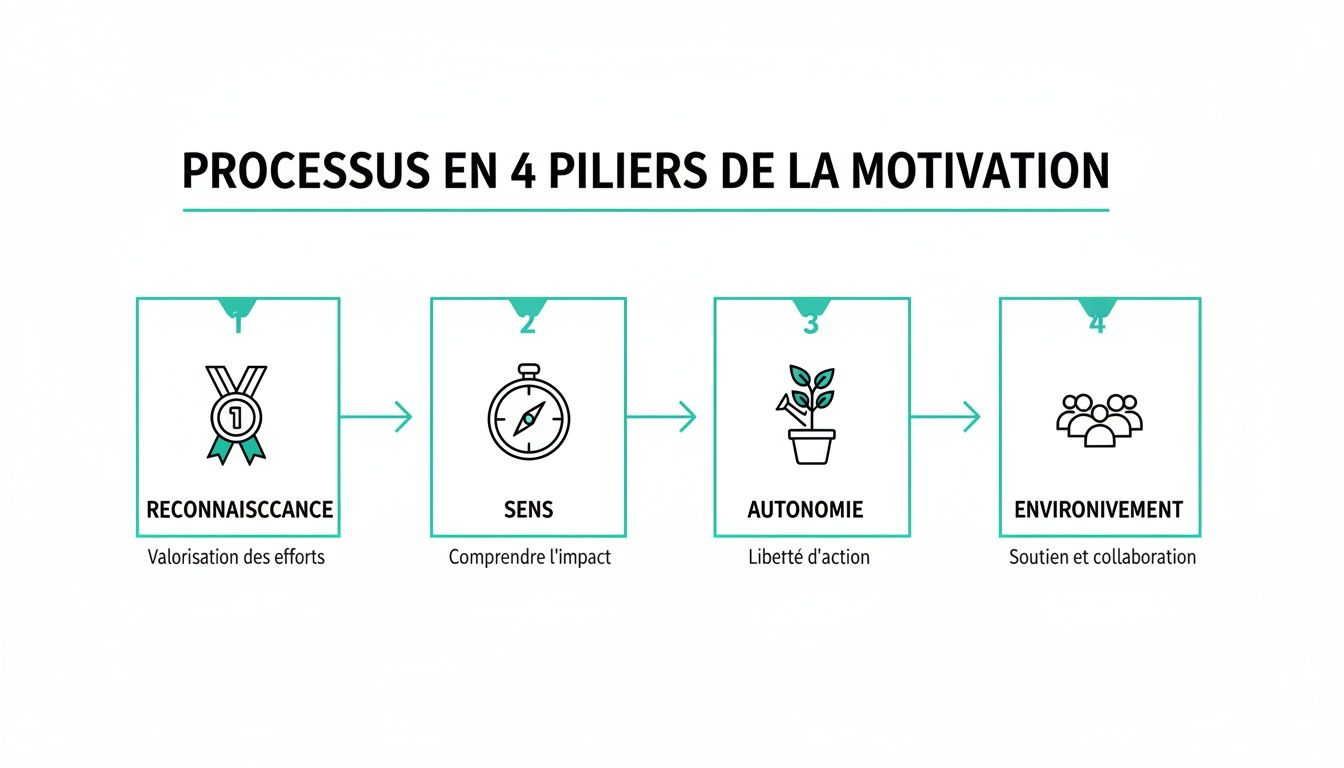
It is clear that recognition, meaning, autonomy, and a healthy work environment are all interconnected. By acting on these four levers, you build sustainable motivation.
Launching a Pilot Project to Test and Adjust
Rather than deploying a massive and costly program across the entire company, why not start small? The pilot project approach is your best ally. Choose a willing team or department to test your new ideas.
This small-scale "laboratory" will allow you to:
- Test your initiatives without taking big risks.
- Gather direct and honest feedback from participants.
- Identify obstacles and unforeseen issues before a wider rollout.
- Adjust your approach to make it more effective and better accepted.
Imagine, for example, testing a new weekly feedback ritual or a more flexible telework charter within a single team for a quarter. The feedback will be infinitely richer than any theoretical study.
The classic mistake is to want to change everything at once. A successful pilot project creates internal ambassadors and provides proof that your approach works. The buy-in for the next steps will be much easier.
Training and Engaging Managers
Your action plan will largely rest on the shoulders of managers. Day-to-day, they embody the company culture. If they are not convinced and well-trained, even the best ideas will fall flat.
Training should not just be a simple presentation of your plan. They need to be given concrete tools to:
- Conduct meaningful individual interviews.
- Provide effective and caring feedback.
- Manage resistance to change within their teams.
- Facilitate rituals that reinforce cohesion and meaning.
The best approach is to involve them from the plan's conception. Their feedback from the field is invaluable, and by participating, they will naturally take ownership of the project. A manager who feels like a co-author of the plan becomes its first advocate.
Finally, communication is key. Explain the "why" behind your actions, share the results (even modest) of the pilot project, and celebrate the first successes. This is how you transform a simple initiative into a true culture of motivation.
Strengthening Team Cohesion with Unifying Activities

We cannot emphasize enough: an employee's motivation is not solely determined by their tasks or paycheck. The overall atmosphere and the quality of relationships with colleagues weigh heavily in the balance. This is precisely where more informal moments and team activities make perfect sense.
Far from being a mere gimmick, organizing unifying events is a true strategic lever. It allows employees to step outside the strictly professional framework, see their colleagues in a different light, and share positive emotions. These shared experiences, whether fun, sporty, or charitable, create shared memories and strengthen the sense of belonging in the most natural way.
Stepping Outside the Box to Create Connections
The traditional farewell party or Christmas tree still has its place, of course. But to truly make an impression, sometimes you need to dare to be a bit more original. The idea is to propose activities that resonate with your company culture and appeal to the majority.
Here are some ideas to energize your teams:
- Accessible sports challenges. Launch a charity run where the company matches donations based on kilometers covered, or a friendly pétanque or Mölkky tournament. The important thing is that everyone, regardless of their level, can participate and have fun.
- Charitable initiatives. Participate in a volunteer day for a local association (litter picking, helping at a shelter...). These actions give meaning and strengthen pride in belonging to a committed company.
- Creative or culinary workshops. A cooking class, pottery workshop, or mixology introduction are excellent ways to stimulate collaboration in a completely relaxed context.
These initiatives are all the more important as the social climate in companies has become tense. In France, the engagement rate is only 8% (the lowest in Europe!), and deteriorating relationships are cited as a reason for departure by 42% of young professionals. There is an urgent need to recreate connections.
Gamification, an Ally for Healthy Competition
Major sporting events like the World Cup or the Olympics are golden opportunities to bring everyone together. They spontaneously generate discussions and collective excitement. So why not ride this wave to organize an internal prediction contest?
This is a very simple and effective way to create engagement over several weeks, with minimal investment. Even better, it breaks down silos between departments: the accountant can suddenly find themselves at the top of the leaderboard ahead of the sales director, creating new and fun interactions.
Specialized platforms exist to simplify your life.
The goal is not to turn the office into a fan club, but to use this universal passion for sports as a pretext. A pretext to interact differently, laugh together, and create friendly competition that bonds teams.
Tools like ccup.io greatly facilitate the implementation of these prediction contests. Their interface is designed to be simple and engaging, with leaderboards, badges to win, and customization in the company colors. This allows you to manage the engagement without spending hours, while providing a great experience for participants.
If this topic interests you, our complete guide on uniting teams through sports will give you even more ideas.
What Concrete Benefits for the Company?
Investing in team activities is not a superfluous expense. It is a true investment with a real return.
| Benefit for the company | Direct impact on employees |
|---|---|
| Better inter-departmental communication | Employees get to know each other personally, which naturally smooths professional exchanges. |
| Strengthened sense of belonging | Sharing strong moments outside of work creates a deeper attachment to the company and its values. |
| Less stress, better atmosphere | These breaks allow for releasing pressure and contribute to a more positive work environment. |
| Enhanced employer brand | A company where it is good to live and that offers activities is simply more attractive to talent. |
Ultimately, strengthening cohesion is investing in the most precious capital of the company: its human capital. An employee who is happy to come to work in the morning and see their colleagues is a more engaged, more creative, and more loyal employee. These shared moments are the glue that transforms a group of individuals into a true team.
Rewritten for a more human tone:
Measuring the Impact of Your Actions for Continuous Improvement
Launching initiatives to motivate your teams is a good start. But knowing whether they really work is what makes all the difference. Without measurement, you are navigating blindly. It is impossible to distinguish what has a real impact from what is just a nice gadget.
Establishing clear indicators is not just a simple administrative chore. It is what transforms your efforts into a true strategy for continuous improvement.
This approach also proves to your teams that their well-being is taken seriously. When employees see that their feedback leads to concrete and measurable actions, trust in management is strengthened over time. This is the beginning of a virtuous cycle.
Quantitative Indicators to Monitor Closely
To objectify your approach, nothing beats numbers. They are factual, easy to track over time, and allow for unambiguous comparisons.
- eNPS (Employee Net Promoter Score): This is the key indicator for gauging engagement. The question is simple: "On a scale of 0 to 10, would you recommend working here to a friend?" Tracking its evolution, for example, each quarter, gives you a very reliable thermometer of the internal climate.
- Retention rate (or turnover): A classic but fundamental metric. If your best talents stay longer after launching your actions, it’s a sign that doesn’t lie. Consider analyzing it by team or department to identify potential hotspots.
These numbers are the skeleton of your analysis. But to understand the "why" behind the data, you need to add a more human dimension.
Don’t fall into the trap of the "vanity metric". A high participation rate in a team event is great, but it doesn’t measure deep engagement. Focus on indicators that reflect a real change in behavior over the long term.
Gathering Qualitative Feedback, the Story Behind the Numbers
Numbers show the what, qualitative feedback explains the why. To truly understand what motivates your employees, you need to listen to them speak in their own words.
- "Pulse" surveys with open-ended questions: Right after the eNPS score, include an open-ended question like: "What is the best thing that happened to you at work this month?" or "If you had a magic wand, what would you change first?" The insights you will gather are invaluable.
- "Listening circles": Nothing beats small discussion groups (5-6 people max) led by a neutral third party (an HR person or a manager trained in active listening). The idea is to free up speech on specific themes like recognition or workload, all in a caring and non-judgmental environment.
Building Your Motivation Dashboard
Centralize all this data, both quantitative and qualitative, in a simple and visual dashboard. Share it transparently with managers and, in a simplified version, with all teams. Transparency is key.
| Indicator (KPI) | Objective (example) | Monitoring frequency |
|---|---|---|
| eNPS Score | Increase by 10 points in 6 months | Monthly |
| Voluntary turnover rate | Reduce by 5% over the year | Quarterly |
| Absenteeism rate | Keep below 4% | Monthly |
| Survey verbatim | Analyze the 3 recurring themes | Monthly |
By reviewing these results during regular meetings, you stop being a victim of demotivation. You learn, you adjust, and you show everyone that employee motivation is a strategic, living project that evolves with you.
The Questions You Ask Yourself About Motivation at Work
In the daily life of management, certain questions about team motivation keep coming up. Here are some concrete insights to answer them, drawn from our field experience.
What to Do When an Employee Only Thinks About Salary?
An employee who seems motivated only by their paycheck is often a sign of a deeper problem. If their compensation is fair and aligned with the market, you need to look elsewhere. It’s a symptom of an unmet need: a lack of challenges, absence of recognition, or the feeling of stagnating professionally.
Take the time for a one-on-one meeting to understand their true expectations. By asking open-ended questions about what would excite them daily or about their long-term ambitions, you will discover much more powerful levers than money.
Are Team Buildings a Gimmick or a Real Tool?
Yes, team buildings are useful, but be careful; they don’t work miracles. If they are well-designed, they can bond a team where relationships are already healthy. However, they cannot serve as a band-aid to mask poor management or a bad atmosphere.
If perceived as a constraint or a forced break to forget tensions, a team building can even be counterproductive. It’s better to have small, authentic, and regular gestures than a large, one-off event that feels false.
How to Remotivate Teams on a Tight Budget?
Fortunately, motivation is not just a matter of budget! Many high-impact actions cost absolutely nothing.
- Sincere recognition: A simple "thank you," explaining concretely what you appreciated.
- Feedback that helps grow: Regular and caring feedback to help everyone progress.
- A bit of flexibility: When possible, offering more flexibility in hours or telework is a very appreciated sign of trust.
Celebrating small successes of the week or organizing a friendly lunch where everyone brings something are excellent ways to strengthen bonds without touching the budget.
To animate your teams in an original and unifying way, think of ccup.io. Discover how our prediction contests can energize your daily life and strengthen cohesion at https://ccup.io.
From Content To Conversion
Turn your next sports event into a company prediction contest
Discover the platform, explore available competitions, and launch a branded experience that supports engagement, internal communication, and team cohesion.
See available competitions
Related articles

last month
How to Successfully Retain Your Employees
You may have this file open right now. A few departures happening in succession, managers talking about a "tight market," management asking for a retention plan, and HR teams sensing that the problem won't be solved with a one-off seminar or a hastily decided bonus. This is often where everything is...

2 months ago
How to Improve Employee Experience: The 2026 Guide
You may have the same impression as many HR directors, internal communication managers, or People Partners right now. You launch initiatives, teams participate politely, and then the energy drops. Annual surveys always highlight the same irritants. Managers ask for ideas that "really work." And mana...

4 months ago
How to Choose the Right Internal Communication Tools for Your Team
Internal communication tools are simply the platforms and systems that allow a company to communicate with its teams, motivate them, and create connections. Today, especially with the rise of hybrid work, they have become the cornerstone of a strong company culture and perfect alignment. Why Interna...




















Contact us
For any question or quotation requests, do not hesitate to reach us by phone at 01 83 79 24 54 or by email : contact@ccup.io
Contact us


Frequently asked questions
What is ccup.io?
Ccup.io is a cohesion tool, allowing firms to gather their collaborators on the occasion of major sporting events, such as World Cup or Olympic Games. We offer an interactive forecasting platform, turnkey and customisable to your company’s colours.
What are you doing with our data?
By deciding to use our services, you decide to entrust us a part of your data – this will allow us to optimise your experience. We place great emphasis on the protection of your data, in compliance with current regulations. Given that it is important to be informed on the issues and challenges of personal data protection, ccup.io provides you with a most complete documentation on this matter.
How much does it cost?
In order to give our clients flexibility, we make a special rate depending on the number of registered players using a degressive system for an important number of participants. This allows firms to organise tailored events, adapted to their capacity. To receive a commercial offer in less than an hour, you only need to fill out the quotation requests form, with just a few clicks.



Don’t miss this opportunity 😍
Start now and enjoy numerous benefits