



How to Improve Quality of Life at Work with Concrete Strategies
Talking about improving quality of life at work (QVT) is not just about adding a green plant or a foosball table. It's much deeper than that. It's about rethinking work organization, building strong social connections, and creating an environment where everyone feels psychologically safe.
A well-executed QVT approach is not an expense; it's an investment. The impact is directly visible on performance, with reduced turnover and skyrocketing engagement.
Why QVT Has Become a Strategic Issue

The vision of quality of life at work has completely changed. Gone are the days when it was just a nice "plus." It is now a pillar of corporate strategy. Organizations that ignore it pay a high price, both in productivity and reputation.
Today, one thing is certain: neglecting employee well-being costs much more than investing in it. A toxic climate or constant stress opens the door to absenteeism and talent flight. These are direct and indirect costs that weigh down financial statements.
The New Face of Occupational Risks
Psychosocial risks (RPS), such as burnout or chronic stress, are no longer topics to be swept under the rug. They are at the heart of concerns for any company aware of its responsibility.
Mental health has become central. In France, the figures speak for themselves: the number of recognized occupational mental illnesses has surged by +25% in 2023. This reality has forced public authorities to react, as shown by the latest publications on mental health at work.
Ignoring QVT is like ignoring a water leak in a ship. At first, it seems minor, but it inevitably compromises the entire structure.
A Strong Expectation from Employees
Employee expectations have evolved, especially among new generations. They are no longer just looking for a good salary. They want meaning, work-life balance, and human management. To attract and retain the best, these aspirations must be met.
A solid QVT approach then becomes a true talent magnet. It shapes the perception of the company, both for candidates and for existing teams. It is an essential building block of what is called the employer brand.
In short, companies that succeed are those that understand that their human capital is their greatest treasure. Investing to improve quality of life at work is simply investing in one's own growth and future.
Here is the rewritten version of the section, following the requested style, tone, and requirements.
Focusing on What Really Matters: The QVT Diagnosis
To truly improve quality of life at work, one must start with the basics: listening. It cannot be said enough, but a good QVT diagnosis is not just a checkbox. It is the moment when you take the pulse of the company to understand what employees experience daily, with their successes but also their frustrations.
Launching an action plan without this step is like navigating blindly in a storm. The risk? Implementing initiatives that fall flat because they do not address any real needs. The goal is simple: to obtain an honest snapshot of the situation, even if the truth is not always easy to hear.
Crossing Perspectives for a 360° Vision
One method is never enough to grasp the complexity of human feelings. For a truly reliable diagnosis, the secret is to combine several tools. Think of it like an investigation: every clue counts to reconstruct the puzzle.
The idea is to create a space of trust where people can speak freely, without fear of judgment. This is the sine qua non condition for gathering raw, authentic information on which you can truly build something.
- Anonymous surveys: They are perfect for taking the temperature on a large scale and collecting quantitative data. Anonymity is key for people to dare to express themselves on sometimes sensitive topics, such as relationships with management or workload.
- Individual interviews: Nothing replaces a face-to-face (or video) discussion. This is where you can delve into topics, understand nuances, and capture emotions that a questionnaire can never convey.
- Group workshops: Excellent for bringing shared issues to light and starting to outline the first solutions together. Plus, it reinforces the feeling of being heard and involved.
The classic mistake is to limit oneself to the big annual survey. A good diagnosis is a dialogue that lives throughout the year. It shows that the teams' opinions really matter, not just once a year for statistics.
Before choosing your tools, this table can help clarify your choices.
Comparison of QVT Diagnostic Tools
This table helps choose the most suitable diagnostic method based on objectives, resources, and company culture.
| Diagnostic Tool | Advantages | Disadvantages | Ideal for... |
|---|---|---|---|
| Online anonymous survey | Quick to deploy, collects quantitative data on a large scale, guarantees anonymity. | Lacks depth, risk of "neutral" responses, no direct interaction. | Getting a first overall picture, measuring trends, and identifying major areas of concern. |
| Individual interviews | Rich qualitative information, allows understanding of the "why," builds trust. | Time-consuming, requires active listening skills, difficult to analyze on a large scale. | Exploring sensitive or complex topics identified by a survey in depth. |
| Group workshops | Fosters collective intelligence, brings concrete solutions to light, strengthens cohesion. | Can be influenced by dominant personalities, requires excellent facilitation. | Co-constructing action plans with teams and prioritizing initiatives. |
| Suggestion box (physical/digital) | Simple, accessible continuously, allows for spontaneous feedback collection. | Suggestions often disorganized, no guarantee of response, can remain empty if poorly managed. | Maintaining an open listening channel daily for small and large suggestions. |
Each tool has its place. The best approach is often to start broad with a survey, then dig into hot points through interviews or workshops.
The Art of Asking the Right Questions
The quality of your diagnosis will directly depend on the relevance of your questions. Avoid closed and vague questions like "Are you happy at work?" This will yield nothing useful. You need to seek the concrete, the lived experience.
To ensure nothing is forgotten, rely on the 6 key dimensions of QVT defined by ANACT (National Agency for the Improvement of Working Conditions). Here are some question prompts, of course to be adapted to your own reality:
Work Content
- "Do you feel you have the autonomy and resources necessary to do good work?"
- "On a scale of 1 to 10, how do you rate your workload right now?"
Social Relations and Management
- "Do you feel recognized for the work you provide?"
- "Would you say that communication in your team is rather fluid and transparent?"
Work-Life Balance
- "What does the company do to help you reconcile your professional and personal imperatives?"
- "Do you feel any pressure (even implicit) to remain reachable outside of your working hours?"
These open questions are entry points. They invite rich and personal responses that, once analyzed, will allow you to prioritize the projects that will have the most impact. Because a well-conducted diagnosis is never an end in itself; it is the solid foundation on which you will build a QVT strategy that works.
Transforming the QVT Diagnosis into a Concrete Roadmap
A QVT diagnosis is good. But a diagnosis that collects dust on a shelf is useless. The real work begins once you have gathered all this valuable feedback from your teams. The challenge? Transform this raw material into a structured action plan, without falling into the trap of wanting to solve everything at once.
It is about intelligently transitioning from listening to action. You must identify the real friction points, the daily irritants, and concentrate energy where the impact will be maximal. A well-thought-out roadmap then becomes your best ally for sustainably improving quality of life at work.
This process ultimately boils down to three key phases: listen, analyze, then act.
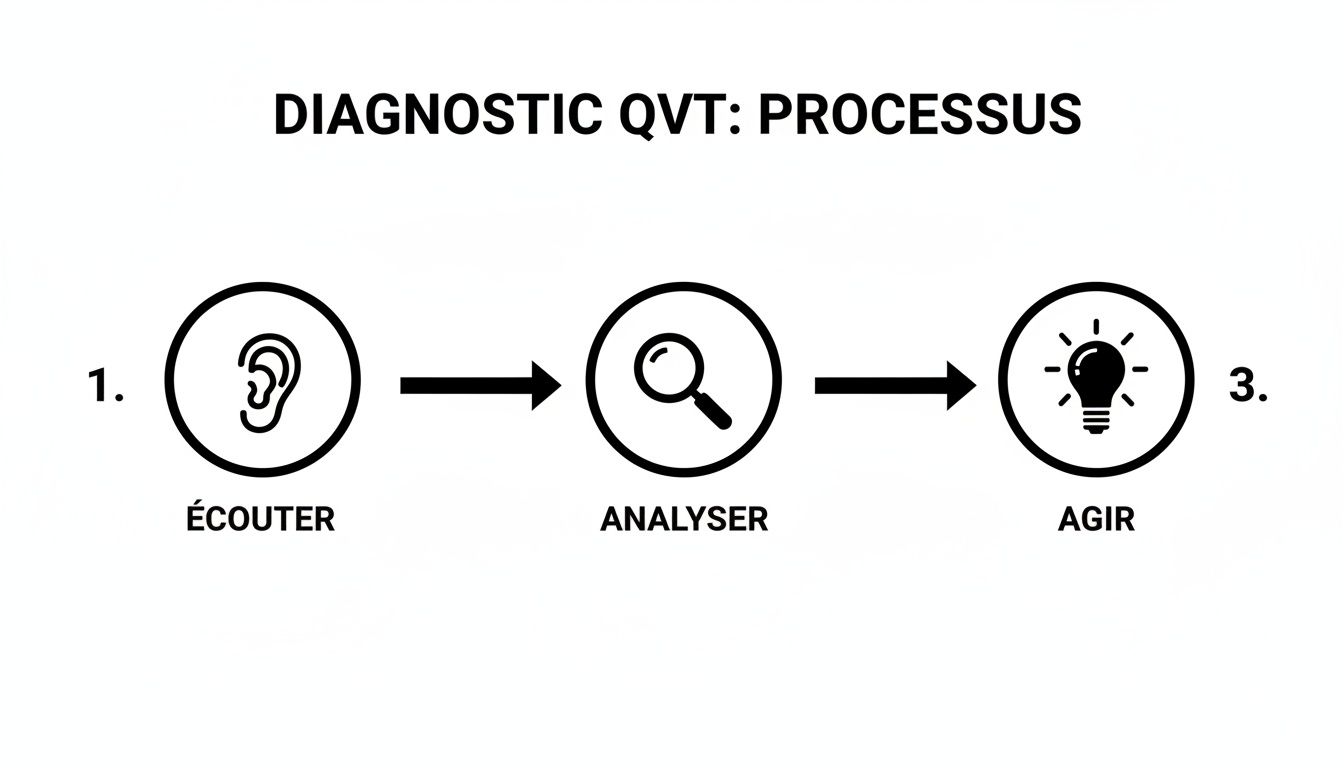
This logic is simple but powerful: each step feeds the next, creating a true dynamic of continuous improvement.
How to Prioritize Actions? The Impact-Effort Matrix
Faced with a mountain of suggestions and problems, the burning question is always the same: where to start? To clarify, a simple yet remarkably effective method is the impact-effort matrix. The principle is to classify each idea according to two axes: its potential impact on team well-being and the effort required to implement it (time, budget, resources).
This sorting gives you four distinct types of actions:
- Quick Wins: High impact, low effort. These are your absolute priorities. They deliver visible results quickly, boost morale, and prove that the QVT approach is not just empty words.
- Major Projects: High impact, high effort. These foundational projects require more planning and resources, but their potential is enormous.
- Small Improvements: Low impact, low effort. These can be launched when you have a bit of time. They won't revolutionize daily life but contribute to improving it in small ways.
- False Good Ideas: Low impact, high effort. These should be set aside. The effort simply isn't worth it.
My advice: focus on one or two "quick wins" to start. Nothing like that to create a positive dynamic and show employees that their voices have been heard. It's proof that things are really changing.
4 Pillars for a Clear and Balanced Roadmap
For your action plan to be coherent and easy to communicate, structure it around major axes. These pillars will help you balance your efforts and cover all facets of QVT.
Here is a simple model you can draw inspiration from:
1. Work Organization Here, we touch on the core: workload, autonomy, clarity of missions...
- Example Action: Organize team workshops to redefine everyone's roles and eliminate the gray areas that generate unnecessary stress.
- SMART Objective: Reduce by 15% the number of employees reporting being overloaded in the next biannual survey, having clarified the mission scopes for 80% of teams.
2. Work Environment and Spaces This refers to the physical framework: ergonomics of workstations, office layout, quality of break areas.
- Example Action: Redesign the break room to make it a real place for disconnection, more friendly and better equipped.
- SMART Objective: Increase satisfaction rates for common areas by 20 points in 3 months, involving a group of volunteers in the redesign project.
3. Social Cohesion and Relationships The glue of any company. This axis covers the quality of management, atmosphere, recognition, and shared moments.
- Example Action: Launch activities to strengthen bonds, such as inter-departmental sports challenges or contests. This is an excellent way to oil the wheels and boost the collective. To go further, check out our guide on organizing a company contest.
- SMART Objective: Achieve 60% participation in team events by the end of the year and improve the "cohesion" score by 10% in our internal survey.
4. Digital Tools and Environment Digital well-being has become essential. It involves tools that work well and a healthy culture of disconnection.
- Example Action: Implement a right to disconnect charter and train managers on best practices to limit "always on".
- SMART Objective: Reduce the volume of emails sent outside working hours by 25% within 6 months, through anonymized measurement.
By structuring your roadmap in this way, you build a readable, balanced action plan that directly responds to your employees' expectations. This is the key for your QVT approach to become a real driver of performance and engagement.
Strengthening Cohesion with Meaningful Activities
Once your QVT roadmap is well-structured, it's time to move on to one of the most human and rewarding aspects: team cohesion. A good salary or exciting missions are essential. But let's be honest, it is often the bonds formed with colleagues that transform a mundane workday into a truly positive experience. This social capital is what makes you want to get up in the morning.
This bond, however, cannot be decreed. It must be cultivated. And for that, nothing beats moments of sharing that go beyond the purely professional framework. These activities are not mere distractions; they are real tools for breaking down barriers between departments, easing tensions, and creating shared memories that strengthen the sense of belonging.

Well-chosen, these initiatives can revitalize teams and anchor a positive and collaborative corporate culture.
Going Beyond Simple Entertainment
The most common mistake? Viewing these moments as mere recreational breaks. Their potential is much greater. A successful activity is one that makes sense, aligns with your corporate culture, and allows everyone to connect on a different level than just files and meetings.
Take a sports prediction contest during a major event like the World Cup or the Olympics. It's a golden opportunity to create healthy excitement and informal conversations. Suddenly, the accountant on the third floor and the developer working remotely at the other end of France have an exciting topic to share.
Platforms like ccup.io make organizing such events ultra-simple, even for dispersed teams. They create a friendly gaming space where employees can challenge each other, exchange ideas, and share excitement, all in a very intuitive way. By the way, we explain in detail how sports prediction contests create a pleasant work environment in our dedicated article.
The goal is not to organize the most spectacular event, but the one that generates the most authentic interactions. A simple ping-pong tournament or a cooking workshop can have a huge impact if done well.
This investment in social bonds is even more crucial for younger generations. A recent study revealed alarming figures: 66% of those under 30 find their job stressful, and 49% of them have had at least one sick leave in 2024. This is 7 points higher than the average for employees. In light of this, strengthening solidarity and support among colleagues becomes an essential preventive action.
Choosing and Communicating to Maximize Participation
Team buy-in is key. Imposing an activity never works. For it to take off, employees must be involved from the start.
Here are some tips to achieve this:
- Gauge interests: Launch a small questionnaire to ask teams what they would enjoy. Sports, culture, games, creative workshops? The responses might surprise you.
- Vary the pleasures: Don't bet everything on sports if some of your teams are not interested. Alternate with baking contests, cultural quizzes, or solidarity challenges. The idea is for everyone to feel included.
- Communicate with enthusiasm: Don't settle for an impersonal email. Use your internal communication channels (Slack, intranet, newsletter) to create real buzz around the event. Highlight the benefits: relaxing, seeing colleagues in a different light, and, of course, having fun.
The way you present the initiative is as important as the initiative itself. Highlight the rewards (even symbolic), the simplicity of the rules, and the joy of participating together.
Integrating Activities into the Overall QVT Strategy
For a lasting impact, these moments of conviviality should not be isolated events. They must fit into a global and coherent approach.
Associate these activities with key moments in the life of the company:
- Integration of newcomers: An escape game or a sports challenge is perfect for breaking the ice and quickly integrating new recruits.
- Team seminars: Use these moments to organize activities that go beyond the ordinary and strengthen bonds outside the formal framework.
- Annual events: QVT week or year-end celebrations are ideal pretexts to launch unifying initiatives.
By making cohesion a strategic axis of your QVT policy, you are not only making work more enjoyable. You are building a more resilient culture, where solidarity and mutual support become reflexes. It is this team spirit that will allow you to overcome challenges and celebrate successes together.
Measuring the Real Impact of Your QVT Actions
You have launched initiatives to improve quality of life at work? That’s an excellent starting point. But the real test begins now: how to know if your efforts are truly paying off? This is where measurement comes into play. This step, often underestimated, transforms a simple action into a solid and credible long-term QVT strategy.
Without measurement, we navigate blindly. The risk? Continuing to invest time and resources in actions that do not meet the real needs of teams. Establishing clear indicators is the only way to prove that your approach is more than just a passing trend, but a deep and lasting commitment.
Defining Your QVT Performance Indicators
To evaluate the effectiveness of your plan, you need reliable thermometers. These are the famous KPIs (Key Performance Indicators). The secret is not to limit yourself to numbers. You must absolutely combine quantitative indicators, which measure the "how much," with qualitative indicators, which explore the "why" and the feelings.
Quantitative data is perfect for getting an objective overall view. They allow you to track major trends and present tangible results to your management.
- Absenteeism rate: A slight decrease is often the very first signal of an improvement in the social climate.
- Turnover rate: A golden indicator for measuring retention. If fewer talents leave the company, you are on the right track.
- Number of applications received: A good QVT radiates outward. It strengthens your employer brand and mechanically attracts more candidates.
Qualitative feedback, on the other hand, provides nuance, the human element behind the numbers. They help you understand in detail what your employees are experiencing and adjust your approach to better meet their expectations.
The classic mistake is to want to measure everything. Choose 3 to 5 KPIs that are truly representative of your objectives and easy to track. It's better to have a few relevant indicators than a data overload that serves no one.
To help you get started, here is a selection of quantitative and qualitative indicators that you can integrate into your QVT dashboard.
Examples of KPIs to Track Your QVT Approach
This table presents a selection of quantitative and qualitative indicators to evaluate the effectiveness of your quality of life at work initiatives.
| Indicator Category | Example KPI | Measurement Frequency |
|---|---|---|
| Health & Safety | Sick leave absenteeism rate | Monthly |
| Engagement & Retention | Voluntary turnover rate | Quarterly |
| Satisfaction | eNPS (Employee Net Promoter Score) | Biannual |
| Social Relations | Participation rate in events | Per event |
These examples are just a starting point. The essential thing is to choose KPIs aligned with the action levers you have prioritized.
Establishing a Continuous Improvement Loop
Measurement is not a destination; it is a starting point. Its true value lies in what you do with it. The goal is to create a virtuous circle: Measure → Analyze → Adjust. This is what we call continuous improvement, the engine that ensures your QVT approach remains connected to the reality on the ground.
This cycle makes you agile. An action does not produce the expected results? Team feedback highlights a new friction? You can adjust immediately, without waiting for the end-of-year report. This responsiveness is concrete proof that employees' voices are heard and taken into account.
"Pulse" surveys are an excellent tool for this. Short, targeted, and frequent, they allow you to take the temperature and obtain quick feedback to guide your adjustments.
Moreover, the balance between professional and personal life has become a major criterion. A recent study revealed that for 84% of employees in France, it is the main motivating factor, well ahead of salary. To delve deeper into this topic, I recommend checking out the Workmonitor 2025 study.
Communicating Results Transparently
The last step, often forgotten, is crucial: sharing the results with everyone. Transparency is the cement of trust. Openly communicating successes, but also points that still need work, shows that you take the issue seriously.
This communication can take several forms:
- A dedicated section in the internal newsletter.
- Clear displays in break areas.
- A quick and regular update during team meetings.
By sharing the numbers, testimonials, and next steps, you keep the approach alive. It is the best way to close the loop, value everyone's contribution, and show that the company's commitment to well-being is a concrete and measurable reality.
Frequently Asked Questions about QVT
You now have the game plan to launch a solid QVT approach. But often, it is when it comes time to take action that concrete questions arise. This is normal. This section is here to answer them directly, to remove the last barriers.
What budget should be planned for a QVT approach?
This is THE question that comes up every time, and it's quite legitimate. The good news is that there is no one-size-fits-all answer. You can start to improve quality of life at work with very, very limited resources. It all depends on the ambition of your project and, above all, the actions you will prioritize.
It is important to understand that a large part of QVT costs almost nothing financially. Clarifying who does what, improving how feedback is given, or implementing a real right to disconnect is primarily a question of culture, not budget.
To give you an idea:
- Low-cost actions: Launching discussion groups, creating an online suggestion box, organizing "project cafes" to simplify processes that annoy everyone. Here, the investment is mostly time.
- Moderate-cost actions: Subscribing to an animation platform (like prediction contests), funding some small training sessions on stress management, or simply improving the break area.
- More significant investments: Completely renovating offices, purchasing ergonomic furniture for everyone, offering individual coaching programs.
Field advice: Start small. Aim for "quick wins," those small victories that are low-cost but high-impact. The success of these initial actions will be your best argument for seeking a larger budget later.
How to convince my management to invest in QVT?
If your management remains skeptical, you must absolutely move away from the "well-being" discourse. Speak their language: performance, risk, return on investment. Prepare solid arguments, with figures, and show the link to the company's objectives.
Here is a three-step approach to build your case:
- Talk about "hidden costs": Put a number on the cost of inaction. Calculate the impact of turnover (recruitment costs, training time, loss of productivity...), absenteeism, workplace accidents. An employee leaving costs an average of between 6 and 9 months of their annual salary. That gets attention.
- Highlight performance gains: Rely on well-known studies. Companies where employees are truly engaged – a direct result of QVT – are on average 21% more profitable. Present QVT not as an expense, but as a direct investment in productivity.
- Use your own data: Nothing is more powerful than the voice of your teams. Present the anonymous results of your surveys. Showing that very concrete problems (workload, lack of recognition) are undermining motivation is often a wake-up call.
What simple actions to start with when resources are limited?
The desire is there, but time and money are lacking. Don't panic. Many highly effective actions require only a bit of organization. The idea is to focus on what has the most impact on people.
Here are some ideas to get started without a budget (or almost):
- Establish recognition rituals: Launch a "wall of thanks" on a board or a Slack channel. Everyone can publicly thank a colleague. Simple, free, and incredibly good for morale.
- Clarify disconnection rules: Organize a one-hour workshop to define together some ground rules (e.g., no emails after 7 PM, no meetings on Friday afternoons).
- Launch "walk in my shoes": Offer colleagues to spend half a day in another department to see others' constraints. This breaks down silos and greatly smooths collaboration.
- Create simple moments of conviviality: A team breakfast once a month, a snack where everyone brings something... These little things nourish social bonds like never before.
Is QVT reserved for large companies?
Absolutely not. This is a persistent misconception. In reality, SMEs and startups often have an agility that large groups envy, allowing them to implement changes much faster.
In a small structure, communication is easier. It's simpler to take the pulse, test an idea, and adjust it in real-time. The corporate culture is also much easier to evolve.
The real challenge for an SME is to structure the approach enough so that it does not rely solely on the goodwill of the boss. Even without an HR department, you can appoint a QVT referent, launch a simple survey, and set two or three clear objectives per year.
How to measure the return on investment (ROI) of QVT?
Measuring the direct ROI of QVT is a complex issue. It's difficult because the benefits are often diffuse and spread over time. However, it is entirely possible to measure its impact through indicators that are concrete.
You can look at things in two complementary ways:
- Financial ROI (difficult to isolate): Calculate the reduction in costs related to turnover and absenteeism. Compare these savings to the amounts you have invested in your QVT actions.
- Engagement ROI (easier to track): Monitor indicators like eNPS (Employee Net Promoter Score), participation rates in internal projects, or productivity indicators in your jobs. An improvement in these figures is tangible proof that your approach is bearing fruit.
The most important thing is to track these indicators over time and communicate about them. This proves that your efforts to improve quality of life at work create real value for everyone.
Implementing fun activities is one of the simplest and most effective actions to energize your QVT. With ccup.io, organize sports prediction contests that bring your teams together, whether they are in the office or working remotely. Discover how to transform major sporting events into unforgettable moments of cohesion at https://ccup.io.
From Content To Conversion
Turn your next sports event into a company prediction contest
Discover the platform, explore available competitions, and launch a branded experience that supports engagement, internal communication, and team cohesion.
See available competitions
Related articles

2 weeks ago
Olympic Games 2026 Animations: Team Building Ideas
The Olympics: a gold medal for your company culture. Many HR and internal communication teams, however, start with a bad reflex. They reduce Olympic Games activities to an office olympiad, an improvised quiz, or an evening in front of a final. This creates a highlight, but rarely a true engagement m...

2 weeks ago
Rugby Contest: 7 Formats to Engage Your Teams
Transform the try. Many companies still think that a rugby contest is just about "guessing a score" and giving away a prize at the end. That's too short. The real issue is to convert a major sports moment into a long-lasting engagement device that is easy to join and does not create legal or operati...

2 weeks ago
Sports Event Poster: 7 Models and Tips 2026
Your next sports event poster probably doesn't look like what you had in mind yet. You have a date, a location, maybe an interdepartmental tournament, a charity run, or a prediction contest to launch. But between the management brief, brand constraints, printing deadlines, and the fear of producing...





















Contact us
For any question or quotation requests, do not hesitate to reach us by phone at 01 83 79 24 54 or by email : contact@ccup.io
Contact us


Frequently asked questions
What is ccup.io?
Ccup.io is a cohesion tool, allowing firms to gather their collaborators on the occasion of major sporting events, such as World Cup or Olympic Games. We offer an interactive forecasting platform, turnkey and customisable to your company’s colours.
What are you doing with our data?
By deciding to use our services, you decide to entrust us a part of your data – this will allow us to optimise your experience. We place great emphasis on the protection of your data, in compliance with current regulations. Given that it is important to be informed on the issues and challenges of personal data protection, ccup.io provides you with a most complete documentation on this matter.
How much does it cost?
In order to give our clients flexibility, we make a special rate depending on the number of registered players using a degressive system for an important number of participants. This allows firms to organise tailored events, adapted to their capacity. To receive a commercial offer in less than an hour, you only need to fill out the quotation requests form, with just a few clicks.



Don’t miss this opportunity 😍
Start now and enjoy numerous benefits