



Unite Teams to Transform Your Company Culture
Uniting your teams is not just about organizing a farewell party or an annual seminar. It goes much deeper than that. It’s about transforming a group of individuals into a collective force, bonded by goals and values that resonate with everyone. Think of it as a strategic investment, one that directly impacts your performance, your ability to innovate, and your resilience in the face of unexpected challenges.
Why Uniting Teams is a Real Performance Lever

We all know that a united team is more enjoyable on a daily basis. But beyond the good atmosphere, it is fundamentally more effective. When employees truly feel connected to each other and to the company’s mission, their engagement and productivity soar. It’s a true virtuous circle.
This positive dynamic quickly reflects in the results:
- Collaboration becomes natural. Silos between departments begin to crumble. We see smoother communication and spontaneous help.
- Turnover decreases. Employees who feel good and in their place are much less likely to look elsewhere. This reduces costs and time spent on recruitment and training. If this topic interests you, we have explored in detail the importance of the feeling of belonging in the workplace in this article.
- Innovation takes off. A climate of trust changes everything. It encourages people to take initiatives, to share their ideas without fear, even the craziest ones. And that’s where the best innovations are born.
Sports: An Obvious Cohesion Catalyst
Corporate sports are a perfect example of an action that unites. The latest Corporate Sports Barometer shows it well: for 75% of leaders, these initiatives improve overall well-being. Even better, 53% notice a better ability to work as a team. And the numbers don’t stop there: 30% report stronger engagement and 29% a better overall performance.
Uniting a team is investing in human capital, the true engine of your organization. It’s creating a culture where collective success takes precedence over individual achievement.
To go further and understand how to transform collaboration into a real asset, feel free to explore ways to enhance synergy at work and build solid foundations for your teams.
Assessing the Real State of Cohesion in Your Teams
Before launching any initiative, a good reflex is to take stock. Uniting teams starts with a listening phase to understand where you really stand right now. Charging in headfirst is the best way to launch actions that miss the mark, wasting time and budget for little gain.
The idea is to go beyond mere impressions and get concrete data on group dynamics. We seek to identify friction points, invisible silos that hinder collaboration, or to understand how existing rituals are perceived.
Seeking Authentic Feedback
To obtain an accurate view, the secret is to vary the approaches. Combining several methods allows for cross-referencing information and forming a complete picture, without blind spots.
Here are three tools that complement each other well for this diagnosis:
- Anonymous Surveys (Pulse Surveys): These are small questionnaires, super easy to deploy, that allow you to take the pulse of the company in the blink of an eye. Anonymity is crucial here, as it frees up speech on sometimes sensitive topics.
- Targeted One-on-One Interviews: Nothing replaces a good one-on-one discussion to delve into certain points. Choose a representative sample of employees (some old, some new, people from different departments) for confidential exchanges.
- Group Feedback Workshops: Organize small working sessions to openly discuss collaboration. Bringing in an external facilitator can help create a supportive environment where ideas and solutions emerge more easily.
To kick off the discussion, here are some questions you can adapt:
On a scale of 1 to 10, how do you rate your sense of belonging to the team? What could raise that score?
When was the last time we celebrated a collective success together?
Are there obstacles that make communication with other departments difficult?
A good diagnosis involves choosing the right tools. Each has its strengths and weaknesses, and combining them is often the best strategy for a 360° view.
Diagnostic Tools for Team Cohesion
A comparison of methods to assess the level of cohesion and identify concrete areas for improvement.
| Tool | Main Objective | Advantages | Points of Caution |
|---|---|---|---|
| Anonymous Surveys | Quantify general sentiment and identify global trends. | Quick, easy to analyze, ideal for a large number of people. Anonymity encourages honesty. | Lacks depth, does not capture the "why" behind the responses. |
| Individual Interviews | Understand personal experiences and perceptions in depth. | Rich in qualitative insights, allows for exploration of complex topics and builds trust. | Time-consuming, results may be subjective and hard to generalize. |
| Group Workshops | Bring collective issues to light and co-create solutions. | Dynamic, collaborative, allows for real-time observation of interactions and validation of hypotheses. | The group can influence individual responses, requires neutral and experienced facilitation. |
The choice of tools will depend on your company culture, the time you have available, and the issues you suspect. Don’t hesitate to mix a quantitative survey with some qualitative interviews to get the best of both worlds.
Interpreting Signals to Act Effectively
Once all this information is collected, the real work begins: analysis. Try to spot recurring patterns. Does the lack of recognition come up in several interviews? Do the surveys consistently point to a communication problem between two departments?
This analysis will allow you to address the root causes of the lack of cohesion, not just put a band-aid on the symptoms. It is from this precise diagnosis that you can build a strategy to unite teams that will have a real and lasting impact. Your actions will thus be targeted, relevant, and, above all, anticipated by your employees.
Implementing Rituals and Unifying Actions
Now that you have a clear vision of the state of cohesion, it’s time to take action. The goal is not to multiply one-off events that quickly fade from memory, but to build habits and rituals that strengthen bonds over time. These actions should become real landmarks that rhythm the life of the company.
Rather than an annual seminar, often costly and with limited impact, favor lighter and recurring formats. The idea is to create regular and authentic opportunities for people to connect outside the strict framework of their missions.
Creating Habits that Bring People Together
The most effective rituals are often the simplest. They naturally integrate into the workweek without requiring a logistics nightmare.
Here are some ideas:
- Themed Breakfasts: Once a month, a department presents a project that matters to them over coffee. It’s an excellent way to break down silos and better understand others’ work.
- Monthly Challenges: Launch fun challenges (a step challenge, a photo contest, a themed quiz) that create healthy competition and informal conversation topics at the coffee machine.
- Celebrating Successes: Always take the time to collectively celebrate small and large victories. Whether it’s signing a contract or launching a project, it’s an opportunity to recognize the work done.
To ensure these moments truly resonate, don’t hesitate to think outside the box. A change of scenery can be enough to stimulate creativity, for example by exploring unusual venues for team building.
To ensure you’re on the right track, assessing the situation beforehand is a good practice.
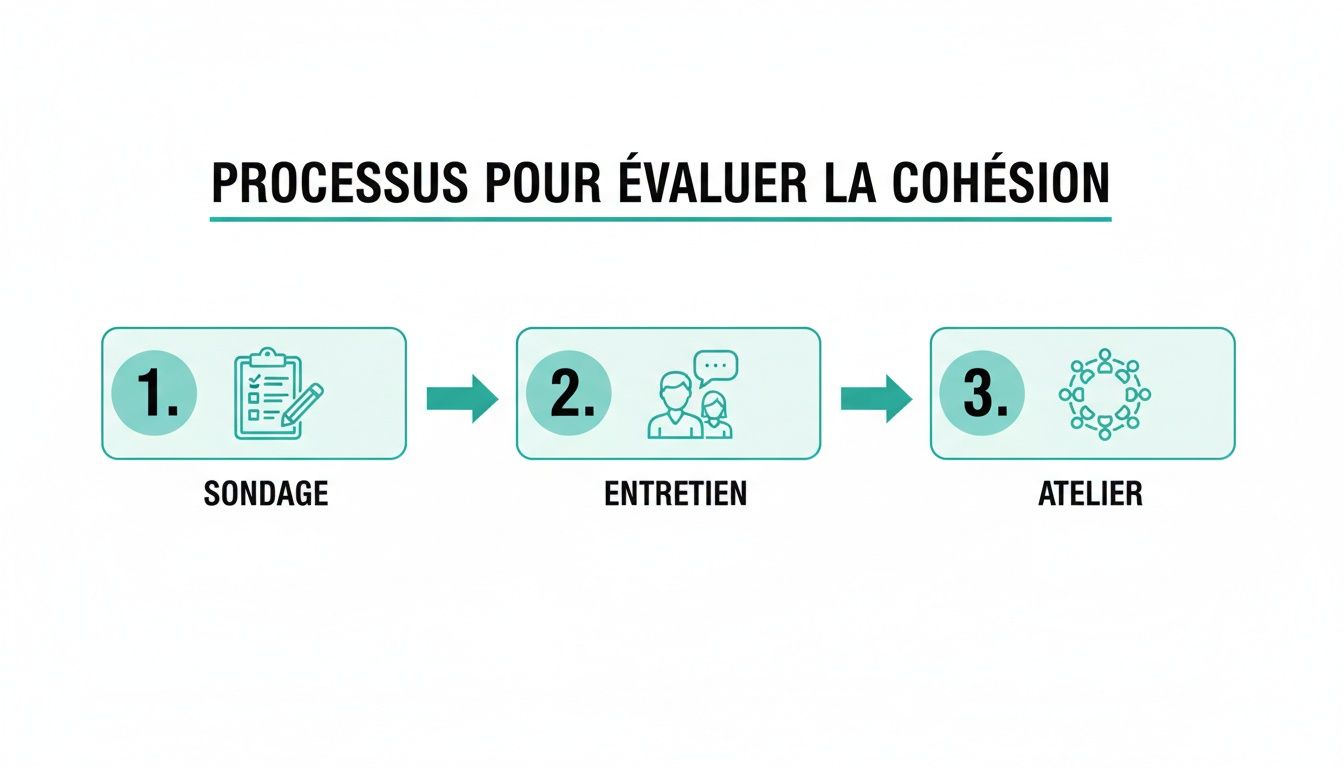
This three-step process, from survey to workshop, allows you to precisely target the actions that will have the most impact on your teams.
Using Major Sporting Events as a Catalyst
Major sporting events, such as a World Cup or the Olympics, are golden opportunities to unite teams. They transcend hierarchies and departments, creating a universal conversation topic and a shared passion. It’s an incredibly powerful lever for creating connections.
These moments of collective fervor create a shared experience that bonds employees. The issue is not the sport itself, but the emotion and energy it generates.
Platforms like ccup.io are specifically designed to transform these events into true internal cohesion tools. They allow for easy organization of prediction contests, quizzes, and challenges among colleagues, all in a friendly atmosphere.
The advantage of this type of tool? It includes everyone, whether they are a sports expert or a complete novice. The goal is primarily to participate and share a convivial moment.
These initiatives also directly contribute to improving quality of life at work, a topic we discuss in more detail in our comprehensive guide. By capitalizing on these strong moments, you infuse a positive and lasting energy within your teams.
Uniting Teams Remotely and Internationally

Uniting teams spread across multiple sites, or even multiple countries, is a whole different game. Let’s not kid ourselves, the challenges are very real: time zone differences, cultural and language barriers... Not to mention the risk of isolation that quickly threatens remote workers. The key is to successfully recreate connections and a true sense of belonging, despite the miles.
To achieve this, it is essential to adapt rituals and tools. Important meetings must be scheduled to suit the majority. Above all, informal interactions, so natural in the office, must be provoked virtually.
Strategies to Connect Distributed Teams
The number one goal: ensure that no one feels left out. Digital tools are obviously your best allies, provided you use them wisely.
- Establish Virtual Coffee Breaks: Block short, informal slots where colleagues can chat about anything... except work. This greatly helps recreate spontaneous conversations at the coffee machine.
- Adapt Your Communication: For non-urgent topics, favor asynchronous communication. It’s much more respectful of everyone’s rhythms and avoids the pressure to respond immediately.
- Recognize Everyone’s Efforts: This is essential. Ensure that the successes of remote employees are celebrated with the same enthusiasm as those of in-office teams.
The biggest challenge of remote management is not technological, but human. It’s about maintaining a sense of fairness and belonging, no matter where the employee is located.
This context has become the norm for many. According to Insee, multinational companies employ 6.4 million employees in France, which represents 50.6% of employees in the commercial sectors. To delve deeper into the topic, you can consult Insee's statistics.
Sports as a Universal Language
In the face of cultural diversity, sports act as a wonderful common language. A sports competition is something everyone understands and appreciates, creating a shared passion that transcends borders and hierarchies.
This is where multilingual and mobile-accessible platforms like ccup.io make perfect sense. They allow for launching a global prediction challenge, uniting subsidiaries around a common event. Everyone can participate, whether they are in Paris, New York, or Singapore.
These initiatives are much more than just a game. They create a shared experience, generate conversations, and strengthen the feeling of belonging to one large team. To see how it works in practice, take a look at our article explaining how sports predictions are an excellent team-building tool.
Perfect, here’s the section rewritten in a natural, human, and expert style, strictly following the guidelines and examples provided.
Measuring the Impact of Your Actions on Engagement
Launching actions to unite teams is an excellent start. But how do you know if your efforts are truly paying off? Without measurement, we navigate a bit blindly, making it difficult to adjust course or justify the resources invested. It is therefore crucial to define clear indicators that go well beyond mere participation in an event.
The idea is to track metrics that reveal a real change in your teams’ dynamics. These indicators, or KPIs, should reflect your company culture and objectives.
Defining Your Success Indicators
To have a complete view, the secret is to mix quantitative indicators (raw numbers) and qualitative ones (feelings). This blend will give you a fine and accurate reading of the situation.
Here are some examples of relevant KPIs to include in your dashboard:
- eNPS (employee Net Promoter Score): This score simply measures the likelihood that your employees would recommend your company. If this number rises, it’s an excellent signal of strengthening engagement.
- Voluntary Turnover Rate: A decrease, even slight, is very telling. It indicates that employees feel more connected and valued, and are therefore less tempted to look elsewhere.
- Fluidity of Inter-Project Collaboration: This can be measured by the number of cross-departmental projects that succeed without a hitch, or by the speed at which issues involving multiple departments are resolved.
The impact of good cohesion can be impressive. A study on French integration companies showed that uniting structures allowed for achieving 69% positive outcomes towards employment. Even more telling, the average revenue of members increased by 13%. This is proof that a strong collective dynamic boosts performance. To explore the topic further, you can consult the complete observatory here.
Establishing a Continuous Improvement Loop
Measuring for the sake of measuring is pointless. The goal is to use it to adjust the strategy. This is where continuous feedback collection comes in, the key to transforming your initiatives into a true culture of cohesion.
The objective is not to achieve perfection on the first try, but to create a system that learns and improves constantly thanks to direct feedback from your teams.
After each action, take the time to debrief. What worked? What didn’t work as well? For example, after a prediction contest on a platform like ccup.io, take a look at participation statistics and, above all, seek out some testimonials at the coffee machine. It’s by measuring and adapting that you will build a truly effective and sustainable cohesion strategy.
We Often Ask the Same Questions...
Talking about team cohesion is great, but in practice, we quickly run into very concrete questions. Let’s untangle some key points together to help you see clearly and take action.
How to Unite a Team with Multiple Generations Coexisting?
This is THE big question. The answer lies in one word: diversity. If you only offer afterworks or football tournaments, you’re sure to leave part of the team on the sidelines.
The idea is to vary the pleasures so that everyone finds their place. Think about mixing formats:
- More cerebral challenges, like quizzes or online escape games, that engage logic and collaboration.
- Solidarity projects, which give meaning to work and gather around strong values. Nothing like it to create bonds.
- Family-friendly events, so that connections can be made on a more personal and relaxed level.
The important thing is to create common playgrounds where everyone feels legitimate and can express themselves, regardless of age or physical condition. Flexible platforms allow for launching challenges where competition remains friendly and accessible to all.
What Budget Should You Really Plan for It to Work?
We often feel that a colossal budget is needed to make an impact. This is a misconception. Sometimes, the simplest and least expensive actions are the ones that leave the most lasting impressions.
Start small, but be consistent. Celebrating a success, a weekly virtual coffee, or even a discussion channel dedicated to light topics can already work wonders.
For slightly more ambitious events, tools like ccup.io offer turnkey solutions that allow you to control costs while providing a truly engaging experience.
The most important thing is to change your perspective: don’t see this as an expense, but as a real investment. You will measure the return in engagement, motivation, and ultimately, in reduced turnover.
What if you took advantage of major sporting events to energize your teams and strengthen bonds? Discover how ccup.io can help you transform a competition into a memorable collective experience. Schedule your demo today on ccup.io
From Content To Conversion
Turn your next sports event into a company prediction contest
Discover the platform, explore available competitions, and launch a branded experience that supports engagement, internal communication, and team cohesion.
See available competitions
Latest articles

6 hours ago
How to Lead an Engaging Team Meeting
Let's be honest: we've all experienced meetings that drag on for no reason. This infamous "meetingitis" is not a fatality. It's just a symptom of bad habits and outdated methods.
The idea is to transform this often-dreaded appointment into a real moment of exchange and decision-making. A g...

3 days ago
Your Serie A Prediction Guide for the 7 Best Tools 2026
The Serie A, with its tactical duels and twists, is an exciting playground for prediction enthusiasts. But how do you move from intuition to structured analysis? To succeed in your next Serie A prediction, it is essential to rely on effective tools that combine advanced statistic...



















Contact us
For any question or quotation requests, do not hesitate to reach us by phone at 01 83 79 24 54 or by email : contact@ccup.io
Contact us


Frequently asked questions
What is ccup.io?
Ccup.io is a cohesion tool, allowing firms to gather their collaborators on the occasion of major sporting events, such as World Cup or Olympic Games. We offer an interactive forecasting platform, turnkey and customisable to your company’s colours.
What are you doing with our data?
By deciding to use our services, you decide to entrust us a part of your data – this will allow us to optimise your experience. We place great emphasis on the protection of your data, in compliance with current regulations. Given that it is important to be informed on the issues and challenges of personal data protection, ccup.io provides you with a most complete documentation on this matter.
How much does it cost?
In order to give our clients flexibility, we make a special rate depending on the number of registered players using a degressive system for an important number of participants. This allows firms to organise tailored events, adapted to their capacity. To receive a commercial offer in less than an hour, you only need to fill out the quotation requests form, with just a few clicks.



Don’t miss this opportunity 😍
Start now and enjoy numerous benefits