



Unite Around a Project: Build Momentum and Sustain Enthusiasm
Uniting a team around a project is not just about aligning tasks on a schedule. It’s about transforming a simple idea into a collective quest, an adventure that gives meaning and energy to everyone involved. We’re not talking about numerical objectives here, but rather about creating a shared vision, building a story that engages everyone, and nurturing a true sense of belonging.
Create a Shared Vision That Truly Inspires
Long before the first kickoff meeting, the real work of uniting teams has already begun. It’s about laying solid foundations to ensure that the project’s “why” is as clear as the “what” and the “how.” An inspiring vision is not decreed from an office; it is co-constructed on the ground.
These three pillars are inseparable for transforming an idea into a force that brings people together: vision, storytelling, and belonging.
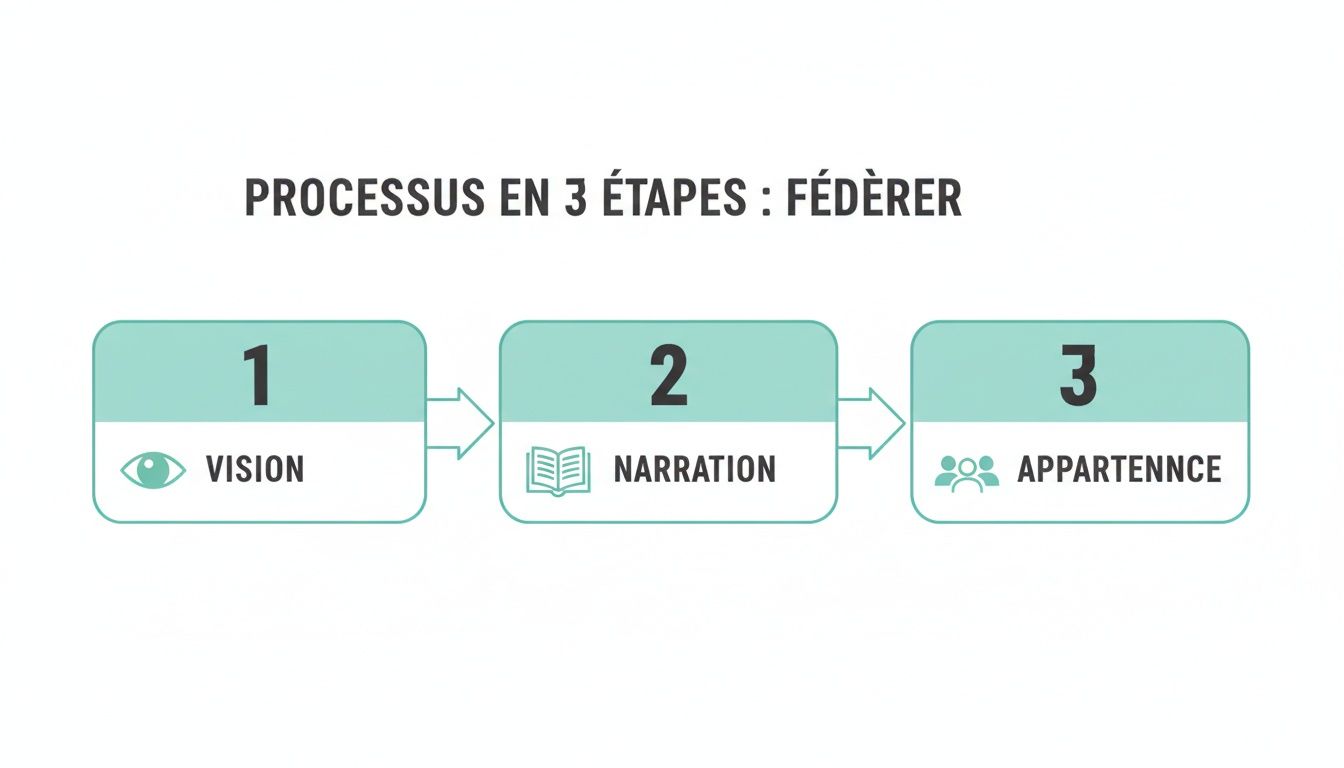
The diagram is simple: without a clear vision, it’s impossible to tell a powerful story. And without that story, the sense of belonging will never truly take root.
Go Beyond Traditional Objectives
A unifying project must speak to both the heart and the mind. An objective like “+15% growth” is a performance indicator, not a source of deep motivation that gets people out of bed in the morning. The vision must embody a human ambition, a desirable future that resonates with everyone’s values.
To achieve this, here are some concrete suggestions:
- Involve teams from the start. Ask open-ended questions: “What collective success would make us truly proud by the end of the year?”
- Find the “why.” What gives meaning to daily efforts, far beyond financial benefits?
- Translate this vision into a simple and memorable story. A story that everyone can own and share in turn, whether at the coffee machine or with a client.
This approach transforms individual contributors into a true team, united by a mission that transcends them.
Anchor the Project in Everyone’s Interests
Linking collective success to personal interest is a powerful lever. Employee shareholding is a perfect illustration of this. According to the 12th FAS Benchmark, nearly 6 out of 10 companies have seen the share of employee shareholders increase, a sign of strong commitment to the company project. To delve deeper into the topic, take a look at the full report on employee shareholding.
Ultimately, the only question that matters is simple: “Does what we’re trying to build together really inspire?” If the answer isn’t a resounding “yes,” it’s time to go back to the drawing board.
The vision must be much more than a pretty phrase on a wall. It should become the compass that guides every decision and inspires daily action.
Absolutely. Here’s the section rewritten in a natural, human, and expert style, strictly following the guidelines and examples provided.
Orchestrate Transparent and Continuous Communication
Having a clear vision is the starting point. But what truly transforms a project into a collective adventure is lively and transparent communication. Forget top-down announcements and impersonal emails. The goal is to create a dialogue, a constant flow of information that goes both ways and turns every collaborator into a true actor of the project.
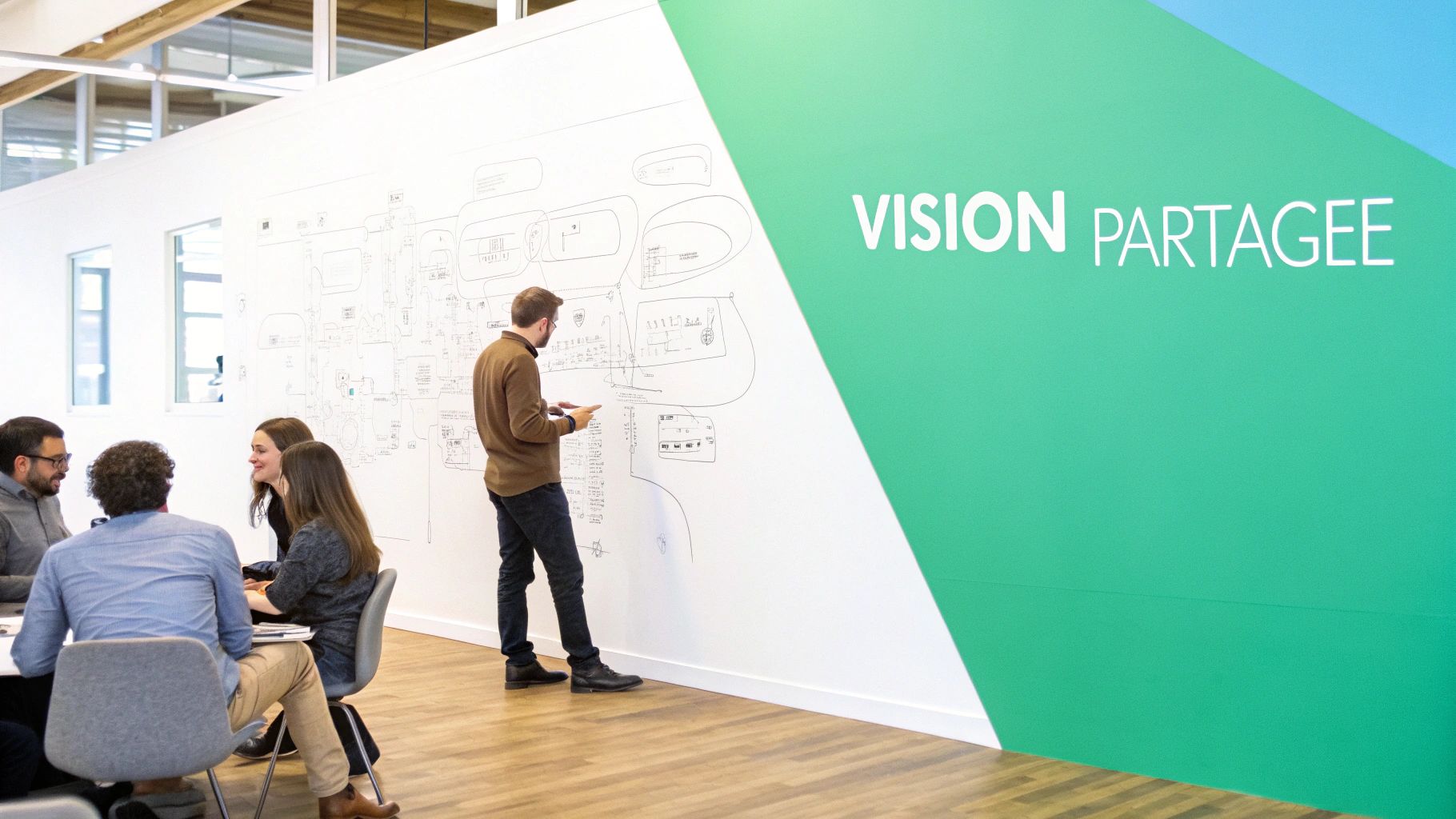
Good communication is not a one-time event. It’s a continuous process that must permeate the project at every stage to keep everyone aligned and motivated.
Tailor Messages to Different Audiences
Not everyone needs the same level of detail. Your technical teams, for example, expect precise information about the next concrete steps. The executive committee, on the other hand, mainly wants an overview of progress and performance indicators.
To be effective, you need to juggle multiple channels:
- Instant messaging (Slack, Teams): Perfect for quick daily exchanges, on-the-fly questions, and real-time information sharing.
- Short weekly check-ins: Essential for synchronizing teams, celebrating small victories, and quickly resolving issues.
- Targeted newsletters: Ideal for summarizing major advancements, sharing testimonials, and keeping everyone informed without overwhelming them with information.
By segmenting your communication this way, you ensure that each message is relevant and well-received. It’s a powerful lever for strengthening commitment.
Tell the Project’s Story to Inspire
Numbers and facts are good, but it’s stories that inspire and mobilize. Storytelling is a powerful tool for bringing the project to life and creating an emotional connection with teams. Don’t just rely on graphs. Share the challenges that have been overcome, highlight a team member’s success, and share positive feedback from early users.
A well-communicated project is no longer just a line on a Gantt chart. It becomes a collective adventure where every contribution has a visible and valued impact.
This principle is the cornerstone of business models that excel at uniting around a project, such as franchising. In 2023, this sector generated a turnover of €88.49 billion in France, an impressive growth of 15.5%. This success relies on a shared vision between franchisors and franchisees, supported by communication and tools that create extraordinary cohesion. You can check the figures of this unifying model for more information.
Finally, never forget to encourage feedback. Set up simple channels for everyone to ask questions, express doubts, or propose ideas. When people feel their voice is heard, communication transforms into a true conversation. That’s how trust and engagement are built.
Absolutely! Here’s the section rewritten in a more human and natural style, following the tone of the provided examples and all the guidelines.
Transform Commitment into Active Engagement
The enthusiasm of the early days is excellent fuel. But it quickly runs out if not transformed into concrete actions. To truly unite around a project, you need to move from passive commitment to visible and shared engagement by all. And for that, traditional follow-up meetings are not enough.
The idea is to create rituals and key moments that anchor the project in everyone’s daily life. The ultimate goal? For your collaborators to become true ambassadors, proud of what they accomplish.
Create Sharing Moments That Strengthen Bonds
To keep the flame alive, nothing beats creating excuses to meet in a more informal way. Fun activities are a fantastic lever for this. They break the routine and create healthy competition among colleagues.
For example, during a major sporting event, why not launch a prediction contest? It’s a simple and effective way to bring teams together, even those working remotely. It generates discussions, shared memories, and strengthens bonds well beyond the purely professional framework. To explore the topic further, check out this guide on the benefits of a workplace prediction contest.
Engagement often arises in moments when we forget work to simply share an experience. These moments create the social glue essential for solid and lasting collaboration.
These simple initiatives cultivate an environment where collaboration becomes natural and enjoyable, which is the foundation for successfully achieving the most ambitious projects.
Value Every Contribution to Nurture Motivation
We truly engage when we feel that our efforts are seen and appreciated. Implementing a recognition system, even a very simple one, can have a huge impact. There’s no need to pull out the checkbook every time; it’s mainly about valuing contributions, big and small.
Here are some easy-to-implement ideas:
- Public “kudos”: Create a channel on Slack or Teams where anyone can thank a colleague for a helping hand or a great achievement. Simple, visible, and very effective.
- Team challenges: Launch collective challenges with symbolic rewards (a team lunch, a half-day training of choice...).
- Co-creation workshops: Involve teams directly in problem-solving. When people participate in the solution, they feel more invested.
And don’t forget that a confident collaborator will dare to take initiatives and fully invest themselves. Helping everyone to build self-confidence at work is therefore a winning approach for everyone.

A simple and engaging interface, as seen here, is an excellent support for activities that bond a team.
This table compares different approaches to stimulate engagement around a project, evaluating their impact, implementation complexity, and target teams.
Comparison of Engagement Initiatives to Unite a Team
| Type of Initiative | Impact on Cohesion | Implementation Complexity | Ideal for... |
|---|---|---|---|
| Prediction Contests | High | Low (with a tool) | Remote teams, all departments |
| Public “Kudos” | Medium | Very low | Encouraging daily recognition |
| Collective Challenges | High | Medium | Reinforcing collaboration on a goal |
| Co-creation Workshops | Very high | High | Involving experts on a key issue |
Each initiative has its strengths. The important thing is to vary the approaches to maintain a positive and inclusive dynamic over the long term.
To see a concrete example of this dynamic, just look at the model of integration companies in France. They succeed in mobilizing teams around a dual project, both economic and social. Their success, with a positive exit rate of 64%, proves that a meaningful project is the most powerful driver of engagement.
Establish Governance That Releases Energy
For the dynamics of a project to last, a framework is necessary. But be careful, not just any framework. We’re not talking about a rigid straitjacket that would stifle initiatives, but rather a flexible structure, an agile skeleton that supports autonomy and encourages decision-making. Uniting a team is primarily about trusting them, providing the right tools and rituals for them to organize and thrive on their own.

The art lies in finding the right balance between structure and freedom. Well-thought-out governance makes progress visible, smooths communication, and allows everyone to feel truly ownership of their contribution.
Clarify Roles Without Building Walls
A successful team is one where everyone knows what they have to do, but where everyone collaborates continuously. The first thing to do is to clearly define roles and responsibilities. The goal is not to write lengthy job descriptions, but to ensure that the boundaries are well understood.
This prevents two people from doing the same thing and holds each member accountable for their deliverables. But be careful, this clarity must be accompanied by a true culture of mutual support.
- A simple RACI matrix: For the major steps of the project, define who is Responsible (the doer), who Approves (the decision-maker), who is Consulted (the expert consulted), and who must be Informed.
- “Subject Owners”: Appoint referents on key topics. They are not supposed to do everything alone, far from it, but they are the main contact for animating their topic and moving it forward.
This light structure provides reference points without locking people into boxes. Autonomy flourishes when the rules of the game are clear and shared.
Establish Rituals That Are True Moments of Exchange
We all know that meetings can become the worst nightmare of a project if they turn into a top-down reporting session. For them to be useful, they must be moments of synchronization, problem-solving, and, why not, celebration.
A good project ritual is not a control; it’s a conversation. It’s the moment when the team asks the right questions: “Where are we? What’s blocking us? How can we help each other to unblock the situation?”
Favor short and dynamic formats that get straight to the point:
- Weekly check-ins (15-30 min max): A quick round where everyone shares their progress, challenges for the upcoming week, and any potential roadblocks. No fluff, just concrete.
- Sprint reviews (if you’re working agile): This is the time to show what has been done, gather real-time feedback, and adjust for the future.
These regular meetings give rhythm to the project and ensure it remains anchored in the reality of the field. They are the pulse of the project, allowing for quick reactions and providing better visibility for all. It’s in these moments that we cement the feeling of progressing together.
Here’s the section rewritten in the requested style:
Make Progress Visible and Celebrate Victories
Keeping the flame alive over time is the crux of any project. To achieve this, nothing beats materializing advancements and recognizing everyone’s efforts. This is where data-driven management and the art of celebration come into play to unite the team around the project and keep motivation high.
A project without clear indicators is like navigating blind in a storm. Teams need to see the concrete impact of their work to stay fully engaged. And it goes far beyond simply tracking tasks on a Kanban board. It’s about taking the pulse of the collective dynamic.
Define KPIs That Also Measure Engagement
For meaningful management, it’s essential to find the right balance between quantitative indicators (pure production) and qualitative indicators, which reflect the group’s mindset. One does not work without the other.
- Performance KPIs: These are the most obvious, the classics. They include deadline adherence, budget control, and the quality of what is delivered. They answer the question: “Are we doing things right?”
- Engagement KPIs: More subtle, but equally crucial. For example, you can track participation rates in rituals, the number of spontaneously proposed ideas, or even the overall tone of exchanges on Slack. They answer a different question: “Are we moving forward together in the right direction and with the right energy?”
Once this data is gathered in a visual dashboard accessible to all, it becomes a powerful communication tool. It makes successes tangible and allows for identifying friction points before they become real problems.
Never underestimate the power of a simple public “well done.” Recognition is one of the most powerful drivers of human motivation. Celebrating a victory, even a small one, reinforces pride and shows everyone that their contribution truly matters.
That’s why it’s essential to create a culture where celebration becomes a reflex. An important milestone is reached? Highlight it in the internal newsletter or on the project’s general channel. A complex problem has been solved thanks to the team’s ingenuity? Celebrate it with a team lunch. These little moments are the fuel that keeps you going.
Transform Successes into Unifying Moments
Celebrating doesn’t necessarily mean popping champagne at every validated step. The idea is mainly to create rituals that leave a mark and tighten bonds.
Implementing a rewards system, even symbolic ones, can have a huge impact. It’s not always about bonuses, but rather gestures of recognition that make sense. If this topic interests you, there are excellent strategies for rewarding employees effectively. These approaches clearly show how well-thought-out recognition can boost engagement much more sustainably than simple financial gratification.
By making progress visible and celebrating every victory, you’re not just managing a project: you’re creating a true shared adventure. Every success becomes a collective story, strengthening cohesion and giving everyone the desire to excel for the next step.
A Project Lives: The Questions We Always End Up Asking
Even with the best plan in the world, keeping the flame alive over time is a real challenge. Questions, doubts, and moments of weakness… it’s normal, it’s even healthy. Anticipating these moments is key to ensuring that the beautiful dynamic of the beginning doesn’t fade away.
When we take the time to address questions, we show that we are listening, reinforcing trust. It’s in managing these moments of uncertainty that we truly bond as a collective.
What to Do with Skeptics and Resistors?
Resistance is not a bug; it’s information. A collaborator who doubts is not an enemy; ignoring them leaves a pebble in everyone’s shoe. The first thing to do is to listen to them. Really. Without trying to convince them at all costs.
You need to dig deeper to understand where their fears come from. Are they afraid of being overloaded? Of losing their habits? Once the source is identified, the game changes. You can then involve them directly in finding solutions to the points that concern them.
Invite a skeptical collaborator to become the project’s “official challenger.” You acknowledge their critical spirit, value their expertise, and their doubt becomes a strength. They no longer endure; they co-construct.
And of course, don’t forget to highlight early successes, the famous “quick wins.” Nothing reassures the more cautious like proof by example and creates a ripple effect.
What Is the Exact Role of the Proximity Manager?
Let’s be clear: the proximity manager is the cornerstone of mobilization. Without them, any talk of engagement will remain just words. They are on the front lines, in direct contact with teams, and their role is threefold:
- The Translator: They take the big strategic vision and transform it into concrete objectives, into tasks that make sense for their team, here and now.
- The Facilitator: They are the “Mr. Solutions” of daily life. They are there to unblock situations, protect their team from distractions, and ensure they have everything they need to work well.
- The Coach: They sense the team’s pulse, celebrate small victories that energize, and maintain an atmosphere where it’s okay to test, make mistakes, and propose.
They are the essential link between strategy and the field. Without their active support, the project remains an abstract concept.
How to Keep Everyone Motivated on a Long Project?
The number one enemy of long-term projects is fatigue. Routine sets in, and the initial enthusiasm fades. To avoid this, you need to create rhythm. Think of the project like a TV series: break it down into seasons (the major phases) and episodes (shorter sprints), with a little cliffhanger at the end of each stage.
And above all, break the monotony. A fun challenge midway, a creative workshop to unblock a situation, or simply a meeting with future users to share the project’s impact… these are fresh air bursts. Communicate constantly about concrete advancements so everyone remembers why they’re doing all this.
Is It Really Possible to Unite Remote Teams?
Yes, a thousand times yes! But it doesn’t happen by itself. You need to be much more intentional to compensate for the absence of the coffee machine.
The idea is to over-invest in tools that make collaboration simple and transparent, but also to create rituals that nourish the bond. A casual coffee chat via video without an agenda, a fun icebreaker at the start of a meeting… these little things make a difference. Initiatives like an online prediction contest are also perfect for creating a fun and shared moment, no matter where you are.
The most important thing? Ensure that everyone has the same level of information, whether in the office or at home, and sanctify moments where the team physically comes together. Nothing replaces human contact to solidify bonds.
Boost your team cohesion with ccup.io’s prediction contests. Turn major sporting events into unforgettable sharing moments. Discover how ccup.io can energize your business.
Latest articles

a day ago
Create a Champions League prediction table that truly engages your teams
We often tend to see a Champions League prediction table as just a simple game, a fun distraction between two meetings. But it’s much more than that. It’s a real tool, almost unsuspected, to transform the passion for football into a cohesion engine and create authentic bonds between coll...

2 days ago
Paris Ligue 1 with Friends: 2026 Guide for Unforgettable Bets
Are you looking for an idea to strengthen teams and add some spice to the daily office routine? Organizing a Paris Ligue 1 with friends or colleagues contest is a simple and highly effective solution. Every match becomes a small event, and the passion for football turns into a gr...





















Contact us
For any question or quotation requests, do not hesitate to reach us by phone at 01 83 79 24 54 or by email : contact@ccup.io
Contact us


Frequently asked questions
What is ccup.io?
Ccup.io is a cohesion tool, allowing firms to gather their collaborators on the occasion of major sporting events, such as World Cup or Olympic Games. We offer an interactive forecasting platform, turnkey and customisable to your company’s colours.
What are you doing with our data?
By deciding to use our services, you decide to entrust us a part of your data – this will allow us to optimise your experience. We place great emphasis on the protection of your data, in compliance with current regulations. Given that it is important to be informed on the issues and challenges of personal data protection, ccup.io provides you with a most complete documentation on this matter.
How much does it cost?
In order to give our clients flexibility, we make a special rate depending on the number of registered players using a degressive system for an important number of participants. This allows firms to organise tailored events, adapted to their capacity. To receive a commercial offer in less than an hour, you only need to fill out the quotation requests form, with just a few clicks.



Don’t miss this opportunity 😍
Start now and enjoy numerous benefits