



Discover Team Federation Definition: Practical and Strategic Guide
When we talk about "federating a team," we often imagine well-organized meetings and schedules. But in reality, it’s much more than that. Federating a team is the subtle art of transforming a group of colleagues into a true tribe, united by a project that transcends them. We’re not just talking about checking boxes on a to-do list, but about creating an authentic bond, a shared energy, and a sense of belonging that gives meaning to everyday life.
What does it really mean to federate a team?

Imagine an orchestra. Each musician is an expert on their instrument, but it’s only under the baton of a passionate conductor, who shares their vision, that the magic happens. Harmony arises from this perfect synchronization. It’s exactly the same in business. To federate is to become that conductor.
This skill, purely human, has become a major strategic issue. We no longer just manage tasks; we animate a culture. To achieve this, the leader's role is central. This is why approaches like executive coaching are gaining popularity: they aim to strengthen this ability to bring people together.
And this dynamic is far from being a detail for employees. A Microsoft study revealed that 91% of French people consider teamwork an important criterion when choosing a job. This figure even places us at the top of the global collaboration ranking!
This simple table summarizes the essential elements on which a truly united team rests.
The Pillars of a Federated Team
| Pillar | Definition | Direct Impact on the Team |
|---|---|---|
| Shared Vision | Each member understands and adheres to the common goal. It’s the "why" that gives meaning to the collective effort. | Motivation, alignment of actions, initiative-taking. |
| Mutual Trust | A secure environment where one can express themselves, test ideas, and even make mistakes without fear of judgment. | Creativity, risk-taking, faster problem-solving. |
| Fluid Communication | Information flows transparently and openly, without silos or retention. | Fewer misunderstandings, better responsiveness, informed decision-making. |
| Recognition | Everyone's contributions, big and small, are seen, appreciated, and celebrated. | Increased engagement, loyalty, feeling valued. |
Integrating these pillars transforms the work dynamic, especially in this hybrid era where social connections are no longer a given. They must be built and maintained. This is what helps nurture a sense of belonging, even from a distance.
A federated team is not just a team that works together. It’s a team that succeeds together, facing challenges by supporting each other and celebrating victories as one.
By laying these foundations, we’re not just building a more effective team. We’re building a more resilient, more creative, and ultimately, more human team.
The Strategic Impact of a Truly Federated Team

Federating a team is not just about organizing a farewell party or ensuring everyone says hello in the morning. It’s a real strategic investment, and its effects are directly reflected in the company’s performance. Far from being a trivial expense, cohesion is a powerful driver of growth.
Imagine a united team as a living organism. Information flows without blockage, projects advance faster. Not because people work harder, but because they work better together.
Accelerating Productivity and Innovation
In a close-knit group, communication is no longer a formal process; it’s a reflex. A problem arises? Help is spontaneous, and solutions are found much more quickly.
This fluidity creates an ideal playground for innovation. When employees feel trusted and psychologically safe, they are not afraid to propose new ideas, challenge the status quo, or take measured risks.
- Agile Problem Solving: Silos fall. Members no longer hesitate to seek their colleagues' expertise to unblock a situation.
- Activated Collective Intelligence: Brainstorming sessions become genuinely productive. Mutual trust frees up speech and encourages honest and creative contributions.
- Reduction of Errors: Transparent communication limits misunderstandings and oversights, which are often the source of costly mistakes.
Ultimately, this synergy translates into a very concrete productivity gain. Deadlines are better met, work quality improves, and the company gains agility to face the unexpected.
Talent Retention as an Economic Shield
We can’t say it enough: recruiting and training a new employee is expensive. Very expensive. Federating your teams is one of the most effective weapons to reduce turnover and keep your talents at home.
A strong sense of belonging transforms a simple job into a collective adventure. Employees no longer stay just for the salary or the tasks, but for the colleagues and the culture they share. It’s this emotional bond that makes all the difference.
The current context makes this retention even more vital. In 2022, turnover among executives rose to 9%, a figure that clearly shows the tension in the job market. To delve deeper into the topic, the statistical portrait of executives conducted by Apec is very enlightening.
Federating a team is building a human fortress. Each engaged employee becomes a pillar that strengthens the structure, making it more resilient to external turbulence.
The Radiance of Employer Branding
A federated team does not just work well internally. It radiates externally. Your employees, if they are happy and engaged, naturally become the best ambassadors for your company.
Their authentic voice on professional social networks or in their personal networks has much more impact than a polished corporate communication campaign. They naturally attract profiles that share the same values, which greatly simplifies future recruitments.
By cultivating cohesion, you’re not just boosting your performance. You’re building a solid and attractive reputation. It’s an invaluable competitive advantage for attracting and retaining the best, plain and simple.
Absolutely. Here’s the section rewritten in a more human, natural, and expert style, following the guidelines and examples provided.
Learning to Spot the Weak Signals of a Cracking Team
Before even thinking about a solution, a manager’s first reflex should be that of a good doctor: observe, listen, diagnose. It’s essential to spot the signs, sometimes discreet, that betray a cohesion that is starting to crumble. Turning a blind eye to these alerts risks turning a simple crack into a fracture.
A team rarely disunites overnight with a bang. It’s most often a slow, insidious process, an accumulation of small attitude changes that, when added together, reveal that the group dynamic is starting to jam. Knowing how to identify them is the first, essential step to act before it’s too late.
Visible Symptoms in Daily Life
Taken in isolation, these signs may seem anecdotal. But their accumulation should immediately raise a red flag. They are a direct reflection of a trust that is evaporating and a common project that is losing its meaning.
- Communication in Silos. Information no longer flows, or flows poorly. Conversations are limited to personal affinities or the bare minimum functional. We then see the emergence of "clans," and information retention becomes a bad habit.
- Meetings Become Passive. Roundtable discussions turn into a long series of monologues. No one builds on others' ideas, questions become rare, and energy is at a standstill. Silence settles where debate should flourish.
- The End of Spontaneous Help. The little phrase "sorry, that’s not my problem" becomes a refrain. The natural momentum to help a struggling colleague has disappeared, replaced by an exclusive focus on one’s own files.
One of the worst indicators? The blame culture. When a mistake is no longer an opportunity to learn together, but an individual fault that needs to be pointed out, it means the group’s psychological safety is broken.
Engagement and Initiative in Decline
Beyond daily interactions, the lack of cohesion strikes directly at the heart of the reactor: motivation. Collective energy drains, and a form of resignation sets in.
One unmistakable sign is the general decline in initiative. Your employees are content to do what they are asked, no more, no less. Gone are the proposals to improve a process, gone are the new ideas. Why would they do more? They simply no longer feel invested in the shared adventure.
Similarly, if you notice an increase in misunderstandings or small conflicts over trivial matters, it’s a clear symptom. When trust is eroded, the slightest friction takes on enormous proportions, as we default to attributing bad intentions to others. Ask yourself this simple question: are individual successes still celebrated by everyone, or do they provoke indifference or even a hint of jealousy? The answer says a lot about your team’s health.
Concrete Methods to Strengthen Team Cohesion
Once you’ve spotted the signs of a team that’s struggling, it’s time to take action. Federating a team is not a magic formula; it’s built with intentional initiatives, day by day, that create bonds and nurture the sense of belonging. Far from miracle solutions, it’s about building a true culture of cohesion, brick by brick.
We can articulate these strategies around three simple yet fundamental axes: improving communication rituals, creating strong shared memories, and spicing up daily life with engaging activities. Each of these methods, even the simplest, contributes to weaving a truly solid network of trust and collaboration.
Optimizing Communication Rituals
Communication is a bit like the bloodstream of a team. For it to thrive, it must be fluid, transparent, and above all, regular.
- Establish Constructive Feedback: Create dedicated moments where feedback (both good and less good) is welcome, in a supportive environment. The idea is not to judge, but simply to help everyone grow.
- Make Meetings More Effective: Every meeting should have a clear purpose, a known agenda, and end with clear actions. Consider starting with a little "ice breaker" for a few minutes to lighten the atmosphere and strengthen bonds.
The diagram below clearly shows how a team can slide from simple communication silos to a blame culture.
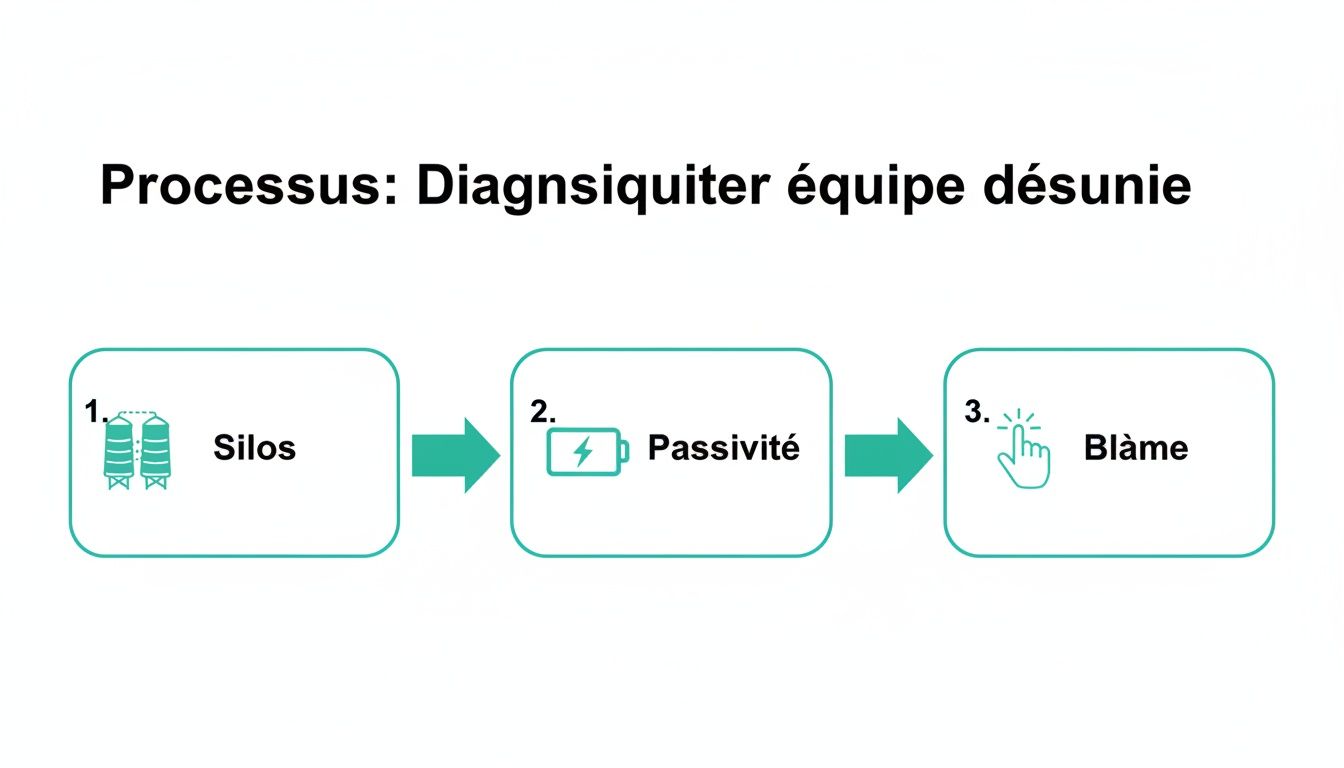
Recognizing this mechanism is the very first step to reversing the trend and restoring openness in exchanges.
Creating Strong Shared Moments
Shared memories are the cement of a collective. They anchor collaboration in positive experiences that go well beyond simple files and deadlines.
Organizing regular events, even very simple ones, helps break the routine and discover colleagues from a different angle. A team breakfast, a cultural outing, or even a creative workshop can be enough to reignite a dynamic. Among the more unusual options, organizing team building activities in unique accommodations offers an original and truly stimulating setting to strengthen bonds.
What matters most is not the budget, but the regularity and authenticity of the approach. A simple informal coffee every week can have much more impact than a large annual seminar if it’s a real moment of sharing.
This approach has become crucial with hybrid work. For example, the Syntec sector saw the proportion of employees in companies with more than 50 employees drop from 63% in 2019 to 57% in 2020. This is a sign of fragmentation that makes cohesion at a distance absolutely essential.
Integrating Play to Energize Engagement
Gamification, or ludification if you prefer, is a powerful lever for federating. The principle? Use game mechanics (points, rankings, challenges) to motivate troops and create healthy emulation. We transform sometimes flat professional interactions into much more fun experiences.
A perfect example is organizing a sports prediction contest during a major event like the World Cup or the Olympics. A turnkey platform like ccup.io allows you to launch this kind of activity in just a few clicks.
This instantly creates conversation topics that transcend hierarchical barriers and silos between departments. Suddenly, at the coffee machine, we’re not just talking about work, but also about the latest scores and rankings. It’s a simple and remarkably effective way to create shared memories and strengthen team spirit in a playful manner. To delve deeper into the topic, check out our complete guide to strengthening your team’s cohesion with plenty of other practical tips.
This table compares different strategies for federating a team, helping managers choose the option best suited to their context and objectives.
Comparison of Cohesion Initiatives
| Initiative | Key Benefits | Ideal for... | Points of Caution |
|---|---|---|---|
| Communication Rituals | Improves transparency, strengthens trust, aligns objectives. | Remote or hybrid teams, complex projects requiring strong synchronization. | Can become a soulless routine if the format is not renewed or lacks authenticity. |
| Team Building Events | Creates strong memories, breaks the ice, allows colleagues to discover each other differently. | Integrating new members, celebrating a success, reigniting a dynamic after a difficult period. | Cost can be a barrier. The choice of activity must appeal to the majority to avoid the opposite effect. |
| Prediction Contests (Gamification) | Very inclusive, low cost, creates positive emulation and informal conversations. | Animating daily life, creating links between different departments, capitalizing on an external event. | Must ensure that the spirit remains friendly and that competition does not become a source of tension. |
| Co-development Workshops | Strengthens collaboration on concrete issues, values collective intelligence. | Solving cross-cutting problems, developing everyone’s skills, empowering the team. | Requires good preparation and quality facilitation to be truly productive. |
Each approach has its place in the manager's toolbox. The ideal is often to combine several of these initiatives to create a rich and sustainable culture of cohesion, tailored to your team’s personality.
How to Measure the Impact of Your Actions to Federate the Team
Implementing actions to bond your teams is an excellent initiative. But how do you know if it’s really working? To justify your efforts and, let’s be honest, sustain the allocated budget, you need to be able to measure the effectiveness of what you’re doing.
Going beyond the simple "it was nice" allows you to transform what could be seen as an expense into a strategic investment, with concrete results at stake.
It’s not just about counting the number of participants at an event. Measuring team cohesion relies on performance indicators (KPIs) that are both quantitative and qualitative. The goal is simple: to prove the return on investment of your initiatives, not only in terms of atmosphere but also in overall performance.
Defining the Right Performance Indicators
For your dashboard to make sense, you need to choose metrics that truly reflect the health of your collective. The secret is to mix types of data to obtain a complete and nuanced view.
Here are some concrete indicators you can start tracking right now:
- Employee Engagement Rate: It’s a bit like taking the pulse of the company. Regular, anonymous "pulse" surveys, with simple questions like "Do you feel connected to your colleagues?" can reveal very valuable trends.
- Decrease in Absenteeism: An employee who feels good in their team and involved in a common project is simply less often absent. A decrease, even slight, is a very strong signal.
- Reduction in Turnover: This is the king indicator. A united team retains its talents; it’s mechanical. Tracking the evolution of voluntary departure rates is tangible proof of the impact of your actions on retention.
To delve deeper into the topic, our detailed article guides you on the best ways to measure employee engagement and move from numbers to action.
Measuring the impact of cohesion is not about trying to put human relationships into boxes. It’s simply giving an objective voice to the progress made to better guide future efforts.
Seeking Out Weak Signals
Numbers are good, but they don’t tell the whole story. Observing daily life and getting direct feedback from your teams are a goldmine for assessing the real quality of interactions.
Pay attention to these often more subtle signals:
- Fluidity Between Departments: Are cross-cutting projects progressing better? Do people feel more comfortable asking for help from another department?
- The General Tone of Exchanges: Listen to the atmosphere in meetings or on internal messaging. Are there more informal exchanges, kindness, or even humor?
- Spontaneous Feedback: When an employee comes to tell you, "the atmosphere has really improved since the last team building," it’s a qualitative data point that’s worth its weight in gold. Note it!
By combining these numbers and observations, you’ll gain a 360-degree view of the effectiveness of your strategy. This will not only allow you to defend your projects to management but also adjust your future actions to have an even greater impact.
Even after exploring strategies to federate a team, certain very concrete questions often arise. So we’ve gathered clear and direct answers to the most frequently asked questions to help you move from theory to practice without hesitation.
What’s the difference between managing and federating a team?
Managing is primarily a question of organization. We’re talking about planning tasks, tracking objectives, and ensuring that the gears turn smoothly to deliver results. It’s the skeleton that structures daily work.
Federating is something entirely different: it’s about infusing a soul. It involves weaving human connections, sparking enthusiasm, and nurturing that famous sense of belonging that transforms a group of individuals into a true team united around a common project.
To put it simply, a good manager organizes work; a leader who federates aligns energies.
How long does it take to federate a new team?
Well, there’s no magic recipe. The time required depends on a multitude of factors: the size of the group, the existing company culture, and above all, the regularity of the actions you implement.
You can lay the foundations of trust in just a few weeks with well-thought-out communication rituals. But to achieve truly deep and lasting cohesion, where mutual support becomes a reflex, you should count on several months.
It’s a marathon, not a sprint. The consistency of your efforts will always have more impact than the intensity of a single punchy action, like the annual seminar.
Can you really federate a team in remote work?
Absolutely! But it requires a different, much more intentional approach. You need to compensate for the absence of those little spontaneous interactions at the coffee machine that, unnoticed, nourish social bonds. The key is to actively recreate those moments of connection.
Here are a few ideas that work very well:
- Virtual coffees with no agenda, just to chat.
- Discussion channels dedicated to everything except work (hobbies, series, weekend plans…).
- Engaging online activities, like games or a prediction contest.
You just need to be a bit more proactive and creative to keep the flame alive at a distance. But it’s totally possible, and the results are there.
Engage your teams and create memorable memories with ccup.io. Launch your sports prediction contest in just a few clicks and turn every major event into an opportunity to strengthen cohesion.
From Content To Conversion
Turn your next sports event into a company prediction contest
Discover the platform, explore available competitions, and launch a branded experience that supports engagement, internal communication, and team cohesion.
See available competitions
Related articles

2 weeks ago
Olympic Games 2026 Animations: Team Building Ideas
The Olympics: a gold medal for your company culture. Many HR and internal communication teams, however, start with a bad reflex. They reduce Olympic Games activities to an office olympiad, an improvised quiz, or an evening in front of a final. This creates a highlight, but rarely a true engagement m...

2 weeks ago
Rugby Contest: 7 Formats to Engage Your Teams
Transform the try. Many companies still think that a rugby contest is just about "guessing a score" and giving away a prize at the end. That's too short. The real issue is to convert a major sports moment into a long-lasting engagement device that is easy to join and does not create legal or operati...

2 weeks ago
Sports Event Poster: 7 Models and Tips 2026
Your next sports event poster probably doesn't look like what you had in mind yet. You have a date, a location, maybe an interdepartmental tournament, a charity run, or a prediction contest to launch. But between the management brief, brand constraints, printing deadlines, and the fear of producing...




















Contact us
For any question or quotation requests, do not hesitate to reach us by phone at 01 83 79 24 54 or by email : contact@ccup.io
Contact us


Frequently asked questions
What is ccup.io?
Ccup.io is a cohesion tool, allowing firms to gather their collaborators on the occasion of major sporting events, such as World Cup or Olympic Games. We offer an interactive forecasting platform, turnkey and customisable to your company’s colours.
What are you doing with our data?
By deciding to use our services, you decide to entrust us a part of your data – this will allow us to optimise your experience. We place great emphasis on the protection of your data, in compliance with current regulations. Given that it is important to be informed on the issues and challenges of personal data protection, ccup.io provides you with a most complete documentation on this matter.
How much does it cost?
In order to give our clients flexibility, we make a special rate depending on the number of registered players using a degressive system for an important number of participants. This allows firms to organise tailored events, adapted to their capacity. To receive a commercial offer in less than an hour, you only need to fill out the quotation requests form, with just a few clicks.



Don’t miss this opportunity 😍
Start now and enjoy numerous benefits