



How to Unite a Team with Concrete Practices
Uniting a team is much more than organizing a team building seminar once a year. It is an art, the art of transforming a group of colleagues into a true collective force, bonded by a shared vision and common goals. A process that is nourished daily by trust, communication, and a shared project.
The goal? To create an environment where each member feels not only useful but essential to overall success.
Cohesion: The True Driver of Performance
Knowing how to unite a team is no longer just a managerial skill; it has become a strategic imperative. A well-functioning team is simply stronger in the face of challenges, more ingenious in finding solutions, and ultimately, much more effective. Cohesion acts as a multiplier of talents: the synergy of the group always ends up exceeding the simple sum of each individual's skills.
However, a paradox is evident in French companies. A recent study highlights a striking gap:
- 94% of employees are convinced that the collective has a direct impact on their own performance.
- But at the same time, 80% believe that their team is not reaching its full potential.
This figure is telling. Everyone is aware of the importance of the collective, but putting it into practice remains a real puzzle. Moreover, the vast majority of employees (89%) believe that the proper functioning of the team is everyone's responsibility, not just the manager's. To delve deeper into the subject, the results of the Collective Barometer are very enlightening.
Uniting a team is not just about checking off an event box. It is a foundational work to weave authentic connections, day after day, through rituals, a clear vision, and transparent communication.
The challenge is to cultivate a true sense of belonging to the company, where each person feels not only like a member of a group but also an actor in its success. More informal activities, like a prediction contest, can be excellent catalysts to spark conversations and strengthen these bonds in a playful way.
Implementing these strategies can sometimes seem complex. Turning to professional support services can be a real plus to guide managers. This guide aims to provide you with concrete ideas to transform your work group into a united team ready to perform.
Step 1: Gauge the Ground to Understand Your Team's Dynamics
Before even thinking about organizing a seminar or workshop, the first step is to stop and take the pulse of the team. Too many managers, full of good intentions, jump into ready-made solutions without really grasping what is happening behind the scenes. The idea is not to embark on a complex audit but to make a quick and honest diagnosis.
This listening phase is crucial. It will prevent you from wasting time and energy on non-existent problems while missing the real points of friction. In short, it will allow you to hit the mark.
Conducting the Investigation Discreetly
To obtain honest feedback, nothing beats an anonymous survey. It is a simple yet remarkably effective tool that allows everyone to express themselves without filters or fear. The key is to ask open-ended questions, those that invite reflection rather than a simple "yes" or "no".
Here are some examples that work well:
- “If there were one thing to change in our way of working together, what would it be?”
- “Share a recent moment when you were really proud to be part of the team.”
- “With a magic wand, what would you do to improve the daily atmosphere?”
These simple questions are true gold mines. They can reveal latent frustrations but also unsuspected strengths within the group.
Launching without this diagnosis is a bit like going hiking without a map. No matter how motivated you are, you are likely to get lost along the way.
The gap between a team's potential and its reality is often enormous. The following image illustrates this well.
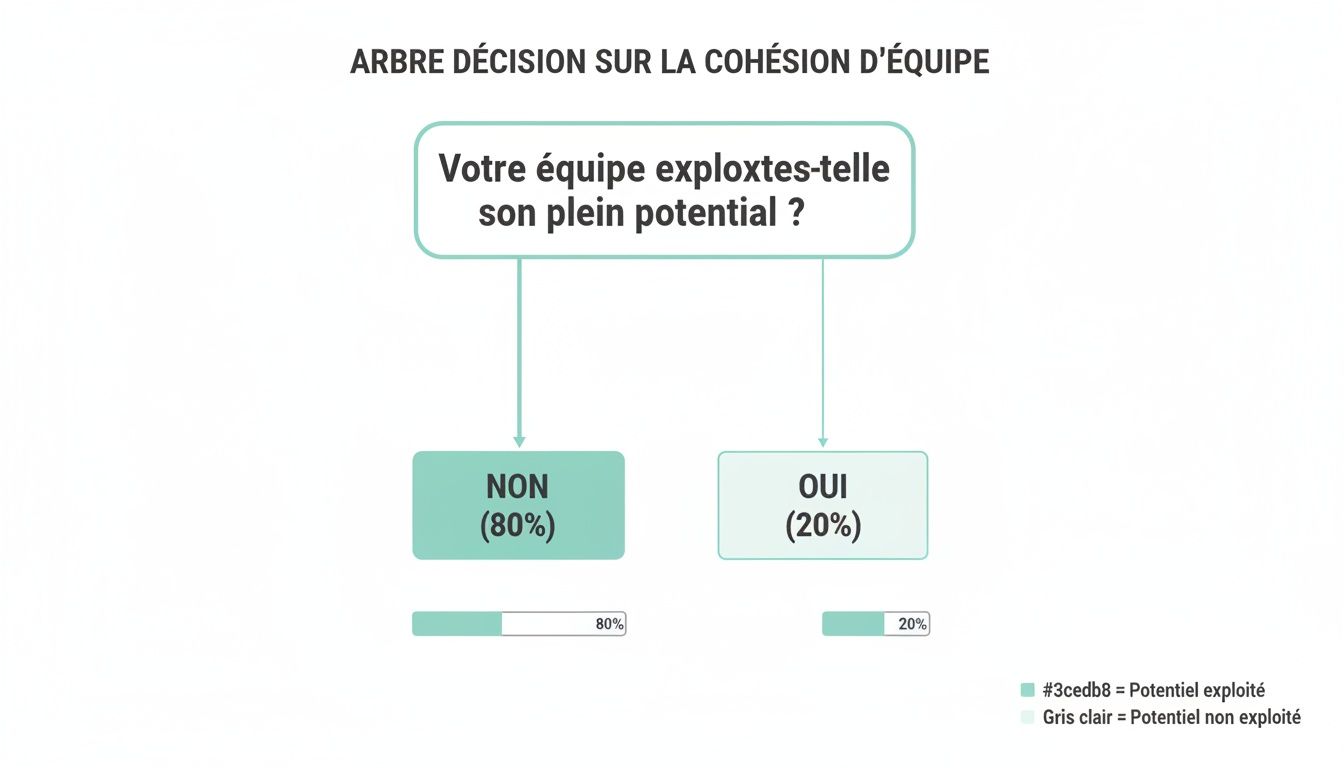
This figure of 80% of teams operating below capacity is striking. It shows how urgent it is to identify the barriers to unleash all this collective potential.
To go further in your analysis, here is a simple self-assessment grid you can use.
Quick Diagnostic Grid for Team Cohesion
Use this table to quickly self-assess the main indicators of cohesion within your team, on a scale of 1 (Low) to 5 (Excellent).
| Cohesion Indicator | Current Level (1-5) | Observable Signs (Examples) | Suggested Priority Action |
|---|---|---|---|
| Communication | 3 | Information circulates, but mainly in a formal manner. Little spontaneous feedback. | Implement a more informal weekly team check-in. |
| Mutual Trust | 2 | Errors are often hidden. There is hesitation to ask for help. | Launch a workshop on the right to make mistakes and constructive feedback. |
| Solidarity | 4 | Strong support on urgent projects. Individual successes are rarely celebrated. | Create a discussion channel to share small and big victories. |
| Shared Vision | 2 | Overall objectives are unclear for many. Everyone works in their own corner. | Organize a session to redefine and communicate the team vision. |
| Conflict Management | 1 | Disagreements are avoided or turn into personal tensions. | Train the team on the basics of non-violent communication (NVC). |
This type of tool gives you a tangible basis to identify where to focus your efforts first.
Create a Space for Open Dialogue
Beyond forms, informal one-on-one discussions are irreplaceable for capturing nuances. Take the time to talk 15-20 minutes with each team member over coffee, away from the rigid office setting. The goal is simple: to create a climate of trust so that dialogue flows freely.
Also consider small group feedback workshops. Fun formats like “Speed Boat” are excellent for this. The team identifies together what holds them back (the anchors) and what propels them forward (the wind in their sails). These methods transform what could be a critique session into a constructive and collective conversation.
Once you have gathered all this information, you will see much more clearly. Is it a lack of recognition? A silo between two poles? Or simply a need to celebrate successes more often? This factual analysis will be your best compass for the future.
Define a Vision and Goals that Unite
Once the diagnosis is on the table, the real work begins. To unite a team, the most powerful tool is neither an unlimited budget nor a bowling outing, but something much more essential: a common purpose. Without a clear and shared direction, even the most talented team in the world will only tread water.
A common goal is the cement of a winning team. It transforms a simple addition of talents into a true striking force. The manager's role here is not to impose their vision vertically but to let it emerge from the group. The idea is for everyone to understand the “what,” but especially the “why” of their mission.

From Imposed Objectives to Shared Mission
The difference is enormous. A SMART objective (Specific, Measurable, Achievable, Realistic, Time-bound) is a great management tool, but it has never inspired anyone. For a team to invest body and soul, they must feel that the mission belongs to them.
To achieve this, nothing beats a good old participatory workshop. The concept is simple: bring everyone together and ask the right questions to define, together, the team's purpose.
- What impact do we really want to have? This question forces you to lift your head from the handlebars and look beyond daily tasks.
- What will our success look like in a year? This allows for a concrete visualization of victory and makes it desirable for all.
- What are our 3 non-negotiable values? This is the “how” we want to work together, our internal code of conduct.
This exercise transforms a to-do list into a true story where each team member is the hero. Everyone finally sees how their small contribution helps build the cathedral, and that is an unparalleled motivational driver.
Your role as a manager then changes completely. You are no longer the one who distributes tasks but the guardian of the flame. Your job is to remind this vision, celebrate every step in the right direction, and reconnect each person's work to the collective ambition.
Transform the Vision into Concrete Actions
A vision is good. Results are better. Once the direction is defined, it must be translated into clear and visible objectives for everyone. A simple whiteboard in the middle of the open space or a shared dashboard on a screen can work wonders. The goal is to make progress tangible and celebrate every small victory.
Let’s take the example of a customer service team defining its vision: “To become the most responsive and appreciated support in our sector.”
Very well, but concretely, what does that mean? It can be broken down into measurable objectives:
- Reduce the first response time by 20% before the end of the quarter.
- Achieve a satisfaction score of 9/10 on at least 95% of tickets.
- Implement a new feedback process to identify friction points.
Each week, the team tracks these numbers. Each achieved objective is not just a box checked; it is proof that they are moving together towards their common goal. It is this virtuous circle – define, act, celebrate – that truly binds a team.
Create Rituals that Strengthen Authentic Bonds
True team cohesion cannot be decreed at an annual seminar. It is woven through the small interactions of daily life. To unite a team in the long term, the secret lies in the regularity and authenticity of shared moments. Of course, major events have their place, but it is the rituals that sustainably establish a sense of familiarity and psychological safety.
These well-established routines structure work, celebrate progress, and, above all, maintain the connection. This is especially vital in a hybrid context, where the risk of isolation is a reality for many. It is what transforms a group of colleagues into a truly united team.

Establish Simple and Effective Connection Moments
No need to reinvent the wheel. Well-thought-out rituals, even very simple ones, can have a huge impact on the atmosphere and collaboration. The important thing is to find the format that fits your team culture and stick to it.
Here are some concrete ideas to pick from and adapt:
- The Monday morning “check-in.” Much more than a roundtable on the week's tasks, it is the moment to share a weekend anecdote or your mood for the day. It humanizes exchanges and starts the week on a much more personal and positive note.
- The random virtual coffee. Ideal for remote teams. Tools can randomly pair people each week for a 15-minute video coffee. It is an ultra-effective method to break down silos and spark conversations that would never have happened otherwise.
- Celebrating small victories. Don’t save the champagne only for major launches. A simple dedicated discussion channel where everyone can share a success, big or small, works wonders. Instant recognition is a powerful driver.
These initiatives have become crucial. The numbers are telling: only 20% of French employees say they have a “good” relationship with their work. Worse still, 39% feel less engaged and 38% disconnected from their company. These rituals are a direct response to this urgency.
Play: An Unexpected Catalyst for Interactions
One of the most powerful levers for uniting is to capitalize on moments of collective emotion. And for that, major sporting events are a golden opportunity. They provide a universal conversation topic and a perfect excuse to launch a friendly and healthy competition internally.
Organizing a fun activity around a sporting event is not a gimmick. It is a pretext to create informal bonds, stimulate team spirit, and break the routine, especially between departments or countries that rarely communicate.
Imagine a company with offices in Paris, Berlin, and Madrid during the Euro or the World Cup. By setting up a prediction contest, you instantly create a common thread that connects everyone. The gaming platform becomes a place for exchange where scores are commented on, friendly banter occurs, and the internal ranking is followed with passion.
This approach has multiple advantages:
- It is inclusive: even those who are not sports fans can get into the ranking game and participate for fun.
- It is easy to implement: ready-to-use platforms allow you to launch the activity in just a few clicks.
- It maintains engagement: the activity spans several weeks, which keeps a positive dynamic over time.
This is an excellent method to strengthen bonds without it seeming forced. If this idea interests you, our guide on workplace prediction contests explains step by step how to successfully organize such an event. A simple strategy for real results on cohesion.
Establish Transparent and Inclusive Communication
A winning team is, above all, a team that communicates. Really. The glue of a solid collective is fluid and quality communication. When information flows without blockage and everyone feels confident enough to share their ideas, even those that are outside the box, the magic happens. Trust is established.
This ongoing dialogue transforms a simple group of colleagues into a cohesive and much more effective collective. The real challenge? To go beyond top-down communication, where the manager merely informs, to create a true exchange. A space where every voice counts and where everyone feels heard. To achieve this, simply piling on meetings is not enough. It is necessary to rethink habits and tools to make everything more inclusive.
Make Exchanges More Human, Especially Remotely
With hybrid work, maintaining authentic communication has become a major challenge. A written message can quickly be misinterpreted, and physical distance can create a sense of isolation. It has therefore become crucial to multiply intentional touchpoints, those that go beyond the simple project brief.
Organizing open meetings, where difficult questions are not only tolerated but encouraged, is an excellent first step. The message is clear: all opinions have value. For remote teams, it is necessary to recreate the equivalent of the coffee machine.
Here are some simple ideas to implement:
- Create informal discussion channels: A space to share vacation photos, a good series to watch, or simply to catch up.
- Establish clear rules for tools: For example, use Slack for urgent matters, email for formal follow-ups. This helps reduce ambient noise and digital stress for everyone.
- Sanctify regular one-on-one meetings: These tête-à-têtes are perfect for taking the temperature, listening to everyone's concerns, and ensuring that no one feels disconnected.
Transparency is not about telling everyone everything all the time. It is about giving each person the information they need to do their job well and understand how they contribute to the overall project. It is a matter of context and, above all, trust.
Establish a Culture of Constructive Feedback
Feedback is the oil in the gears. Without it, small frustrations accumulate, misunderstandings set in, and the machine grinds to a halt. To unite a team, constructive feedback must become a reflex. A kind and natural exchange, at all levels.
The best way to start is to lead by example. As a manager, regularly ask for feedback on your work. Show concretely how you use this feedback to improve. This completely demystifies the exercise and encourages others to engage.
Then, provide the team with simple tools, like the “Start, Stop, Continue” method, to formulate their feedback positively and action-oriented. By creating this climate of psychological safety, you give your team the right to make mistakes and, more importantly, the power to grow together.
Measure and Adjust Your Engagement Strategy
Uniting a team is not an action to check off a list. It is a continuous process. Once you have launched your initiatives, how do you know if they have a real impact? Measuring engagement is essential to avoid navigating blindly.
Far from heavy annual surveys, there are much more agile indicators to take the pulse of the team daily. These metrics help you see what really works, correct course quickly, and maintain a good dynamic over the long term.
Key Indicators to Keep an Eye On
To see clearly, there is no need to drown in numbers. Focus on a few truly relevant indicators. The idea is to track what matters.
Here are three particularly effective ones:
- eNPS (Employee Net Promoter Score): Regularly ask this simple question: “On a scale of 0 to 10, how likely are you to recommend our team as a good place to work?” Measured quarterly, it is an excellent barometer of overall morale.
- Voluntary Participation Rate: Look at who attends non-mandatory activities, whether virtual coffees, lunches, or events. A high participation rate is a telling sign of the group's real cohesion.
- Analysis of Qualitative Feedback: Verbatim from individual interviews or anonymous surveys are a gold mine. This is where all the nuances that numbers cannot show are hidden.
An indicator in the red is not a failure; it is an invitation to discuss. The key is to turn this data into concrete actions, in collaboration with the team.
Establish a Continuous Improvement Loop
This data is not meant to stay in a dashboard. The next step is to use it to engage in dialogue and improve. Share the results with the team, transparently, even if they are disappointing.
This approach shows that their opinion matters and directly involves them in finding solutions. If the eNPS drops, ask them what could be done. If participation in a ritual wanes, it may be time to reinvent it together. Recognizing collective efforts is also crucial; consult our guide for ideas on how to reward employees meaningfully.
This iterative approach is the best guarantee that your strategy remains alive and relevant. By listening, measuring, and constantly adjusting, you build a strong and lasting team culture.
Questions You May Have About Team Cohesion
We conclude with the most frequently asked questions among managers. The answers are intentionally direct and pragmatic, designed to provide you with concrete solutions to everyday challenges.
How to Unite a Team in Hybrid or Remote Mode?
Physical distance is a fact. Therefore, it must be compensated by intentionally created proximity. Multiply informal rituals via video, such as morning virtual coffees, to recreate those spontaneous bonding moments we had at the coffee machine.
Fun tools, like online contests, are perfect for maintaining collective dynamics and healthy competition. In this context, over-communicating the company's vision and publicly celebrating every success becomes even more essential.
A key piece of advice: sanctify regular physical meetings. Even if they only happen quarterly, these days are vital for nurturing human connection and solidifying the foundations of trust.
What Budget to Allocate for Strengthening Cohesion?
This is a common misconception: budget is not the primary factor for success. Many high-impact actions are actually free.
- Establish sincere recognition rituals.
- Improve the quality and frequency of feedback.
- Clarify everyone's roles and the common vision.
For paid activities, my advice is to prioritize regularity over a single costly event. Online solutions offer excellent returns on investment in terms of engagement for a controlled cost. Think of it as a direct investment in retaining your talents and overall performance.
What to Do About a Colleague Who Never Participates?
The first rule: forcing participation is always counterproductive.
First, seek to understand the reasons for this withdrawal. An individual conversation, without judgment, is the best approach. The person may simply be introverted, and group activities may make them uncomfortable.
Vary the types of activities to include different profiles and sensitivities. If this behavior truly isolates the person and begins to harm the collective, the dialogue must then change nature. It will focus on the expectation of professional collaboration, which is an integral part of their role in the team.
Engage your teams in a fun and engaging way with ccup.io. Discover how our turnkey platform can transform your sporting events into powerful cohesion levers. Launch your prediction contest today.
From Content To Conversion
Turn your next sports event into a company prediction contest
Discover the platform, explore available competitions, and launch a branded experience that supports engagement, internal communication, and team cohesion.
See available competitions
Latest articles

18 hours ago
Guide: Your Optimal Free Prize Request in 2026
The management's message is often the same. There needs to be internal engagement that creates momentum, unites multiple sites, and encourages participation, but the rewards budget is almost non-existent. In many companies, this is when motivation drops. This is a mistake.
A well-t...

2 days ago
Prediction or Prognosis: Don't Make the Mistake Again!
You are about to send the launch email for the company's football contest. The subject is ready, the visuals are too, and the registration link is set. Then doubt creeps in about a simple word. Should you write "Make your prediction" or "Make your prognosis"?
This hesitation is normal. It ...




















Contact us
For any question or quotation requests, do not hesitate to reach us by phone at 01 83 79 24 54 or by email : contact@ccup.io
Contact us


Frequently asked questions
What is ccup.io?
Ccup.io is a cohesion tool, allowing firms to gather their collaborators on the occasion of major sporting events, such as World Cup or Olympic Games. We offer an interactive forecasting platform, turnkey and customisable to your company’s colours.
What are you doing with our data?
By deciding to use our services, you decide to entrust us a part of your data – this will allow us to optimise your experience. We place great emphasis on the protection of your data, in compliance with current regulations. Given that it is important to be informed on the issues and challenges of personal data protection, ccup.io provides you with a most complete documentation on this matter.
How much does it cost?
In order to give our clients flexibility, we make a special rate depending on the number of registered players using a degressive system for an important number of participants. This allows firms to organise tailored events, adapted to their capacity. To receive a commercial offer in less than an hour, you only need to fill out the quotation requests form, with just a few clicks.



Don’t miss this opportunity 😍
Start now and enjoy numerous benefits