



Corporate Advent Calendar: Ideas and Strategies to Boost Your Teams
More than just a year-end tradition, the corporate advent calendar is a powerful lever for internal communication and a true catalyst for team cohesion. It’s an opportunity to transform the final sprint before the holidays into a strategic experience to energize engagement, highlight your culture, and, most importantly, create strong memories.
Why the Advent Calendar is a Powerful Engagement Tool
Imagine for a moment: the routine of December, often synonymous with rush and fatigue, transforms into a daily appointment eagerly awaited by all. Far from being just a gimmick, the professional advent calendar is designed to inject a dose of positive energy and break the monotony.
This tradition, known to us all, takes on a whole new dimension in the workplace. Each day, a new "box" opens to reveal a surprise, information, or a fun activity. This ritual creates a regular and informal point of contact between the company and its employees, even when teams are scattered working from home.

An Investment in Your Human Capital
Rather than a line item expense, view this initiative as a direct investment in what you hold most dear: your teams. For HR and communication departments, the benefits are concrete and manifold.
- Boosting collective motivation: Gamification, small challenges, and rewards create a healthy competition and value everyone’s involvement.
- Smoothing cross-departmental communication: Collaborative activities encourage colleagues from different departments, who barely cross paths normally, to exchange and work together.
- Enhancing your employer brand: A creative and caring operation strengthens the image of a company that takes care of its employees.
- Forging shared memories: Laughter, challenges, and shared moments build an authentic company culture and a real sense of belonging.
A successful advent calendar is not one that offers the biggest gifts. It’s the one that creates the best interactions. The goal is to generate enthusiasm and conversations, transforming a simple countdown into a true shared experience.
A Deep-Rooted Trend That Adapts to the Workplace
The success of this tradition in private life is impressive. In France, the market exploded, going from 10 million copies sold in 2010 to over 35 million in recent years. This massive popularity logically inspires the world of work.
Platforms like ccup.io have seized the concept to adapt it into interactive digital calendars. The program includes daily challenges, quizzes, sports predictions... everything is designed to turn anticipation into a powerful engine of engagement. If you want to delve into the figures of this marketing phenomenon, Le Figaro has published a very comprehensive article.
Before diving headfirst into choosing chocolates and activities, there’s a crucial step not to overlook: laying the foundations of your corporate advent calendar. The excitement of year-end is indeed a great driver. But without a solid strategy, your project risks missing its target completely. It’s this preparation that will make all the difference.
The very first question to ask is disarmingly simple, yet fundamental: Why? What is the ultimate goal of this operation? Without a clear answer, it’s impossible to build a meaningful experience.
Defining Achievable Objectives
Your objectives will dictate each of your decisions, from the format of the calendar to the content of each box. To be useful, they must be concrete. Forget lofty wishes and aim for specific goals.
Here are some ideas to inspire you:
- Want to finally introduce your new products? Daily quizzes on their features will do the trick.
- Celebrate the successes of the year? Each day can highlight a project or a team that has shone.
- Break down silos between departments? Launch mixed-team challenges to force colleagues who never talk to collaborate.
- Welcome new recruits? Offer them a fun journey to discover the company culture and its key figures.
Once your main goal is on paper, find ways to measure it. If you want to encourage collaboration, for example, count the number of unique teams formed during your challenges. It’s as simple as that.
A well-thought-out calendar is not just a distraction before the holidays. It’s a true internal communication tool serving a strategy. Each activity is a building block that constructs something greater.
The Big Match: Physical or Digital?
This decision will structure your entire project. It directly depends on the distribution of your teams and your company culture. There’s no wrong choice, just the one that fits your reality.
The physical calendar, with its packages, office activities, and gift distributions, creates a tangible experience and strong memories. It’s ideal for teams that primarily work on the same site. Imagine a hot chocolate bar appearing one morning, or a surprise goodies distribution. The effect is immediate and visually striking, but beware of the logistics that can quickly become a headache.
On the opposite end, the digital advent calendar is the champion of flexibility. Whether through a platform, intranet, or a simple series of well-crafted emails, it allows absolutely everyone to be included. Remote work, foreign subsidiaries, nomadic teams... no one is left behind. It’s undoubtedly the most inclusive solution for modern organizations.
And why not both? The hybrid approach combines the best of both worlds. One can easily imagine a digital platform as a rallying point, complemented by a few physical events in the offices for those who can take advantage of them.
| Type of Company | Recommended Format | Scenario Idea |
|---|---|---|
| Tech Startup (100% remote) | 100% Digital | A gaming platform with rankings, video call challenges, and a final gift sent by mail. |
| Large Industrial Group (multi-site) | Hybrid | A central activity on the intranet, with a budget allocated to each site to organize 2 or 3 local events. |
| Service SME (on-site teams) | Primarily Physical | Daily activities in the office (breakfasts, workshops) supported by email communications. |
The key to success is to align the format, budget, and culture of your company. An agile and remote startup will not approach the project like a large industrial group attached to its traditions. The essential thing is to create an authentic experience that fits your DNA and to which everyone can participate equally.
24 Concrete Ideas to Animate Each Day of December
The secret to a successful corporate advent calendar? Variety. To keep your teams on their toes from December 1st to 24th, you need to surprise, engage, and above all, create moments that stand out. The idea is not to check boxes, but to weave connections.
Before diving into the ideas, this little decision tree can guide you on the most relevant format based on the geography of your teams.
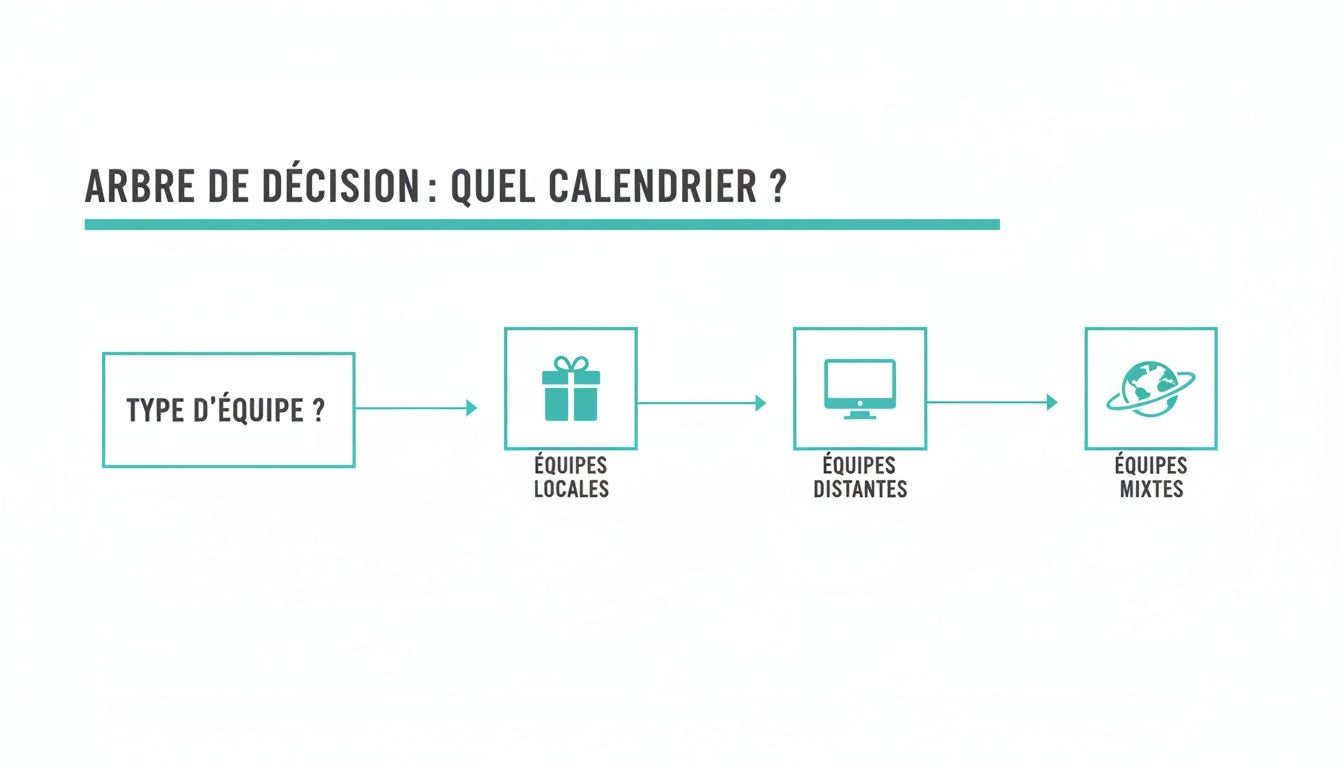
It’s clear that the digital format is by far the most flexible. It adapts to all configurations, from 100% office to 100% remote work, including hybrid models, and ensures that no one feels excluded.
To give you a boost, here are 24 tested and approved ideas, to pick and adapt to your company culture. We’ve grouped them into four main families to help you see more clearly.
Collaborative Activities to Strengthen Bonds
Here, the goal is simple: to ensure that people talk to each other, even from a distance. These activities are designed to break the routine and barriers between departments.
Virtual Escape Game: Form diverse teams and send them off to solve online puzzles. It’s an excellent exercise to boost communication and group logic.
Weekly Photo Contest: Launch a simple theme ("My office in Christmas mode", "The most kitsch Christmas sweater") and let employees vote for their favorite picture. Guaranteed fun.
Collaborative Christmas Playlist: Create a shared playlist (on Spotify, Deezer...) where everyone adds their favorite tracks. The result? The unique soundtrack of your year-end.
Sharing Holiday Recipes: Each day, a colleague reveals their secret Christmas recipe. To go further, organize a cooking workshop via video to prepare a dish together.
Digital Wish Wall: Use an online whiteboard like Miro or Mural for everyone to leave a note, drawing, or GIF for the coming year.
Digital "Secret Santa" : An online draw to exchange small symbolic gifts or, even simpler, kind messages. The important thing is the intention.
What makes a corporate advent calendar successful is not the budget, but its ability to create authentic human interactions and shared memories.
Quizzes and Games to Stimulate Daily Engagement
Gamification is the engine of engagement. Quick little games and quizzes create healthy competition and encourage people to return each day.
- Quiz on Company History: Questions about key dates, hallway anecdotes, or major successes of the year. A fun way to reinforce company culture.
- "Who is it?" Childhood Edition: Each participant sends a baby photo of themselves, and others must guess who it is. Guaranteed laughs!
- Daily Poll: A light question every morning ("Gingerbread or hot chocolate?") with results revealed at the end of the day.
- Pictionary or Online Blind Test: Perfect for a lively lunch break. Many free tools allow you to organize this in just a few clicks.
- Daily Crossword or Puzzle: A small daily brain challenge with terms or images related to your industry.
- Sports Prediction Contest: If a major sporting event occurs in December, it’s the perfect opportunity to launch a friendly internal competition.
Useful Content for Learning and Growing
Your calendar can also become a tool for personal and professional development. Offer short, high-value content that shows you invest in the well-being of your teams.
- Micro-Training of the Day: A 5-minute video on a concrete topic. Example: "3 tips for better managing your inbox".
- Wellness Break: A short guided meditation audio session or a stretching session for those who work seated.
- Inspiration of the Day: Sharing a significant TED talk on a theme like creativity or leadership.
- This Week's Life Hack: A tutorial to master an unknown keyboard shortcut on software used by everyone.
- Focus on an Internal Tool: Highlight an underutilized but very useful feature of one of your in-house software.
- Management's Recommendation: Each day, a member of the executive committee shares the book, podcast, or article that recently inspired them.
Recognition and Celebration to Value Teams
December is the perfect time to say thank you and celebrate successes, big and small. It’s essential to end the year on a positive note.
- Portrait of the Day: Highlight an employee, their journey, role, and contribution. A great way to value individuals.
- The Thank You Wall: A space where everyone can publicly thank a colleague for their help, support, or work during the year.
- Year's Success Retrospective: Each day, revisit a project that marked the year, congratulating and naming the teams that carried it.
- A Word from Management: A short, personal, and authentic video message from the CEO or a director thanking the teams for their commitment.
- The Grand Final Draw: On December 24th, reward participation by organizing a draw among all participants. If you’re short on inspiration, our guide on cheap prize ideas can help you.
- The Surprise Announcement: End on a high note by revealing good news for the coming year: a new benefit, a seminar, an exciting project... Something to start the new year with motivation.
Staging Your Internal Communication Campaign
Even the most amazing advent calendar will fall flat without good communication to support it. Let’s be clear: it’s not about bombarding your teams with emails, but about building a real little internal event. A successful launch is primarily a simple plan executed with care.
To make it work, you need to pace your communication in three stages: first, teasing to intrigue; then, launching to make an impact; and finally, daily animation to keep the flame alive. It’s this orchestration that will transform your initiative into a highly anticipated event throughout December.

Creating Anticipation with a Teasing Phase
The magic must happen well before December 1st. The goal is to build excitement without revealing everything. Ideally, launch this phase two weeks before the start, around mid-November.
Drop short, somewhat enigmatic messages on your usual channels (Slack, Teams, the intranet...). The idea is to pique curiosity and start the first conversations at the coffee machine.
Some teasing message ideas:
- D-15: A simple visual with a message like: "December will not be like any other this year. Stay tuned..."
- D-10: A small animated GIF of a calendar box timidly opening, accompanied by "Get ready for a surprise every day."
- D-5: A mini one-minute video where employees whisper their impatience (without showing themselves, for mystery!).
This gradual approach establishes the idea that something special is being prepared and transforms a simple announcement into an event that people genuinely look forward to.
Making an Impact with a Memorable Launch
December 1st is the big day. You need to make a strong impression. All the promises of the teasing must materialize. Your launch communication must be clear, full of energy, and above all, provide all the practical information to get started.
Your message should answer the questions everyone is asking:
- What is it about? The official announcement of the company's advent calendar.
- Why are we doing this? To have fun, celebrate the end of the year together, and strengthen bonds.
- How do we participate? Provide the link, instructions, and rules of the game. Simple and direct.
- What do we win? Mention the big prizes to motivate the troops from day one.
A friendly piece of advice: never underestimate the power of your managers. They are your best allies. Organize a quick call with them just before to present the project and give them a mini communication kit (a template email, a few visuals). Their direct support will multiply engagement, that’s guaranteed.
Keeping the Flame Alive Daily
The biggest challenge? Maintaining momentum for 24 days. Daily animation is therefore crucial to prevent enthusiasm from deflating like a soufflé after the first week.
To avoid monotony, vary the pleasures:
- The Morning Reminder: A friendly message on instant messaging to announce the opening of the day’s box.
- The Ranking Update: At the end of each week, share the top 5 or top 10 to spice up the competition.
- The Week's Best Of: Highlight the funniest photos from a contest or the most creative answers to a quiz.
- Targeted Notifications: If your tool allows it, send a little personalized reminder to those who haven’t participated in a few days.
One last point, but not the least: a technical support that responds quickly. Identify a person or a small reference team to handle questions (connection issues, unclear rules...). Nothing discourages more than an unresolved bug. Prepare a small FAQ with obvious questions to save time. By combining anticipation and responsiveness, you ensure a smooth and pleasant experience for everyone.
Which Tools to Choose for a Successful Digital Advent Calendar?
Switching to a digital format for your corporate advent calendar opens up a world of possibilities. But be careful, the success of the operation entirely depends on the technology you choose. It’s the one that will guarantee a smooth experience for your teams and stress-free management for you. Basically, you have two main options: "in-house" solutions or specialized platforms.
The first option is "homemade". The idea is to cobble something together with the tools you already use daily. You can imagine a series of posts on your SharePoint intranet, a dedicated channel on Slack or Teams, or even a simple sequence of well-crafted emails. The advantage? It’s economical and quick to launch. The downside is that you will quickly run into limits in terms of interactivity, gamification, and especially, tracking results.
On the opposite end, you have dedicated platforms, designed specifically for this type of event. Turnkey solutions like ccup.io, for example, integrate all the features you need to create a professional and engaging experience without requiring any technical skills.
Essential Features to Check
Whether you’re going for an internal solution or comparing providers, certain criteria are simply non-negotiable if you want your calendar to have an impact. Your specifications should absolutely include these points:
- Graphic Customization: The tool must be able to dress in your company’s colors (logo, colors, fonts). The experience should reflect your brand, not that of an external tool.
- Gamification Mechanisms: This is the heart of the reactor. Look for features like points, collectible badges, and especially, real-time rankings to spice up friendly competition.
- Multilingual Management: If you have offices internationally, this is imperative. Everyone should be able to participate comfortably in their native language.
- Statistical Dashboard: You should be able to track participation rates, daily engagement, and quiz scores at a glance. These metrics are gold for measuring the success of your operation.
- GDPR Compliance: No compromises on this point. The management of your employees' data must be impeccable. Ensure that the solution strictly adheres to regulations.
Moreover, this enthusiasm for advent calendars is far from anecdotal. A YouGov study revealed that 54% of French people aged 25 to 34 – an age group massively present in the workplace – were considering buying a calendar in 2025. They were only 27% in 2017! This underlying trend shows that the format has largely surpassed the childhood circle. Platforms like ccup.io have understood this well by adapting this concept to the professional world with targeted animations. You can check the details of this trend on Alouette.fr to learn more.
Simplifying Management with a Dedicated Platform
The biggest advantage of a specialized solution is the time savings and peace of mind. A platform like ccup.io, to name just one, automates a huge part of the work.
This screenshot of the ccup.io interface illustrates the simplicity and clarity of a dedicated platform. The design is clean, in the colors of a fictional company, with a clearly visible ranking that motivates the teams.
Everything is centralized in one place: creating animations, scheduling notifications to remind people to open their box, and collecting engagement data. This frees up precious time for you to focus on what really matters: the human animation of the event. And if you’re looking to strengthen your overall strategy, take a look at our guide on the best internal communication tools to complete your toolkit.
The best tool is the one that is forgotten. It should be so intuitive for participants and so easy to manage for you that only the experience matters. If technology becomes an obstacle, it’s already lost.
Ultimately, your choice will depend on your resources (time, budget, technical skills) and your ambitions. To put it simply: a "homemade" solution can work for a modest project with a tight budget. But as soon as you aim for strong engagement with gamification and precise tracking, a dedicated platform becomes an investment that pays off quickly.
Measuring the Impact of Your Operation and Preparing for the Future
The excitement fades, the last box has been opened... but your mission is not quite over. To turn this beautiful initiative into a lasting success, you now need to take a step back and measure its concrete outcomes. This analysis will not only allow you to prove the value of the operation to your management but also to gather valuable insights for the next edition of your corporate advent calendar.
To evaluate the impact, there are two angles to consider: raw numbers and human sentiment. Both are equally important for drawing a complete and honest assessment.
Quantitative Indicators Under the Microscope
Numerical data are your best allies for objectifying success. They provide tangible proof of the engagement you have managed to generate. Most digital platforms, like ccup.io, will provide these metrics directly in a dashboard.
Here are the essential KPIs to keep an eye on:
- Unique Participation Rate: The percentage of employees who opened at least one box. This is the key indicator that shows you the real reach of your campaign.
- Average Daily Engagement: The average number of participants each day. Ideal for measuring the regularity and your calendar's ability to maintain interest over time.
- Activity Completion Rate: Out of 100 people who open a "quiz" box, how many go all the way? An excellent way to measure the relevance of your activities.
- Number of Contributions: The total number of photos sent for a contest, comments posted, or responses to surveys. This is the barometer of interactivity.
Don’t just present raw numbers. Tell the story they hide. A spike in participation on the day of the "ugly Christmas sweater contest" is much more telling than a simple percentage.
Qualitative Analysis to Understand the "Why"
Beyond the numbers, it’s vital to capture the teams' sentiments. This qualitative dimension will give depth to your report and provide you with the most relevant improvement paths for next year.
To do this, nothing could be simpler: launch a short satisfaction survey right after the operation ends. Ask simple and direct questions, mixing rating scales ("On a scale of 1 to 5...") and open-ended questions to gather sincere feedback.
Then analyze these comments: what were the favorite moments? What didn’t work as well? Also, observe any changes in the overall atmosphere. Did you notice more informal exchanges on internal messaging? These weak signals are often very revealing of the impact on cohesion.
To go further on this topic, discover our tips for effectively measuring employee engagement throughout the year.
By combining these two approaches, quantitative and qualitative, you will build a solid performance report. It will justify the investment and give you all the cards in hand to prepare for an even more memorable future edition.
The Last Questions You May Have About Your Advent Calendar
Even with the best plans, some questions often linger before launching. That’s normal! Here are clear answers to the questions we are most frequently asked, to help you finalize your project with peace of mind.
What Budget Should You Plan for?
There’s no one-size-fits-all answer, as it all depends on the ambition of your project. A very simple advent calendar, relying solely on emails and small animations without prizes, will cost you almost nothing.
For a more developed experience, deployed on a digital platform and punctuated with a few symbolic gifts, a good range is between €10 and €50 per employee.
A good reflex: don’t see this budget as a simple expense, but as a true investment. Put it in perspective with the cost of a single team meal. The impact on engagement will last for 24 days.
How to Handle International Teams?
The digital format is your best ally. The key is to choose a tool that natively manages multiple languages. Each participant will thus be able to experience the event in their native language, which makes all the difference.
Also, consider adapting certain activities to different cultures and checking local holidays to ensure no one is left out. This attention to detail will make a difference.
What to Do If Participation Wanes Along the Way?
This is a classic, don’t panic! If you feel enthusiasm dropping, it’s time to reignite the engine. Targeted communication, highlighting rankings to spark competition, or the surprise announcement of an exceptional prize for a specific day are excellent levers.
Above all, don’t hesitate to ask for feedback. A quick survey can give you valuable insights into what’s not working as well and allow you to adjust the course for the future.
A corporate advent calendar is a fantastic project, but its management can quickly become a second job. With ccup.io, you have a turnkey platform to launch an engaging animation without the hassle.
Discover how we can simplify your project at https://ccup.io.
From Content To Conversion
Turn your next sports event into a company prediction contest
Discover the platform, explore available competitions, and launch a branded experience that supports engagement, internal communication, and team cohesion.
See available competitions
Latest articles

8 hours ago
How to Lead an Engaging Team Meeting
Let's be honest: we've all experienced meetings that drag on for no reason. This infamous "meetingitis" is not a fatality. It's just a symptom of bad habits and outdated methods.
The idea is to transform this often-dreaded appointment into a real moment of exchange and decision-making. A g...

3 days ago
Your Serie A Prediction Guide for the 7 Best Tools 2026
The Serie A, with its tactical duels and twists, is an exciting playground for prediction enthusiasts. But how do you move from intuition to structured analysis? To succeed in your next Serie A prediction, it is essential to rely on effective tools that combine advanced statistic...



















Contact us
For any question or quotation requests, do not hesitate to reach us by phone at 01 83 79 24 54 or by email : contact@ccup.io
Contact us


Frequently asked questions
What is ccup.io?
Ccup.io is a cohesion tool, allowing firms to gather their collaborators on the occasion of major sporting events, such as World Cup or Olympic Games. We offer an interactive forecasting platform, turnkey and customisable to your company’s colours.
What are you doing with our data?
By deciding to use our services, you decide to entrust us a part of your data – this will allow us to optimise your experience. We place great emphasis on the protection of your data, in compliance with current regulations. Given that it is important to be informed on the issues and challenges of personal data protection, ccup.io provides you with a most complete documentation on this matter.
How much does it cost?
In order to give our clients flexibility, we make a special rate depending on the number of registered players using a degressive system for an important number of participants. This allows firms to organise tailored events, adapted to their capacity. To receive a commercial offer in less than an hour, you only need to fill out the quotation requests form, with just a few clicks.



Don’t miss this opportunity 😍
Start now and enjoy numerous benefits