



Company Advent Calendar: Ideas, Budget, and Guaranteed Engagement
Forget the simple box of chocolates. A company Advent calendar is much more than that. It’s a real opportunity to strengthen bonds, boost team morale, and energize internal communication during the hectic end-of-year rush. It’s a chance to create a positive and shared ritual, transforming the month of December into a memorable experience.
Why an Advent Calendar is More Than Just a HR Gadget

Let’s be honest, the idea of a company Advent calendar may initially seem a bit frivolous. However, organizations that master it use it as a real tool to diffuse end-of-year stress and strengthen cohesion, especially with the hybrid work model that has become widespread.
We’re not just talking about a tradition. It’s a powerful way to transform a sometimes gloomy atmosphere into a positive dynamic, creating shared memories that last long after the holidays. Behind the fun lies very concrete management objectives.
Strengthening Bonds and Communication
When teams are dispersed, a digital calendar becomes a daily rallying point. It provides a pretext for informal interactions, those little moments that don’t have a place in a classic meeting but are essential to team life.
Imagine the scene: a project team is under pressure to meet its annual goals. The atmosphere is electric. The day’s calendar challenge, a quirky quiz about the unusual habits of managers, makes everyone laugh. Suddenly, the tension eases, conversations start, and collective energy is reignited. It’s precisely this kind of moment that helps to unite teams sustainably.
Improving Employer Brand and Motivation
A well-thought-out calendar sends a strong signal: the company cares about the well-being of its employees. This is not only good for team morale, but it’s also an undeniable asset for your employer brand. Employees who feel valued are more engaged and become your best ambassadors.
The impact on motivation is anything but trivial. The idea has gained traction in France, to the point of becoming a must: 85% of companies with more than 250 employees organize one. And when it goes digital, the participation rate skyrockets, reaching 92%, compared to barely 60% for paper versions.
A successful Advent calendar doesn’t just distribute gifts. It distributes smiles, recognition, and a sense of belonging. That’s where its true return on investment lies.
This type of activity unites teams around a positive and light-hearted project. Looking closely at the various services for businesses that are emerging, we can clearly see this underlying trend aimed at improving the employee experience on a daily basis.
Ultimately, the company Advent calendar is not an expense, but a real investment in your human capital. It allows you to end the year on a positive note, counter seasonal disengagement, and lay the groundwork for a productive and cohesive new year.
Setting the Right Foundations for a Memorable Calendar
A brilliant idea, without a solid action plan, remains just an idea. For your company Advent calendar to go from a nice concept to a resounding success, you need to start with clear and well-thought-out foundations. This preparation step is far from a formality: it will save you from the stress of improvisation and ensure the smooth running of the project.
The very first question to ask is simple: why are we doing this? The answer will guide all your decisions. You may be looking to celebrate the collective successes of the year, create connections between departments that rarely communicate, or simply inject a good dose of lightness into a typically intense period.
Defining Your Objectives and Audience
To be useful, your objectives must be clear and, if possible, measurable. Are you aiming for a 15% increase in interactions on your intranet in December? Or perhaps a daily participation rate of 70%? Setting numerical targets, even simple ones, will give you a real benchmark to evaluate the impact of the operation.
At the same time, sketch out a profile of your audience. Is this calendar aimed at the entire company, including foreign subsidiaries? Or are you targeting a specific department? Knowing your participants is essential to adjust the tone, type of content, and even the rewards. A bit of quirky humor will resonate with a creative team, but a more sober approach will be necessary for another audience.
Building the Project Team and Mapping the Road
No one should carry this project alone. Form a small team, a commando of two or three motivated individuals from different departments (HR, communication, marketing...). This diversity guarantees more ideas and better internal information dissemination.
Once the team is in place, your best ally becomes the retro planning. It’s your roadmap, breaking the mountain down into small, manageable hills, with clear deadlines.
A good retro planning is not a constraint; it’s an assurance. It transforms the stress of “will we be ready on time?” into serene confidence. It frees the mind to focus on creativity rather than logistics.
Here’s what a retro planning for a launch on December 1st might look like:
Week 1 (mid-October): Framing and Validation
- Defining objectives and audience.
- Validating the preliminary budget with management.
- Choosing the format: 100% digital, physical, or a mix of both?
Weeks 2 & 3 (end of October): Brainstorming and Content
- Creativity session to list the 24 activation ideas.
- Task distribution: who writes the texts, creates the visuals, prepares the quizzes?
- Selecting and ordering any prizes or gifts.
Week 4 (early November): Creation and Assembly
- Final writing of all content.
- Integration into the digital platform if you are using one.
- Technical testing phase to ensure everything works perfectly.
Week 5 (mid-November): Communication and Teasing
- Preparing the internal communication plan.
- Creating materials (emails, posters, posts on the internal network).
- Launching the teasing campaign to start building anticipation.
Week 6 (end of November): Finalization and Launch
- Final proofreading and validation of the entire calendar.
- Sending launch communications.
- Setting up tools to track participation from day one.
This schedule is a structure, not a prison. The idea is to anticipate the major steps so that, by December 1st, everyone is ready and eager to open the first door.
What Format to Choose for Your Company Advent Calendar?
The choice of format for your Advent calendar is a key decision. It’s even the very first step. It must align with your culture, budget, and the geographical reality of your teams. A wrong turn here, and the entire operation risks falling flat.
So, let’s look together at the three main options on the table: physical, digital, and hybrid. The idea is not to follow a trend, but to find the approach that will resonate most with your employees and serve your objectives.
The Physical Calendar: The Tangible Experience
This is the quintessential traditional option. One immediately imagines a large structure set up in a high-traffic area, like the cafeteria or reception. Its major strength? Creating a rallying point, a visible ritual that encourages spontaneous discussions at the coffee machine.
It’s an excellent choice if most of your teams are on-site. It reinforces the feeling of presence and sharing. But be careful, this format almost automatically excludes remote workers or those based at other sites. It quickly creates a two-speed experience. Not to mention the logistics, which can become a real headache between managing gifts and on-site activities.
The Digital Calendar: The Ally of Flexibility
On the opposite end, the 100% digital option offers unbeatable flexibility. Accessible via a simple web link, on computer or mobile, it allows absolutely everyone to be included, no matter where they are. It’s the ideal solution for companies with a strong remote work culture or teams scattered across the globe.
Specialized platforms, like ccup.io, allow you to deploy an interactive, gamified experience in just a few clicks, tailored to your company’s colors. Their major advantage: precise measurement of engagement. You can track participation rates in real-time, quiz scores, the number of interactions... Golden data for evaluating the success of your operation.
The choice of digital is not just a logistical question. It’s a real commitment to inclusion. It ensures that every employee, whether at headquarters, at home, or on the other side of the world, experiences the same event.
The Hybrid Approach: The Best of Both Worlds?
The hybrid format tries to combine the tangibility of the physical with the accessibility of the digital. It can take several forms. For example, an online platform as the foundation of the experience, complemented by occasional physical events (like a launch breakfast) or gifts sent directly to employees.
This is often the richest option, but also the most complex to orchestrate. It requires flawless coordination between physical logistics and digital activities, and of course, a generally larger budget.
To help you see more clearly, here’s a small comparative table summarizing the advantages and disadvantages of each format.
Comparison of Company Advent Calendar Formats
This table compares the physical, digital, and hybrid formats based on several key criteria to aid decision-making.
| Criterion | Physical Format | Digital Format (e.g., ccup.io) | Hybrid Format |
|---|---|---|---|
| Inclusion | Low (excludes remote workers/multi-sites) | Very high (accessible everywhere, anytime) | High (combines accessibility and physical moments) |
| Logistics | Complex (stock management, distribution) | Very simple (online deployment) | Very complex (online/offline coordination) |
| Budget | Variable (material costs, venue rental) | Controlled and predictable (software license) | High (cumulative costs) |
| Engagement | Difficult to measure | Very easy (real-time statistics) | Measurable via the digital component |
| Experience | Concrete, creates a meeting point | Interactive, gamified, personalized | Rich and multi-channel |
This comparison clearly shows that each option has its strengths. The final choice will really depend on your priorities: tangible experience, maximum inclusion, or a mix of both.
To summarize, this decision tree can help you sort through your two main constraints: budget and team distribution.
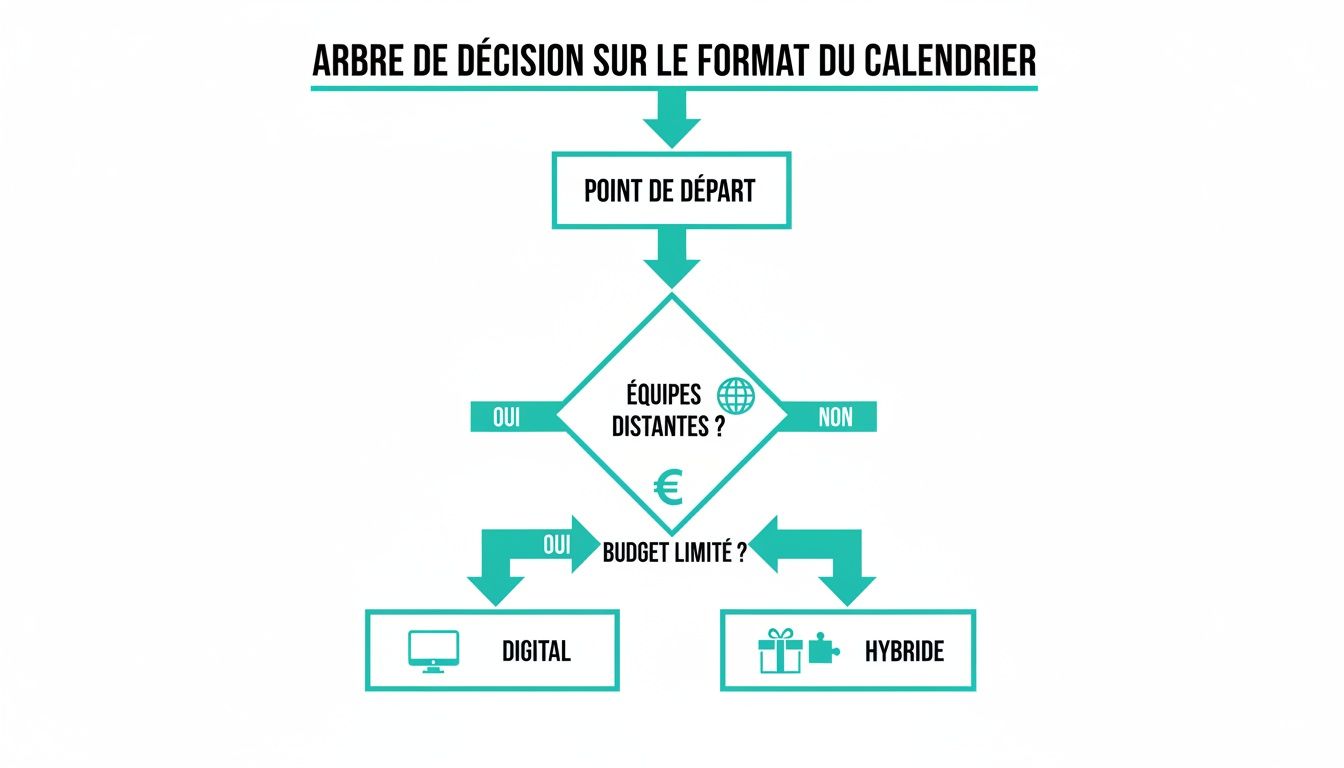
As we can see, the digital format often emerges as the most agile and inclusive solution, especially when teams are remote and the budget needs to be controlled. It’s an excellent starting point for many companies. Moreover, if you’re interested in the topic, you can explore the benefits of a digital Advent calendar in the workplace.
Ultimately, the ideal format is the one that feels most natural to you. Ask yourself the right questions: where are my employees? How do they communicate daily? What message do I want to convey? The answer will guide you toward a solution that will be much more than just a gadget: a true engine of cohesion.
24 Concrete Ideas to Bring Your Calendar to Life

The secret to a successful company Advent calendar? The variety and quality of surprises you reserve each day. To spare you from the blank page syndrome, here’s a goldmine of ideas, divided into four main categories. The goal is simple: mix the pleasures to keep everyone on their toes from December 1st to 24th.
And rest assured, you don’t need a huge budget to create memorable moments. Most of these ideas require just a dash of creativity and a bit of organization.
Fun and Competitive
Here, we aim to awaken the spirit of play and healthy competition. These activities are perfect for energizing the days and creating positive momentum among teams.
- Quiz "Do You Really Know the Company?" : Prepare quirky questions about the company’s history, office anecdotes, or the little quirks of certain departments. An excellent way to reinforce internal culture in a light-hearted tone.
- Ugliest Christmas Sweater Contest: Everyone shares a photo of their most kitschy Christmas sweater. Voting takes place live via a poll on your platform. Guaranteed laughs.
- Musical Blind Test: A themed playlist (Christmas songs, 90s hits, movie soundtracks...) and off you go! The first to guess the title and artist scores points.
- "Two Truths, One Lie": A member of the management team or a manager shares three anecdotes about themselves, one of which is false. It’s up to the teams to spot the intruder! Ideal for getting to know colleagues from a different angle.
- Daily Riddle: Each morning, launch a rebus, charade, or puzzle. The first to post the correct answer wins the round.
- Spot the Differences Game: Take two nearly identical photos of an open space or office, and ask participants to find the elements that have changed.
Collaborative and Creative
These ideas are designed to bond teams by involving them in a common project. It’s an opportunity to build something together, even from a distance, and to value everyone’s creativity.
Team spirit is not decreed; it is built. Collaborative challenges transform participants into co-creators of the event, which amplifies their sense of belonging and engagement.
- Virtual Thank You Wall: Invite employees to post a note, anonymously or not, for a colleague who helped them this year. A great boost of kindness!
- Collaborative Christmas Playlist: Create a shared playlist on Spotify or Deezer and let everyone add their favorite Christmas song. The perfect soundtrack for the end-of-year party.
- Best Decoration Contest (at the office or remote): Each team or individual posts a photo of their decorated workspace. May the most creative win!
- The Christmas Recipe Book: Ask everyone to share their favorite festive recipe. On December 24th, compile everything into an e-book to gift to all.
- Poll "The Best Christmas Movie of All Time": A simple vote to elect the movie that everyone agrees on. Share the results with humor.
- "Your Best Work Memory of the Year": Open a door where everyone can share a success or a good moment experienced as a team. Nothing like it to end the year on a positive note.
Well-being and Development
The end of the year is often a sprint. Offering well-being breaks shows that the company cares about its teams beyond mere performance. This attention is always greatly appreciated.
- Daily Relaxation Tip: Share a short video or infographic with a breathing or stretching exercise that can be easily done at the computer.
- Mini Online Workshop: Organize a 15-minute webinar on a practical theme: "how to manage your inbox before the holidays" or "introduction to meditation".
- The Inspiring Resource: Provide a link to a podcast, a deep-dive article, or a TED talk that goes beyond purely professional topics (creativity, time management, etc.).
- The Nap for Dummies: A small practical sheet explaining the benefits of a power nap and how to practice it to recharge effectively.
- Suggestion for a Disconnecting Walk: Recommend a nice place (park, forest, waterfront) near the offices for a lunch break that truly clears the mind.
- The "No Internal Meetings" Challenge: Propose to block an afternoon without any internal meetings so that everyone can focus and wrap up their files before leaving for vacation.
Recognition and Appreciation
This last category is crucial. The Advent calendar is a golden opportunity to highlight the people and successes that have marked the year.
- Portrait of the Day: Each day, highlight an employee from a different department through a short, quirky interview.
- Key Figures of the Year, Fun Version: Present the company’s successes (new clients, completed projects, recruitments) in a playful infographic format.
- The "Thank You" from Management: A short, simple, and sincere video from the CEO or managers thanking the teams for their commitment throughout the year.
- Spotlight on a Significant Project: Share behind-the-scenes stories of a major project from the year, giving a voice to those who carried it out.
- Anniversaries of Service: Use the calendar to celebrate those who are marking their 5, 10, or 15 years with the company in December.
- The Big Final Raffle: On December 24th, organize a raffle among all participants for a slightly more exceptional prize. The cherry on top to reward everyone’s loyalty.
Managing Practical Aspects: Budget, Communication, and GDPR
Now that ideas are flowing, it’s time to get your hands dirty. A successful company Advent calendar is also a well-oiled machine behind the scenes. Budget, internal communication, and legal compliance are the three pillars that will support the entire operation. If one of them is shaky, even the best idea risks falling flat.
Estimating and Optimizing Your Budget
The budget is often the nerve of war. But rather than seeing it as a simple line of expense, view it as a real investment in the atmosphere and cohesion of your teams. To build it intelligently, you need to think of everything.
Of course, there are the prizes and gifts. But that’s just the tip of the iceberg. Don’t forget the cost of the platform if you’re going for a digital solution, any expenses for physical events (like a launch breakfast), or the time and resources needed to create content (visuals, videos, etc.).
The good news is that cost optimization is an excellent playground for creativity.
- Think of Immaterial Prizes: A half-day of extra leave, a lunch with management, the right to choose the office playlist for a day... These rewards have immense value without costing anything.
- Collaborate Internally: Does the marketing department have some goodies in stock? Can the works council contribute to funding some prizes? All synergies are worth exploring.
- Leverage Group Effect: By purchasing gift cards or experiences in bulk, you can often negotiate much better rates.
The value of a gift is not measured by its price, but by the intention behind it. A well-thought-out and personalized reward will always leave a stronger impression than an expensive but impersonal prize.
And if you’re short on inspiration, turning the search for cheap prize ideas for your Advent calendar into a collaborative challenge can be an excellent initiative in itself.
A Communication Plan to Create the Event
Even the most amazing calendar in the world is useless if no one participates. Your communication is therefore just as crucial as the content of the doors. The goal? Create anticipation, spark curiosity, and make this calendar the daily event that no one wants to miss.
Launch a teasing campaign about a week before December 1st. Mobilize all your channels: emails, intranet, Slack, Teams, and even screens in common areas. Vary the messages to intrigue without revealing everything right away.
Once the operation is launched, don’t let up. A small notification each morning to announce the opening of the day’s door is perfect for keeping the flame alive. Share highlights: announce the winners from the previous day, post photos from the challenges, display rankings to stimulate the spirit of competition.
GDPR Compliance: An Absolute Priority
This is a non-negotiable point. As soon as you collect data about your employees – names, email addresses, scores, photos – you enter the scope of GDPR. And on this subject, amateurism is not allowed.
Transparency is your best ally. Clearly explain what data is collected, why, and how it will be used. Make sure to obtain explicit consent from each participant, especially if you plan to publish photos or testimonials. Using a specialized digital solution like ccup.io gives you peace of mind: these constraints are managed natively, ensuring a secure and compliant operation.
The impact of such initiatives is no longer in doubt: 92% of HR managers believe that these events strengthen the internal image and generate +35% social interactions. In a context where digitalization is accelerating, especially with the upcoming obligation for electronic invoicing in 2026, relying on digital tools becomes a no-brainer. You can also learn more about the timeline of this reform and its implications.
Do You Have Questions? We Have Answers.
The idea of an Advent calendar to unite your teams appeals to you, but some points remain unclear before you take the plunge? That’s completely normal. We’ve gathered here the most frequently asked questions to provide you with clear answers and help you finalize your project with peace of mind.
How to Measure the Return on Investment?
The impact of your calendar goes far beyond exchanged smiles. To measure the return on investment (ROI), you need to look at both the numbers and the human aspect. It’s by combining the two that you get a complete picture of the operation’s success.
On the numerical side, if you’re going for a digital solution, tracking is a piece of cake. Platforms like ccup.io give you access to real-time statistics. Focus on a few key indicators:
- Daily Participation Rate: How many employees logged in each day? A stable and high rate is a sign of genuine enthusiasm.
- Number of Interactions: Track comments, likes, or shares generated by each door of the calendar.
- Completion Rate of Activities: Out of 100 people who start a quiz, how many go all the way to the end?
On the qualitative side, the human impact is just as crucial. Launch a small anonymous survey right after the event. Ask simple questions about the atmosphere, team cohesion, and morale. Putting this feedback in perspective with your usual HR indicators, like absenteeism rates in December, can reveal very interesting correlations.
It’s Already November, Is It Too Late?
Absolutely not! This is a common scenario, and the answer is no. Of course, planning ahead is always more comfortable, but an agile and well-structured project can absolutely come to life in just a few weeks.
The secret is not to reinvent the wheel. Rely on a turnkey digital solution. These platforms are designed for quick deployment and require no technical skills. Focus on content that is quick to create but impactful: quizzes, polls, photo challenges...
It’s better to execute a well-planned initiative quickly than to have a complex idea that ends up falling through. The essential thing is to create a moment of sharing, not to aim for perfection.
Good internal communication will do the rest to mobilize the troops in record time.
How to Ensure Inclusion of Remote Teams?
This is THE essential question today. Including remote employees is the cornerstone of a successful Advent calendar. To ensure no one feels left out, the 100% digital and mobile-accessible format is not an option; it’s a necessity.
Design your activities so that they do not depend on a physical location. For example, the "best Christmas office contest" easily transforms into the "best workspace contest," thus including home offices.
To go further, you can organize micro-events via video, like a 15-minute Christmas coffee or a live blind test. If your teams are spread across different time zones, prioritize asynchronous activities that can be done at any time of day. The key is to offer universal content that speaks to everyone.
What Are the Mistakes to Avoid?
We’ve seen quite a few projects, and certain mistakes come up more often than others. To help you avoid them, here are the top 4 pitfalls to dodge:
- Neglecting Communication: This is the number one mistake. If no one knows about it, no one will participate. Good teasing in advance and regular reminders are essential.
- Proposing Too Complicated Activities: The end of the year is a rush for everyone. A challenge that requires 30 minutes of investment is likely to discourage even the most motivated. Aim for short, fun, and instant interactions.
- Forgetting to Involve Managers: Your managers are your best relays. If they are not convinced and do not encourage their teams to participate, adoption will be much lower. Involve them from the start!
- Overlooking Legal and Technical Aspects: Ensuring that your solution works on the company’s tools and, above all, that it complies with GDPR is no small feat. Ignoring these points can turn a great idea into a real headache.
Ready to create an end-of-year event that will truly leave a mark? With ccup.io, launch an interactive and engaging Advent calendar in just a few days. Discover how our platform can help energize your teams by visiting https://ccup.io.
From Content To Conversion
Turn your next sports event into a company prediction contest
Discover the platform, explore available competitions, and launch a branded experience that supports engagement, internal communication, and team cohesion.
See available competitions
Latest articles

3 days ago
Women's Euro Prediction: Women's Euro 2026 Prediction: The Def
You probably already have the scene in mind. The tournament is approaching, management asks you for a unifying activity, teams are scattered between offices, remote work, and subsidiaries, and you have no desire to manage a prediction contest in a makeshift spreadsheet at the last minute.
...

4 days ago
Football Predictions Among Friends: Create and Run a Successful Contest
You probably have the same scene in mind as many P&C teams before a big competition. The Teams or Slack thread comes alive, a few colleagues throw out predictions "for fun," an Excel spreadsheet circulates, and then no one knows which version is correct, who responded, or how to break ties. T...



















Contact us
For any question or quotation requests, do not hesitate to reach us by phone at 01 83 79 24 54 or by email : contact@ccup.io
Contact us


Frequently asked questions
What is ccup.io?
Ccup.io is a cohesion tool, allowing firms to gather their collaborators on the occasion of major sporting events, such as World Cup or Olympic Games. We offer an interactive forecasting platform, turnkey and customisable to your company’s colours.
What are you doing with our data?
By deciding to use our services, you decide to entrust us a part of your data – this will allow us to optimise your experience. We place great emphasis on the protection of your data, in compliance with current regulations. Given that it is important to be informed on the issues and challenges of personal data protection, ccup.io provides you with a most complete documentation on this matter.
How much does it cost?
In order to give our clients flexibility, we make a special rate depending on the number of registered players using a degressive system for an important number of participants. This allows firms to organise tailored events, adapted to their capacity. To receive a commercial offer in less than an hour, you only need to fill out the quotation requests form, with just a few clicks.



Don’t miss this opportunity 😍
Start now and enjoy numerous benefits